

Updated June 2026
Yes — you should show prices on your barber shop website. The majority of top-ranking barber shops we analyzed hide their pricing, yet the shops that publish a clear price menu are consistently the conversion leaders: more trust signals, more review proof in the hero, and the booking CTAs that actually get clicked. Across GrowLocal's proprietary research into local business websites, 92% of local businesses hide pricing entirely (see the full pricing-transparency data) — and in the barber category, that herd behavior is costing shops new clients every day. Below: what to charge, how to display it, and why transparency wins.
This is based on GrowLocal's proprietary research into top-ranking local business websites across Austin, Denver, Phoenix, Charlotte, Nashville, and Tampa.
What do most barber shops charge for a haircut in 2026?
The national average for a men's haircut at a local barbershop is around $35–45, but the range is wide. Chain shops (Great Clips, Supercuts) run $15–30. Independent neighborhood shops land $25–45 in mid-tier markets and $45–65 in high-cost cities. Premium shops offering hot towel shaves, complimentary beverages, and master barbers regularly charge $60–75 for a full service.
Here's what typical services look like across the barber shops we researched in mid-tier markets (Charlotte, Nashville, Denver, Tampa):
| Service | Typical Range | Notes |
|---|---|---|
| Standard haircut | $35–45 | Most booked service |
| Skin fade / taper | $35–50 | Higher end for master barbers |
| Beard trim | $20–25 | Often added to a cut |
| Combo cut + beard | $55–65 | Common upsell package |
| Buzz cut | $25–35 | Fastest chair time |
| Hot towel shave | $40–55 | Premium experience service |
| Full shave + haircut | $63–75 | Top-ticket service |
| Kids' cut | $20–30 | Market-dependent |
Regional reality matters. A fade at a well-reviewed shop in Nashville or Charlotte runs $35–45. The same level of skill in a high-cost urban market — Denver's Capitol Hill, Austin's East Side — can command $45–65. Know your market, know your competitors' rates, and price to match your experience level and overhead.
Why do most barber shops hide their prices online?
Most shops don't have a strategic reason — it's habit. Pricing wasn't listed on the paper menu on the wall twenty years ago, so it isn't listed on the website today. Some shops worry that visible pricing will invite price shoppers. A few are genuinely mid-transition ("we're updating our service menu") and let the website go stale.
The result: competitors who hide pricing often have weaker overall web presence — no review counts on the homepage, passive CTAs, and contact pages instead of booking flows. Hiding prices isn't a competitive tactic; it's a signal the site hasn't been thought through.
Key takeaway: Across GrowLocal's proprietary local-business website research (N=237 sites, 28 categories), 92% of local business websites hide pricing entirely. In the barber category specifically, the majority of top-ranked competitor sites we analyzed follow this pattern. The shops that break from it consistently show the strongest trust-signal stacking on the page.
What happens when you DO show prices on your barber shop website?
Three things happen that hiding pricing prevents:
1. New-to-town clients self-qualify before calling. The highest-value new client for a barber shop is someone who just moved to the area and is actively looking for "their barber." That client will search, land on two or three websites, and pick the one that answers all their questions — including price. A site that shows "$40 fade, $20 beard trim, walk-ins welcome" captures that client. A site that says "call for pricing" sends them to the next tab.
2. You remove friction from the first visit. First-time clients feel the most price anxiety. Transparent pricing removes the awkward "so, uh, how much does this cost?" moment at the register. Clients who arrive knowing the price are more relaxed, more likely to tip well, and more likely to return.
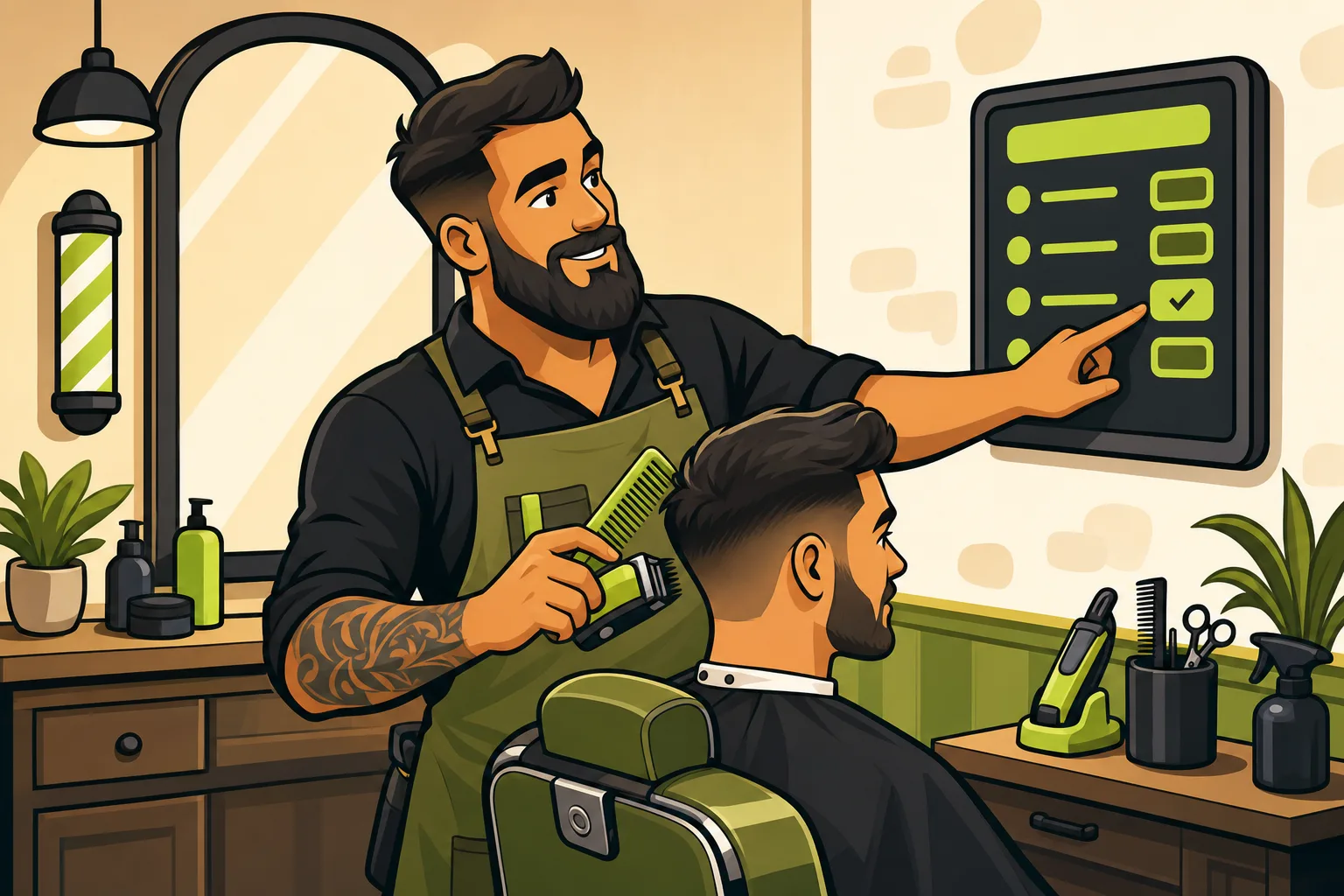
3. Your pricing page doubles as a service menu. Many barber shop websites list services as bullet points with no prices. Adding prices turns a list into a menu — and a menu is what converts browsers into bookers. List services with what's included ("haircut includes hot-towel neck cleanup and styling consultation") and the price becomes an easy yes.
The strongest barber shop websites we analyzed in our research paired a visible price menu with a phone number in the header and a booking CTA above the fold. That combination — transparency + access + a clear next step — is what separates the conversion leaders from everyone else. You can see a breakdown of what those high-performing sites include in our barber shop website guide.
What should a barber shop price menu include?
A price menu that converts includes more than just numbers. Here's what to put on it:
- Service name — be specific ("Skin Fade" not just "Haircut")
- Brief description — what's included (wash, blow-dry, hot towel, styling product)
- Price — clear, no asterisks, no "starting at" unless the range is genuinely wide
- Approximate time — helps clients plan their visit
- Add-on options — beard line-up +$10, hot towel +$5, etc.
- Package deals — cut + beard combo at a slight discount vs. separate
- First-visit offer — a "$10 off your first cut" line converts new clients; it's the most common high-performing promotional tactic in the category
- Walk-in vs. appointment note — "walk-ins welcome, appointments recommended on weekends"
One practical tip: list your most popular service first, not your cheapest. Most visitors aren't price-shopping — they're confirming you're in their range. Lead with the service most people actually book.
Will showing prices online make it harder to raise rates later?
This is the most common objection — and it doesn't hold up. Barbers in every market raise prices regularly. The shops with fully visible pricing do it too: update the page, post about it on Instagram, and move on. Most loyal clients expect occasional rate increases; they don't leave over $5.
The bigger risk is the opposite: hiding prices to avoid the rate-increase conversation often means you delay raising prices too long, because there's no visible number to update. A published price menu makes you take your rates seriously — which is good for your business.
If you're mid-transition ("we're restructuring our service menu"), put SOMETHING on the page. Even a note like "haircuts from $40 — see our full menu" with a link to your booking page is better than a blank services section.
How do you display pricing on a barber shop website?
Keep it simple. A dedicated Services & Pricing page in your nav is the standard approach — and it's what the highest-performing barber sites do. The page should be:
- One column or two-column layout — not a PDF, not an image (images don't update easily and aren't crawlable by search engines)
- Mobile-readable — most clients will check prices on their phone before a first visit
- Linked from your homepage — a "See Prices" or "Services" link in your main navigation
On the homepage itself, consider showing your two or three most popular services with prices in a simple highlight block. Visitors who see "$40 cut / $20 beard trim / $65 cut + shave" in three lines know immediately whether you're in their range — and that's the only question most of them have before they book.
One thing GrowLocal barber shop websites include by default: a services section with editable pricing entries and a dedicated contact form for clients who want to ask questions before booking. Online booking via third-party schedulers (Squire, Booksy, Vagaro) is the standard in this trade, and your website should link directly to whichever platform you use — the website is the trust checkpoint before the booking click.
For a broader look at how to structure your full barber shop web presence, see GrowLocal's barber shop website guide. And if you're still weighing the cost of building the site itself, barber shop website cost breaks down every option.
Across all the local trades we cover at GrowLocal — from restaurants and salons to home services — the same pattern holds: sites that display pricing attract better-qualified visitors than sites that funnel everyone into a "call for rates" dead end.
Frequently Asked Questions About Barber Shop Pricing
How much is the average haircut at a barber shop?
The national average for a men's haircut at an independent barbershop runs $35–45 in 2026. Mid-tier markets like Charlotte, Nashville, and Phoenix tend to cluster around $35–42. High-cost cities like New York, San Francisco, and Chicago see $50–75 for a mid-level cut. Chain shops (Great Clips, Supercuts) average $20–28.
Should I display prices on my barbershop website?
Yes. Across GrowLocal's proprietary research into local business websites (N=237 sites, 28 categories), 92% of local businesses hide pricing entirely — and in the barber category, that majority is the norm, not the best practice. The barber shops that publish transparent pricing also tend to have stronger trust signals on their pages: review counts, named barbers, and booking CTAs that convert.
How often should I raise my barber prices?
Most established shops review prices once a year as overhead costs change. A modest $3–5 increase on core services is standard. Loyal clients rarely leave over a price increase — update your website and your in-shop menu at the same time so there's no confusion.
What's a good first-visit offer for a new barbershop?
A small discount on the first cut — "$10 off your first visit" — is the highest-performing new-client offer in the category. It shows confidence in your pricing and gives a new client a low-risk reason to choose you over their current shop. Promote it on your pricing page and your Google Business Profile.
Does hiding prices help avoid price shoppers?
Not in practice. Price shoppers will call to ask anyway, or move on. The clients who self-select out based on seeing your prices are clients who wouldn't have stayed long-term regardless. Meanwhile, hiding prices costs you the clients who see a competitor's published menu and book there instead of calling yours. Transparency filters out bad fits and converts good ones faster.
Can I use a GrowLocal site to show my barber shop pricing?
Yes — every GrowLocal barber shop site includes an editable services and pricing section, a gallery, client testimonials, a FAQ section, and a contact form. You link your existing booking platform (Squire, Booksy, Vagaro, or any other) and your GrowLocal site handles the first impression: who you are, what you charge, and why a new client should trust you. See what's included at growlocal.site/websites-for/barber-shop.