


Updated June 2026
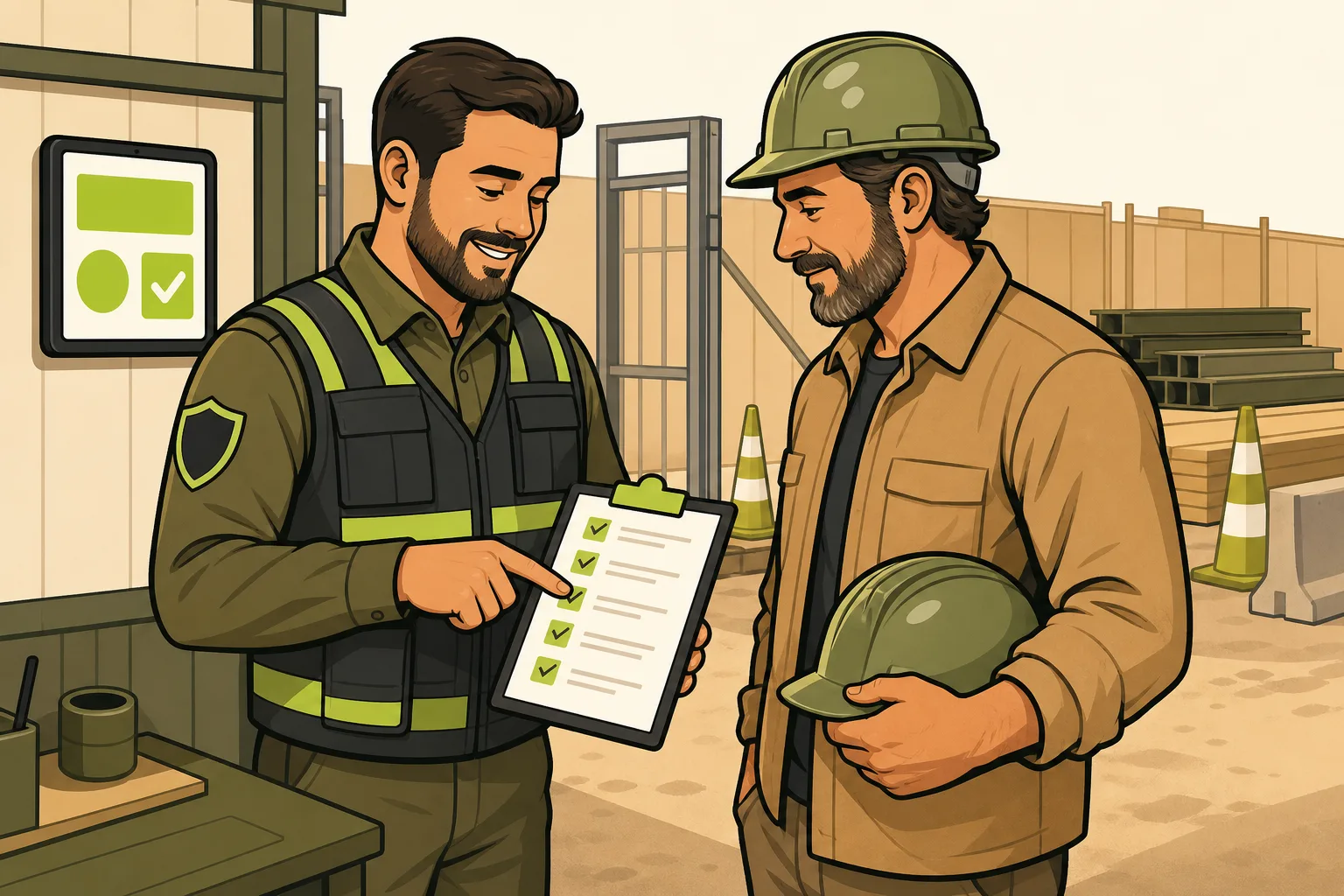
Construction site security is one of the most valuable verticals a security guard company can pursue — multi-month contracts, recurring revenue, and buyers who renew when the work is good. The primary mechanism for winning general contractor (GC) contracts is your website: a dedicated construction security service page displaying your state license number, mentioning GPS-verified patrol reporting, and showing at least one named testimonial from a GC or property manager. That combination is what converts a project manager researching vendors from a job-site trailer at 10pm.
This is based on GrowLocal's proprietary research into top-ranking local business websites in the security services category.
Why is construction site security a high-value vertical for security companies?
Construction accounts are fundamentally different from event or retail security. A single commercial build can run 12–18 months — one contract becomes a long, stable revenue line, and scope often expands as the project progresses. The site needs coverage whether active or dormant.
The demand is real and growing. Copper theft surged 77% in 2025 (CargoNet industry data), and construction theft can consume 0.5–2% of a total project budget when left unaddressed. That makes professional security an easy ROI conversation with any GC carrying liquidated damages exposure for late delivery. Seasonal demand peaks in summer and fall — security companies that build a construction vertical can count on higher booking density during those months.
What do general contractors actually look for in a security vendor?
GCs are professional risk managers, not impulse buyers. Here is what they evaluate before picking up the phone:
| GC Evaluation Criterion | What They're Actually Checking |
|---|---|
| State license number | Visible on the website — they verify it before calling |
| Insurance coverage | At minimum $1M general liability; some GCs require certificates |
| GPS-verified patrol reporting | Proof of service delivery, not just a verbal promise |
| Named testimonials from construction clients | Social proof specific to their industry, not generic praise |
| Dedicated construction security service page | Signals you've done this before, not that you're generalists trying it |
| Response time and communication protocol | How incidents get escalated and documented |
GCs are also protecting themselves contractually. If a theft occurs and access logs don't exist, the exposure is the GC's problem. A vendor who can produce patrol timestamps and incident reports shifts that risk where it belongs.
Does your security company website have a dedicated construction security page?
If your website lists "construction site security" as a bullet under a general Services page, you are invisible to the GC doing vendor research at midnight.
Across GrowLocal's proprietary research into top-ranking security services websites, the strongest sites dedicate individual sub-pages to each service type — construction site security, unarmed guards, mobile patrol, and event security are the core five. Specialized vertical pages like construction and dispensary security drive contract-specific search traffic when given their own URL. A GC searching "[your city] construction site security guard" will land on a page that speaks directly to them — or they will land on a competitor's page that does.
A dedicated URL — /services/construction-site-security — signals commitment: you have done this before, you understand the site's specific risks, and you are not a generalist trying construction for the first time.
See how this fits into a complete security services website structure — and compare the pattern across all service-based website categories.
What should go on a construction security service page?
A construction security service page that converts GC inquiries needs six elements:
- Your state license number — displayed in the page header or within the first screen. Across our research into top-ranking security services sites, every competitive site treats the license number as a pre-qualification requirement: buyers verify it before contacting you, not after. If it isn't on the page, they move on.
- Services specific to construction — access control, overnight patrol schedule, fire watch, equipment protection, GPS-verified reporting. Don't list "professional security guard services." List what actually happens on a job site.
- GPS patrol reporting mentioned explicitly — this tells the GC that your guards check in digitally at designated points, that patrol timestamps exist, and that you can produce a report if asked. Most competitors don't mention it. The ones that do stand out.
- A named testimonial from a GC, developer, or property manager — not "great service, very professional." A testimonial that says "protected our [project type] build for [X months], zero incidents" from a named company or contact signals that you have construction experience and that a real buyer trusted you with it.
- Quote form with a note about what to include — site address, project type, coverage hours needed, start date. Pre-qualifying questions reduce back-and-forth and signal operational seriousness.
- Your service area — construction GCs often manage multiple active sites. If you cover the metro they're building in, say so explicitly.
Key Takeaway: Across GrowLocal's proprietary research into top-ranking security services websites, named testimonials that identify the client's organization type — GC, property management company, government agency — carry measurably more weight than generic praise. The strongest site in our research leads with a state government testimonial as its primary social proof. One named GC testimonial on your construction page outperforms a dozen generic five-star reviews.
Why does GPS-verified patrol reporting win construction contracts?
GCs don't trust promises. Their entire business is built on documentation — change orders, punch lists, inspection reports. When they hire a security company, they want the same paper trail.
GPS-verified patrol reporting means your guard checks in at designated patrol points using a mobile app that logs a timestamp and GPS coordinate. The GC can request that report. The insurance carrier can request it. If a theft occurs, the patrol log is evidence — not a promise.
Across GrowLocal's proprietary research into the security services category, the site that foregrounds GPS-verified patrol reporting is a measurable outlier — it stands out against competitors who rely only on "24/7 coverage" and "licensed guards" language. Those phrases are table stakes. GPS patrol proof is evidence.
If your company uses GPS patrol apps — even basic ones — mention it on your construction security page. "GPS-verified patrol reporting available upon request" is enough to separate you from competitors who don't mention it at all.
For more on the conversion mechanics of a security company website, see what your security guard company website must do to win the quote call and the security services website checklist.
How do you get your first named GC testimonial for the website?
You ask specifically and you make it easy. After a project wraps, send a short email to your site contact: "We're updating our website — would you write two or three sentences about our team on [project]? It helps other GCs in [city] know what to expect." Most will say yes if you ask directly and keep it low-friction. If they're slow to follow through, draft something and ask if it's accurate.
The goal is not a glowing review. It's a testimonial that identifies the buyer as a GC, developer, or property manager — because that's who your next prospect needs to see. Generic praise from "John D." is invisible. A testimonial from "the project manager at [commercial developer name]" is a signal. When you have it, put it on your construction security page, not just your homepage.
Frequently Asked Questions About Construction Site Security Guard Contracts
What makes construction site security contracts more valuable than one-off jobs?
Construction contracts typically run the length of the build — often 6–18 months for commercial projects. That means predictable revenue and recurring shifts rather than one-off event coverage. As the project scales, coverage scope often expands too. A single strong construction relationship can anchor a meaningful portion of your annual revenue.
Do I need a separate license to provide construction site security?
Standard state guard licensing covers construction site security in most states — you do not need a separate construction-specific license. However, construction sites have specific safety requirements: OSHA 10-hour certification is increasingly expected by GCs, and some states have site-specific training mandates. California's SB 652 (effective January 2026) added Power to Arrest and Use of Force training requirements before any guard license application. Check your state's licensing authority and confirm that your guards' credentials are current.
What does GPS-verified patrol reporting cost to implement?
Most guard management apps with GPS patrol verification cost $1–$5 per guard per month on basic plans. Apps like TrackTik or Silvertrac create timestamped patrol logs, incident reports, and client-facing dashboards. The cost is minimal relative to what it signals to a GC — and it's an operational improvement beyond the marketing benefit alone.
Should my construction security page include pricing?
Across GrowLocal's proprietary research into the security services category, 100% of competitive security company websites hide pricing entirely — all funnel to a quote form. This is appropriate for construction: coverage hours, guard count, armed vs. unarmed, patrol frequency, and site size all affect cost. Instead of pricing, use a quote form that asks the right qualifying questions (site size, hours needed, start date), which saves back-and-forth and shows operational professionalism.
What should my quote form ask for on a construction security page?
At minimum: project address or area, project type (commercial build, residential development, infrastructure), anticipated start date, coverage hours needed (overnight only, 24/7, partial day), and the best contact number. Asking these upfront tells the GC that you understand their world. It also pre-qualifies the inquiry so your proposal isn't built on guesswork.
Is a GrowLocal website the right fit for a security company pursuing construction contracts?
Yes — GrowLocal's security services websites include dedicated service pages, a professional quote form, testimonials section, license number display in the hero, and fast mobile-optimized hosting. Everything a construction security service page needs from a trust and conversion standpoint is available out of the box. GrowLocal does not provide a live GPS tracking dashboard or client portal — those are features of guard management SaaS tools (TrackTik, Silvertrac, Belfry). A GrowLocal site is the trust layer that gets the GC to call; the guard management platform is what delivers the service once you've won the contract.
Construction is a patient buyer. The GC researches, verifies licenses, and asks for referrals before calling anyone. Your website is the research destination — a dedicated construction security service page with your license number, GPS patrol mention, and a named GC testimonial is the difference between being found and being skipped. See the full data behind local business website performance and how it applies to service companies like yours.