


Updated June 2026
Personal training marketing works best when it ends at a website that closes. Referrals, social media, Google Business Profile, and local events all generate interest — but that interest dies if prospects land on a generic homepage with no clear next step. The gyms that consistently convert leads into paying members treat their website as the final step in every marketing channel, not an afterthought.
This is based on GrowLocal's proprietary research into top-ranking local business websites.
What does a gym marketing funnel actually look like?
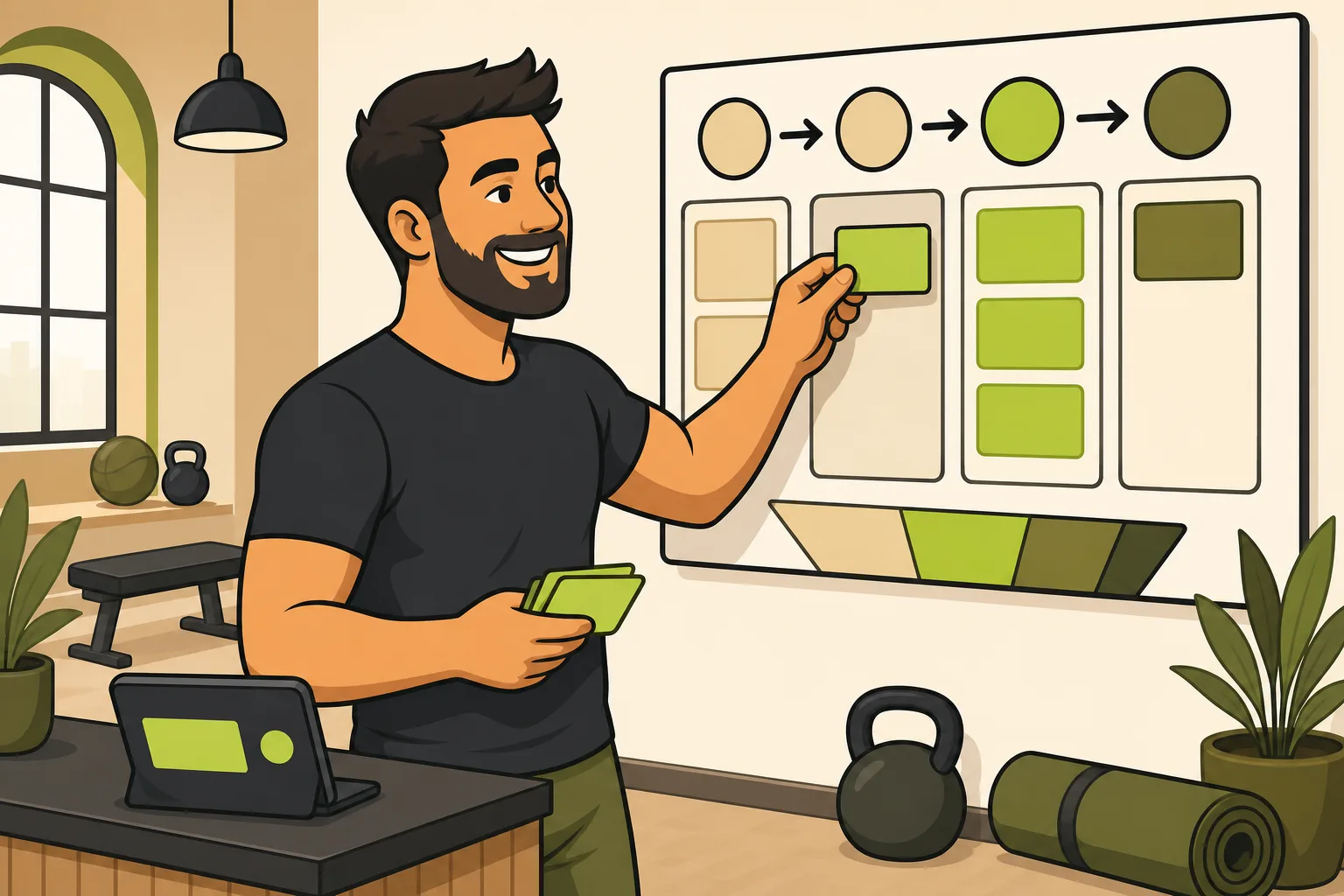
A marketing funnel has three stages: awareness at the top, consideration in the middle, and conversion at the bottom.
Most gym marketing advice focuses on the top — get more followers, run more ads, post more reels. That advice is not wrong, but it is incomplete. The bottom of the funnel is where revenue happens, and the bottom of the funnel for almost every gym is the same place: your website.
Here is how the stages map for an independent gym or personal training studio:
| Funnel Stage | Goal | Channels |
|---|---|---|
| Top — Awareness | Get discovered | Google Business Profile, Instagram, Facebook, local events, referral programs |
| Middle — Consideration | Build trust | Your website, testimonials, coach profiles, social proof, email |
| Bottom — Conversion | Capture the lead | Free-trial CTA, quote/inquiry form, 3-step onboarding |
Most gyms invest heavily in the top. Almost no independent gym invests enough in the bottom.
Which top-of-funnel channels actually bring gym leads?
Referrals from current members
Referrals are the highest-converting lead source — referred prospects come pre-sold by someone they trust. A "free day pass for a friend" loop is a natural fit: your best members already want their friends to join. Make it easy and name the referral benefit explicitly on your website.
Google Business Profile and local search
When someone types "personal training near me," your GBP is often the first impression. A complete profile — photos, hours, recent posts — puts you in the local map pack. Your website URL is the click-through destination, which makes what they land on critical.
Social media (organic)
Instagram is where gym culture lives. Trainer spotlights, member transformations, and short workout clips build familiarity over time. Social media is excellent for staying top-of-mind — it is a poor place to close a sale. That happens on your website.
Local events and community presence
Free community workouts, gym open houses, charity runs, and neighborhood sponsorships generate walk-in traffic and brand awareness. These work especially well for positioning an independent gym as the local alternative to a big-box chain. For how to sharpen that positioning, see how independent gyms compete with franchises online.
Why do most gyms lose leads at the website?
Most independent gym websites have the same structural problem: they were built to look good, not to convert.
A visitor who clicked a referral link, a GBP listing, or an Instagram bio link lands on a homepage that shows beautiful photos of equipment — and then asks them to... "Contact Us."
"Contact Us" is not a conversion action. It implies effort, uncertainty, and a cold sales call. The prospect who was 70% ready to try your gym decides they'll come back later. Most never do.
Across the strongest gym sites we analyzed, homepage pricing is universally hidden — gated behind a booking form, a consult CTA, or a dedicated memberships page — making a low-friction free-trial button the de facto primary conversion action on every homepage. In other words, the best gym sites in the country do not ask visitors to call them. They ask visitors to claim a free session.
There is a second conversion killer: no trust near the CTA. A visitor sees "Try Us Free" and their next thought is: who are these coaches? If credentials, a Google rating, and a testimonial are buried in the footer, you have lost the moment of peak intent.
See our full pricing-transparency data to understand how widespread this pattern is across local service businesses.
What should a gym website do to convert marketing traffic?
A gym website that closes leads has five things above the fold or within one scroll:
1. A pain-point or community promise in the headline
"Training So Good You'll WANT to Work Out" works. "Welcome to [Gym Name]" does not. The best gym headlines name a transformation, a community, or a release from a pain — not a facility description.
2. A free-trial CTA as the primary button
"Claim Your Free Day Pass →" converts better than "Learn More." It is specific, low-risk, and action-oriented. Backed by a simple quote/inquiry form — name, email, phone — this is the mechanism that captures the lead. Platforms like Mindbody and Glofox handle live scheduling; a contact/inquiry form is the free-trial capture for gyms that do not use one.
3. Trust signals near the CTA, not buried in the footer
The strongest gym sites we analyzed display named, credentialed coaches — NASM, ISSA, NSCA, CPT, Precision Nutrition L1/L2 — alongside a visible Google rating near the primary CTA. Sites that omit both read as lower-trust regardless of facility quality. A coach photo and star rating next to "Claim Your Free Day Pass" answer the prospect's silent objection at the moment they are about to click.
4. Specific-outcome testimonials over generic stars
"Lost 80 pounds and my knees no longer hurt" converts better than "5 stars — great gym!" The strongest gym sites we analyzed use specific-outcome testimonials — naming a measurable result like weight lost, an injury avoided, or a life event like a wedding — rather than generic star ratings. Three outcome testimonials near the CTA outperform a widget of anonymous reviews.
5. A 3-step onboarding flow
The commitment objection is real. Joining a gym feels permanent and expensive. The strongest gym sites we analyzed use a 3-step onboarding sequence — Book → Meet Coach → Train — as a friction-reducer. This pattern appears on boutique studios and performance gyms alike because it turns "joining a gym" into "scheduling a free intro."
Key takeaway: In GrowLocal's proprietary research into top-ranking gym websites, the single strongest conversion driver is a low-friction free-trial button — not a phone number, not "Contact Us," not a price list. Every top-performing independent gym uses a free day pass or "no sweat intro" as the primary CTA, backed by a simple inquiry form. Marketing that drives traffic to a homepage without this mechanism produces likes, not members.
How do you measure whether your gym marketing is working?
Instagram followers, post reach, and ad impressions are easy to track and feel like progress. They are not revenue.
The metrics that matter for an independent gym:
- Trial inquiry form submissions — how many people requested the free pass this week?
- Trial-to-member conversion rate — of the people who came in for a free session, what percentage joined?
- Lead source — did this week's trial requests come from referral, GBP, Instagram, or ads?
If trial inquiry numbers are flat while your follower count grows, the problem is your website. The fix is the conversion layer: free-trial CTA, trust signals near the button, a quote form that makes claiming the pass frictionless.
For a deep dive into getting found on Google before the conversion conversation starts, see our gym SEO guide — search rankings and website conversion are the same problem for most independent gyms.
GrowLocal sites for gyms include a quote form, testimonials gallery, named service pages (Personal Training, Prenatal, Injury Recovery, Group Classes), and fast static hosting. See our gym website options to understand what that looks like for your studio.
Frequently Asked Questions About Gym and Personal Training Marketing
How do I get more personal training clients?
The fastest path is a referral program paired with a free-trial offer on your website. Referred prospects are pre-sold — a "free day pass for a friend" converts higher than any cold ad channel. The website must have a visible free-trial CTA and a simple inquiry form; otherwise referral traffic lands and bounces without a next step.
What is the most effective gym marketing channel?
Referrals from current members produce the highest conversion rate. Google Business Profile drives local search discovery at zero ad spend. Social media builds familiarity over time but rarely closes a sale directly. The multiplier for all three is a high-converting website — the channel that receives all the traffic and either closes it or loses it.
Do gyms need to spend money on ads to grow?
Not necessarily. 41% of consumers always read online reviews when browsing for a local business (BrightLocal, 2026), which means a complete GBP profile with a strong review base drives discovery without ad spend. Community events, referral programs, and local SEO all generate leads before paid advertising is needed. Ads accelerate what is already working — they do not fix a broken conversion layer.
What should a gym homepage include to convert visitors?
A pain-point headline, a free-trial CTA as the primary button, coach credentials and a Google rating near that button, two to three specific-outcome testimonials, and a 3-step onboarding flow (Book → Meet Coach → Train). Pricing belongs on a dedicated memberships page — the homepage's job is to capture the free-trial lead, not close a sale on first visit.
Should I use a booking widget or a contact form on my gym website?
If you use gym management software like Mindbody, Vagaro, or Glofox, a live booking widget handles scheduling. If you do not, a simple contact/inquiry form — name, email, phone, preferred time — is the right free-trial capture mechanism. The form is not the bottleneck; what matters is that the CTA and the form are visible above the fold, not buried in a footer.
Can a gym website actually replace a social media presence?
No — they serve different purposes. Social media keeps your gym top-of-mind with warm audiences. Your website is where prospects make the decision to try you. The pattern that works: social and GBP drive traffic → website captures the lead → you close on the free-trial call. Every follower you earn without a conversion-ready website is a lead you cannot capture. For a wider view of how local businesses use their web presence, see local business websites overview.
For more on the conversion layer, see why your gym website isn't getting you members — it covers the five elements top-performing independent gym sites use.
See our gym website options and find out what a conversion-first gym site looks like for your studio.