


Updated June 2026
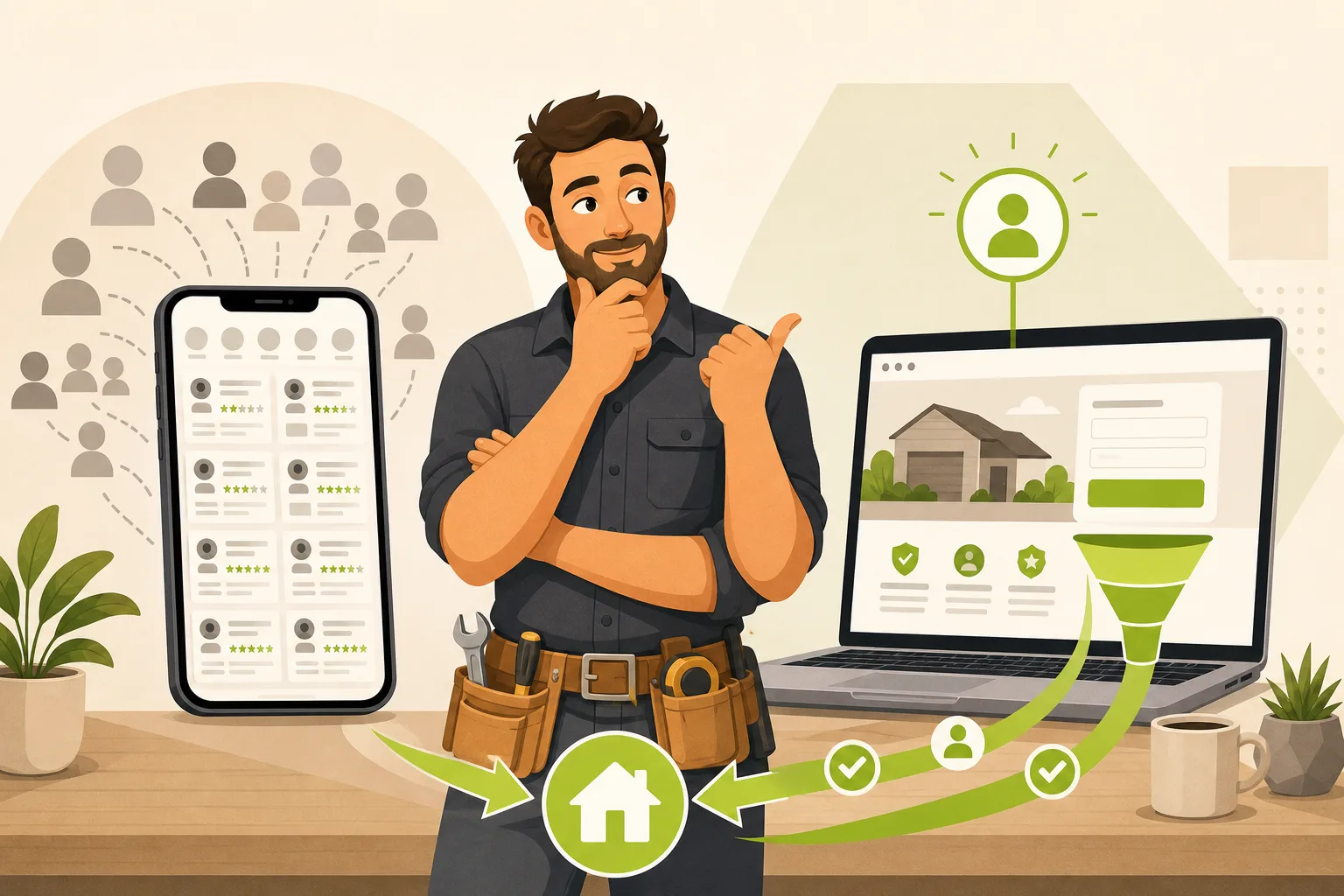
From a handyman's perspective, Thumbtack works — until the math turns against you. Lead costs run $15–$80+ per contact depending on your market, and those leads are shared with up to four competing pros. A handyman closing 25% of leads at $40/lead spends $160 per acquired job before touching a single tool. That spend resets to zero every month. It never builds anything you own. This is the honest calculus most Thumbtack reviews skip — and the reason experienced handymen eventually look for an exit.
This is based on GrowLocal's proprietary research into top-ranking local business websites.
What does Thumbtack actually cost a handyman in 2026?
Thumbtack's pricing is dynamic. Lead costs are set by the platform's algorithm based on job type, your market, and how many other pros are competing for the same inquiry. What handymen report in practice:
- Small repairs (furniture assembly, TV mounting, minor fixes): $8–$25 per lead
- Mid-range work (drywall repair, bathroom tile, carpentry): $25–$55 per lead
- Larger scopes (deck repair, painting, partial remodels): $50–$80+ per lead
Those leads go to multiple contractors simultaneously. Thumbtack sends each inquiry to up to four or five pros, and every contacted pro pays the lead fee — not just the one who wins the job. A $40 lead shared with four competitors, at a 25% close rate, means an effective cost of $160 per booked job. For a handyman whose average ticket is $200–$350, that lead cost represents 45–80% of gross revenue before labor and materials.
What do handymen actually think about Thumbtack — the honest review
The frustrations that surface consistently in 2026 pro reviews, forums, and Better Business Bureau filings:
Shared leads force a speed-over-quality mindset. Thumbtack's internal data and user reports both confirm that responding within five minutes is the primary conversion driver. That's a structural incentive to chase every lead instantly — regardless of job type, location fit, or minimum job size. Handymen who try to be selective find that the platform lowers their visibility when response metrics drop.
You pay for contacts who never hired anyone. BBB complaints through 2026 include recurring descriptions of being charged for leads from homeowners who confirmed they never submitted a service request. Language like "predatory lead billing" and "charged for leads I never received" appears repeatedly. Disputing these charges is consistently described as difficult.
Single-platform dependency is genuinely dangerous. Contractors who route 80%+ of their customer acquisition through Thumbtack get "hammered" when the platform raises prices, changes the matching algorithm, or downgrades visibility for any reason. Thumbtack has no obligation to maintain your placement — your profile's reach is entirely at the platform's discretion.
Small-job trades get squeezed hardest. The economics work better for high-ticket trades — HVAC installs at $5,000+, roofing at $15,000+, kitchen remodels at $20,000+. For a handyman doing repair-only work at $150–$350 per call, a $25–$50 lead cost can eat 15–30% of gross before you've turned a wrench.
Key takeaway: Across GrowLocal's proprietary research into top-ranking local business websites, independent handyman operators in analyzed markets charged $50–$95/hr while franchise competitors ran $75–$100/hr — a meaningful price advantage. But marketplace lead fees eat directly into that independent-operator edge. The handyman who wins on price and loses on acquisition costs is working harder for the same net.
When does Thumbtack actually work for handymen?
It works in specific conditions. The question is whether those conditions apply to your business:
You're early-stage with no existing reputation. A handyman with zero reviews and no website has no organic presence — Thumbtack gives you an addressable audience immediately. That's a real advantage early on. Use it while you build the foundation that will eventually replace it.
You respond within five minutes, consistently. If you can answer new lead inquiries within five minutes during business hours, your close rate can reach 15–25%. That's where the math starts to pencil. If your response time averages two hours, close rates below 10% make the cost per acquired job unsustainable.
Your average job ticket is $600 or higher. Larger scopes absorb the lead cost without destroying margin. Deck builds, bathroom renovations, larger carpentry projects — these have room for a $100–$150 cost of acquisition. Small repair work generally doesn't.
You use it as a customer pipeline seed, not a permanent strategy. Every Thumbtack job is an opportunity to collect a Google review, add a real project photo to your site gallery, and convert a one-time customer into someone who calls you directly next time — not through the platform. The operators who break free from permanent lead-fee dependence treat each Thumbtack job this way from day one.
What does a handyman's owned pipeline cost instead?
An owned inbound pipeline has two parts: a professional website and a fully built-out Google Business Profile. Neither replaces marketplace leads immediately. Both get more valuable over time — unlike a Thumbtack credit balance that disappears when you stop funding it.
| Asset | Ongoing Annual Cost | What You Own |
|---|---|---|
| GrowLocal handyman website | Low — see our handyman website breakdown | A permanent lead-capture asset; yours to keep |
| Google Business Profile | Free | Your map-pack placement |
| Thumbtack (moderate, 15 leads/mo at $35 avg) | ~$6,300/yr | Nothing — resets to zero if you stop |
| Angi subscription + shared leads | ~$6,500–$9,000/yr | Nothing — resets to zero if you stop |
The handyman spending $500/month on Thumbtack leads has spent $18,000 after three years. That spend has produced jobs. It has not produced a single asset that generates the next job for free.
What does an owned handyman website do that a marketplace profile can't?
A Thumbtack profile puts you on a list next to four competitors. Your own site is the only business on the page — and you control everything the visitor sees.
Phone-first conversion, without the platform in the way. Across GrowLocal's proprietary local-business website research, the phone number appeared in the header on every single handyman site analyzed — and the highest-converting CTAs embedded the number directly in the button text. "Call for a FREE Estimate: (615) 709-6010." That direct path — search → site → phone tap → job — doesn't exist when a marketplace controls access to the customer.
Your trust signals are fully yours. License number printed verbatim, named testimonials with city and neighborhood, labeled real project gallery, your actual trip fee. Across our research, printing a state contractor license number on the homepage was one of the highest-impact trust signals in the category — used by fewer than a third of analyzed sites, yet immediately differentiating for those that displayed it. (See the full trust-signal data.)
Service-specific pages rank without lead fees. A dedicated page for "drywall repair Phoenix" or "ceiling fan installation Denver" can appear in Google results with no per-click cost attached. A GrowLocal handyman site is structured to support this pattern — see the full handyman website template.
Repeat customers belong to you. A homeowner who found you through Thumbtack is in Thumbtack's retargeting funnel. A homeowner who bookmarked your site calls you directly next time — no platform takes a cut.
Pricing transparency is a differentiator, not a risk. Fewer than a third of the handyman sites we analyzed showed any pricing at all. Yet those that published at minimum a trip fee or hourly rate stood out immediately as the most credible operators in their market. Your own site lets you make that move. A marketplace profile doesn't.
The honest handyman marketing approach: use both, then graduate
The handymen who win long-term aren't choosing between Thumbtack and a website. They run both — with a deliberate exit plan for the lead fees.
The practical path:
- Build your website and GBP now, even if Thumbtack is working. The 3–6 month SEO runway starts when the site goes live. Every week you wait is a week longer to your first organic call.
- Collect a Google review after every job. The 40-review threshold is where most consumers start trusting a star rating. Every Thumbtack job is a seed for that count.
- Add labeled real project photos by job type. "Ceiling Fan Installation — Phoenix AZ" is content your site owns. Across our research, labeled real-work galleries were the dominant pattern on the highest-converting handyman sites we analyzed.
- Track where calls come from. When organic starts converting, you have the data to pull back on Thumbtack spend methodically — not based on a hunch.
For the full picture of how your website becomes the conversion hub in this trade — not just a brochure — see our handyman marketing strategy breakdown. We also cover the full scope of what a handyman website should include if you want the technical foundation side.
We see the same compounding pattern in other trades — plumber websites run the same math, the same timeline, the same exit from platform dependency. Browse all the trades we cover to see how the economics compare across categories.
Common Questions About Thumbtack for Handymen
How much does Thumbtack charge handymen per lead in 2026?
Lead costs are dynamic and set by Thumbtack's algorithm. Small repair jobs typically cost $8–$25 per lead. Mid-range work like drywall or carpentry runs $25–$55. Larger scopes — deck work, painting, partial renovations — can run $50–$80+ per contact. Leads are typically shared with three to five other pros, so your effective cost per acquired job is substantially higher than the face lead price.
Is Thumbtack worth it for a handyman doing small jobs?
For repair-only work averaging $150–$250 per job, the math is usually punishing. Lead costs can represent 20–40% of gross revenue before labor and materials. The economics improve significantly for handymen doing larger scopes — deck builds, bathroom renovations, larger carpentry projects where the average ticket is $600 or above.
What's the biggest complaint handymen have about Thumbtack?
The most consistent complaint is paying for leads from homeowners who never hired anyone, combined with difficulty disputing those charges. A secondary pattern is that shared leads force an instant-response culture that doesn't suit all operators — if you can't respond within five minutes consistently, your close rate drops below the point where the costs make sense.
How long does a handyman website take to generate organic leads?
Expect 3–6 months for local search rankings to build meaningful visibility, and 6–12 months before the owned pipeline generates enough volume to meaningfully reduce Thumbtack dependence. The inputs that accelerate this: a fully completed Google Business Profile with real photos, service-specific pages targeting local search queries, regular review requests after every job, and a labeled real-work gallery. A GBP often starts ranking in the local map pack faster than the website ranks organically.
Can I run Thumbtack and a website at the same time?
Yes — this is the recommended path for most handymen. Thumbtack generates immediate cash flow while your site and GBP build organic visibility. The key is treating every Thumbtack job as a pipeline seed: collect the review, add the project photo, save the customer contact. Over 12–18 months, the owned pipeline absorbs more volume and your dependence on paid lead fees decreases.
Does a handyman website rank on Google without paying per lead?
Yes, with the right structure. A site with service-specific pages targeting local queries — "drywall repair Denver," "ceiling fan installation Phoenix," "handyman near me Tampa" — can rank in Google search within 3–6 months. Across GrowLocal's proprietary research, the handyman sites with the strongest organic footprints ran dedicated pages per service type rather than a single generic services page. See our handyman website plans for how that structure looks in practice.
What does a GrowLocal handyman website include?
A GrowLocal handyman website includes a quote/contact form, manually entered client testimonials, a project photo gallery, service pages, an FAQ section, service area content, and fast static hosting with local SEO fundamentals built in. It does not include live Google Reviews integration, real-time online booking, or payment processing — those require separate tools like Housecall Pro or Jobber. For the full scope and current pricing, see our handyman website plans or browse all the trades we cover.