


Updated June 2026
The fastest way to get more appliance repair calls is to be the first credible result a panicked homeowner sees when their fridge dies at 9 p.m. — and to make calling you feel safe before they dial. That means a fast website with your phone number above the fold, a stated diagnostic fee, a real review count, and a quote form for after-hours leads. No lead marketplace required.
This is based on GrowLocal's proprietary research into top-ranking appliance repair sites across Austin, Denver, Phoenix, Charlotte, Nashville, and Tampa.
Why is appliance repair different from other home-service trades?
The buying trigger is a household emergency, not a planned project. Across GrowLocal's research into top-ranking appliance repair sites, most searches carry same-day intent — and the customer calls the first result that looks credible, within hours, not days.
That urgency is your biggest marketing asset if your website converts. It's your biggest liability if you rank but fail the credibility check.
Should I buy appliance repair leads or generate my own?
Lead-buying gets you in front of customers quickly, but the economics rarely hold. When you purchase from a marketplace, you're competing against two to four shops who got the same lead — triggering a price war before the homeowner calls. The lead vendor wins; your margin usually doesn't.
Building your own inbound channel takes three to six months to gain traction, but every call it generates costs nothing and arrives pre-warmed — the homeowner found your site, saw your review count, and chose to call you. That caller converts at a far higher rate than a shared marketplace lead.
| Channel | Lead Quality | Longevity | Who Controls It |
|---|---|---|---|
| Lead marketplace (Angi, Thumbtack) | Shared, price-sensitive | Ends when you stop paying | The marketplace |
| Google Ads | High intent, not shared | Ends when budget runs out | You (partially) |
| Optimized website + GBP | High intent, unshared | Compounds over time | You |
| Referrals | Highest quality | Grows with reputation | You |
The owned-channel stack is slower to build but generates the lowest cost-per-call over a 12-month horizon.
What does my appliance repair website need to actually generate calls?
Most appliance repair websites rank for the right keywords and still lose the call. The gap is almost always in the first five seconds of the visitor's experience. Here is what the highest-converting sites in the category do differently.
Phone number visible without scrolling. Across GrowLocal's research into top-ranking appliance repair sites, every single competitor displayed a tap-to-call phone number in the site header — and the strongest repeated the number eight or more times across the page. On mobile, a sticky call bar at the bottom of the screen captures the homeowner who found you while standing in their kitchen.
State the diagnostic fee explicitly. Across the analyzed competitors, appliance repair pricing was hidden on the majority of sites — with the most effective transparency pattern being a stated diagnostic fee plus an explicit waiver policy (for example, "service call waived when we complete the repair"). Fewer than half of competitors do this, yet it directly defuses the biggest objection a homeowner has before picking up the phone: what is this going to cost me just to find out?
Show a real review count, not just a link. Displaying "4,768 reviews, 5.0 stars" next to your phone number does more conversion work than linking to your Google profile. Across our research, the strongest sites showed counts ranging from roughly 500 to nearly 5,000 reviews — stated as a number in the hero, not buried in a footer. See our full review-signal data for home services.
A quote form for after-hours capture. Many appliance emergencies happen evenings and weekends. A short form — name, phone, appliance type, brief description — captures the lead when you can't answer. GrowLocal sites include a quote form by default; live chat and instant booking widgets (HouseCall Pro, Jobber) are separate tools for real-time scheduling.
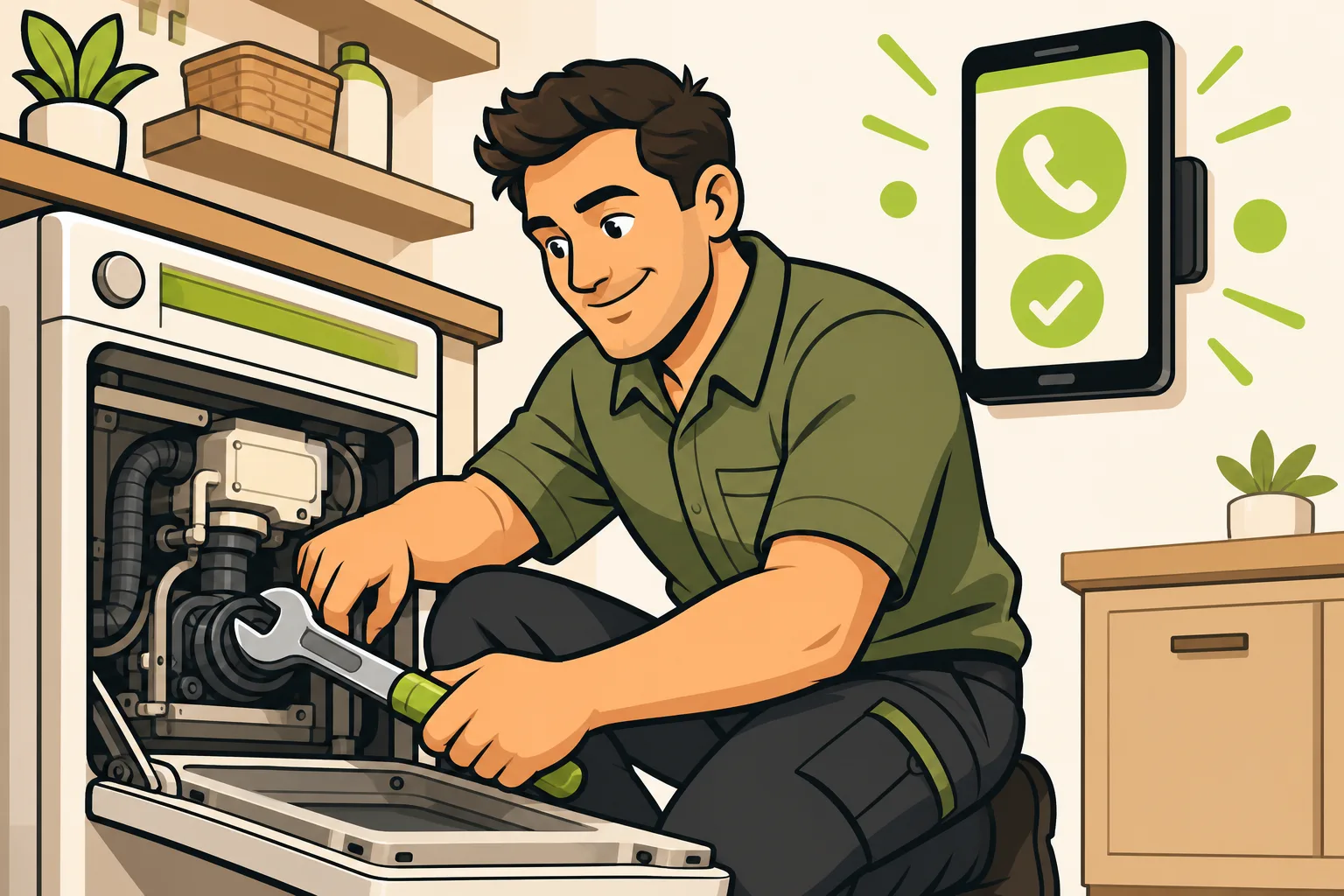
Real photos of your techs. A photo of your actual uniformed technician — company truck visible — signals accountability in a way stock imagery cannot. It answers the "stranger in my home" anxiety before the call.
See how these elements come together at our appliance repair website examples.
Key takeaway: The strongest appliance repair sites show a review count as a number — between 500 and nearly 5,000 — displayed in the hero section, not just a link to Google. That single change moves a skeptical homeowner from "maybe" to "I'll call them first."
How does Google Business Profile fit into my lead strategy?
Your Google Business Profile (GBP) is how you appear in the local map pack — the three results that sit above the organic listings for searches like "appliance repair near me." For most appliance repair shops, the map pack drives more calls than any other channel.
Key GBP actions that move the needle: set your primary category to "Appliance Repair Service," list every suburb you serve in service areas, upload at least 10 real photos (technician and vehicle), keep hours accurate, and build a post-job review-request habit. 80% of consumers are more likely to use a business that responds to every review (BrightLocal, 2026) — responding to negatives matters as much as collecting positives.
GBP optimization is covered in depth in our appliance repair Google Business Profile guide.
Does having a background-check badge actually help?
Yes. In six markets of competitor research, only one appliance repair business displayed a third-party background-check badge on its homepage — and that shop was the only one that explicitly addressed the "stranger in my home" anxiety every homeowner feels. If your techs are background-verified, say so with the badge. A text claim ("licensed and insured") blends into the noise; a PBSA or Checkr badge stands apart.
What about service-area pages for local SEO?
A single "Austin Appliance Repair" homepage competes for one city. Dedicated suburb pages — "Pflugerville Appliance Repair," "Cedar Park Appliance Repair" — each target an independent query your homepage can't rank for. The most thorough operators in our research maintained 14 or more location pages and 15 or more per-brand pages (Samsung, LG, Whirlpool), each capturing a specific search no generic page can reach.
Our local SEO guide for appliance repair covers the full architecture. The same location-page pattern drives rankings across other home-service websites — HVAC, plumbing, and electrical shops all use it.
How do I generate referrals more consistently?
A good tech earns the "our appliance person" slot in the household for years. Formalizing it is simple:
- Text a review request immediately after every job
- Leave one card with the homeowner and a second to pass on
- Follow up six months later: "any other appliances acting up?"
- For property managers: a monthly contact email keeps you top-of-mind
No CRM required.
What about the repair-vs-replace moment?
A page answering Is it worth fixing? is one of the best organic lead generators in this trade. Walking homeowners through the 50% rule, typical appliance lifespans, and which failure types are worth repairing builds trust before the call — and gives you a natural invitation for a diagnostic visit. The homeowner who arrived to decide whether to replace their fridge is a call-away customer once your content earns their confidence.
An appliance repair website that's built to convert — real photos, diagnostic fee statement, quote form, service-area pages — is where all these strategies funnel. Make sure where they land closes the call.
Frequently Asked Questions About Appliance Repair Lead Generation
How do I get more appliance repair customers without paying for leads?
The most effective owned-channel stack: a fast website with your phone number above the fold, a Google Business Profile with real photos and a review-request habit, and service-area pages for every suburb you serve. These compound over time; paid leads stop the moment you stop paying.
Is buying appliance repair leads worth it?
Purchased leads are typically shared with two to four competitors, which drives callers to price-shop before the first conversation. They can fill schedule gaps while you build owned channels, but they're rarely profitable long-term. The businesses in our research with the lowest reliance on lead marketplaces were the ones that invested in service-area pages and quantified their review counts on-site.
What should my appliance repair website include to get more calls?
The essentials: tap-to-call number in the header, stated diagnostic fee with waiver policy, review count displayed as a number, appliance-type grid, real technician photos, service-area section, and a short quote form. Mobile page speed matters — most homeowners search on a phone, and a slow site loses the call before the homepage finishes loading.
Does stating the diagnostic fee on my website help or hurt?
It helps. Homeowners in an emergency are already anxious about hidden fees. Stating the diagnostic fee and its waiver policy removes the biggest pre-call objection. Fewer than half the competitors in our research publish this — doing it puts you ahead of most shops at zero cost.
How many Google reviews do I need before they start helping?
Even 25–30 recent reviews at 4.8 stars or above meaningfully improves your map-pack position. The bigger conversion lever is displaying the count as a specific number ("312 reviews, 4.9 stars") rather than only linking to Google. At 100+ reviews you have enough social proof to win most first-time callers comparing you against a shop that shows no count at all.
Do I need a booking widget on my appliance repair website?
Not necessarily. The primary CTA in appliance repair is a phone call; a quote form is an effective after-hours fallback. If you want real-time scheduling, HouseCall Pro and Jobber offer booking integrations as separate subscriptions. A quote form with a same-day-response promise converts most after-hours leads without live booking.
Is a background-check badge worth adding to my website?
Yes, if your techs are verified. It's one of the rarest trust signals in the category — only one shop across six markets used it — and it directly addresses the "stranger in my home" anxiety that every other competitor left unspoken. A third-party badge (PBSA, Checkr) carries more weight than a text claim alone.
Can content marketing generate appliance repair leads?
Yes, but only with the right topics. Pages that answer the repair-vs-replace decision attract homeowners mid-decision and funnel them toward a diagnostic call. General "What is appliance repair?" content gets no meaningful traffic. Target questions people actually search — "is it worth fixing a 10-year-old refrigerator?" — and close each answer with a CTA to schedule a diagnostic visit.