

The short answer: there's a stack, and each piece does a different job
If you want your local business to show up on Google, you need four things working together: a Google Business Profile, a real website with service pages, customer reviews, and content that uses the words your customers actually type. No single piece is enough on its own. The businesses ranking consistently in your market have all four running in sync.
Here's what each piece does, why it matters, and what you can skip.
Layer 1: Google Business Profile — your map presence
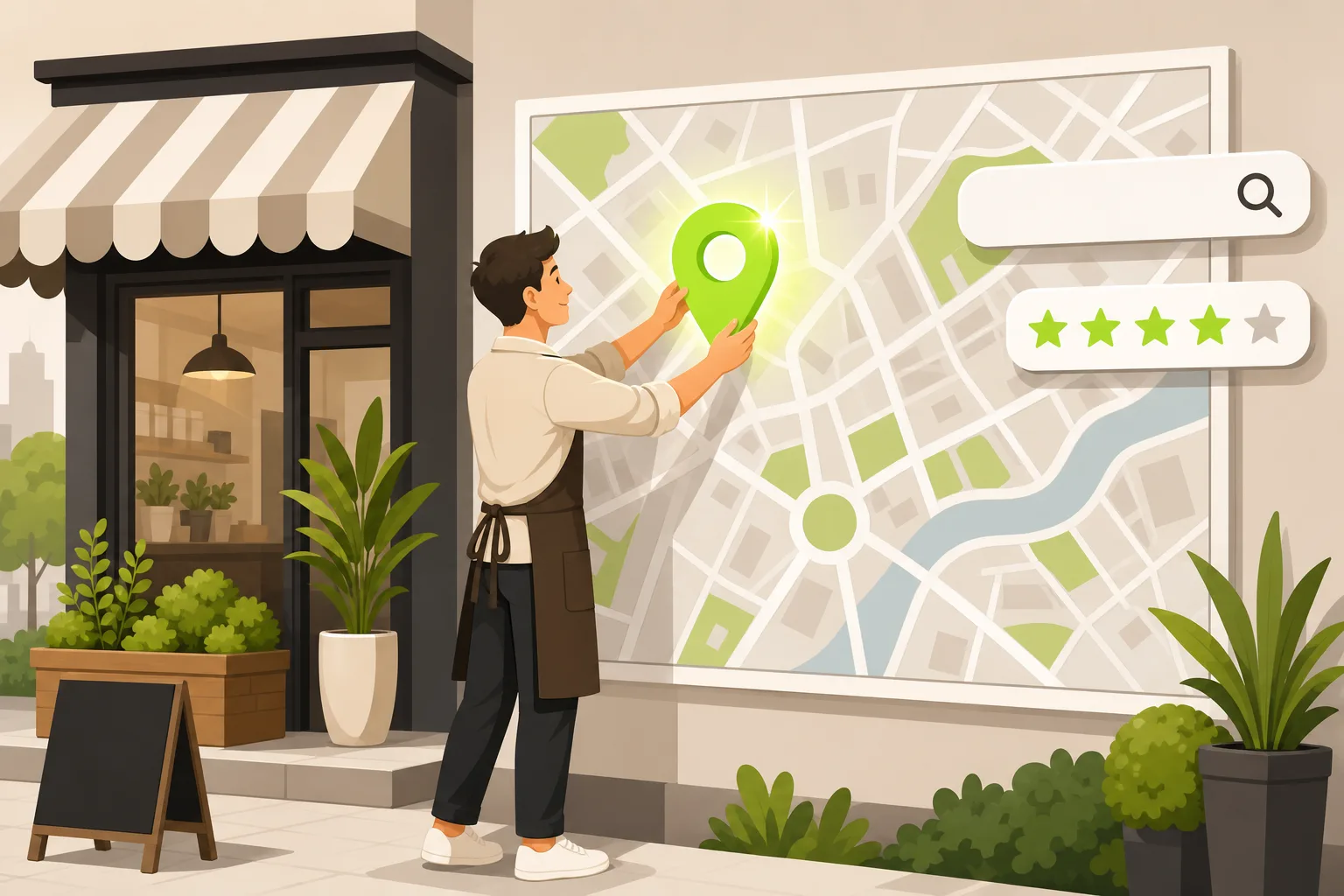
Google Business Profile (GBP) is what puts you on the local map pack — the three results with a pin that appear above the regular search results. If someone searches "electrician near me" or "dog groomer in Charlotte," those map results are GBP listings.
A complete GBP is non-negotiable if you serve local customers. That means:
- Full business name, address, and phone number (consistent with your website — more on that below)
- Your correct service category selected
- Hours that are actually up to date
- Photos — real ones, not stock
- Responding to reviews, even the negative ones
GBP is free. There's no reason not to have it fully filled out. But there's a ceiling: GBP handles discovery, not conversion. The moment a customer taps on your listing and wants to know more about you, your GBP runs out of room.
Layer 2: Your website — where GBP sends people to get hired
A well-maintained GBP gets you found. Your website gets you hired.
Your website does three things for local rankings that GBP cannot:
It tells Google what you actually do. A dedicated page for each service — "drain cleaning," "water heater installation," "emergency plumbing" — lets Google understand your full scope and match your site to specific queries. One generic homepage targeting all your services is a fraction as powerful as five focused service pages. For how this plays out in a specific trade, see our plumber website breakdown or the HVAC website breakdown.
It feeds your GBP ranking. Google uses signals from your website to inform where your GBP listing appears. NAP consistency (the same name, address, and phone number on both), relevant service content, and page load speed all factor in. Your GBP and website aren't separate — they're a system.
It captures leads from searches GBP doesn't touch. "What does it cost to replace a water heater" and "how do I know if I need an electrician" are searches your potential customers are running. A website with real content can rank for those queries and pull someone into your pipeline before they're ready to call. GBP doesn't reach these at all.
Across our proprietary local-business website research, city name in the hero headline was present across most local-service categories — the top-ranked competitors write "Trusted Denver Plumber Since 1989" not just "Trusted Plumber," because Google and the customer both want local confirmation. Your website should follow the same pattern.
Layer 3: Reviews — the trust signal that affects both rankings and conversions
Customer reviews on your GBP listing are one of the clearest ranking signals Google uses for local results. Volume matters. Recency matters. And responding to reviews — including negative ones — matters for both rankings and for every potential customer reading them.
The tactical reality:
- Ask every satisfied customer for a Google review. Most won't do it unless asked.
- Make it frictionless — send a direct link to your GBP review form via text after the job is done.
- Respond to every review, positive and negative. One gracious response to a 2-star review tells the next ten customers more about your business than the review itself.
- Don't let your reviews go stale. Across our proprietary local-business website research, stale reviews actively damaged trust — testimonials dated years back signaled that the business wasn't actively maintaining its reputation online.
Reviews also belong on your website. A testimonials section with the customer's name, what they hired you for, and when — even if it's short — builds trust with every visitor. This is different from automated Google review syncing, which doesn't exist as a self-service feature for most website platforms. It means manually adding your best reviews where they're visible.
Layer 4: Local keywords and service pages — how Google decides what queries you match
This is the layer most local businesses skip, and it's where most of the opportunity sits.
"Local keywords" doesn't mean stuffing your city name everywhere — it means writing content that matches exactly what your customers search for. Here's what that looks like in practice:
Service pages, not a service list. A single "Services" page with bullet points is worse than five separate pages, one per service. Each page targets its own query, builds its own relevance, and has room for useful detail: what's included, what the process looks like, what a realistic price range is, how long it takes. A homeowner searching "basement waterproofing cost" is further down the buying path than one searching "plumber near me" — a page built for that query converts at a higher rate.
Service area pages if you travel. If you serve multiple cities, a page for each city — "tree removal in Denver," "tree removal in Boulder," "tree removal in Aurora" — is how you rank in markets where you work but aren't physically located. Across our proprietary local-business website research, service area pages appeared across many categories and were especially concentrated in trades, moving, pest control, and courier services. One competitor in the data had 47 dedicated city pages. Another had 86.
Questions your customers actually ask. "How much does a roof inspection cost in Phoenix?" "Do I need a permit to add a deck in Charlotte?" These question-based queries match what people type. A FAQ section or a short blog post answers them and captures the search. Our pest control website breakdown and roofing website breakdown show how this plays out by category.
What's actually wasted effort
Not everything people tell you about local SEO is worth your time. Here's an honest list of what to skip:
Chasing every directory listing. Yelp, YellowPages, Angi, and dozens of other directories have marginal value unless your specific category happens to get real leads from them. A consistent GBP and a solid website outperform 30 half-maintained directory listings.
Blogging for its own sake. Blogs show up across most competitor categories in our analysis — but the playbooks consistently flag thin SEO content as the norm, not genuine authority. A blog post that actually answers a customer question is worth writing. A blog post that restates your services and calls it "content" is noise.
Social media as an SEO play. Social signals are not a significant local ranking factor. Post because it builds social proof with potential customers who look you up; don't post because you think it moves your Google ranking. It doesn't, meaningfully.
Paid ads as a long-term strategy. Google Ads can generate leads immediately. They stop the moment you stop paying, and they don't build the organic foundation that keeps working over time. For most local businesses, ads make sense as a bridge while your organic presence builds — not as a substitute for it.
The comparison: DIY vs. done-for-you vs. agency
Here's an honest breakdown of your options for getting the website layer right:
| Option | Cost | Your time | Result |
|---|---|---|---|
| DIY builders (Wix, Squarespace, GoDaddy) | $16–$40/month | 20–60+ hours to build, ongoing to maintain | Full control; template sites look like template sites; most owners stall at 70% done |
| GrowLocal | From $5/month (band $5–$14), $0 to build and preview | Minimal — we handle design, build, hosting, and updates | Done-for-you; preview before you pay; designed around local-business conversion patterns |
| Freelancer | $1,500–$5,000 upfront + maintenance | Medium — approvals, content gathering, back-and-forth | Quality varies widely; ongoing hosting and updates billed separately |
| Agency | $5,000–$25,000+ | High — sales cycle, approvals, revisions | Right for complex sites; often overkill for a local service business |
Where DIY wins: if you have genuine design ability, enjoy the work, and your time is free, a Squarespace or Wix site is the cheapest path and gives you full control. The risk is the stall. Most owners build 70% of a site and leave it — and a half-finished site with a 2019 copyright year and broken contact form hurts more than it helps.
Where done-for-you wins: when you're already running a business and have no interest in managing a website. For less than most phone plans, you get a site designed around local-business conversion patterns, hosted and updated for you. See how it works across local businesses of every type.
Where an agency wins: complex custom builds, e-commerce at scale, multi-location brands. For a single-location local service business, you're paying for overhead you don't need.
How the stack fits together
If you want a clear mental model:
- GBP = discovery layer. Gets you on the map. Needs to be complete and actively maintained.
- Website with service pages = conversion layer. Where GBP sends people. Where Google ranks you for everything outside the map pack. Needs to match what you do and where you do it.
- Reviews = trust layer. What customers read before they decide. Affects both rankings and conversion.
- Local keywords in your content = relevance layer. Tells Google exactly which queries you match. Service pages, service area pages, and FAQ content all contribute.
These four reinforce each other. A strong website improves your GBP ranking. GBP reviews provide content for your website testimonials section. Service pages signal relevance for the queries your reviews mention. The whole system works better together than any piece does alone.
The businesses dominating local search in your market aren't doing anything exotic — they've just been consistent with these four fundamentals for longer than their competitors.
For more on the website side specifically, read what "free" website builders actually cost your business and what website maintenance actually costs small businesses.
Frequently Asked Questions
How long does it take to show up on Google after I build a website?
Google indexes new sites within a few days to a few weeks. Ranking for competitive queries takes longer — typically three to six months of consistent, well-structured content. Your GBP map results will appear faster, usually within a week of a complete and verified profile.
Do I need to hire an SEO specialist for a local business?
For most local businesses, no. The fundamentals — a complete GBP, a site with real service pages, consistent reviews, and content that uses your customers' actual search language — are things you can have done for you without a specialist retainer. SEO specialists add value when you're competing in highly saturated markets or targeting many locations at scale.
What's the most important thing to fix first if I'm not showing up on Google?
Start with your GBP — make sure it's fully claimed, accurate, and has real photos. Then check whether your website has individual service pages or just a single generic page. That single page vs. service-specific pages is typically the biggest gap between a business that ranks and one that doesn't.
Does my Google Business Profile ranking improve if I have a website?
Yes. Google factors your website's content, authority, and NAP consistency into GBP rankings. A relevant, well-structured website lifts your map pack position. The two reinforce each other.
How many reviews do I need to rank in the local map pack?
There's no magic number — it depends on your market and category. In competitive urban markets, the top three local results often have 50–200+ reviews. In smaller markets or less-competitive categories, a business with 20 recent, genuine reviews can rank at the top. Recency and response rate matter alongside volume.
Is a blog worth it for local SEO?
A useful blog — one that answers real customer questions — is worth it. A blog that exists only to add pages isn't. If you're going to write, make each post answer a specific question your customers ask before hiring someone in your category. If you don't have time to do it well, don't do it at all — thin content can hurt as much as help.
The bottom line
Local visibility on Google isn't a single tactic — it's a system. Google Business Profile puts you on the map. Your website gives Google something to rank and gives customers something to trust. Reviews build the credibility that closes the sale. Local keywords in your content connect you to the exact queries your customers type.
Most local businesses have one or two of these working. The ones that show up consistently have all four.
If your website is the missing piece, GrowLocal builds and hosts done-for-you small business websites with hosting starting at $5/month — $0 to build and preview, and your exact rate depends mostly on the working features in your finished site. You run your business; we handle the site.