


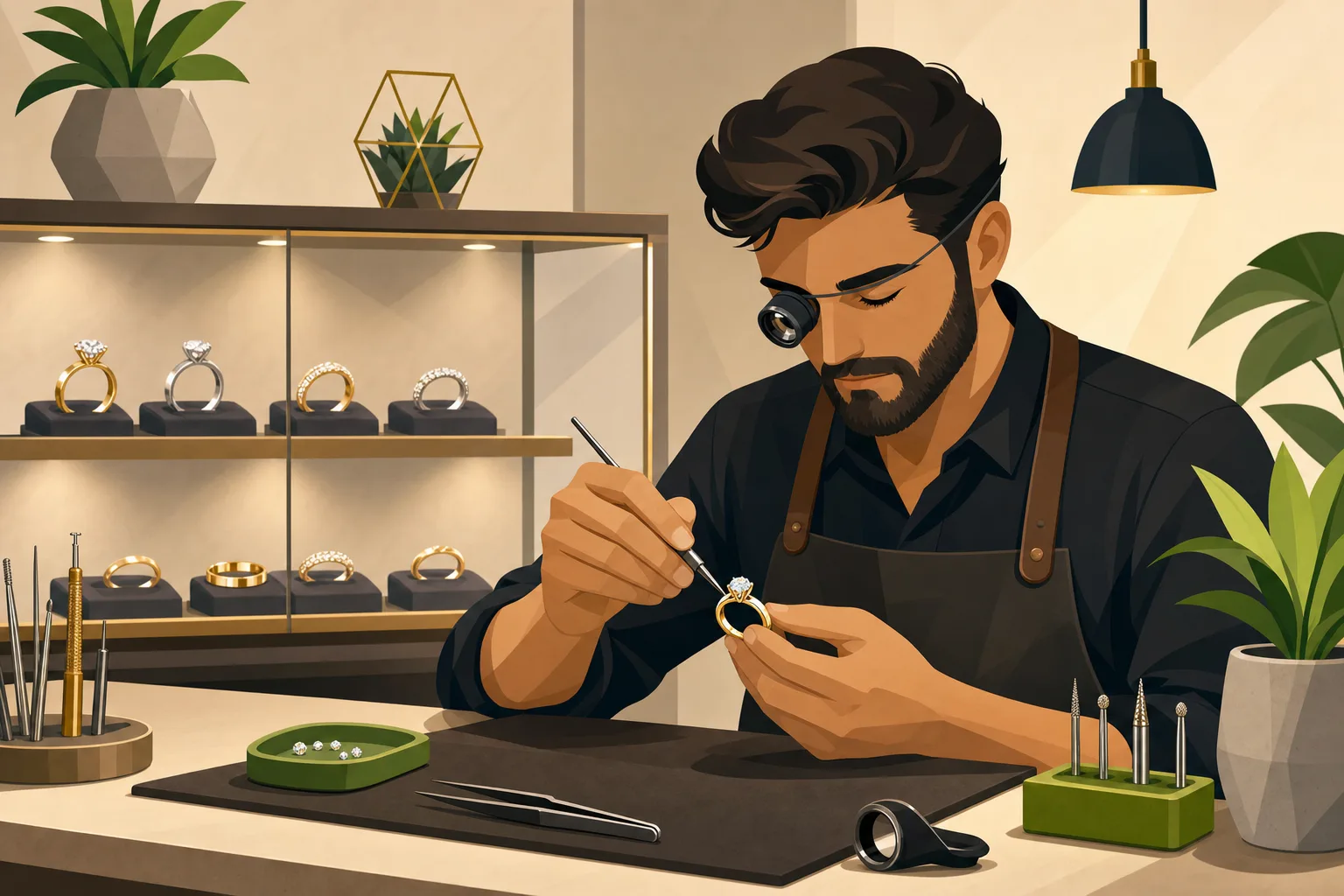
Most couples walk into a jewelry store before they've made their first phone call. They saw the website, decided you looked like someone worth trusting with a $3,000–$8,000 purchase, and then they showed up. Your website didn't close the sale — it opened the door. That's the job it needs to do, and for most small jewelry stores, it's the one job the site is failing at.
After analyzing jewelry store websites from all over the country — studying hero copy, trust signal placement, photography choices, custom-design flows, and appointment CTAs — the stores that consistently fill their consultation calendar share a recognizable structure. And the ones that don't are usually making the same three or four mistakes.
What we found looking at jewelry store websites
The first thing that stands out: every top-ranking jewelry store site treats the appointment as the conversion event, not the sale. Fine jewelry doesn't convert online at any meaningful rate. The research is clear. The site's job is to earn the in-store visit — specifically, to earn a booked consultation for an engagement ring or custom piece.
That reframes everything. You're not building a cart checkout. You're building a trust engine that ends with a phone call or an appointment form submission.
The second pattern: every competitive jewelry store site leads with the love story, not the product catalog. The headlines that work — "Celebrate Your Love Story," "Made for Your Forever," "Where [City] Gets Engaged" — aren't generic. They're aspirational and specific. The functional equivalents — "Shop Our Fine Jewelry," "Custom Engagement Rings" — are weaker every time. Save the keyword phrases for your page title and subheadings.
Third: the trust signals have a specific order that matters. Heritage comes first — "Since 1947," "Third-generation family jewelers," "Est. 1982." Then a real review count with a number attached, not just "trusted by thousands." Then awards or certifications. That sequence mimics how a new customer builds confidence in a jeweler they've never visited.
Table stakes vs. differentiators
Here's how to divide your energy:
Every competitive jewelry store site already has these — you can't skip them:
| Element | Why it's required |
|---|---|
| A love-story hero headline (not a product string) | Functional headlines rank but don't persuade. Emotional ones do both. |
| Appointment booking as the primary CTA | The site's one job is a booked visit or consult call — not "Add to Cart." |
| Heritage "Since [year]" claim | Present on every single competitor we analyzed. Absence is a red flag. |
| Phone number in the header, not just the footer | Heritage-dominant stores all do this. Boutiques that bury the number leave warm leads behind. |
| Real product and lifestyle photography | Across our proprietary local-business website research, real photography vs. stock was a dividing line between top-ranked and lower-ranked competitors across virtually every category where the product is the brand. For jewelry, it's non-negotiable. |
| Custom design entry point | Every competitor has some version of custom work. The question is whether it's a real flow or a contact form with a different label. |
| Lab-grown vs. natural diamond mention | Now expected. Ethical sourcing messaging appears on the majority of competitive sites we analyzed. |
These are what separate the appointment calendars that are full from the ones that aren't:
The phone number in your header with "Call or Text Us." Not in the footer. Not under Contact. In the header, visible on mobile without scrolling, formatted so a tap starts the call. The jewelers running the most successful consultation models treat the phone as a primary CTA alongside the appointment button — not an afterthought. The ones that bury it in the footer are leaving a category of warm leads (the ones who want to ask a quick question before committing to an appointment) completely unserved.
Named testimonials with a real number. "4.8 stars based on 1,000+ Google reviews" is a different signal than a badge that says "Trusted." The number is the trust signal. Named testimonials — first name, last initial, verbatim quote — add another layer. A customer who reads "We spent months looking and couldn't find the right setting. They made ours from scratch" has received actual information. "5 stars — great experience!" tells them nothing.
A deliberate pricing decision. The competitive set is roughly split on this — about half show pricing, half hide it. Neither is wrong, but you need to pick one intentionally. Heritage stores typically hide pricing (it signals custom, relationship-driven, and ultra-luxury). Boutiques with transparent DTC models show price ranges ($620–$4,980+) as a confidence signal for buyers who won't walk in without a ballpark. What doesn't work is accidentally hiding pricing with no explanation — leaving a curious buyer with no signal and no path forward.
A real custom design flow. The stores that win on custom work don't just say "we do custom." They have a dedicated page that explains the process — the consultation, the CAD rendering, the wax casting, the timeline — and ends with a clear consultation booking step. A customer who understands your process is a customer who books. A customer who sees "Custom Jewelry — contact us" goes back to Google.
Lab-grown diamonds as a genuine section, not a footnote. Younger buyers are asking about lab-grown almost universally. The stores handling this well have a dedicated split between natural and lab-grown with honest comparisons — what the differences are, what the price difference means, what the resale implications are. That's not a concession; it's the consultation starting on your site.
The mistakes we see most often
The appointment CTA is buried. You have a "Book Appointment" button in the footer, but your hero says "Shop Now." The hero CTA should be "Book a Consultation" or "Schedule an Appointment." Every click on "Shop Now" from a bridal buyer is a missed conversion — they're there to decide if you're worth visiting, not to browse a catalog.
The hero headline is an SEO string. "Fine Diamonds, Designer Jewelry, Custom Engagement Rings in [City]" is technically correct and persuades no one. It tells Google where you are. It tells a couple looking at your site nothing about why they should choose you. Separate the two functions: put the keyword-rich description in the page subtitle or trust strip, and give the hero a real headline with some humanity in it.
Stock or inconsistent photography. Real product photography and real store photography — that's the category expectation. Lifestyle shots of actual couples (not models in generic studio settings), studio close-ups of your actual ring inventory, and at least one or two showroom interior shots. The moment a customer sees a photo that feels like a template, the trust signal breaks. You're asking someone to trust you with an emotionally significant multi-thousand-dollar purchase. Every image should reinforce that you're real, local, and specific.
Over-stuffed copy in the hero or CTA. One Austin jeweler we analyzed had a hero CTA reading "BOOK YOUR CUSTOM JEWELRY or REPAIR APPOINTMENT NOW." That's two verbs, two product categories, and an urgency word all fighting for the same moment of attention. Pick one verb. Pick the primary conversion action. A couple looking at engagement rings doesn't need to know you do repairs in the same breath.
Custom design positioned as a contact form. "Interested in custom work? Contact us" is not a custom design page — it's an afterthought. Couples wanting a custom ring research extensively before walking in anywhere. A page explaining your process, showing past custom work, and ending with a "Book a Design Consultation" CTA does actual marketing. A contact form redirect does not.
FAQ
Should I show ring prices on my website?
It depends on how you're positioned. If you're a heritage institution with a relationship-first model, hiding pricing is defensible — just give buyers a reason ("custom work means every piece is priced at our consultation") rather than leaving them guessing. If you're a boutique or DTC-leaning brand, showing price ranges ($800–$5,500+) actually builds confidence and pre-qualifies buyers before they book. What doesn't work is hiding pricing with no explanation — a couple with a $3,000 budget who can't get any signal from your site will book the appointment somewhere that gave them a range.
What should my primary CTA actually be?
"Book a Consultation" or "Schedule an Appointment" — one or the other, consistently. Not "Shop Now" for your primary bridal traffic. Fine jewelry's online-to-purchase rate is well under one percent. You are not converting rings online; you are booking visits. Build the whole site around that.
Do I need a separate lab-grown diamond page?
Yes, if engagement rings are a significant part of your business. Buyers are asking about lab-grown in almost every initial consultation today. A page that honestly addresses the comparison — quality, cost difference, resale considerations, your honest take — positions you as the expert and often generates the consultation request. A jeweler who handles this question well on their site is one less reason for a buyer to go find another store's blog.
How does a GrowLocal jewelry store website handle this?
GrowLocal builds jewelry store websites around exactly this appointment-first model: love-story hero copy, consultation CTAs in the right positions, testimonial display using quotes your customers actually wrote, and contact forms that capture bridal inquiries. You preview the full site before paying anything — hosting starts at $20–30/month. No online booking engine or Google review automation — we use a clean contact form and a manual testimonial system, which keeps things honest and avoids the "last review was 2019" credibility problem.
Couples deciding where to buy an engagement ring are doing three to five times more research than they were a decade ago. They're reading reviews, comparing photos, assessing whether a jeweler's site looks like the kind of place where their ring should come from. Your website is part of that decision — not after the sale, before the walk-in.
The stores with full consultation calendars aren't the ones with the fanciest sites. They're the ones whose sites answered the trust questions (who are you, how long, what do real customers say), made the appointment ask clearly, and looked like a real place staffed by real people.
GrowLocal builds jewelry store websites designed around this model — appointment-first structure, trust signals in the right order, testimonial display, custom-work positioning, and contact forms for bridal inquiries. If you're exploring the category, you might also look at how we approach boutique websites and event planning websites — high-consideration purchases where the trust architecture is doing similar work. Browse the full local business website catalog if you want to see the range.