


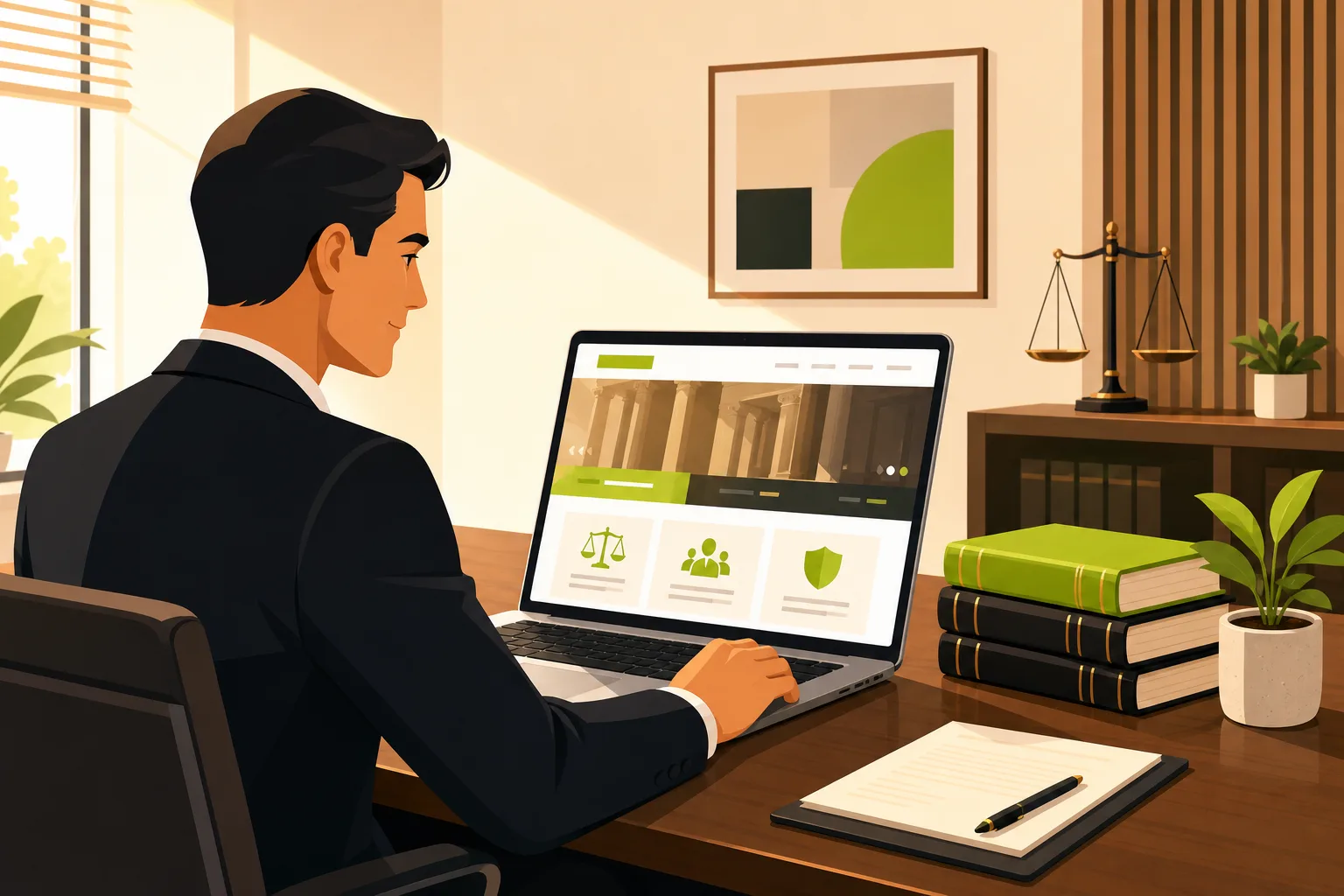
Tonight, somewhere in your city, five people are sitting with a legal problem they can't solve alone. They open a browser, they search for a lawyer, and five firms come back. They'll click through all five. By the time they're done — probably within twenty minutes — they've already decided who to call first. The question is whether your firm is that one.
This is the decision your website is either winning or losing right now, while you're reading this. Here's what we found when we analyzed law firm websites from all over the country — and what it takes for yours to come out on top.
What We Found Analyzing Real Law Firm Websites
We analyzed top-ranking small law firm websites across multiple markets — practices competing locally for clients searching for attorneys in personal injury, family law, estate planning, business formation, criminal defense, and related areas. These were owner-operated or small-partnership firms, not BigLaw offices. Here's the honest picture of what separates the ones that convert visitors into consultations from the ones that don't.
Every single firm hides pricing — and prospects expect it. Across our proprietary local-business website research, legal services showed 100% pricing opacity. No firm we analyzed shows rates on the homepage. The universal conversion offer is the free consultation — and it works because it removes the "how much will this cost me?" anxiety without asking you to give up negotiating leverage. The one exception is personal injury, where "No Recovery, No Fee" serves as a strong, specific guarantee that functions better than showing rates ever could. If you're in PI, lead with that guarantee loudly. If you're in any other practice area, gate everything behind a free consult and make it easy to schedule one.
The navy-and-gold palette isn't a coincidence — it's a genre signal. Across the law firm websites we analyzed, the color palette is strikingly uniform: deep navy primary, metallic gold or red accent, white or light grey backgrounds. No firm we analyzed uses casual colors or trendy gradients. This isn't about lack of creativity — it's about genre literacy. When a prospective client lands on your site, they're processing "is this a serious law firm?" in about three seconds. The conservative palette answers that question immediately. Deviating from it doesn't signal boldness; it signals inexperience.
Real attorney headshots are the single biggest credibility lever. The firms whose websites convert best share one consistent visual element: real photographs of the actual attorneys. Not stock photos of generic professionals. Not illustrated placeholders. Real faces, real offices, real people. This matters more in legal than in almost any other service category because the product is fundamentally the attorney — their judgment, their experience, their presence in a negotiation or courtroom. A prospective divorce client doesn't want to hire "a law firm." They want to hire a specific attorney they feel they can trust and work closely with for months. Your photo is that trust signal. Sites that skip it or substitute stock photography of courthouse buildings and gavels are telling visitors: "you don't get to know us yet." That's not mystery — that's a barrier.
Named testimonials with outcomes outperform awards for small firms. The larger established firms — those with 20+ years of operation — lead with named recognition programs like Super Lawyers or Best Lawyers designations. If you have those, display them. But if you're a smaller or newer firm, the more powerful trust signal is a named testimonial with a specific outcome: "Michael handled my DUI case and kept my record clean — best money I ever spent." That's more persuasive than a badge a prospective client doesn't recognize. Collect these actively. Get the client's permission to use their first name and last initial, and write down what you accomplished for them.
Practice area clarity is the first filter. Prospective legal clients arrive self-sorted. The person with a DUI isn't looking for "legal services." They're looking for a criminal defense attorney who handles DUI. If your homepage lists a sprawling set of practice areas without clear organization, they'll leave and find someone who makes it immediately obvious they specialize in exactly that problem. Dedicate clear sections — ideally individual pages — to each practice area. Use the exact language clients use to search: "divorce attorney," "estate planning lawyer," "personal injury," "business formation." Practice-specific landing pages also do better SEO work than a single services page.
Positioning without a hook blends into the background. The firms that do best pick one clear angle: specialization depth ("we only do fiduciary litigation"), heritage ("serving [City] since 1971"), or accessibility ("we do home visits, after-hours calls, bilingual"). What converts poorly is the "full-service, we do everything, experienced and caring" description that could apply to any of the five firms in the comparison set. Visitors comparing firms are actively looking for a reason to pick you. Give them one.
What Your Law Firm Site Needs
Table Stakes — Every Credible Competitor Has This
If your site is missing any of these, you're losing to competitors who aren't necessarily better lawyers — just better presented.
| Element | What It Does |
|---|---|
| Free consultation CTA above the fold | Universal conversion offer; reduce barrier to first contact |
| Clickable phone number in sticky header | Co-primary CTA; 60%+ of legal searches are mobile |
| Practice area cards or pages | Self-sorting visitors need to find their issue immediately |
| Attorney bios with real headshots | The product is the attorney; trust requires a face |
| Named testimonials | Social proof that a real person had a good outcome |
| Contact form + phone + hours + map | Multiple contact pathways reduce friction |
| Bar association and credential badges in footer | Expected legitimacy signal; absence is noticed |
| Blog or resources section | Freshness signal; SEO work over time |
Differentiators — What Separates Converting Sites From Credible Ones
- A specific positioning line in the hero — geo + practice + experience ("Experienced [City] Estate Planning Attorneys") or a clear differentiator ("We Don't Run an Assembly Line"). Mushy "we're here for you" language loses visitors who are making a fast comparison.
- Outcomes-tied testimonials — not just "great service" but "she guided us through a complex situation and we kept the house."
- An "Our Process" section — three steps showing what happens after someone fills out a contact form. The biggest hesitation for first-time legal clients is "I don't know what I'm walking into." Reduce that anxiety before it becomes a reason not to call.
- Specific trust numbers — years in practice, number of cases handled, specific award designations with year. "18 years" converts better than "experienced." "Handled 400+ injury cases" converts better than "extensive track record."
- Accessibility hooks — after-hours availability, bilingual service if applicable, home visits for estate/elder law, virtual consultations. Any one of these is a genuine differentiator when competitors don't offer it and don't say so.
Common Mistakes That Cost You the Consultation
A generic hero headline. "Committed to Clients. Committed to Results." could appear on any of the five firms in a comparison. Your headline should answer: what kind of legal problem do I handle, for what kind of client, and why should you trust me with it? If it doesn't answer those three things, rewrite it.
Photos that work against you. Stock photos of gavels, courthouses, scales of justice, and unidentifiable couples reviewing documents have become visual shorthand for "this firm didn't invest in their website." They're so common that they actively signal low credibility. If you don't have professional photos yet, a decent iPhone photo of you at your desk beats stock every time.
A weak or absent guarantee. "We'll do our best!" is the worst thing in a hero section — it's filler that signals you couldn't think of anything meaningful to say. PI attorneys have the strongest version: "No Recovery, No Fee." Non-PI practices have equivalents: free initial consultation (mean it), a written engagement letter detailing scope and billing, flat-fee pricing for defined-scope matters. Find the credible commitment you can make and state it clearly.
One big undifferentiated "About Us" page. The attorneys bio page is typically the highest-traffic destination on a law firm website — people navigate to it after landing on the homepage to evaluate who they'd be working with. If it's a 50-word generic paragraph and a small headshot, it's working against you. Each attorney deserves a full bio: practice focus, years of experience, notable types of cases handled, credentials, and a real photo.
No follow-up path for visitors who aren't ready to call. Most legal decisions involve some comparison and hesitation — especially for planned matters like estate planning or business formation. If the only conversion option is "call us now," you're losing the visitors who are 30 days away from being ready to hire. A contact form with a low-commitment ask ("Tell us what you're dealing with and we'll follow up") captures them without pressuring them into a phone call they're not ready for.
Making the practice area list do the heavy lifting. A list of 12 practice areas in small text under a carousel hero doesn't help visitors find you as quickly as a card grid with icons and a line of description under each one. Organize your practices visually so a visitor scanning the page can find their situation in under five seconds.
Quick Questions
Should I show attorney pricing on my website?
No — and this is unanimous across the firms we analyzed. All legal pricing is behind a free consultation or a direct inquiry. The exception is PI: replace price with "No Recovery, No Fee," stated prominently. That guarantee does more work than any rate card could.
How important is it to have individual pages for each practice area?
Very. It matters for SEO (each page can rank for a specific query), and it matters for conversion (a visitor searching for a divorce attorney wants to land on a page that talks directly to their situation, not a general "we handle everything" page). Start with your highest-volume practices.
What if I don't have professional photography yet?
Don't delay launching a site waiting for it — but make getting real photos a near-term priority. In the meantime, a genuine iPhone photo of you at your desk or in your office outperforms stock photography. Clients aren't looking for perfection; they're looking for a real person.
What should the free consultation CTA actually say?
"Schedule Your Free Consultation" is the clear winner across the competitive sites we analyzed. "Contact Us" is the weakest version — it sounds like admin, not service. Make the CTA button label describe what the prospect gets, not what you want them to do.
Does a law firm website need a blog?
Yes, though it doesn't have to be high-volume. One or two well-written posts per month on topics your clients actually search for ("what happens at a first meeting with a divorce attorney," "do I need an attorney to form an LLC in [State]") compound over time as SEO assets. Thin, keyword-stuffed posts hurt more than they help.
The Bottom Line
Tonight's prospective client is comparing five firms and they're giving each one roughly four minutes. In those four minutes, they're asking: does this attorney handle my specific situation? Does the site look like this firm is established and cares? Can I see who I'd be working with? Is it easy to reach them?
The firms that win that four-minute evaluation have a specific hero headline, visible attorney photos, clearly organized practice areas, a free consultation CTA that's impossible to miss, and at least a few testimonials from named clients with real outcomes. Everything else is noise.
GrowLocal builds websites for law firms — professionally designed, hosted, and maintained, starting at $20–30/month. You get a contact form that captures inquiries, a manually curated testimonials section, and a site that tells your story clearly to the clients comparing you tonight. Preview your site free at growlocal.site/websites-for/law-firm.
The same trust-first challenge plays out across related professional service practices — accounting firms and financial advisors face nearly identical dynamics. See everything we build at growlocal.site/websites-for.