


When someone's screen cracks, their first move is a Google search: "cracked screen repair near me," "iPhone repair [city]," or just "computer repair shop." The results fill up with mall kiosks, national chains, and a handful of local independents. The customer picks one of the first three results and calls. If you're not in those results — or if your website doesn't immediately answer the questions running through their head — they're not calling you.
This post breaks down what we found when we analyzed computer and phone repair websites from across the country: what the best ones do, what most get wrong, and what it actually takes to rank and convert in this category.
The customer's real mindset when they search
Understanding this is more important than any SEO tactic. A cracked screen, a laptop that won't boot, or a data loss scare is a distress purchase. The customer is anxious, they need a fast answer, and they're handing over a device that has their photos, their banking app, and their work files on it. That's a trust transaction, not just a service transaction.
The two questions running through their head are: Can you fix it today? and Are you going to rip me off?
Every element of your website should answer those two questions. If it doesn't, you're losing calls to whoever answers them first — and in this category, that often means the mall kiosk with a sign that says "Phone Repair — Walk-Ins Welcome."
What we found analyzing real repair websites
We analyzed computer and phone repair websites from Austin, Denver, Phoenix, Charlotte, Nashville, Tampa, and other markets. The gap between the best-performing sites and the rest of the field was significant — and almost entirely explained by a handful of decisions.
The headline matters more than anything else. One Austin shop leads with: "Austin computer repair for PCs, Macs, laptops & gaming computers." It's plain, it's keyword-rich, it tells you exactly what they fix and where. Compare that to a competitor whose hero says "Forge Your Path to Digital Excellence." When your laptop won't boot and you need help today, which one makes you pick up the phone?
We see the same principle at work in other local service categories — across our proprietary local-business website research, city name in the H1 headline appeared across most categories as the dominant pattern, serving double duty as both a local SEO signal and an instant trust cue. Repair shops are no different. "Phoenix computer repair" in the headline beats any amount of brand-voice cleverness.
Speed claims that are specific convert better than speed claims that are vague. "Same-day service available" is wallpaper. One Nashville shop we studied says "99.999% of our repairs are finished same day or within 48 hours." That's a number you can hold the shop to — and it signals a business that tracks its own performance. Specificity implies accountability.
Most shops bury their best asset: their reviews. We found that across the repair shops we studied, most either linked to Google with a vague "5-star rated" claim (no count) or showed a testimonial carousel that visitors scroll past. One Austin shop was the clear outlier: they surface "4.6 stars · 141 verified reviews" directly on the page. That number, shown on-page rather than buried behind a link, is more persuasive than any written testimonial.
Across our proprietary local-business website research, the majority of competitors across most categories mentioned reviews in vague terms — "trusted," "5-star" — without a specific count. A specific number above the fold is still a differentiator in nearly every local service category.
Pricing transparency is a genuine edge — because almost nobody does it. Most of the repair shops we analyzed hide pricing entirely, funneling visitors to call or submit a form. The outliers — shops that showed a diagnostic fee and an hourly rate — stood out immediately. One shop's pricing page lists: $50 standard diagnostic, $99 gaming diagnostic, $99/hr labor, with the clear statement "Pay only on success." That combination of visible numbers plus a no-risk guarantee does more to pre-qualify and convert leads than any chatbot or pop-up. Your competitors' reluctance to show prices is an open opportunity.
"Free Diagnostic" outperforms "Get a Quote." Every strong site in this category uses some version of the free diagnostic offer as the primary call to action. The logic is sound: the customer's fear is unknown cost and the risk of paying for nothing. "Bring it in, we'll diagnose it for free, and you decide what to do" eliminates the main objection before they even call. One Charlotte shop pairs the free diagnostic with "if you decline the repair, you pay zero fees" — which addresses the exact anxiety most customers have. Shops that lead with "Get a Quote" instead are asking customers to do more work upfront than the situation warrants.
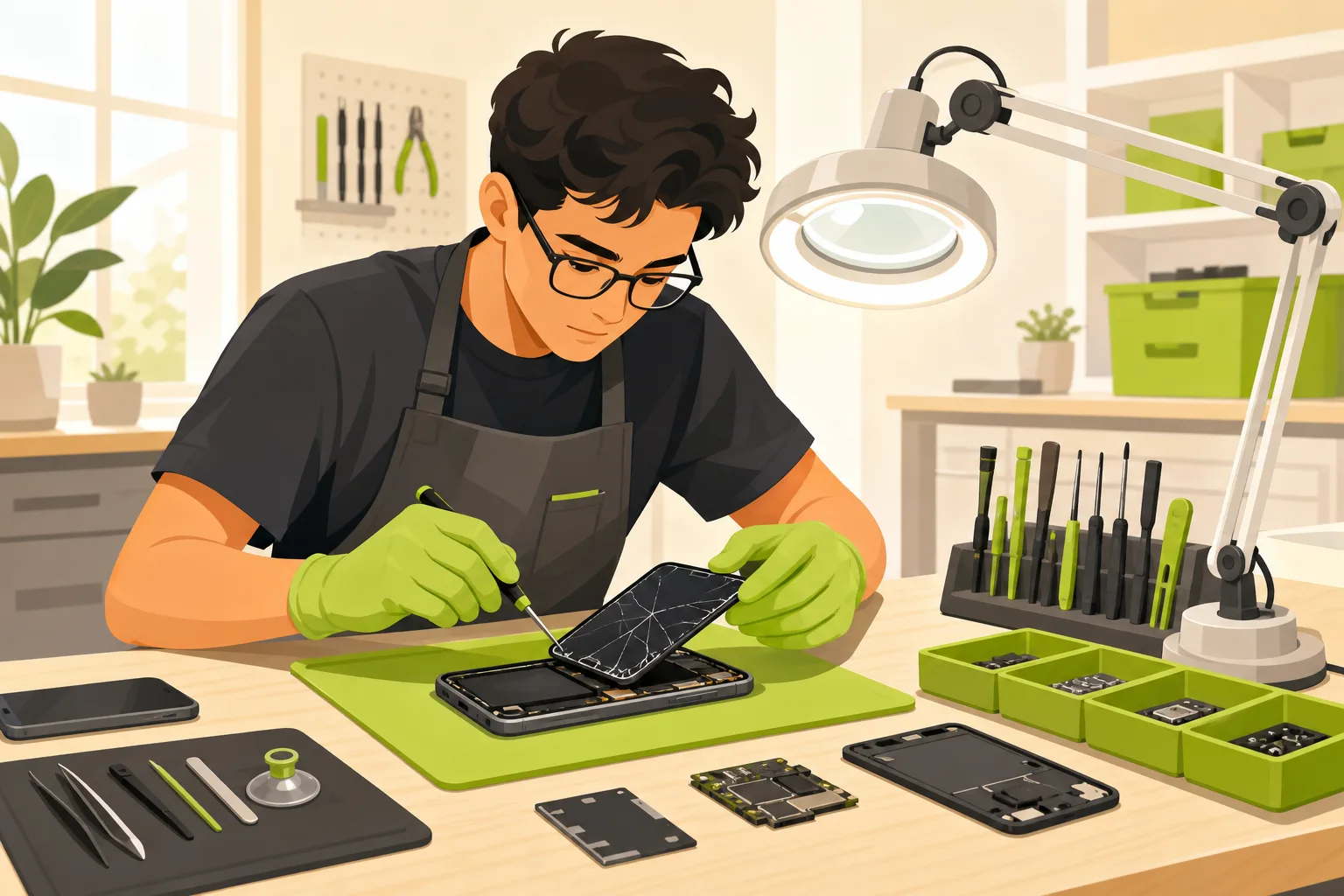
Real team photos beat stock photography every time. The strongest sites we analyzed have real staff headshots and bench photos prominently placed. The rest ship stock network-cable images or, in two cases, SVG placeholder images with no photography at all. In a category where you're asking someone to hand over a device with all their data, a real face matters. A technician at a bench with actual equipment is worth ten testimonials.
A "How It Works" section dramatically reduces friction. About half the repair shops we looked at include a three-to-five-step process section explaining what happens after someone walks in or submits a form. This section addresses the anxiety of the unknown: drop off → diagnose and quote → approve → repair and pick up. It's simple, it takes twenty seconds to read, and it converts. The shops that skip it leave customers wondering what the process looks like — which creates hesitation right before they pick up the phone.
What your website actually needs — table stakes vs. differentiators
Some things are now expected in this category. Skip them and you signal that your site is amateur:
- Phone number in the sticky header, click-to-call on mobile
- Service-card grid with individual pages for computer repair, laptop repair, Mac repair, phone/iPhone repair, virus removal, and data recovery (this is both your UX and your SEO structure)
- Free diagnostic as the primary CTA
- Same-day service language somewhere visible
- Named warranty with a number — "90-day warranty on parts and labor" next to your CTAs, not buried in the footer
- A "How It Works" process section
- Years in business or a founding-year claim
Genuine differentiators — things most shops in your market are NOT doing:
- Published diagnostic fee and hourly labor rate (even a starting-at figure)
- On-page star rating with a review count, not just a Google link
- "No fix, no fee" language explicitly stated
- Real bench and team photography
- Specific quantified claims (repairs completed, same-day rate, devices serviced)
If you build toward the differentiators while covering the table stakes, you'll stand out in most local markets. We see the same opportunity gap in related categories — from IT support services at growlocal.site/websites-for to auto repair — the shops that treat their website as a trust-building tool rather than a digital business card are consistently the ones showing up at the top of the results.
Common mistakes we see on repair shop sites
Corporate language that confuses residential customers. One site we analyzed had a twelve-item navigation menu that mixed "Endpoint Security" and "B2B Managed Services" alongside phone repair. A panicked customer with a cracked screen doesn't know what endpoint security is — they're going to leave and call the next result. If you do serve businesses, bury it in a single "For Business" nav item. The homepage should speak directly to residential customers.
Vague trust claims without evidence. "Transparent Pricing" is not a trust signal if no prices are shown. "Certified Technicians" means nothing if no certification is named. "Best Geeks in the Business" is the kind of claim that makes people more skeptical, not less. Every trust claim should have a number, a name, or a verifiable fact attached to it. "CompTIA A+ certified technicians" beats "certified professionals" in every head-to-head.
Aspirational hero copy. "Forge Your Path to Digital Excellence" is a real headline from a real repair shop. It says nothing about what the shop does, where it is, or why you should call. When you have thirty seconds to convince a stressed customer to pick up the phone, abstraction is your enemy. Concrete service + city + speed wins every time.
Hiding pricing when you're competing on price. If your shop competes against mall kiosks partly on price, and you're hiding your pricing, you're giving up the argument before the conversation starts. The kiosk has a sign. Your website should be at least as transparent.
Thin SEO footprint. We found that even well-established, multi-location shops in this category have thin sitemaps — one eight-location chain had only 26 pages, no location-specific pages, and an empty blog. Each device type and repair category is a potential search query. A computer repair shop that has individual pages for laptop repair, Mac repair, iPhone repair, screen replacement, battery replacement, virus removal, and data recovery has a much larger surface area for search traffic than one with a single services page.
Quick takeaways
- Lead with service + city + speed. That formula beats every clever brand tagline.
- Put your phone number in the sticky header. The phone call is your primary conversion action — don't make customers hunt for it.
- Show at least your diagnostic fee. Even one number on the page is more than most competitors offer.
- Name your warranty. "90-day warranty on parts and labor" next to your CTA outperforms "guaranteed work."
- Add your review count on-page. Not a Google link — an actual number visible without clicking.
- Use "Free Diagnostic" not "Get a Quote." Lower perceived commitment, higher conversion.
- One "How It Works" section. Three steps. Reduces handover anxiety, which is the real objection.
- Build a service page per repair type. Each page is both an SEO target and a trust signal.
If you run a computer or phone repair shop and your website isn't working as hard as you are, GrowLocal builds websites specifically for repair shops — designed from real competitor research in this category. No templates that look like everyone else. We build the site, write the copy, and handle the hosting. Plans start at $20–30/month, and you can preview your site before spending anything. Take a look at growlocal.site/websites-for/computer-repair to see what a site built for this category actually looks like.