


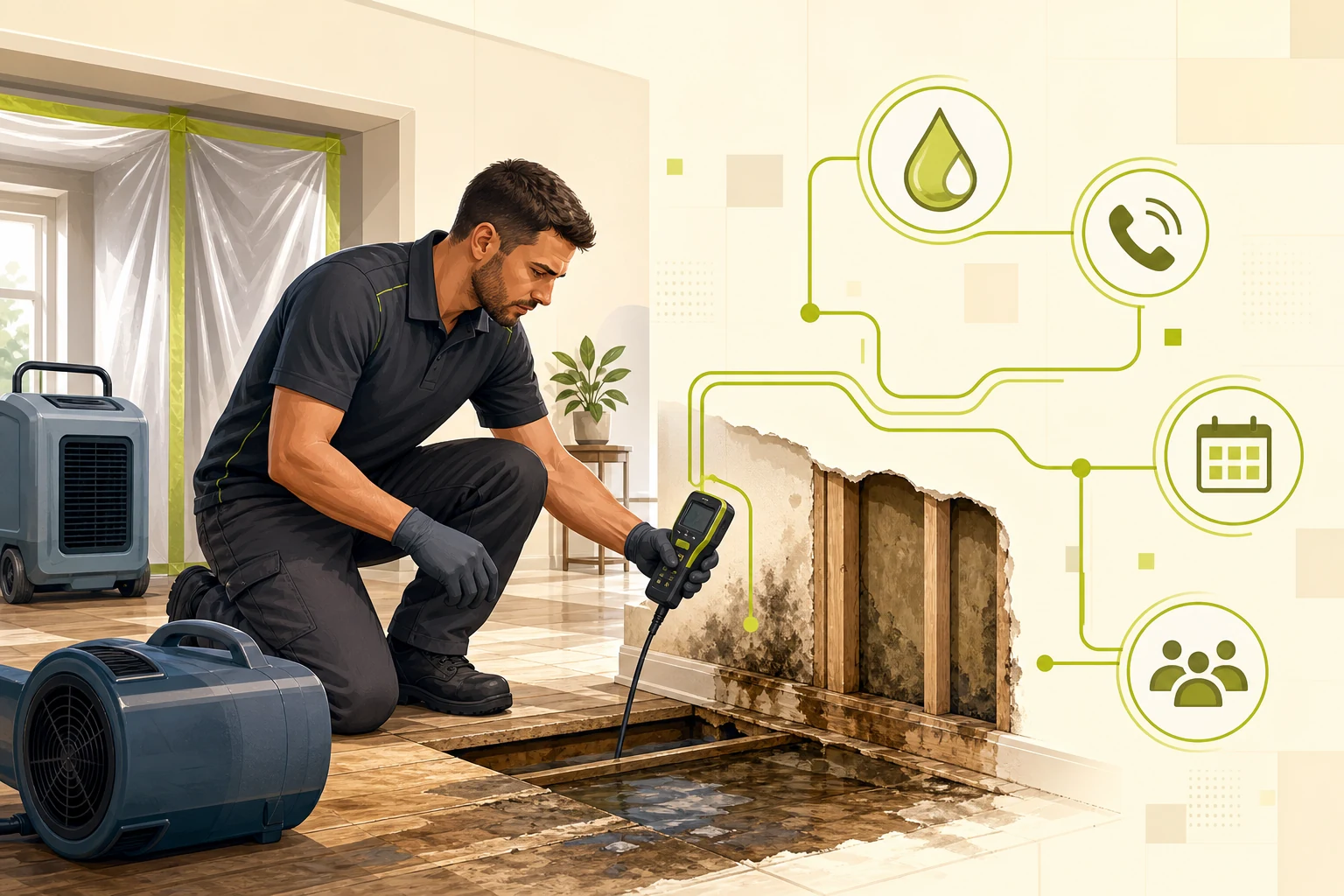
A restoration (water/fire/mold) website has one job: help the right visitor feel confident enough to request a quote. Emergency (pipe burst, flooding, fire) or discovered damage (mold, lingering odor, inspection finding). Mostly URGENT - searching on phone, stressed, needs someone now. Immediate - most conversions happen within minutes of the search. No comparison shopping in a crisis.
Explore the data behind this guide on our local business website statistics page.
This guide breaks down what the site needs to show, what pages matter most, and how to turn category-specific trust into a clearer path from search to contact.
Why visitors hesitate
People looking for restoration (water/fire/mold) rarely compare only design. They are trying to answer practical questions quickly:
- "You have a leak / flooding / fire and don't know what to do".
- "You're worried about mold after water damage".
- "You don't know how to handle the insurance claim".
- "You need someone there RIGHT NOW, not tomorrow".
- "You don't want to be overcharged or under-served".
If those answers are buried, visitors go back to search results. A good site keeps the important proof close to the action.
What belongs above the fold
The hero section should make the business type, service area, and next step obvious. For restoration (water/fire/mold), the primary action is usually request a quote. That CTA should appear in the header and again in the hero, with a short reassurance line beside it.
Strong above-the-fold elements include:
- A direct headline that names the service and local market.
- One primary CTA, not five competing buttons.
- Review score, years in business, certifications, or other proof.
- Mobile click-to-call or a short form, depending on how customers buy.
Pages that support local search
One homepage is not enough for most restoration (water/fire/mold) businesses. The site should give every major offer or buying question a place to live.
- Homepage (emergency-response hero + all services overview).
- Water Damage Restoration.
- Fire & Smoke Damage Restoration.
- Mold Remediation / Mold Removal.
- About Us / Why Choose Us.
- Contact / Free Assessment Request.
Service detail pages are where the site can match high-intent searches. Good candidates for restoration (water/fire/mold) include:
- Basement Flooding / Flood Cleanup.
- Sewage Cleanup (separate from water damage - different contamination class).
- Storm Damage Repair.
- Burst Pipe Repair.
- Smoke & Odor Removal.
- Structural Drying.
These pages do not need to be bloated. They need a clear explanation, proof, FAQs, photos where relevant, and a strong next step.
Trust signals that matter
The best restoration (water/fire/mold) sites make trust visible before asking for contact information. In this category, useful proof includes:
- IICRC Certified Firm badge - present on ALL 5 sites, usually prominently in hero or just below; this is the non-negotiable credential in this category.
- A+ BBB Rating - present on 4 of 5 sites.
- Google Review rating - all 5 display it; Charlotte Restoration Co shows "4.8/5 stars - 150+ reviews"; charlotterestorationco.com also shows "4,500+ homes restored".
- EPA Lead-Safe Firm - 1 site (waterdamageinc.com); niche cert but credible signal.
- Contractor Connection Top Performer - 1 site (trtexas.com); insurance-industry certification.
- 60-minute response guarantee - explicitly stated by 2 sites.
The mistake is treating proof like footer decoration. Put it near the CTA, inside service pages, and anywhere the visitor is deciding whether to keep reading.
Content that makes the site feel specific
Generic small-business copy does not do enough here. A stronger restoration (water/fire/mold) site should speak to the actual buying context: clear service information, local proof, fast ways to contact the business.
That specificity can show up in page names, FAQ questions, gallery captions, form fields, and the order of sections on the homepage. The goal is for a visitor to think, "This business handles exactly what I need."
How GrowLocal builds this
GrowLocal builds custom websites for Restoration (Water/Fire/Mold) with the category structure already planned: core pages, mobile CTAs, review placement, FAQs, and local search pages. You preview the full site before paying, request revisions, and launch only when it feels right.
Bottom line
A restoration (water/fire/mold) website should not be a brochure. It should answer the first questions, show credible proof, and move the visitor toward request a quote without friction. When those pieces are in place, the site becomes part of the sales process instead of a digital business card.