


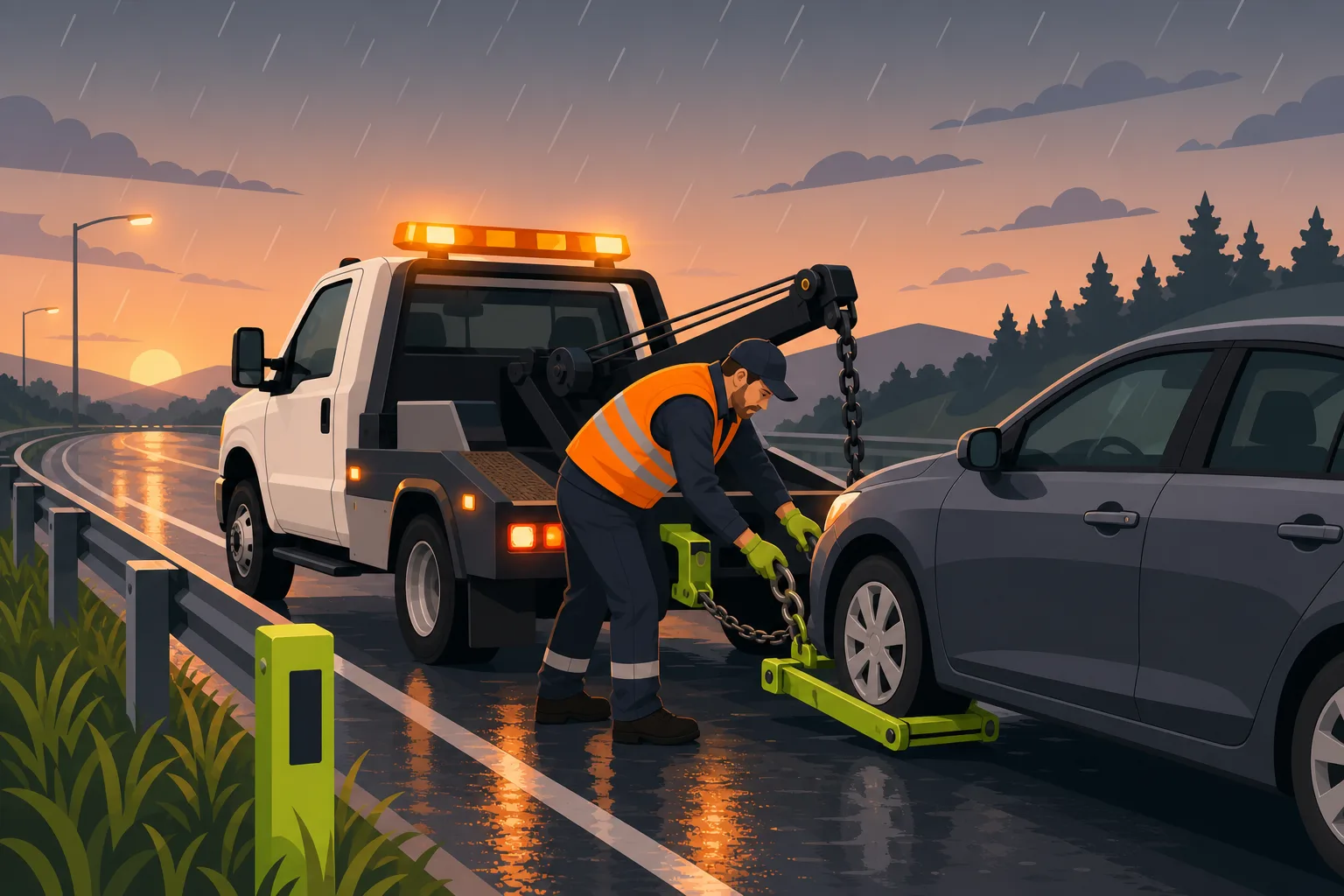
Your phone rings because someone is stuck. Their car is dead on the shoulder, it's midnight, the rain is coming down, and they're scrolling through search results on a phone with a dying battery. They are not comparison-shopping. They are not reading your About page. They tap the first result that loads fast, has a phone number they can call right now, and doesn't look like it'll rip them off.
That three-second decision is what your website is competing for. Here's what we found when we analyzed towing company websites from all over the country, and what it means for the site you're running right now.
What We Found Analyzing Towing Company Websites Across the Country
We looked at towing company websites across multiple markets — real independent operators, no national chains, no directories. These are the businesses showing up above yours right now. The patterns across them are consistent enough to be actionable.
The phone number is the CTA — nothing else comes close. Every single top-ranking towing site had the phone number as the primary, most prominent element in the hero. Not "Call Us Today." Not "Get a Free Quote." The actual number, inside the button text itself: "Call (813) 414-1127." One Charlotte operator puts "Click to call: (704)773-9165" directly on the button. On mobile, every instance tap-to-calls. The phone number is repeated four or more times per page on the strongest sites — in the hero, in a mid-page band, in the footer, in the sticky header. This isn't repetition for its own sake. For a person stranded on the roadside, the phone number is the only thing on the page that matters. Every other design decision is in service of making it easier to find and tap that number.
"24/7" above the fold is not optional. Every site in our research — without exception — displayed a 24/7 availability signal before the first scroll. "24-Hour Towing." "Available 24/7/365." "We Never Close." If a customer loads your page and doesn't see it within the first two seconds, they assume you might not answer and move on.
Concrete arrival time promises win the category. This was the single most powerful differentiator we found. One Tampa operator publishes a written guarantee: "arrival at your location within 45 minutes of your call or sooner." That one sentence — specific, measurable, contractual — was the strongest trust line across everything we read. Only one site out of the set had it. The other operators said things like "fast response" and "quick arrival" — vague enough to mean nothing. A caller choosing between "Fast Response Towing" and "On our way in 45 minutes or less" is not a coin flip. If you can back up a time promise, put it in your hero. It's the most open competitive gap in this category.
Real truck photos win and stock photos lose. Across our proprietary local-business website research, real photography was the most consistent pattern on top-performing local business sites. In towing specifically, operators who photographed their actual fleet looked categorically more credible than the ones using stock imagery. A real truck photo also proves you have real equipment. The best subjects: a branded truck with the lightbar on at night, a vehicle being winched off a shoulder, a loaded flatbed mid-run. Stock photos of generic tow trucks read as placeholder content. The fleet photo does credibility work the moment someone hits your page.
The price-gouging fear is real and your site has to address it. Towing has a reputation problem — customers arrive already worried about being overcharged. Every strong site in our research had explicit copy to counter this: "transparent pricing," "no hidden fees," "no mileage surcharges," "price quoted on your first call." None showed actual prices — pricing was hidden on every site we analyzed. But the copy around it was specific. The word "transparent" appeared again and again. Address the rip-off fear head-on even if the numbers stay in the quote conversation.
Service breadth matters for commercial and for search. The highest-ranking operators in our research had 15+ dedicated service sub-pages: Emergency Towing, Roadside Assistance, Jump Start, Lockout, Flat Tire, Fuel Delivery, Accident Recovery, Long Distance, Heavy Duty, Private Property Impound. Each page targets its own search terms. The consumer searching "locked keys in car" finds a different page than the fleet manager searching "heavy duty recovery." If you only have one page listing every service in a paragraph, you're splitting search equity across keywords that could each be ranking separately.
What Your Towing Website Needs
Table stakes — every competitive site has this
- Phone number visible above the fold, inside the button text, tap-to-call on mobile, sticky in the header on scroll
- "24/7" signal before the first scroll — in the headline or subheadline, not the footer
- Real photo of your actual truck — not stock, not a clip-art tow hook
- "Licensed, insured, and bonded" stated explicitly — not implied
- Services grid linking to individual service pages (6–10 minimum)
- Service area listing — city names, neighborhoods you cover
- Named customer testimonials (3–6 minimum, with first name and city)
- Contact form with name, phone, vehicle type, and current location
- Years in business or founding year stated plainly
Differentiators — what separates the sites that win more calls
- A concrete, written arrival time promise in the hero or immediately below it
- Real fleet photography — branded truck, lightbar, vehicles being recovered
- Heavy-duty and rotator capability prominently displayed if you have it — this unlocks commercial accounts
- Neighborhood-level service pages for the highest-volume zip codes in your area
- Specific trust credentials: BBB badge, Google review count, driver photos or names
- "Transparent pricing" copy that explicitly names what you don't charge — no mileage fees, no fuel surcharges, price on the first call
- A sticky floating call button on mobile — prominent, thumb-reachable, present on every scroll position
The gap between these two lists is where wins happen. Every site in the competitive set had the table stakes. Almost none of them had all the differentiators.
Common Mistakes That Cost You Calls
No tap-to-call on the phone number. A phone number displayed as plain text — not a tel: link — doesn't auto-dial on a tap. The person on the roadside tries to copy it, fumbles it, and moves to the next result. Every phone number on every page should tap-to-call on mobile.
Vague arrival time language. "Fast response" and "quick arrival" appear on dozens of towing sites and mean nothing. The caller can't evaluate "fast" — they can evaluate "30 minutes or less." If you can commit to a window, write it. If you can't, be as specific as you can: "typically on scene within 30–45 minutes." Specificity beats reassurance every time.
No 24/7 signal above the fold. If a visitor has to scroll to find out whether you answer at midnight, you've already created doubt. A clear hours signal should be visible before the first scroll. Honest hours are more trustworthy than a 24/7 claim you can't back up.
Stock truck photography. A real operator has real trucks. If you're not photographing them, you're leaving your single best credibility signal untouched. A branded truck, parked or working, instantly separates "legitimate local operator" from a placeholder listing. Photograph your fleet.
One giant service page instead of individual pages. Listing every service in a paragraph isn't a service architecture. Each service — emergency towing, jump starts, lockouts, flat tire, fuel delivery, long-distance, heavy duty — is a separate search query. Individual pages let each one rank on its own.
Hiding your service area. A stranded driver's first thought is "do they come to where I am?" List the cities and neighborhoods you serve, somewhere visible. Your competitors may not answer this question either — whichever site answers it first wins the call.
Five Things Worth Knowing Before You Build
Most towing searches happen on a phone at the roadside. The customer is in their car, stressed, probably cold or wet, on a cracked screen in low light. Speed, tap-to-call, and visible phone numbers aren't nice-to-have features — they're the whole user experience. A site that loads slowly on mobile is actively losing calls.
The commercial segment is where the recurring revenue lives. Consumer towing is high-frequency and high-cost-to-acquire. Commercial accounts — property managers running impound lots, fleet operators, body shops, dealerships — are the stickiest part of this business. If you have heavy-duty or rotator capability, that needs its own page and prominent placement. The fleet manager doing research has time the stranded driver doesn't — give them the detail they need.
The review count you're not showing is your biggest missed differentiator. Across our proprietary local-business website research, most local businesses vaguely reference "excellent reviews" without a specific count. In towing, a number — "4.8★ — 214 Google reviews" — addresses the speed anxiety, the price-gouging fear, and the "is this a real company" question at the same time. If you have reviews and you're not surfacing the count above the fold, you're giving up your easiest trust win.
Your website is doing anti-scam work whether you realize it or not. The towing category has a reputation problem, and customers land on your site already a little suspicious. Named testimonials, a truck photo, a founding year, a "licensed and insured" line, and transparent pricing copy are all answering the question: "Is this a real, local company that will give me a fair price and actually show up?" Build the site with that question in mind.
If you want to see what a towing website built on these patterns looks like — phone-first design, trust signals wired in, service pages and quote forms ready to go — you can preview one free at GrowLocal's towing website builder. No card required. You fill out a short intake form, we build a site matched to your business, and you preview it before committing to anything.
We build websites for local service businesses across dozens of categories — from towing and roadside assistance to locksmith companies, HVAC, and auto repair — based on real competitor research in each category. The same phone-first, trust-first design principles that work in towing apply across every category where a customer is searching under urgency.
GrowLocal sites include quote forms and manually-entered testimonial displays out of the box — no third-party integrations, no accounts to connect, no ongoing configuration. The platform runs for $20–30/month. You own the content; we handle the build, hosting, and maintenance. Start with a free preview at growlocal.site/websites-for/towing — see the site before you spend a dollar.