


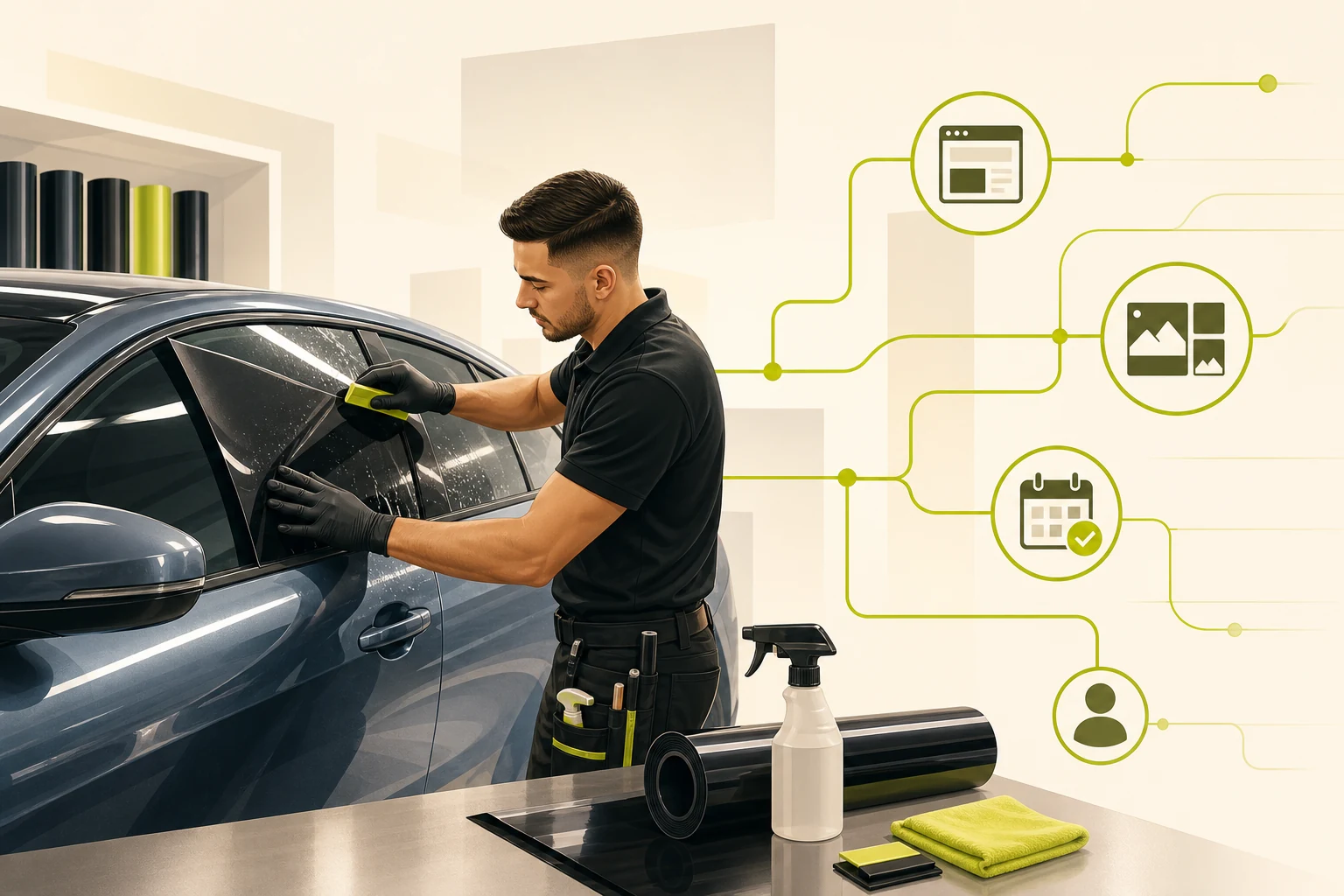
A window tinting website has one job: help the right visitor feel confident enough to request a quote. New vehicle, summer heat discomfort, privacy need, UV protection concern, or moving to a hot climate - mostly planned, occasionally urgent (heat wave). Days to 1-2 weeks; same-day appointment common once decided.
Explore the data behind this guide on our local business website statistics page.
This guide breaks down what the site needs to show, what pages matter most, and how to turn category-specific trust into a clearer path from search to contact.
Why visitors hesitate
People looking for window tinting rarely compare only design. They are trying to answer practical questions quickly:
- Heat inside the vehicle (big deal in TX, AZ, CO summer).
- UV exposure / skin protection (Skin Cancer Foundation partnership common).
- Glare while driving.
- Fading interior / cracked dashboards.
- Privacy / people looking in.
If those answers are buried, visitors go back to search results. A good site keeps the important proof close to the action.
What belongs above the fold
The hero section should make the business type, service area, and next step obvious. For window tinting, the primary action is usually request a quote. That CTA should appear in the header and again in the hero, with a short reassurance line beside it.
Strong above-the-fold elements include:
- A direct headline that names the service and local market.
- One primary CTA, not five competing buttons.
- Review score, years in business, certifications, or other proof.
- Mobile click-to-call or a short form, depending on how customers buy.
Pages that support local search
One homepage is not enough for most window tinting businesses. The site should give every major offer or buying question a place to live.
- Services (auto tinting sub-pages by film type: dyed, carbon, ceramic, IR ceramic).
- Residential Window Tinting.
- Commercial Window Tinting.
- Gallery (before/after).
- Contact / Get a Quote.
- Reviews / Testimonials.
Service detail pages are where the site can match high-intent searches. Good candidates for window tinting include:
- Automotive Window Tinting (hub).
- Ceramic Tint.
- Carbon Tint / Standard Tint.
- Paint Protection Film (PPF) - almost every tint shop cross-sells this.
- Residential Window Film.
- Commercial Window Film.
These pages do not need to be bloated. They need a clear explanation, proof, FAQs, photos where relevant, and a strong next step.
Trust signals that matter
The best window tinting sites make trust visible before asking for contact information. In this category, useful proof includes:
- Lifetime warranty - every top competitor offers it; mentioned prominently above the fold by some.
- Review counts: 184-589 Google/Yelp reviews with 4.6-4.9 star ratings; displayed with badges.
- Brand certifications: XPEL Authorized Dealer, LLumar Select Pro Dealer, SunTek Authorized Dealer, 3M Dealer - shown as logo lockup.
- Industry memberships: NFRC (National Fenestration Rating Council), Skin Cancer Foundation partnership (Sunguard/3M).
- Years in business: 25+, 30+, 40+ years; same location longevity mentioned.
- Dealership trust: "Trusted by Porsche, Audi, Mercedes-Benz" (Extreme Autoworks) - powerful third-party signal.
The mistake is treating proof like footer decoration. Put it near the CTA, inside service pages, and anywhere the visitor is deciding whether to keep reading.
Content that makes the site feel specific
Generic small-business copy does not do enough here. A stronger window tinting site should speak to the actual buying context: Experience/longevity ("X years in business", "40,000+ vehicles protected"), Film brand quality (3M, XPEL, LLumar, SunTek, FormulaOne - drops brand names constantly), Lifetime warranty (on both film and labor - universal differentiator).
That specificity can show up in page names, FAQ questions, gallery captions, form fields, and the order of sections on the homepage. The goal is for a visitor to think, "This business handles exactly what I need."
How GrowLocal builds this
GrowLocal builds custom websites for Window Tinting with the category structure already planned: core pages, mobile CTAs, review placement, FAQs, and local search pages. You preview the full site before paying, request revisions, and launch only when it feels right.
Once those fundamentals are live, the next question is growth. See our breakdown of how to grow a window tinting business, including landing commercial flat-glass contracts and dealership accounts.
Bottom line
A window tinting website should not be a brochure. It should answer the first questions, show credible proof, and move the visitor toward request a quote without friction. When those pieces are in place, the site becomes part of the sales process instead of a digital business card.