

Updated June 2026
Your acai bowl business website needs a photo gallery that doubles as your product demo, a dedicated catering inquiry page for your highest-ticket revenue stream, and local SEO that surfaces you when customers search "acai bowls near me." Instagram drives discovery — your website converts it.
This is based on GrowLocal's proprietary research into top-ranking local business websites, including the strongest juice bars across Austin, Denver, and Nashville.
Below: the exact pages your acai bowl site needs, what each one does, and why some of them matter more for your shop than they would for any other food business.
Is Instagram enough for an acai bowl business?
No — and the reasons are specific to how customers actually find and book from you.
Instagram is where people discover your bowls. But Instagram can't rank for "acai bowls near me" in a Google search. It can't collect a catering inquiry from an office manager at 2am. It can't serve your menu, hours, and story in a format Google can index and cite. And when a corporate wellness coordinator wants to book a build-your-own-bowl station for 80 employees, they're going to email a contact form, not slide into your DMs.
89% of consumers say it's important for small businesses to have a website — even in walk-in categories — according to a GoDaddy survey of over 1,000 U.S. consumers (December 2023). Your Instagram presence and your website serve different jobs in the same funnel. Both are required.
See how leading juice bars handle this at GrowLocal's juice bar website breakdown.
What pages does an acai bowl business website actually need?
Most startup guides give you the generic list: home, menu, about, contact. That's not wrong — it's just incomplete for an acai bowl shop. Here's what actually matters, and why some of these pages work harder for your category than they do for a pizza place or coffee shop.
Home page
Your homepage's single job is to tell a newcomer three things in under five seconds: what you sell, where you are, and why you're worth the detour. Lead with your best bowl photo — not a logo, not a tagline. The product sells itself visually.
Include a short origin paragraph (locally owned, who started it, why) — "locally owned and operated" is a genuine differentiator against chains in this market. Your primary call-to-action should point to your ordering platform or your menu, not a contact form. Acai is an order-now category.
Menu page
This is the most-visited page on any food business site. Keep it current and readable on mobile — most menu visits happen on a phone on the way to your location. Separate your daily bowls from your cleanse program; they are different consideration journeys.
Gallery page (your most underused conversion tool)
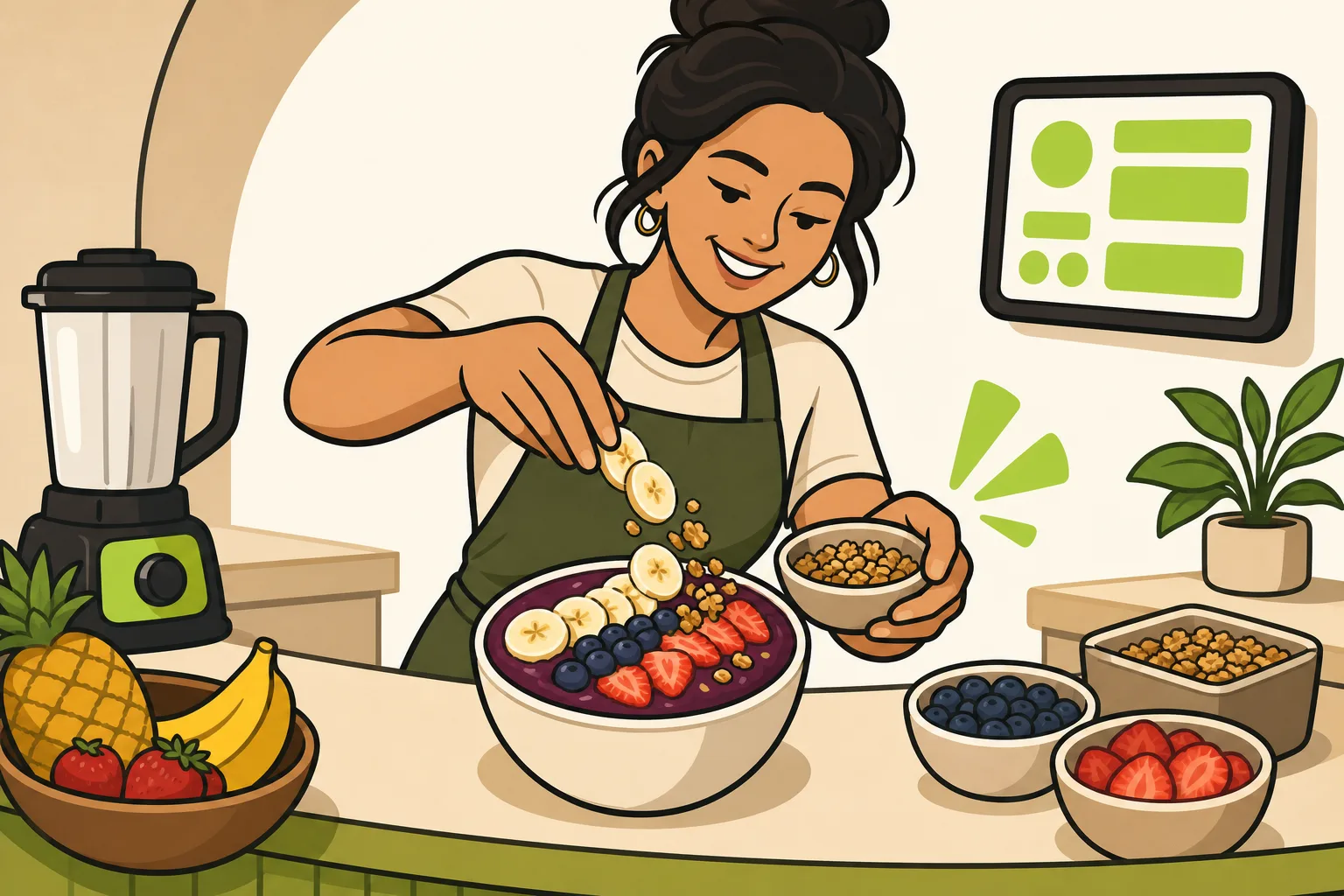
The bowl IS the product demo. Every one of the top-ranked juice bars in our research uses exclusively real photography — top-down acai bowl shots, fresh toppings arranged for visual impact, condensation-heavy bottles. This is not decoration: it's your substitute for a product being on the shelf.
A gallery page organized by bowl type — signature bowls, seasonal specials, build-your-own options — works twice as hard as an embedded Instagram feed. It loads faster, it stays on your domain (so it builds your SEO), and it doesn't disappear if Instagram changes their embed policy.
Catering inquiry page (covered in depth below)
About / Our Story page
This is where certifications live: USDA Organic badge if you have it, local sourcing claims with named farms if you can, founder story, founding year. Specifics win over generics. "Made with organic ingredients from a certified supplier" is weaker than "certified USDA Organic since 2022, sourcing from three Colorado farms."
FAQ page
Juice bar FAQs mostly answer cleanse questions: how long, what do I eat, can I work out. Put these on a dedicated FAQ page — it catches high-intent searchers and reduces your inbound call volume on questions you answer the same way every time.
Why your gallery is your best sales page
Most food businesses treat the gallery as a nice-to-have. For acai bowls, it's mission-critical.
Acai is a visual product. The toppings arrangement, the color contrast between berries and granola, the proportions — this is the thing that convinces a first-time customer to choose you over a competitor they've never tasted either. In our research into the strongest juice bar sites, photography quality was the single strongest visual differentiator between high-performing and low-performing sites. The gap between a shop with editorial-level bowl photography and one with basic phone photos was immediate and significant.
What makes a gallery work harder:
- Organize by category, not just by chronology (signature bowls, seasonal, custom)
- Name each item — a gallery where every image links to a menu item creates a path to purchase
- Include some behind-the-scenes shots — acai prep, topping arrangement, your space — to build familiarity and trust before a first visit
- Keep it on your own site, not just embedded from Instagram, so it loads fast and you own the SEO benefit
For a deeper look at what belongs on your pages, see our juice bar website checklist.
How does the catering page unlock your highest-ticket revenue stream?
This is the most overlooked page in an acai bowl website — and the most financially important.
In our research into top-performing juice bars, the strongest operators ran five revenue channels simultaneously: walk-in orders, online ordering via delivery platforms, a standalone cleanse/subscription program, catering and corporate events, and wholesale partnerships with gyms and offices. The weakest performers were walk-in only. The gap in revenue between these two models is significant.
Walk-in acai bowls average $10–$18 per transaction. Corporate catering bookings — a build-your-own bowl station for a team wellness event, an office breakfast, a gym-client appreciation day — run in the hundreds to thousands of dollars per event. That's the same product at a multiplier most owners never capture because they don't have a page to collect the inquiry.
What your catering page needs:
| Element | Why it matters |
|---|---|
| What you offer (format options) | Pre-made bowls vs. live build-your-own stations — buyers want to know what they're getting |
| Minimum headcount or event size | Sets expectations and filters time-wasters |
| How far you travel / delivery area | Corporate planners need to know if you serve their zip code |
| A contact/inquiry form | The critical piece — this is how the lead reaches you at 2am when they're planning Q3 events |
| Lead time requirements | Corporate events book 2–4 weeks out; tell them this upfront |
| Sample events you've done | Even anonymized ("a 60-person tech company breakfast in Denver") builds credibility |
GrowLocal's contact form covers the catering inquiry channel directly. This is exactly the scenario it's built for: a potential customer lands on your catering page, fills in event size and date, and you follow up the next morning.
If corporate catering is a revenue stream you want to grow, having a dedicated catering page with a working inquiry form is the single highest-ROI page on your site. Refer customers to a booking platform (Square, Ownly, or your own system) for the actual contract and deposit — but the page's job is to capture the lead first.
Key takeaway: Every top-performing juice bar in our research runs catering as a separate revenue channel — and the best ones promote it in their navigation, not buried in a footer link. A single corporate event booking can outperform a full week of walk-in sales. The website page is how you get found when corporate wellness coordinators are searching.
How do you get your acai bowl shop to show up on Google?
Your Google Business Profile and your website work together — you need both.
Your GBP handles "acai bowls near me" map results. Your website handles longer queries: "best acai bowls in [city]," "acai bowl catering [city]." These are higher-intent searches from people already planning to visit or book.
For the website side:
- Write your city name in real page text — not just embedded in a Google Maps iframe.
- Put your city in your page headings. "Acai bowls in Denver" does more SEO work than "Fresh bowls for a healthy lifestyle."
- Your menu page should include item names in text, not just images with no alt text.
See our Google Business Profile guide for juice bars for the full setup. Sites that load fast, have accurate location data, and keep their website and GBP consistent consistently outperform those that rely on social media alone — across GrowLocal's research into local business website patterns.
Frequently Asked Questions About Acai Bowl Business Websites
Do I need a website if I already have an Instagram?
Yes. Instagram drives discovery; your website handles the conversion. Corporate catering inquiries, Google search traffic, and first-time visitors checking your hours all require a real website. Instagram can disappear, change its algorithm, or bury your posts — your website does not.
What's the most important page on an acai bowl website?
For walk-in traffic, the menu page. For revenue growth, the catering inquiry page. In our research into the strongest juice bar sites, the top performers treat catering as a distinct revenue channel with its own dedicated page — and the gap in revenue between those operators and walk-in-only shops is substantial.
Can I use a website builder for my acai bowl shop?
Yes — a fast, mobile-optimized website on a reputable builder will outperform a slow custom site every time. What matters is that it loads in under three seconds, has a working contact form, and accurately displays your menu, hours, and location. GrowLocal builds and hosts static sites specifically for local food and wellness businesses — see juice bar websites for what's included.
Do I need online ordering on my website?
Not necessarily. Most independent acai shops route online orders through DoorDash, Uber Eats, or a third-party platform like Square or Toast. These platforms are better at payments and order management than a standalone website form. Your website's job is to display the menu, build trust, and capture catering leads — not to replace your ordering system.
How do I get my acai bowl shop to rank in Google?
Start with your Google Business Profile — fill it out completely and keep photos current. On your website, make sure your city name appears in your page headings and your address is in real text (not just a map embed). A dedicated catering page, a proper FAQ, and a local About page all contribute to search visibility for category-specific queries that your GBP alone won't capture.
What should my website's call-to-action be?
For most visitors: "View Menu" or "Order Online" (linking to your ordering platform). For catering visitors: a contact/inquiry form. Avoid making "Get a Quote" your primary CTA — acai is an order-now category, and that framing will confuse walk-in customers. Keep the catering inquiry path separate and clearly labeled.
Building a website that works for your acai bowl shop isn't about having every feature — it's about having the right pages doing the right jobs. A gallery that acts as your product demo, a catering page with a working inquiry form, and local SEO that surfaces you to people already searching for what you make. That's the gap between a site that's there and a site that earns.
See what a GrowLocal juice bar website includes — or browse local business websites across trades to see the pattern.