


Updated June 2026
Juice bar catering is a dedicated page on your website — separate from your daily menu — that explains your event offer, lists what you can provide and for how many people, and gives corporate clients and event planners a simple way to send you an inquiry. A strong catering page turns a single walk-in customer's search for "juice bar catering" into a $500–$3,000 booking without any extra foot traffic.
This is based on GrowLocal's proprietary research into top-ranking juice bar websites and catering operator patterns across the U.S.
Below: what the page needs, how to price it, which events to target, and how to make your inquiry form actually convert.
Why does your juice bar need a dedicated catering page?
Most juice bar websites skip a catering page entirely, or bury it in the footer. That's a missed revenue channel.
Walk-in customers spend $10–$18 per drink. A corporate wellness event — fifty employees, a morning smoothie bar, setup and cleanup included — runs $500 to $2,000 at standard per-person catering rates.
Across our research into top-ranking juice bar websites, the strongest competitors run multiple revenue channels: walk-in orders, online delivery, a cleanse/subscription program, catering and corporate events, and wholesale partnerships. Single-channel walk-in-only operators are consistently the weakest performers in the market. The catering page is how you open the second channel without adding a second location.
Key takeaway: A single catering booking replaces 40–120 individual walk-in transactions. A dedicated catering page is the lowest-cost way to capture that demand — the buyer is already searching for you.
The other reason: search. Without a catering page, you're invisible to every event planner typing "juice bar catering [city]" — and they're out there, searching right now.
What should a juice bar catering page include?
Six elements make a catering page convert. Every strong operator catering page we looked at had most of these:
-
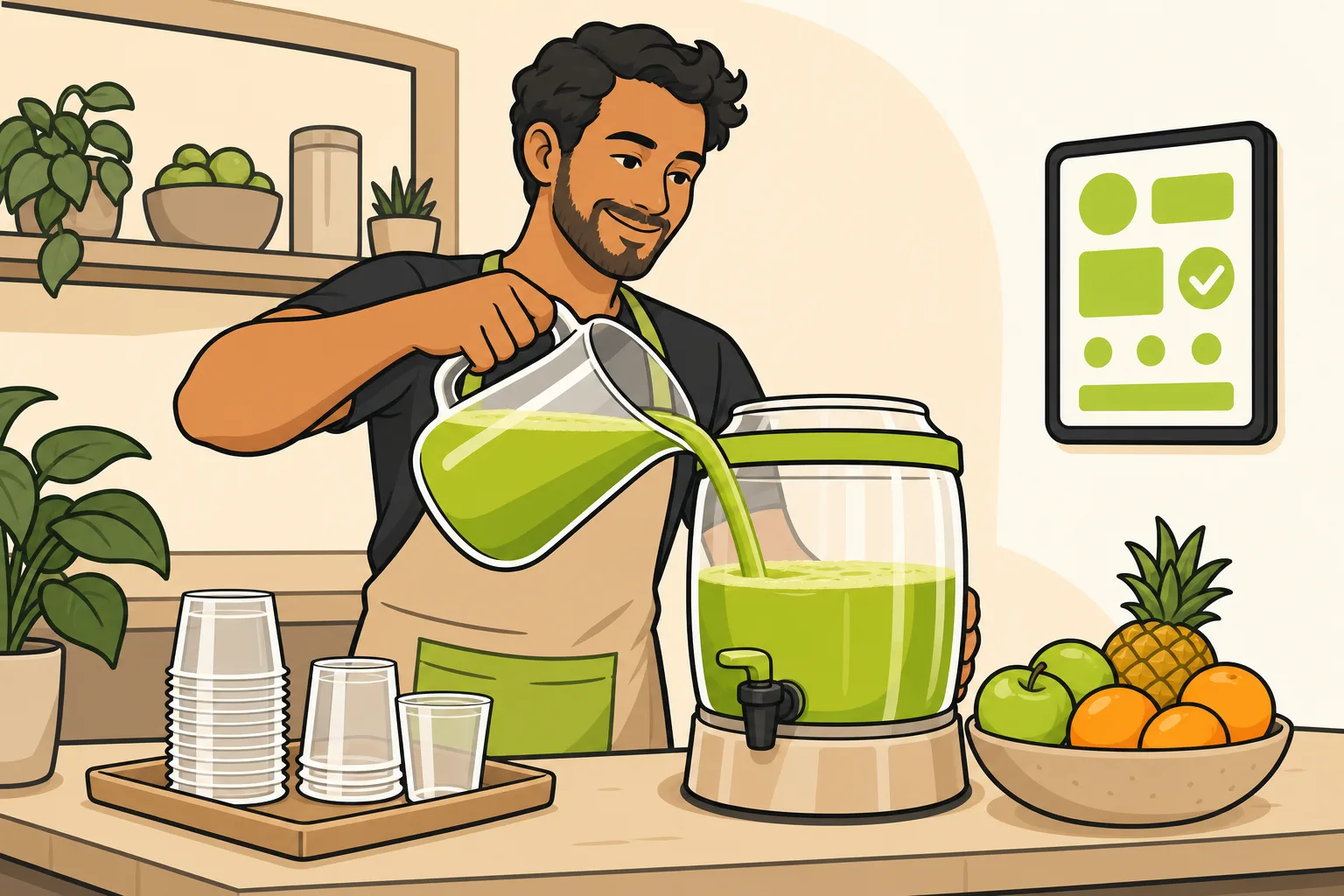
What you offer — A plain-English description of your catering format. Do you bring a pop-up juice bar on-site? Deliver pre-bottled packages? Set up a smoothie station? One paragraph is enough. Be specific: "We set up a staffed smoothie and cold-press station at your location, serve your guests during a 1–2 hour window, and handle setup and cleanup."
-
Event types you serve — List them: corporate wellness events, team meetings, employee appreciation, fitness studio events, bridal showers, birthday parties, community events. A buyer scanning this page should see their event type and feel immediately understood.
-
Capacity range — A minimum and maximum headcount. Buyers need to know whether you can serve twenty people or two hundred. Even a rough range ("we typically serve groups of 15–200") removes the uncertainty that kills inquiries.
GrowLocalSee a finished Juice Bar site — built free, no cardWe build it first. You only pay if you launch it — Starts at $5/mo.See Juice Bar sites we've built -
Pricing signal (not a full rate card) — You do not need to publish per-person pricing, and most catering operations don't. Across our research into catering and food truck businesses, 87–90% hide exact pricing and shift to a "get a quote" CTA — that's the industry norm. What you DO need: a pricing signal so buyers know whether to pursue you at all. "Packages starting at $X" or "priced per person; minimum order applies" is enough to filter unqualified leads without scaring away good ones.
-
An inquiry form — Keep it to five fields: name, company or organization, event date, estimated headcount, and a notes field for special requests or dietary needs. More fields reduce submissions. The actual negotiation — menu specifics, logistics, final pricing — happens over email or phone after the inquiry comes in.
-
Social proof of your catering work — One or two photos of a previous catering setup (a pop-up station at an office, a table of cold-press bottles at a wellness event) outperform a paragraph of description. If you have one sentence of client feedback ("We use them for all our quarterly wellness events" — HR Manager, Denver tech company), add it. If you don't have photos yet, add a section placeholder and plan to shoot your first event.
How should you price juice bar catering?
The industry pattern: per-person pricing with a minimum order. Most juice bar caterers set a minimum in the $300–$500 range and price per head from there. A staffed smoothie station runs $12–$25 per person at typical U.S. rates. Pre-bottled delivery packages can go lower; on-site branded setups go higher.
The per-person model works because your ingredient cost scales with headcount, it's easy for corporate buyers to budget, and the minimum covers your fixed costs (travel, prep, staff time).
On your website: state a starting price that's accurate and defensible. "Packages starting at $400" qualifies the buyer without locking in a final number before you know the details.
What types of events should you target?
The three highest-value event categories for juice bar catering:
| Event Type | Why It Converts | Typical Lead Source |
|---|---|---|
| Corporate wellness events | Recurring — same client, multiple events per year; HR has a budget | "juice bar catering [city]" search, LinkedIn |
| Gym and fitness studio events | Audience is already your customer demographic; low price resistance | Referral, Instagram, local partnership |
| Bridal and celebration events | One-time but high-spend; often found via venue recommendation | "healthy catering [city]", wedding platforms |
Corporate is the most reliable. Companies with 20+ employees run quarterly all-hands events, wellness days, and holiday parties — all of which become repeat catering bookings once you've done one. That's a $500–$1,500 event that recurs three to four times a year from a single relationship.
To reach corporate clients: include "corporate catering" in your first paragraph or event-type list, and add "catering" to your Google Business Profile services — that's where HR managers start their vendor search.
Do you need an online booking system for catering?
No. A contact form is the right tool for catering.
Across our research into local business websites, "Order Now" and "Order Online" are the universal primary CTAs on juice bar sites — but that's for walk-in and delivery orders. Catering is different. It's a negotiated, custom-quote product: the menu varies, the setup logistics vary, the pricing depends on headcount and travel. A buyer cannot self-book a catering order the way they'd add a smoothie to a cart.
What actually works: a short inquiry form on your website that routes to your email. You respond within 24–48 hours with a quote and the conversation starts. Many of the strongest juice bar caterers we looked at use exactly this pattern — a simple inquiry form, a stated response time, and a phone number for larger events.
If you want buyers to check availability first, a free tool like Calendly (linked, not embedded) works alongside your form. But it's optional — the inquiry form is sufficient for most indie juice bars starting out.
GrowLocal's juice bar catering page setup uses a single configurable contact form — no booking widget needed.
How do you market your juice bar catering service?
The most common mistake: adding the catering page but not making it discoverable.
Put catering in your navigation. Top-performing juice bars include "Catering" as a top-level nav item, not buried in the footer. Your catering buyer is often a different person than your walk-in customer.
Add "catering" to your Google Business Profile services list. This gets you into "[city] juice bar catering" searches for free. Takes five minutes once your page is live.
Follow up after every event. A short email after the event ("Thanks for having us — we'd love to come back for your next wellness day") converts a one-time client into a recurring one. It costs nothing and works better than any ad spend.
For broader guidance on what your site needs alongside the catering page, see our juice bar website checklist.
For new juice bar owners building from scratch, our juice bar website guide covers the catering page alongside the other high-impact pages. For how the inquiry-first model works across trades, see the GrowLocal website builder hub. And for the gallery and social-proof elements that support catering inquiries, see our acai bowl business website guide.
Frequently Asked Questions About Juice Bar Catering Pages
What's the minimum information a juice bar catering page needs?
Your event format (what you provide and how), the event types you serve, a capacity range, a pricing signal ("packages starting at $X"), and an inquiry form. Social proof — even one photo of a past catering setup — significantly improves conversion. You do not need a full rate card or a booking system.
How do I handle pricing on my catering page without showing exact rates?
State a minimum booking amount and a general per-person range if you have one. "Packages starting at $400; custom pricing based on headcount and menu" tells the buyer enough to know whether to pursue you without locking you into a fixed rate before you know the event details. Across GrowLocal's research into catering and food businesses, over 87% of catering pages use a "get a quote" model rather than publishing a full price list — you are in good company.
Can GrowLocal build a catering page with an inquiry form?
Yes. GrowLocal sites include a configurable contact/inquiry form — you set the fields (event date, headcount, dietary restrictions, etc.) and leads route to your inbox. The catering page is a standard page type that plugs into the same site as your menu, gallery, and testimonials. There is no live booking widget, which is standard for custom-quote catering anyway.
What events should I focus on when starting a juice bar catering service?
Start with corporate wellness events — they repeat. A company that books you quarterly becomes worth $1,500–$6,000 per year from a single relationship. Gym events come next: your demographic, frequent bookings. Weddings are high-value but one-off — good additions once your calendar has gaps.
Should the catering page be separate from my regular menu page?
Yes — always. Your menu page serves walk-in customers deciding what to order. Your catering page serves event planners deciding whether to hire you. The audiences are different, the CTAs are different (Order Now vs Request a Quote), and the page length and content are different. A single combined page dilutes both.
What's the highest-impact thing I can add to my existing juice bar website?
If you take catering orders but have no dedicated page, build that page first. Every event planner who searches "juice bar catering [your city]" and finds only competitors' pages is a missed booking. A page with an inquiry form starts capturing that traffic the same week it goes live. See our juice bar website guide for the build sequence.