
Updated June 2026
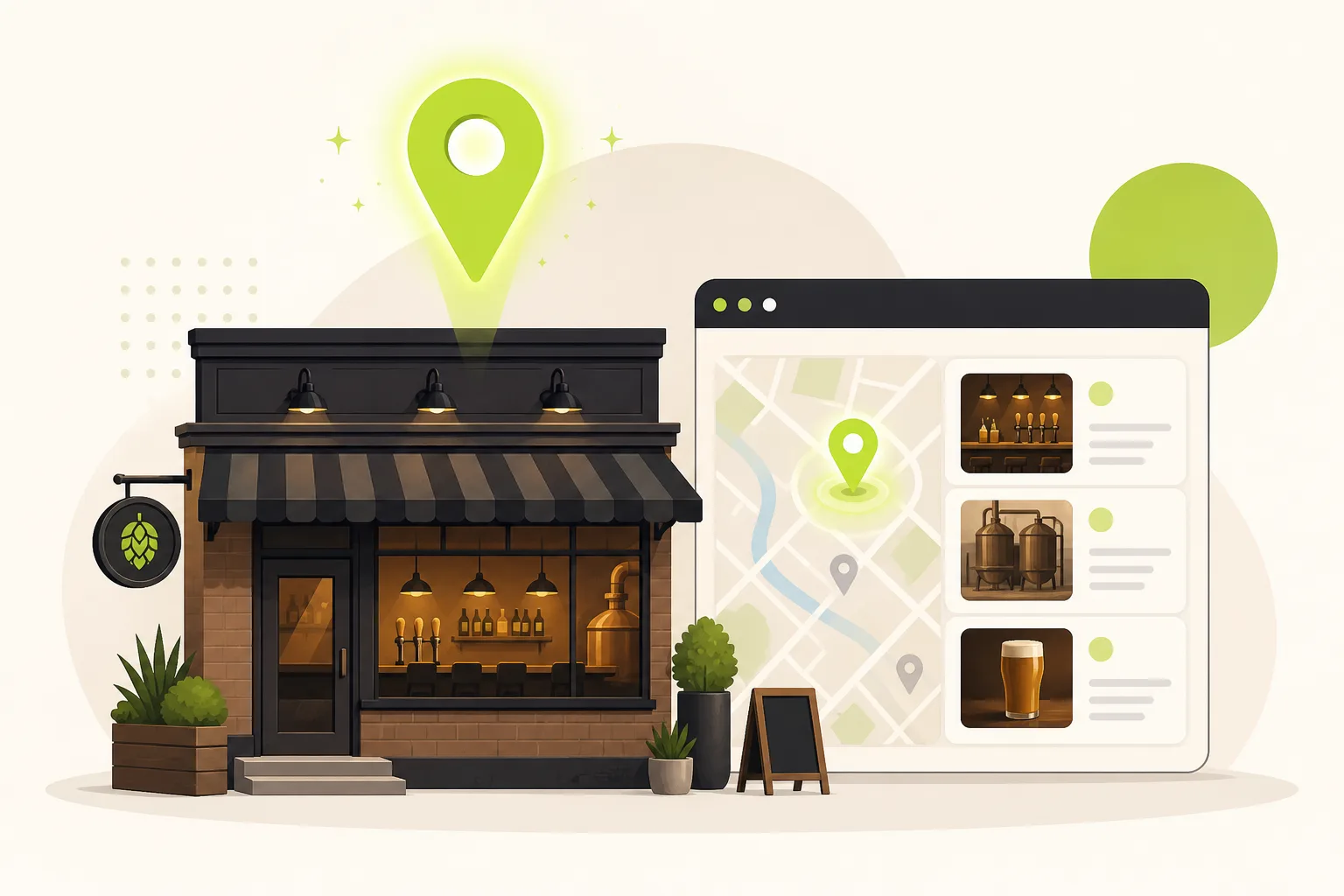
Is Google Business Profile enough for a brewery or bar? No — GBP is essential but it cannot stand alone. A well-optimized GBP gets you found when someone searches "brewery near me." What it cannot do is tell your full story, rank for the dozens of searches that happen before the "near me" moment, or capture a private-event inquiry on your terms. The winning play is GBP doing discovery, your own site doing conversion.
This is based on GrowLocal's proprietary research into top-ranking local business websites, including bars and breweries across Austin, Denver, Phoenix, Charlotte, Nashville, and Tampa.
What does Google Business Profile actually do for a brewery?
GBP is the most important free tool in local search — and for bars and breweries, it handles the things that matter most when someone has already decided to go out tonight.
What GBP does well:
- Shows your hours, address, and phone number in the panel
- Lets searchers read and leave Google reviews
- Surfaces your tap list if you update the menu feature
- Posts can announce events, new releases, or specials
- Photo uploads show your taproom vibe
- Responds to "brewery open now near me" queries directly in Maps
For the spontaneous drinker deciding where to go in the next hour, a complete GBP profile answers the question. That is real value.
But here's the gap: most people searching for a brewery aren't searching "brewery near me" right now. They're planning a birthday party, looking for a patio venue, or wondering if you have food. Those searches happen on Google, but they don't surface your GBP panel — they surface pages.
What can't Google Business Profile do for a bar or brewery?
GBP is a panel, not a page. It has hard structural limits that matter for this trade.
| Capability | Google Business Profile | Your own website |
|---|---|---|
| Rank for "brewery with private event space [city]" | No — GBP is local pack only | Yes — a dedicated page can rank |
| Show your full tap list with style + ABV notes | Limited menu feature, no layout control | Full page, CMS-editable, your design |
| Capture a private-event inquiry with a form | No form, only phone/message | Quote or inquiry form, 24-hr response |
| Tell your founding story with photos | Short "from the business" description only | Full About page, photos, your narrative |
| Build an events calendar with past archives | Posts expire and stack poorly | Dedicated events section, date-sorted |
| Control your visual brand — fonts, colors, can art | Zero control, Google's template | Complete control |
| Rank for "what to do in [neighborhood] weekend" | No | Yes, with good content |
| Show customer review quotes with full attribution | Redirects to Google — they can leave | Curated named quotes on your homepage |
| Appear in AI search citations (Perplexity, ChatGPT) | Rarely | Yes, with structured content |
Across our research into top-ranking local business websites, every bar and brewery had a standalone site. None relied on GBP alone. The brands that dominated their city went deep — tap pages, events, private-event inquiry flows — and used GBP as the first-click entry point.
Where does GBP fall shortest for bars and breweries specifically?
Private events. This is the highest-ticket conversion in the category. A company holiday party, a birthday buyout, a bachelorette reservation — these are four-to-five-figure bookings that no one commits to via a Google message. They need a dedicated page with photos, capacity details, and a way to submit a real inquiry. GBP cannot deliver that funnel.
In the competitor research behind our platform, private-event booking is the highest-ticket revenue line — yet a significant share of bar and brewery sites give it no dedicated section or call to action. Your own site, done right, beats competitors who have stronger GBPs but weaker owned destinations.
Tap list authority. GBP's menu feature lets you list beers, but the layout is Google's — no style control, no ABV or tasting notes in any consistent format, clunky updates. Your own tap list page is shareable, CMS-editable, and ranks for "[brewery name] tap list" searches.
Events depth. GBP posts expire and don't build SEO value. A structured events page archives past events, ranks for "[city] trivia night" or "live music [neighborhood]" over time, and gives you a URL to push to your email list.
What does GrowLocal actually build for bars and breweries?
Our bar and brewery website package includes the pages that do the conversion work GBP can't:
- Tap list page — CMS-editable; update it without a developer
- Events section — trivia nights, live music, food truck dates
- Private events page — contact form with a 24-hour response promise (no live booking widget, but a fast-response form converts well when paired with quick follow-up)
- Gallery — real taproom and can-art photography
- Manual testimonial quotes — 3–5 named reviews from Google or Yelp, displayed on your homepage
- About / Story page — founding narrative, values, neighborhood identity
- Hours + location — above the fold, maps link and tap-to-call phone
- Fast static hosting — under 1 second on mobile
Key takeaway: Across our research into top-ranking local business websites, the majority of bar and brewery homepages show zero trust signals — no reviews, no press quotes, no awards. A site with even 3–5 named review quotes and a clear "book your party" inquiry form beats the category average outright.
We don't build in online booking platforms (Resy, OpenTable, Tock) — if you need live table reservations, you'd wire an existing platform link from your site. What we do build is the structure that converts: strong tap-list pages, event archives, and private-event inquiry flows.
For a broader look at what sets local business sites apart, see our website breakdown across local trades.
GBP vs. your own website: which drives more value?
They do different jobs. Running only GBP is like having a great listing on Google Maps with no destination to send people. Running only a website with no GBP means missing the "brewery open near me" local pack entirely.
The math is simple:
- GBP alone: local pack for "near me" searches. You miss every other query.
- Website alone: long-tail ranking and brand narrative. Invisible in Maps.
- GBP + owned site: both — with a destination to convert private-event traffic and build SEO authority on your terms.
No top-ranked brewery in Austin, Denver, Phoenix, Charlotte, Nashville, or Tampa operates without both.
Does the GBP + website combo work for smaller bars, not just breweries?
Yes — especially when you're not yet a household name. A well-known brewery with 1,200+ Google reviews can coast on GBP for foot traffic. A newer bar competing with established players needs owned content: the tap list page that ranks, the private-event page that converts, the story page that earns repeat visits.
Bars similar to yours — see restaurant websites and coffee shop websites for the same dynamic in adjacent categories — accelerate discovery faster when they build an owned presence rather than waiting for review count alone.
If you want to see what the full build looks like, the GrowLocal bar and brewery website page walks through the structure.
Frequently Asked Questions About Brewery and Bar Websites
Does a brewery really need a website if it has a great Google profile?
A complete GBP handles high-intent "near me" traffic well. But it can't rank for searches that happen before someone picks a destination — "brewery with private event space Denver," "brewery with patio [city]," "best local tap list near me." Those queries surface pages, not GBP panels. A website captures that upper-funnel traffic and gives you a conversion destination for private events.
What does GBP do that a website can't?
GBP puts you in the Google Maps local pack — the three-result block that shows hours, reviews, and distance when someone searches "brewery near me." That placement is invaluable. A standalone website doesn't appear there. You need both: GBP for the local pack, your site for everything else.
How do bars and breweries handle private-event inquiries online?
Across our research into top-ranking local business websites, the strongest bar and brewery sites dedicate a full page to private events with capacity details, photo galleries, and an inquiry form. GBP's messaging feature is too friction-heavy for high-ticket commitments — people booking a $2,000 buyout need a real form with a quick human response, not a Google message thread.
Can I just post events to GBP instead of maintaining an events page?
GBP posts help with visibility, but they expire and don't build long-term SEO value. A structured events page on your own site archives past events, ranks for "[your city] trivia night" or "live music [neighborhood]" searches over time, and gives you a shareable URL you can push to your email list and social. It compounds; GBP posts don't.
Do bars and breweries need to show pricing on their website?
No — and they don't. Based on our analysis of top-ranking local business websites, beer prices are hidden on every competitive bar and brewery homepage analyzed — pricing surfaces on order pages or menus, never on the homepage. The one exception is beer-club or mug-club membership pricing, where showing a specific number drives subscription conversion.
Is it worth having a website if we're mainly a neighborhood bar?
Yes. A neighborhood bar's best customers are people who've heard about it but haven't been yet. "Good neighborhood bar [city neighborhood]" is a real search. A simple site with your hours, a few customer quotes, your story, and a tap list gives that searcher a place to land — and gives you a way to show up when a corporate event planner is looking for a venue for 40 people.
Can I build a brewery website myself or should I hire someone?
DIY builders (Squarespace, Wix) work but require ongoing maintenance — you're the developer. Done-for-you services like GrowLocal's bar and brewery package give you a fast site with a CMS for tap lists and events, without ongoing technical overhead. The real question is whether your time is worth more updating blocks or running your taproom.
How long does a brewery website take to rank on Google?
New sites typically see local ranking movement within 60–90 days for brand-name searches, and 3–6 months for competitive keyword pages. Tap list and private-event pages rank fastest because they answer specific queries with low competition. Consistent GBP updates accelerate both.