


Updated June 2026
A catering website needs five things to turn event searches into inquiry submissions: real food photography, event-type pages (Weddings, Corporate, Private), a qualifying inquiry form, visible trust signals, and a short brand promise that answers "why you" in one line. Every other element is secondary. This is based on GrowLocal's proprietary research into top-ranking catering websites across six major US markets.
The caterers getting the most inquiries from their websites aren't the ones with the fanciest design tools. They're the ones who understand that a catering website is a conversion machine — not a brochure. Below is exactly what that machine looks like, section by section.
What does a catering website need to get inquiries?
Your catering website has one job before a visitor leaves: move them from "maybe" to "I need to reach out." Based on our analysis of top-ranking catering websites from Austin to Tampa, the sites that accomplish this share a consistent structure:
The non-negotiables:
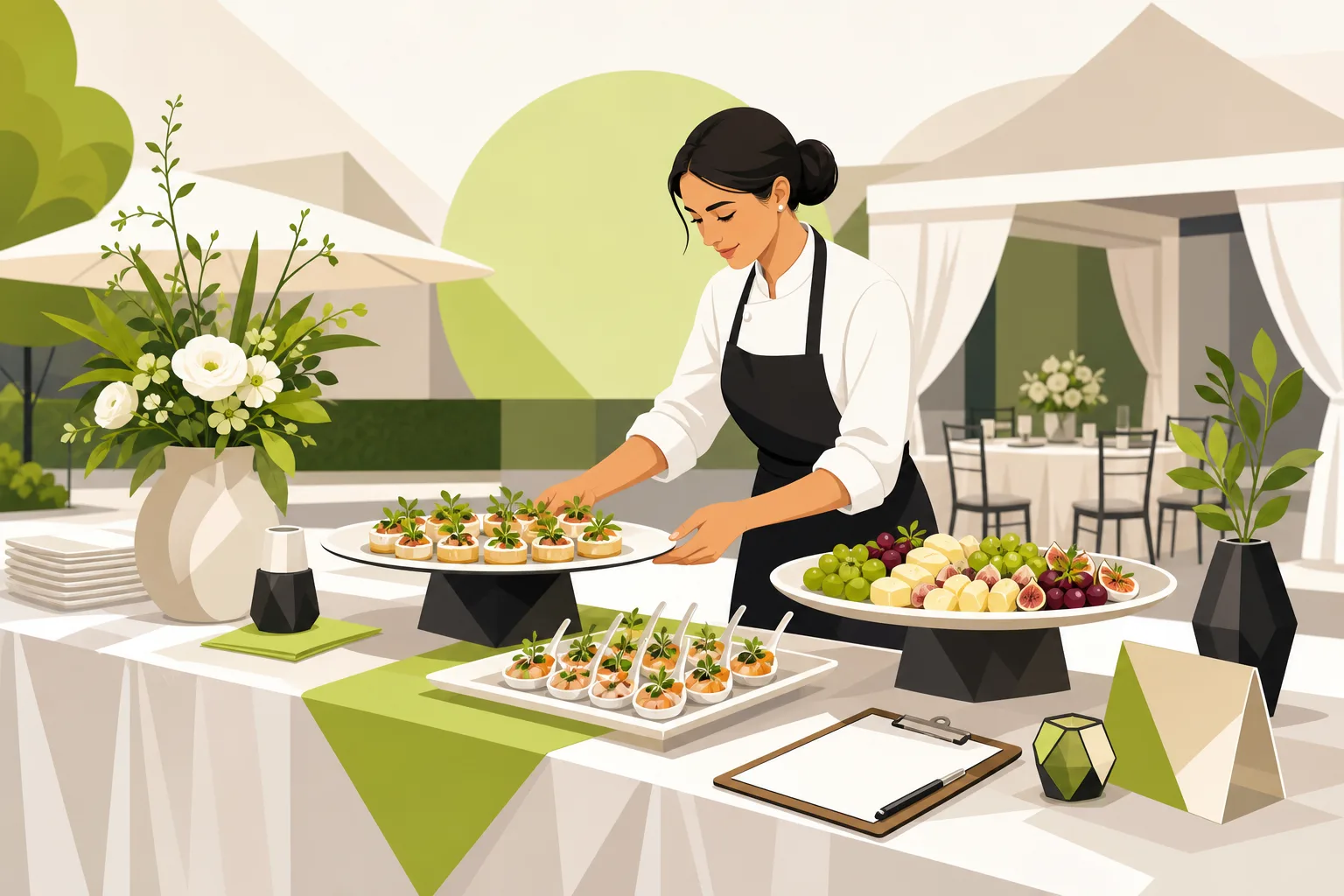
- Real food and event photography (not stock). Plated-food close-ups, grazing boards, full table settings, and event atmosphere shots — in that priority order.
- A short brand promise in the hero. One sentence that answers "why this caterer." Not "Welcome to [Name] Catering." Something with actual personality: "we start with yes," "it's all about hospitality," "RAISE THE BAR."
- Event-type segmentation near the top. Weddings, Corporate, and Private/Social are three completely different buyers with different timelines, budgets, and anxiety points. Each deserves its own page with audience-specific proof.
- An inquiry form that qualifies leads. At minimum: event date, guest count, event type. These fields save your team four back-and-forth emails before every consultation.
- Years in business, stated somewhere prominent. In catering, longevity is the #1 trust signal — across our research into top-ranking local business websites, years-in-business is the single most consistent homepage trust element in the food and events category.
The differentiators almost nobody uses:
- A live Google star rating with review count in the hero or just below it. Not a single catering website we analyzed surfaces this — across GrowLocal's proprietary local-business website research, not one of the top-performing catering sites displays a live star rating on the homepage. This makes "4.9 ★ · 200+ Google reviews" an instant field-wide differentiator — one you can add today.
- A 3-step process strip. "Inquire → Tasting → Your Event." Only the strongest operators include this, and it directly reduces planning anxiety for first-time catering buyers.
- Dated testimonials. Month and year visible. Recency signals that quality is consistent, not just historical.
- Event-specific inquiry CTAs. "Request a Wedding Quote" converts better than "Contact Us." The field has left this completely open.
Key takeaway: Not a single homepage in the catering competitor set we analyzed displays a live Google star rating or review count. Across GrowLocal's proprietary local-business website research, years-in-business is the dominant trust signal — but surfacing an actual "4.9 ★ · 200+ reviews" badge is an available differentiator the entire field has missed. See our full trust-signal data.
How should a catering website handle the three types of buyers?
The biggest structural mistake on catering websites is treating all event buyers as one audience. They're not:
| Buyer type | Timeline | Primary anxiety | What they need on your site |
|---|---|---|---|
| Wedding couple | 6–12 months out | "Can they handle our day?" | Gallery-first, testimonials with dates, platform badges (The Knot, WeddingWire), footer phone |
| Corporate buyer | Days to weeks out | "Will they show up, on time, for 40 people?" | Credentials, guest count capacity, phone-in-hero, recurring-lunch framing |
| Private party host | 4–12 weeks out | "Will this be worth the cost?" | Menu options, "Free Consultation" CTA, process strip, per-person framing if approachable |
Each of these buyers should land on a page that speaks to their specific situation. A wedding buyer landing on a corporate-forward site bounces. A corporate buyer landing on a wedding-photography-forward site starts Googling again. The solution isn't design — it's segmentation: three distinct pages (Weddings, Corporate, Private Parties), each with tailored proof, gallery, and CTA language.
The best catering websites we analyzed segment these event types in the first scroll — three to six cards near the top of the homepage, each linking to its own page. That architecture is doing real conversion work before a visitor even sees your inquiry form.
What should go on a catering website's menus page?
For most catering buyers, the menus page is the research step that precedes the inquiry. They want to confirm you can feed their crowd — the cuisine type, serving format, and scale. The menus pages that performed best in our research were:
- Organized by format first (buffet, plated, cocktail reception, boxed lunch, grazing boards), then by cuisine within each format.
- One sub-page per menu format rather than one long scrollable list. A corporate buyer searching "boxed lunch catering" lands directly on that page, not on a wall of 14 menu categories.
- Real food photography on each option. A menu that lists "Seasonal Tasting Menu" without a photo is an opportunity missed. Food is a visual product.
- An inquiry CTA at the bottom of each menu page. "Inquire About This Menu" or "Get a Quote for the Taco Bar" does real work — far more than a generic footer contact link.
On pricing: the dominant pattern across top-ranking catering sites is full opacity — no ranges, no starting-at figures. That's the right default for premium and wedding-led positioning. There's one proven alternative: the menu-first funnel, where per-person pricing is shown upfront (grazing tables starting at $25/person, Italian menus at $60–$70/person, American buffet packages ranging $500–$3,200+ by guest count) and the primary CTA is "View Menus" instead of "Inquire Now." That model attracts a different buyer: price-sensitive, fast to decide, less interested in a custom consultation. The decision between the two models is covered in depth in Should Your Catering Website Show Prices?.
Does a catering website need a gallery?
Yes — and it should appear much earlier than it typically does. Despite photography being the single most persuasive element in a catering decision, galleries are consistently buried mid-page or below on most catering websites. That's the visual equivalent of hiding your best dishes in the back of the menu.
What to photograph, in priority order:
1. Plated food close-ups (your strongest appetite trigger)
2. Styled grazing and charcuterie boards
3. Full table settings (this is what wedding buyers picture)
4. Event atmosphere — tented receptions, corporate lunch rooms, private party tables
5. Staff actively serving
6. Raw ingredients and prep (farm-to-table positioning)
What to avoid: stock photography. Across our analysis of top-ranking local business websites, real photography was essentially universal in food categories. One catering company we analyzed — despite being the oldest brand in their city, founded in the 1980s — relies on stock plates, and it visibly undermines 40+ years of credibility. For a caterer trying to command $60+ per person at a wedding, Pexels plates telegraph something is wrong.
One good set of professional food photos — 20 to 30 shots — does more conversion work than any redesign. If you don't have them, that's the first investment before you change anything else.
What does a catering inquiry form need?
The inquiry form is the only conversion event on a catering website. Everything else — photography, event pages, menus, testimonials — exists to move the visitor toward this one action.
Minimum qualifying fields:
- Event date (filters out far-future tire-kickers and surfaces urgent leads)
- Guest count (pre-qualifies for scale and pricing)
- Event type (routes the inquiry to the right follow-up)
- How did you hear about us? (essential for attribution)
Fields that reduce your workload significantly:
- Budget range (optional but powerful — prevents quoting a wedding on a boxed-lunch budget)
- Venue (helps you confirm service area and logistics)
- Preferred contact method
CTA copy that works: "Start Planning," "Free Consultation," "Inquire Now," "Get Started." These imply forward motion. "Contact Us" implies nothing.
What almost nobody does: event-specific CTAs. "Request a Wedding Quote" and "Get Corporate Pricing" outperform generic "Contact Us" buttons — and not a single catering website we reviewed in our research actually does this. The field has left a significant conversion upgrade completely untouched.
What trust signals does a catering website need?
Trust is the decisive variable in catering, because the buyer is handing you their entire wedding reception or their company's holiday party. The hierarchy of trust signals that consistently appears on high-performing catering websites:
Tier 1 — what everyone has (table stakes):
- Years in business (near-universal — 9 out of 10 catering sites we analyzed lead with longevity)
- Named testimonials with dates (month and year visible; undated testimonials are significantly weaker)
- Real food photography (not stock)
Tier 2 — what the best sites add:
- Review platform badges (The Knot, WeddingWire, Google) — only the strongest operators in our research display these; it's a fast credibility upgrade for wedding-focused caterers
- Quantified social proof: "500+ events served," "40,000+ meals catered" — only a handful of the top operators have this, but it's instantly persuasive
- Named venues or "preferred caterer at [venue]" claims
Tier 3 — the free gap the whole field has missed:
- A live Google star rating with review count. Not a static "4.9 stars" badge you typed in — an actual current count displayed on the homepage. Across GrowLocal's proprietary research into top-ranking catering websites, not one homepage surfaces this. If you have 100+ Google reviews at 4.7+, displaying that number in your hero section out-trusts every catering website competing for the same events.
The same trust-signal gap shows up across adjacent service categories. We analyzed the same pattern in food truck websites and event planning websites — the review-count gap is consistent across food and events verticals.
Common mistakes that cost catering websites leads
A hero that wastes its real estate. "Welcome to [Name] Catering" is the weakest possible opening. "Catering for Weddings, Corporate Events, and Private Parties" is just a meta description pasted into the headline. One memorable sentence — a real brand promise with personality — does more than three keyword-packed sentences.
No process strip. The inquiry-to-tasting-to-event sequence is obvious to a caterer who has done it a thousand times. For a first-time buyer hiring a caterer, it's opaque and mildly anxiety-inducing. A 3-step visualization — "Inquire → Tasting/Consultation → Your Event" — removes that friction. Only the top operators in our research include it; most don't.
Navigation that's a sitemap. Five to six items is the right nav length; anything over that gets overwhelming. A persistent "Inquire" or "Start Planning" button that stays visible as visitors scroll is more valuable than a seventh nav item.
Missing the corporate buyer entirely. Wedding leads get all the design attention. Corporate buyers — the ones booking recurring monthly lunches, quarterly team events, and the December holiday party — often land on a wedding-photography-forward site and bounce because nothing speaks to their needs: fast turnaround, headcount flexibility, invoicing, and a phone number they can call. A dedicated corporate page, even a lean one, significantly improves conversion for that segment.
Phone number placement that mismatches your audience. If a meaningful share of your revenue is corporate, your phone number belongs in the hero. Corporate buyers with a time crunch want to call, not fill out a form. Premium wedding-focused operators can keep the phone in the footer — wedding buyers are doing weeks of research and aren't ready to call yet. Know which client drives your business and position accordingly.
You can see how we solve this at GrowLocal's catering website builds — including the event-type page structure, inquiry form with qualifying fields, gallery layouts, and mobile-fast static hosting built for how catering buyers actually shop. We also cover the full range of local business websites we build across adjacent categories.
Frequently Asked Questions About Catering Websites
What pages does a catering website need?
The core pages every catering website needs are: Home, Menus (ideally with sub-pages by format or cuisine), event-type pages (Weddings, Corporate, Private/Social), Gallery, About, and a Contact/Inquiry page. An FAQ page is the most common gap — almost no catering websites have a dedicated one, despite it being a cheap way to pre-qualify leads and rank for question-based searches.
How much does a catering website cost?
Catering website costs range from $5/month for a done-for-you subscription model (what GrowLocal offers — hosting starts at $5/month and our published band tops out at $14, with the exact rate depending mostly on your finished site's working features) to $3,000–$8,000+ for a custom agency build. The bigger cost variable is photography — professional food and event photos run $500–$2,000+ and are more important to conversion than the website platform itself. See our full breakdown in how much does a catering website cost.
Should a catering website show prices?
The dominant pattern in the catering industry is full pricing opacity — 9 out of 10 catering sites hide prices entirely and funnel every visitor to a consultation or inquiry form. That's the right default for premium and wedding-led positioning. The alternative (showing per-person pricing) works well for caterers competing on approachability and volume, where a menu-first funnel pre-qualifies leads before the first call. The decision depends on your positioning strategy, not a universal rule.
What makes a catering inquiry form effective?
An effective catering inquiry form includes at minimum: event date, guest count, and event type. These three fields eliminate four back-and-forth emails before the first consultation. Budget range and preferred venue are useful additions. The CTA copy matters too — "Start Planning" or "Free Consultation" dramatically outperforms "Contact Us" in the catering context.
Do catering websites need a gallery?
Yes, and the gallery should appear much earlier than it typically does on most catering websites. Real food photography — plated close-ups, grazing boards, full table settings — is the primary conversion driver in catering. It should be accessible within the first two scrolls, not buried below testimonials and the process strip. If you only have stock photos right now, scheduling a professional shoot is the highest-ROI investment you can make before updating your website.
How does a catering website help with local SEO?
A catering website gets found locally through a combination of event-type pages (Weddings, Corporate, Private Parties), menu format pages ("boxed lunch catering," "taco bar catering"), FAQ pages that answer searcher questions, and consistent NAP (name, address, phone) information. The biggest local SEO gap in the catering category: most competitors have fewer than 15 indexed pages. Adding venue-type landing pages, seasonal sub-pages, and an FAQ section can build a site to 30–50+ indexed pages, dramatically increasing surface area for location-based searches.
Is a catering website necessary if I'm already on The Knot or WeddingWire?
Yes. Platforms like The Knot and WeddingWire generate leads, but they also charge per-inquiry fees or subscriptions, and you're competing directly with every other caterer on the platform on the same page. An owned website converts visitors who found you anywhere — a referral, a Google search, a venue recommendation, a social share — without a platform taking a cut. It's also the only place where your brand, photography, and positioning aren't constrained by a marketplace template. We cover the full owned-vs-marketplace tradeoff in Is The Bash Worth It for Caterers?.