

Updated June 2026
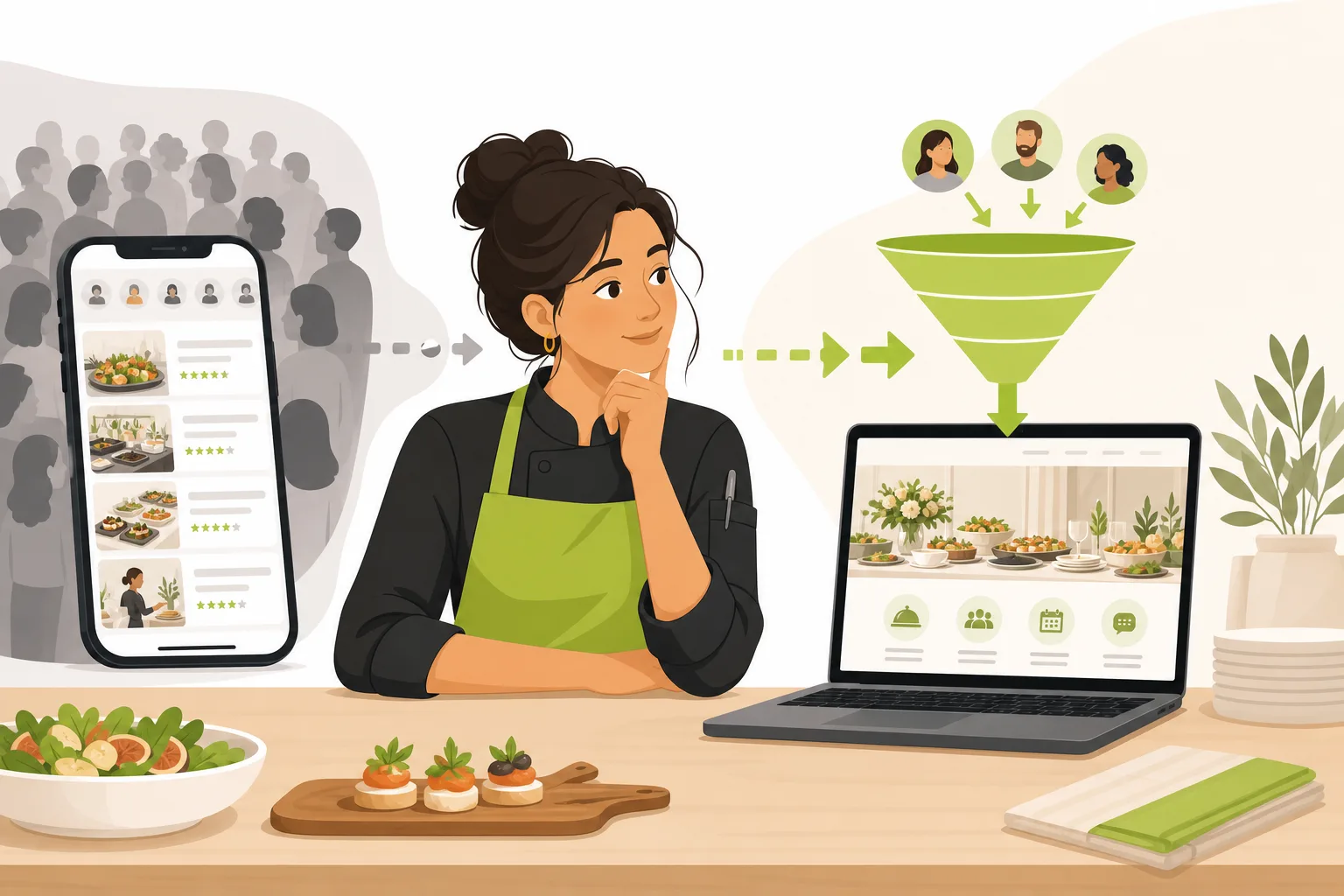
Caterers who rely on The Bash or Thumbtack for new business pay a structural tax on every event — one that compounds as they grow. The honest math: marketplace platforms charge per-lead fees, commission on bookings, or subscription access, and those costs never go away. A caterer with their own website converts the same inquiry at zero marginal cost. This post breaks down exactly how the fee models work and when owning your pipeline pays off.
This analysis is based on GrowLocal's proprietary research into top-ranking local business websites, including catering competitors across Austin, Denver, Phoenix, Charlotte, Nashville, and Tampa.
How do The Bash and Thumbtack actually charge caterers?
Neither platform is free. The fee structures differ, but the direction is the same: you pay for access to buyers you could otherwise reach organically.
The Bash (formerly GigMasters) is a marketplace built around event entertainment and services, including catering. It operates on a subscription-plus-commission model. Caterers pay a recurring membership fee to list their business, and The Bash charges a service fee — commonly reported around 8–10% — on confirmed bookings made through the platform. Because the membership recurs regardless of bookings, you pay even in slow months.
Thumbtack shifted away from flat subscription pricing several years ago toward a pay-per-lead model. Caterers bid for placement in search results and are charged when a customer views their quote or responds to their profile — often before any booking conversation happens. Lead prices vary by market, event type, and competition, but reports from service providers consistently put individual catering leads in the $20–$60+ range. The key structural issue: Thumbtack sells the same lead to multiple vendors simultaneously. You pay for a shot, not a booking.
What does the cost-of-leads math actually look like?
Here is a direct comparison for a caterer booking 40 events per year at an average value of $3,000 per event ($120,000 in revenue):
| Channel | Cost model | Estimated annual spend | Cost per booked event |
|---|---|---|---|
| The Bash | Membership + ~9% commission | ~$1,200 membership + ~$10,800 commission = ~$12,000 | ~$300 |
| Thumbtack | Pay-per-lead ($30 avg), ~25% close rate | ~160 leads × $30 = ~$4,800 | ~$120 |
| Own website (SEO + Google) | Hosting + occasional ad spend | ~$500–$1,200/yr | ~$13–$30 |
| Own website (GrowLocal) | Flat subscription | Flat monthly fee | Marginal cost near $0 |
Caveats: The Bash commission figure is based on commonly reported rates — verify in their vendor agreement. Thumbtack lead costs vary by market; high-competition metros routinely push above $50. Own-website cost assumes the site already exists.
The inflection point: once your site generates even a handful of direct inquiries per year, you have recovered its cost. Every inquiry after that is pure margin improvement.
Why do shared leads hurt more than the price tag suggests?
When Thumbtack sells your contact information to a prospective wedding client, it typically sells that same inquiry to two to four other caterers simultaneously. You race to respond first, and the prospect knows they have options. This structurally depresses close rates and creates pressure to discount.
With your own site, an inquiry arrives after the prospect has read your menus and looked at your gallery. They have already self-selected. Close rates on direct website inquiries are structurally higher.
In the competitor research behind our platform, across 10 catering sites in six US markets, every single one uses an inquiry or quote form as the terminal conversion action — never a direct-booking widget. The standard framing is "Free Consultation" or "Start Planning," and it works cleanly through a simple contact form on your own site.
Do caterers need a website if they're already on The Bash or Thumbtack?
Yes — for three reasons that compound over time.
1. You don't own your reviews or reputation on a marketplace.
If The Bash changes its algorithm, raises its commission, or removes your listing, your review history stays on their platform. A Google Business Profile and your own website build reputation assets you actually own.
2. Marketplace presence doesn't help your direct Google ranking.
When someone searches "wedding caterer Nashville" or "corporate catering Charlotte," a well-optimized website appears in those results. A Thumbtack listing may also appear — but it's their page, not yours.
3. The fee model scales against you.
At low volume, marketplace fees are manageable. At 60–100 events per year, the commission line in your P&L looks significant. Across our research into top-ranking local business websites, 9 out of 10 catering competitors in the markets we analyzed operate sites with inquiry forms — the successful ones are not waiting for marketplace referrals alone.
Key takeaway: A caterer paying Thumbtack's pay-per-lead model and The Bash's commission simultaneously can easily spend $10,000–$15,000 per year on lead acquisition for $120,000 in revenue — a 8–12% tax on top of food and labor costs. A direct website inquiry costs effectively nothing after the site is built.
What does a caterer's own website actually need to compete?
Catering is a high-trust category. Buyers — especially wedding clients — comparison-shop for weeks. Your site needs to do the convincing before the inquiry arrives.
The strongest catering sites in the competitor research behind our platform consistently include:
- A short brand promise and city authority in the hero — not a generic welcome. "Denver's fully custom catering for weddings, corporate, and private events" does more work than three paragraphs of description.
- Event-type segmentation above the fold — Weddings / Corporate / Private Parties as distinct pathways. Corporate clients want a phone number and credentials; wedding clients want a gallery and platform badges.
- Real food photography — across our research, real photography is non-negotiable at the premium level. The one site relying on stock imagery is visibly the weakest despite the longest operating history in the set.
- Named and dated testimonials — only 2 of 10 caterers in our analysis display review-platform badge rows (The Knot, WeddingWire, Google). A site showing a visible star rating and review count immediately out-trusts the entire competitive field.
- A fast quote/contact form with event date, guest count, and event type fields. Wedding leads book 6–12 months out; corporate leads often need turnaround in days.
For a full breakdown of what a catering website needs to book more events, see our catering website guide — it covers menus, gallery structure, and inquiry-form setup.
GrowLocal catering sites include quote/contact forms, manually-entered testimonials, photo galleries, service and menu pages, FAQ sections, and fast static hosting with SEO fundamentals. The conversion model is a direct inquiry — a fast quote form with a 24-hour-response promise, not live calendar booking. For most custom-menu caterers, that is the right flow.
Is The Bash worth it at all for new caterers?
The Bash does one thing a new website cannot: it provides immediate access to an active buyer pool. For a caterer with zero online presence and zero reviews, paying for marketplace leads in the first 6–12 months makes sense. It generates cash flow and testimonials while the organic presence builds.
The mistake is treating it as permanent. Use marketplace leads early to collect testimonials and build gallery content, then invest in a site. Once the site generates direct inquiries, paying $30–$50 per shared lead has no remaining value.
The same economics apply across adjacent event categories. DJ businesses face identical math on The Knot and GigSalad, and the event planning category shows the same organic-vs-marketplace inflection. For all 90+ local service categories, the GrowLocal website hub covers how direct inquiry sites work.
How to get started with a catering website that converts
The conversion path on a well-built catering site mirrors what the best operators in our research already use: hero → event-type cards → gallery → testimonials → inquiry form. It is not complicated, but every element has to be right.
If you are ready to stop paying per lead, see what a GrowLocal catering website includes and how the inquiry form is set up. You get a static-hosted, SEO-optimized site with your menus, gallery, testimonials, and a quote form — no commission, no per-lead charges.
Frequently Asked Questions About Catering Websites and Marketplace Fees
How much does Thumbtack charge caterers per lead?
Thumbtack's lead prices vary by market and event type, but caterers commonly report individual lead costs in the $20–$60+ range. Because Thumbtack sells the same lead to multiple vendors, close rates are structurally lower than on a direct inquiry from your own site. You pay for the contact, not the booking.
Does The Bash take a commission on bookings?
Yes. The Bash uses a subscription-plus-commission model — caterers pay a recurring membership fee plus a service fee (commonly reported around 8–10%) on confirmed bookings made through the platform. The membership recurs even in months with no bookings.
Do I need a website if I'm already getting leads from The Bash?
Yes. Marketplace listings do not build your Google ranking, you do not own your review history on their platform, and the fee model scales against you as volume grows. 9 out of 10 catering competitors in our analysis of top-ranking local business websites have their own site with an inquiry form — the strong ones are not waiting for marketplace referrals alone.
What trust signals do caterers need on their own website?
The biggest gap across the catering sites we analyzed: not a single one surfaces a live star rating or Google review count above the fold. Dated, named testimonials are the closest any competitor gets. A site showing a "4.9 ★ · 137 Google reviews" count instantly out-trusts the entire field. After that: years in business, event-type segmentation, real food photography, and one quantified metric ("500+ events served").
How is a catering website different from an online booking system?
A catering website with a quote/contact form is a direct inquiry channel, not a live booking calendar. The form captures event date, guest count, and event type — then you follow up. For custom-menu catering where every event needs a consultation and a custom quote, this is the correct conversion flow. High-volume boxed-lunch operations may want to pair the site with a separate ordering tool.
Do I still need Google Business Profile if I have a website?
Yes — they are complementary. Google Business Profile controls your map-pack appearance. Your website controls organic ranking below the map and gives buyers a place to land. Cover both discovery layers. For the GBP-only question, see Is Google Business Profile Enough for a Caterer?