


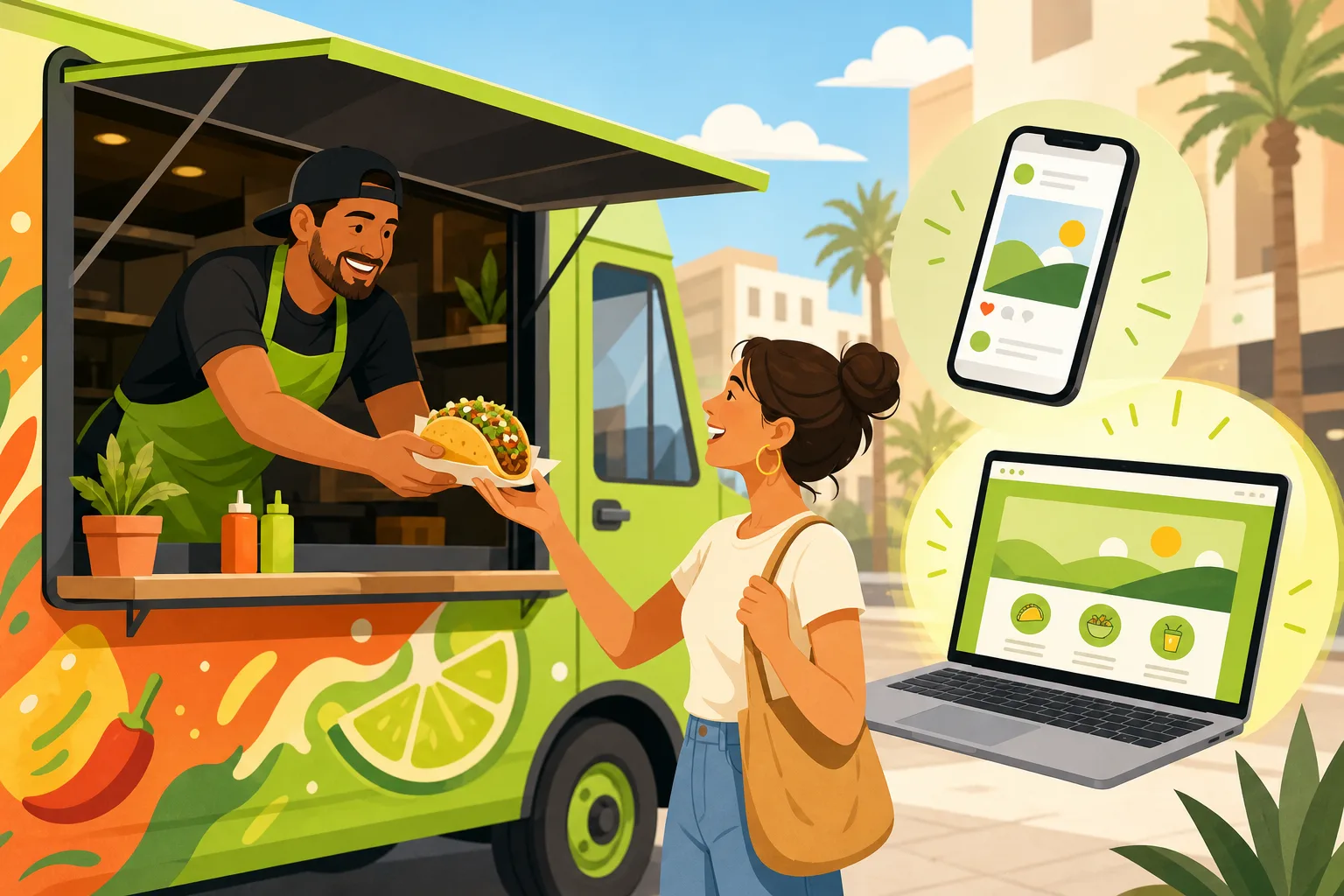
Your Instagram is doing its job. People see where the truck is parked this Tuesday, they like the photos, they show up at lunch. But the catering client who would have booked you for a company quarterly lunch — the one worth $3,000 in a single afternoon — never found you. They searched "food truck catering [your city]" on a Tuesday morning and landed on a competitor with a real catering page and a quote form. You weren't in that search.
That's the tension at the center of the "do I need a website?" question for food trucks. Instagram handles one half of your business well. It's almost useless for the other half — and the other half is where the real money is.
The two buyers you're actually serving
Before you decide what your website needs, you need to be clear on who you're selling to — because food trucks serve two very different buyers who make decisions in completely different ways.
The walk-up diner is hungry now. They want to know where the truck is today and what's on the menu. Instagram handles this well — a story from this morning with your location is genuinely the right tool for this buyer.
The catering client is planning weeks ahead: a corporate lunch for 40 people, a company holiday party, a wedding late-night station. They are not going to find you on Instagram. They're going to search Google. They need a page that says "yes, we cater, here's how it works" and a form to submit their event date and guest count.
When we analyzed food truck websites from all over the country, the pattern was consistent: the sites built around the catering buyer — with a dedicated catering page, named service tiers, and a structured inquiry form — captured leads that the Instagram-only trucks were completely invisible to.
A recurring corporate account running twice a week for 50 people can be worth $60,000+ annually. That client is on Google, not browsing Instagram reels.
What we found analyzing food truck websites from around the country
The food trucks that ranked well and actually converted catering leads shared a consistent structure. The ones that struggled fell into predictable patterns.
Every competitive site leads with cuisine and city — out loud. The strongest hero sections we analyzed didn't bury the basics. They stated the cuisine, the city, and the food truck identity right in the headline. "North Carolina's favorite Haitian food trailer and catering business." "Wood-fired pizza from a real 1964 fire truck." "The best green chile in Arizona." These headlines do double duty: they tell visitors immediately if this is the truck for them, and they signal to search engines what this business is.
The catering path is prominent, often above the fold. On the most effective sites, "Request a Quote" or "Private Events & Catering" wasn't buried in a footer or tucked into a nav item. It was a primary CTA in the hero — sometimes the primary CTA, positioned ahead of "Order Online." The trucks that led with catering had built their business around it. The trucks that buried it were treating catering as an afterthought, and their inquiry flow reflected that.
Catering packages are named, not described. The best operators we analyzed had named service tiers — things like "Drop-Off," "Full-Service," and "Wedding" — each with its own description of what's included. Named tiers do something that a generic "contact us for catering info" page does not: they tell a buyer what's possible before they spend the time on a call. A corporate buyer scanning "Office Lunch Package / 25–100 people" self-qualifies and submits. A buyer who sees "catering — contact for pricing" often doesn't.
Trust comes from numbers and stories, not star ratings. Not one site we analyzed displayed a live Google review count on the homepage. The trust signals that did the work were years in business, event volume ("10,000+ events served"), and attributed testimonials — real quotes from a wedding coordinator, an office manager, or an event planner with their role named. The origin story — where the founder is from, why they started, what makes the food authentic — was the emotional anchor on nearly every site. Heritage is the food truck's version of "licensed and insured."
Real photography is the baseline — not a differentiator. Across our proprietary local-business website research, real photography was essentially universal across food categories. Stock photos weren't found on a single top-performing food truck site we analyzed. This isn't a nice-to-have. Your food is the product. A close-up of your actual tacos, your actual truck window at lunch hour, your team plating food at a catered event — that photography is doing conversion work that no amount of copy can replicate. The trucks without it don't look budget, they look invisible.
What your food truck website actually needs
Here's the honest breakdown of table stakes versus real differentiators.
Table stakes — every competitive site has these:
| Element | Why it matters |
|---|---|
| Cuisine + city stated in the hero | Immediate self-qualification for the visitor; local SEO signal |
| Real food photography | The product itself; no stock, no exceptions |
| A catering / private events page | Captures the high-value buyer segment completely absent from Instagram |
| Catering inquiry form with qualifying fields | At minimum: event date, guest count, location, event type |
| "Where's the truck" answer | A calendar, an embedded schedule, or a clear social link telling people where to find you |
| Named menu with real descriptions | Not a PDF if you can help it; PDFs aren't mobile-friendly and don't load well in search results |
| Origin story / about section | Heritage and authenticity are the food truck trust signal |
Differentiators — almost nobody does these well:
- Named catering packages with real descriptions ("Office Lunch Pack," "Wedding Late-Night Station") — almost every truck just says "inquire for catering"
- A live location widget or embedded event calendar — not one competitor we analyzed had this; it's wide-open whitespace
- A live Google review count on the homepage — zero sites we analyzed showed this; it's an instant credibility separator
- Event photos and customer gallery for catering social proof — every truck we analyzed had food close-ups; almost none showed actual event scenes with guests
- Hard numbers prominently displayed: years in business, events served, guest count capacity
On pricing: hiding retail prices is the dominant pattern — most trucks route diners to an ordering platform. For catering, routing buyers to a quote form is the right path. One exception: if your format is simple and repeatable, showing per-person catering minimums helps buyers self-qualify before calling.
The Instagram gap
Instagram is excellent for what it does: daily location posts, food photos, event announcements, keeping your existing audience updated. For walk-up retail diners, it works.
It is not Google. People searching "food truck catering corporate lunch [city]" are not finding you through Instagram. That search happens on Google, and Google is looking for pages — real web pages with text that answers the query, structured inquiry forms, and the kind of domain authority that Instagram profiles don't have.
There's also the professionalism question. An event planner or corporate office manager evaluating three trucks for a 200-person event is going to do due diligence. A real website with a catering page, named packages, a quote form, and testimonials from event coordinators reads as a professional catering operation. An Instagram profile reads as a lunch truck that might also do events.
Common mistakes that cost food trucks catering leads
The catering page is one paragraph. Many trucks have a catering section — but it's a single paragraph saying "we cater events, contact us for more info." That's not a catering page. That's a placeholder. A real catering page answers: what event types you serve, what your capacity range is, what the named packages are, what the inquiry process looks like, and who has hired you before. A buyer who lands on a paragraph and a generic contact button will keep searching.
The inquiry form asks for nothing. "Name, email, message" is a contact form, not a catering inquiry form. Minimum qualifying fields: event date, estimated guest count, location area, event type. A form that captures this lets you send a meaningful response on the first contact instead of a round of back-and-forth.
No location answer anywhere. If someone lands on your site wanting to know where to find the truck today and there's no answer — no calendar, no schedule, no clear link — they leave. Solving "where's the truck today" was the most obvious gap we found across every food truck site we analyzed. A simple weekly schedule or embedded calendar is genuine differentiation because none of the competitors we looked at had one.
Social proof is generic. "Best tacos I've ever had!" from "Mike S." is not a testimonial — it's noise. The testimonials that convert catering buyers are attributed to roles: "Corporate Events Coordinator" or "Wedding, 120 guests." Those tell the right buyer that someone in their exact position hired you and it went well.
Quick takeaways
- Instagram keeps your lunch regulars informed. It does not capture catering leads.
- The catering buyer — corporate clients, wedding planners, event coordinators — searches Google and needs a real inquiry path with a quote form.
- A recurring corporate lunch account can be worth $60,000+ annually. That buyer is not in your Instagram DMs.
- Named catering packages outperform "contact us for catering info" every time.
- Solving "where's the truck today" with a simple calendar is genuine differentiation — nobody has done it well.
- Real food photography is not optional in any food category. It is the conversion asset.
- Attributed testimonials from event roles (coordinator, bride, office manager) convert catering buyers; generic food quotes do not.
You can run a successful Instagram and still be losing catering revenue to trucks with better websites. The two aren't competing — they serve different parts of your business. Instagram keeps your lunch regulars fed. A real website catches the corporate client, the wedding planner, and the festival organizer before they move on to the next search result.
GrowLocal builds websites for food trucks with catering pages, inquiry forms, location schedules, and menu sections — built around how catering buyers actually search. Preview before you pay a dollar. Pricing starts at $20–30/month, we handle everything. See the full range of local business websites we build — from catering businesses to event planners — or go straight to food truck websites.