


Social Media Marketing for Food Trucks: What Actually Works
Updated June 2026
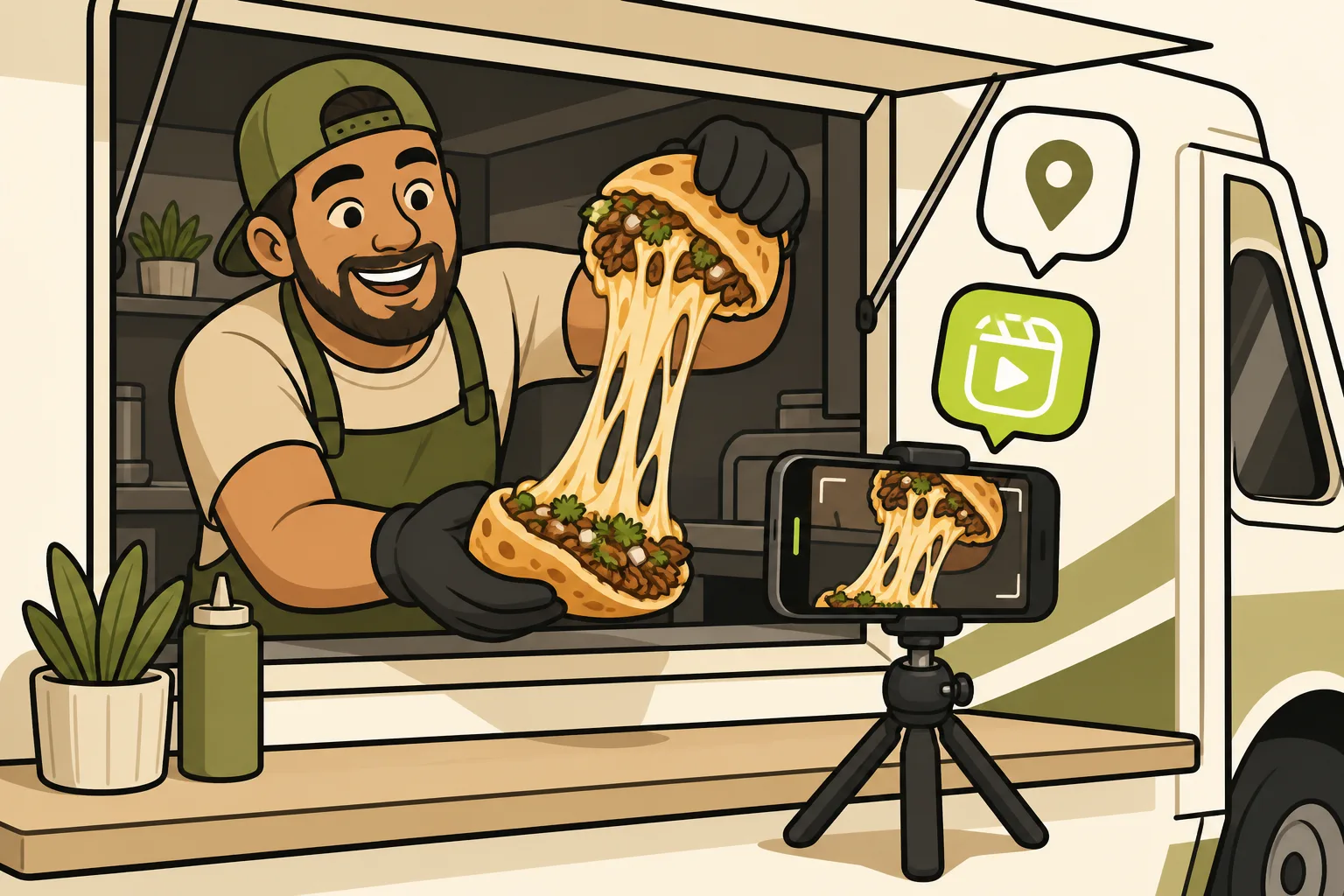
For food trucks, social media marketing comes down to two things: a daily "where's the truck today" post and short vertical clips of food being cooked. Post the day's location to Instagram Stories every operating day, and put one craving-trigger moment — the cheese pull, the sizzle on the flat-top, the build from ticket to window — on Reels and TikTok a few times a week. That combination is what turns a 200-follower truck into a lunch line, because the algorithm rewards how a clip performs, not how many followers you have. A behind-the-counter cook with zero budget can out-reach a polished ad.
Below is the realistic playbook: the specific content veins that travel for this trade, the weekly cadence a one- or two-person truck can actually sustain, and the honest tradeoff that none of the "post consistently!" advice mentions — that doing all of this every single week is a second job.
What kind of content actually gets a food truck views?
Food is craving-bait, so the content that wins is the content that makes a phone-scroller hungry. Five veins do almost all the work for this trade. None of them are "post a flyer" or "share a quote graphic."
1. The satisfying / ASMR cook. This is the single highest-growth vein. Open the clip on the moment — the cheese pull, the smashburger crisping, a slow sauce pour, the sizzle when meat hits the flat-top — with the raw kitchen sound turned up and no music. Hold the close-up three to five seconds. End on the finished dish glistening, no call to action. Fifteen seconds of a burger crisping outperforms any commercial you could pay for. The caption can literally be: "the sound on. that's the whole post."
2. The full assembly, ticket to window. Start the camera on the ticket printer spitting out an order, then follow that one dish through every build step in fast cuts, raw sound up, ending on the hand-off out the window. It's different from what most food accounts post, and it reliably holds attention because people want to see their order get made. You can film it during a normal service rush without adding a single task.
3. Truck setup and the day-in-the-life. Shutter-open at dawn to service-ready, compressed into 30–45 seconds. It's oddly satisfying to watch and it shows the real effort that goes in before anyone takes a bite — "we open the shutter at 6am so you can eat at noon." This is the vein that converts a casual viewer into a regular who roots for you.
4. Owner and crew personality. People follow people. An owner talking to camera with a quick real story, cut to them actually working the window, with a recurring on-camera face the audience comes back for — that's a para-social follow loop. For food trucks the founder's origin story is the credibility engine, so this vein doubles as your trust signal.
5. Relatable food-truck humor. "POV: the lunch rush just hits." "Things only food truck people understand." "When someone asks if you're still open at 1:59." Dramatized, deadpan, the crew in on the joke, set to a trending sound. This is the vein that earns shares and comments, which the algorithm reads as a reason to push you to non-followers.
There's a sixth that's unique to your trade and lives slightly outside the "growth" bucket: the daily location post.
How often should a food truck post — and where?
Post the day's location every operating day as an Instagram Story, and aim for three to four feed posts and one to three Reels a week. That's the sustainable rhythm. The daily location Story is the one non-negotiable, because a mobile business lives or dies on people knowing where to find it.
Here's the realistic weekly shape:
| Slot | Post | Vein |
|---|---|---|
| Every operating day | Today's spot + hours, location sticker | Daily location (Story) |
| Menu Monday | Spotlight one dish | Dish / signature spotlight |
| Wednesday | Prep / setup behind-the-scenes | Day-in-the-life |
| Friday | Cooking-process Reel, trending audio | Satisfying / ASMR cook |
| Weekend | Event Stories, line shots | Social proof / event |
| Sunday night | Recap + next week's schedule | Location / planning |
On platforms: Instagram and TikTok are the growth engines — Reels and short-form are the discovery machine that pushes you to people who don't follow you yet. Instagram Stories carries the daily location updates. Facebook is for event listings and reaching an older crowd. Shoot one vertical clip and repurpose it across Reels, TikTok, and YouTube Shorts — same file, three placements. Over 74% of diners discover new food trucks through social media, so this isn't a vanity exercise; it's how people find your window.
A note on format, because it kills more food-truck posts than anything else: shoot vertical 9:16, under 30 seconds, on your phone — no gimbal needed. Add on-screen captions, because most short-form video is watched on mute. And use real food footage only. Never AI-generated or stock food images; people are skeptical of fake food and it quietly destroys the trust you're trying to build.
Key takeaway: The growth lever is craving-content (the cook, the assembly, the setup); the reason to follow is the daily location and the recurring owner-on-camera face. You need both — viral clips with no daily rhythm don't build a lunch crowd.
What should the actual posts look like this week?
Concrete beats abstract. Here are five posts you could film during one normal service day, pulled straight from the veins above:
- "The sound on 🔊" — 12 seconds, macro shot of your signature dish's cheese pull or sauce pour, raw audio, no music, captions on. Caption: "{dish}. that's the whole post."
- "Watch one {dish} go from ticket to window" — start on the ticket printer, fast-cut the build, end on the hand-off. Caption: "one {dish}, ticket to window — this is the whole process."
- "Where's the truck today? 📍" — Story, real photo of the truck at today's spot with a recognizable landmark, location sticker, exact hours, one line on the day's special.
- "POV: the lunch rush just hit" — dramatized chaos with the crew, trending audio, deadpan punchline. Caption: "iykyk. tag a food truck friend."
- "Meet the person making your {dish}" — owner to camera, quick story, cut to them cooking, end on a wave. Caption: "this is who's behind the window — come say hi."
That's three posts filmed during one shift (prep clip, service clip, post-close clip) plus the daily location Story plus one personality piece. A smart batch — one clip during prep, one during service, one after close — gives you three posts and zero extra time.
For hashtags, the spam era is over: use 10–15 tags mixing generic (#foodtruck #streetfood), local/city (#austinfoodtruck — your actual discovery driver), and cuisine (#tacos, #smashburger). Geo-tag every post, and at events use the host's collab feature so they share you to their audience.
Keep the selling small. The honest mix for this trade is roughly 75–80% organic — cook clips, location, personality, humor — with the catering-quote ask as a periodic minority slice, not a tag on every post. Catering is your highest-margin buyer, so when you do ask, frame it as "get a free catering quote," not "contact us." Staple that CTA onto everything and your followers tune you out.
Isn't this basically a second job?
Yes. That's the honest part most guides skip. Filming a daily location Story, batching three cook clips a shift, jumping on a trend before it decays, editing captions onto everything, writing the catering posts, and keeping a Menu-Monday-through-Sunday-recap rhythm — every week, during the same hours you're prepping, cooking, driving, and serving — is a real, recurring workload. Most trucks that try to post twice a day burn out inside a month. Consistency beats volume, but consistency is exactly the hard part when you're also running the truck.
This is the gap GrowLocal is built for. We build and host your food truck website — fast, mobile, with a structured catering-quote form and a "where to find us" section — and we write your social posts in your trade's veins. We already know the food-truck playbook: the satisfying cook clip, the ticket-to-window build, the daily location hook, the relatable rush humor, the catering ask kept small. You film a few real clips on your phone during service; we turn them into the weekly rhythm, captioned, hashtagged, and scheduled. Real food only — fake food kills credibility.
The work that builds a lunch line doesn't have to be your work every week. See how it fits together on our food truck site breakdown, or browse how we build for other local trades to see the same done-for-you approach applied to your neighbors.
Common Questions About Food Truck Social Media
How often should a food truck post on social media?
Post the day's location every operating day as an Instagram Story, plus three to four feed posts and one to three Reels per week. Consistency matters more than volume — three quality posts a week beats seven rushed ones, and skipping a low-quality day is better than posting filler. Trucks that attempt twice-daily posting tend to burn out within a month.
What is the best platform for food truck marketing?
Instagram and TikTok drive growth because Reels and short-form video push your content to people who don't follow you yet. Instagram Stories carries your daily location updates, and Facebook handles event listings and an older audience. Shoot one vertical clip and reuse it across all three.
What should a food truck post on Instagram?
Lead with craving-content: satisfying cook clips (the cheese pull, the sizzle), the full ticket-to-window assembly of one dish, your setup day-in-the-life, owner and crew personality, and relatable food-truck humor. Anchor it all with a daily "where's the truck today" Story carrying a location sticker and your hours.
Do food trucks really get customers from social media?
Yes — over 74% of diners discover new food trucks through social media. Because the algorithm rewards engagement over follower count, a small truck can hit tens of thousands of views on a single behind-the-counter cook clip with no ad spend, and that reach turns into a real lunch line.
Should I use AI-generated images of my food?
No. Real food footage only — AI-generated or stock food images make viewers skeptical and quietly destroy trust. Across our proprietary local-business website research, top food-category businesses use exclusively real photography of their actual dishes, with stock photos absent across the analyzed competitive set. Your phone camera and good light are enough.
Do I need a website if I have an active Instagram?
Yes, and they do different jobs. Social is discovery — it makes people hungry and tells them where you are today. Your website is where the high-value catering buyer compares you, reads your story, and fills out a quote form on their own timeline. Across our proprietary local-business website research, the founder's origin story is the primary trust mechanism in this category, and a website is where that story lives permanently instead of scrolling away in a feed.
Can someone run my food truck social for me?
Yes — that's what GrowLocal's done-for-you social is for. You film a few real clips on your phone during service; we write, caption, hashtag, and schedule them in your trade's proven veins, and we build the matching food truck website with a catering-quote form. It removes the weekly content workload without making your food look fake.