


Updated June 2026
DTG is faster and cheaper for small, complex orders; screen printing wins on durability and per-unit cost for bulk jobs above 50 pieces. For a local print shop, the more useful question is: how do you explain this to your clients — and how do you use their answer to qualify leads, protect your margins, and build the repeat accounts that call you back every season?
This is based on GrowLocal's proprietary research into top-ranking local screen printing websites.
What's the actual difference between DTG and screen printing?
DTG (Direct-to-Garment) prints like a high-end inkjet: a machine sprays water-based ink directly into the fabric. No screens, no setup plates. It handles unlimited colors, photo-quality gradients, and one-off orders without setup fees. The limitation: it works best on 100% cotton, prints wear faster (expect 50+ wash cycles before visible fading), and per-unit cost stays relatively flat regardless of quantity.
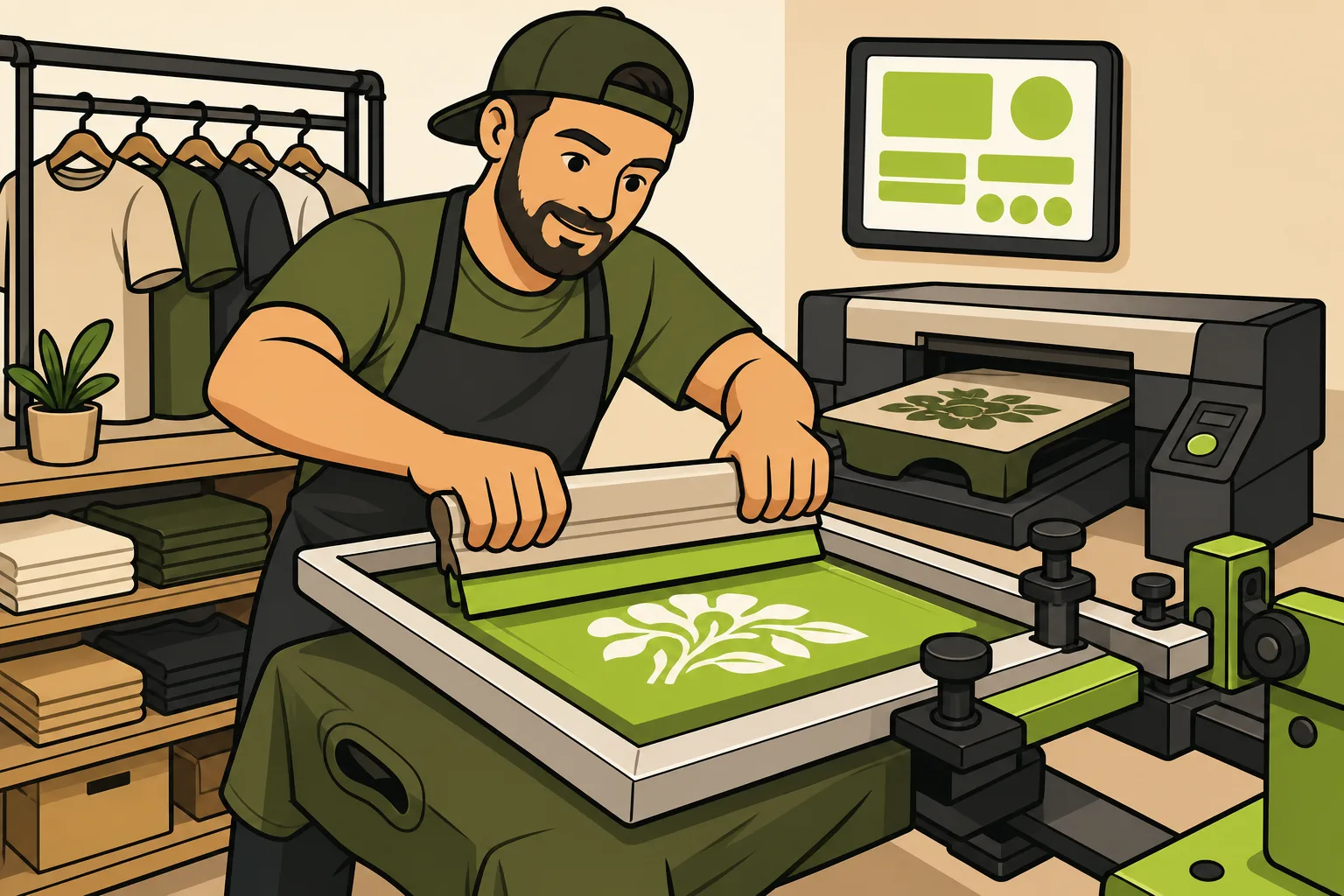
Screen printing pushes ink through a mesh screen — one screen per color. Setup requires burning a screen for each color in the design ($25–$35 per screen is a typical charge). Per-unit cost drops dramatically at volume because you're spreading a fixed setup cost across more shirts. Durability is the strongest argument: thick plastisol ink can survive 100+ wash cycles without fading, making it the right call for uniforms and workwear that take daily punishment.
The short version for client conversations: DTG for small, complex, one-time; screen printing for bulk, bold, repeat.
Which method should you recommend, and when?
This is where every buyer-focused comparison article misses the point. The question for a local shop owner isn't "which is better" — it's "which should I be recommending to this specific client, right now?"
Here's the intake framework that saves time on both sides:
| Client says… | Recommend | Why |
|---|---|---|
| "I need 12 shirts for my team" | DTG (or refer if you don't offer it) | Low volume; setup cost per shirt is unacceptable with screen |
| "I need 200 shirts for our annual uniform run" | Screen printing | High volume + repeat reorders = the economics flip hard |
| "My logo has 8 colors and a gradient" | DTG | Screen printing would require 8 screens + color matching |
| "It's a 2-color corporate logo, 300 pieces" | Screen printing | Simple art + volume = screen printing's sweet spot |
| "Can I order 50 now and reorder later?" | Screen printing | Reorder economics (see below) are a strong argument |
| "We're on polyester / performance wear" | Screen printing or DTF | DTG doesn't bond well to synthetic fabrics |
You don't need to offer both to have this conversation. If your shop doesn't do DTG, be honest about it and explain when you'd refer a client to someone who does — that kind of transparency builds trust and often keeps the client coming back for the orders you CAN fulfill.
Why screen printing reorders are your best-kept sales argument
Here's what almost no print shop website explains — and it's one of screen printing's most powerful advantages.
When a school places its first uniform order, you burn screens for their logo (say, 3 colors = 3 screens). That setup cost is charged on the first run. When they call back in the spring for the JV team, the screens already exist. The reorder cost drops significantly — no new setup, same ink formula, same press settings.
For a client ordering the same design season after season, screen printing becomes dramatically cheaper over time.
This reorder dynamic creates genuine business value that DTG can't match:
- First-order setup is an investment, not just a line item
- Clients who've paid screen setup costs want to reorder through your shop — it's already done
- Corporate accounts with annual uniform cycles become predictable recurring revenue
- The second order's per-unit cost is materially lower than the first
Most screen printers never say this out loud. The clients who understand it become loyal accounts. Putting this on your website — in a FAQ or on your service page — pre-qualifies the corporate and school buyers worth your time.
Key takeaway: Across GrowLocal's proprietary research into top-ranking screen printing websites, every site uses a quote request form as the primary conversion — not a price sheet. The reason is exactly this: screen printing economics are personal to the order. But explaining the reorder advantage in a FAQ or service page gives serious B2B buyers a reason to commit to your shop before they've even spoken to you.
Does artwork format matter? (Yes — and most clients don't know this)
This is the #1 hidden source of delays and misquote calls.
Screen printing requires vector artwork — AI, EPS, or high-resolution SVG files. Raster images (JPG, PNG from a website, low-res phone exports) need to be redrawn or traced before they can be separated into print-ready screens. Art prep typically adds $50–$100 to the job and 1–2 business days. Clients who arrive with a blurry JPG from their business card are surprised by this every time.
DTG handles raster artwork. Gradients, photos, and complex digital designs print directly with no prep. A client with a photorealistic design or a multi-color illustration is genuinely better served by DTG for most order sizes.
The practical move: add a note to your screen printing service page explaining which file formats you accept and what art prep costs when a design needs rebuilding. Clients who read this arrive better prepared and feel less ambushed on their invoice.
A good screen printing website makes this information easy to find — service pages and FAQ sections do the pre-sales work that used to happen on a phone call.
Can you put this explanation on your website?
You should — and it's easier than it sounds.
A short FAQ section on your screen printing service page (or a standalone FAQ page) answering "What's the difference between DTG and screen printing?" does three things:
- Filters serious buyers — clients who read the answer and understand the minimum order math are already pre-qualified when they fill out the quote form
- Reduces quote calls about wrong methods — someone wanting 10 shirts with a photo design now understands why they're being quoted differently than the school that orders 300 uniforms
- Establishes expertise — explaining the nuance builds trust; it signals you know your craft
Across GrowLocal's proprietary research into top-ranking local screen printing websites, five of six shops hide pricing entirely and rely on the quote form as the conversion point. That's rational — pricing really is complex. But a FAQ that explains the logic behind the quote model turns what feels like opacity into transparency. See our full pricing-transparency data.
Across all service trades, 92% of local business websites hide pricing entirely (N=237 sites, 28 categories) — the shops that rank highest explain why they quote, rather than just saying "contact us." Check what a purpose-built screen printing website typically includes.
How does DTG fit into a screen printing shop?
Some shops offer both. Many don't. Either is defensible.
If you don't offer DTG: be honest on your website. For orders under ~50 pieces or with photo-quality design complexity, recommend a DTG shop — and be clear that for bulk orders, repeat corporate accounts, or work where durability matters, screen printing is the stronger choice. Clients respect the candor; it filters out the inquiries that won't convert anyway.
If you do offer both: a service page that explains when you'd recommend each method is one of the most useful things on a print shop site. The screen printing website checklist covers what each core page should include.
Explore how other local service trades structure their websites for cross-trade context on how service pages and FAQs convert differently across industries.
Frequently Asked Questions About DTG vs Screen Printing
Is DTG or screen printing better for small orders?
DTG is generally better for orders under 50 pieces, especially designs with many colors or gradients. Screen printing's per-color screen setup fee makes small orders expensive per unit — that cost is rational at 200 pieces but not at 12. If a client calls for 12 custom shirts with a full-color illustration, DTG is the honest answer.
How long do DTG prints last compared to screen printing?
Screen printing outlasts DTG in most wash-and-wear scenarios. Well-applied plastisol screen printing can hold for 100+ wash cycles without cracking or significant fading. DTG prints are durable too — expect 50+ wash cycles with proper care — but the thinner ink layer shows wear faster. For uniform programs, workwear, or anything that gets laundered frequently, screen printing is the more durable investment.
Is screen printing cheaper than DTG for 100 shirts?
At 100 pieces with a simple 2–3 color design, screen printing is typically cheaper per shirt. The setup cost (burning screens) is spread across 100 units, making the per-unit economics favorable. At 12 pieces with the same design, DTG would likely cost less per shirt because there's no setup. The crossover point is typically around 50 pieces for a single-color design; for multi-color designs, it moves based on how many colors are involved.
Do clients need vector artwork for screen printing?
Yes — screen printing requires vector artwork (AI, EPS, or high-resolution SVG). Raster images like JPGs or low-resolution PNGs need to be redrawn into vector format first, which adds art prep fees ($50–$100 is typical) and 1–2 days to the timeline. DTG handles raster artwork directly, which is one reason it's faster for photo-quality or gradient-heavy designs. Letting clients know upfront — on your service page or in your quote form — prevents the most common surprise on their first invoice.
How do I explain the reorder advantage to corporate clients?
Frame it as an investment: "The first order covers your screen setup. Every reorder of the same design skips that cost entirely — so the more you order through us over time, the lower your per-shirt cost becomes." Add this to your service page or FAQ. Clients who understand this math choose screen printing over one-off options and come back reliably.
Does GrowLocal build websites for screen printing shops?
Yes — GrowLocal builds fast, purpose-built websites for local screen printing shops, including quote forms, portfolio/gallery pages, service pages covering each technique, and FAQ sections where you can answer exactly these client questions before the phone rings. No booking integrations (screen printing is a quote-first business, not a scheduling business), but everything a B2B buyer needs to decide to reach out. See what a screen printing website looks like.