


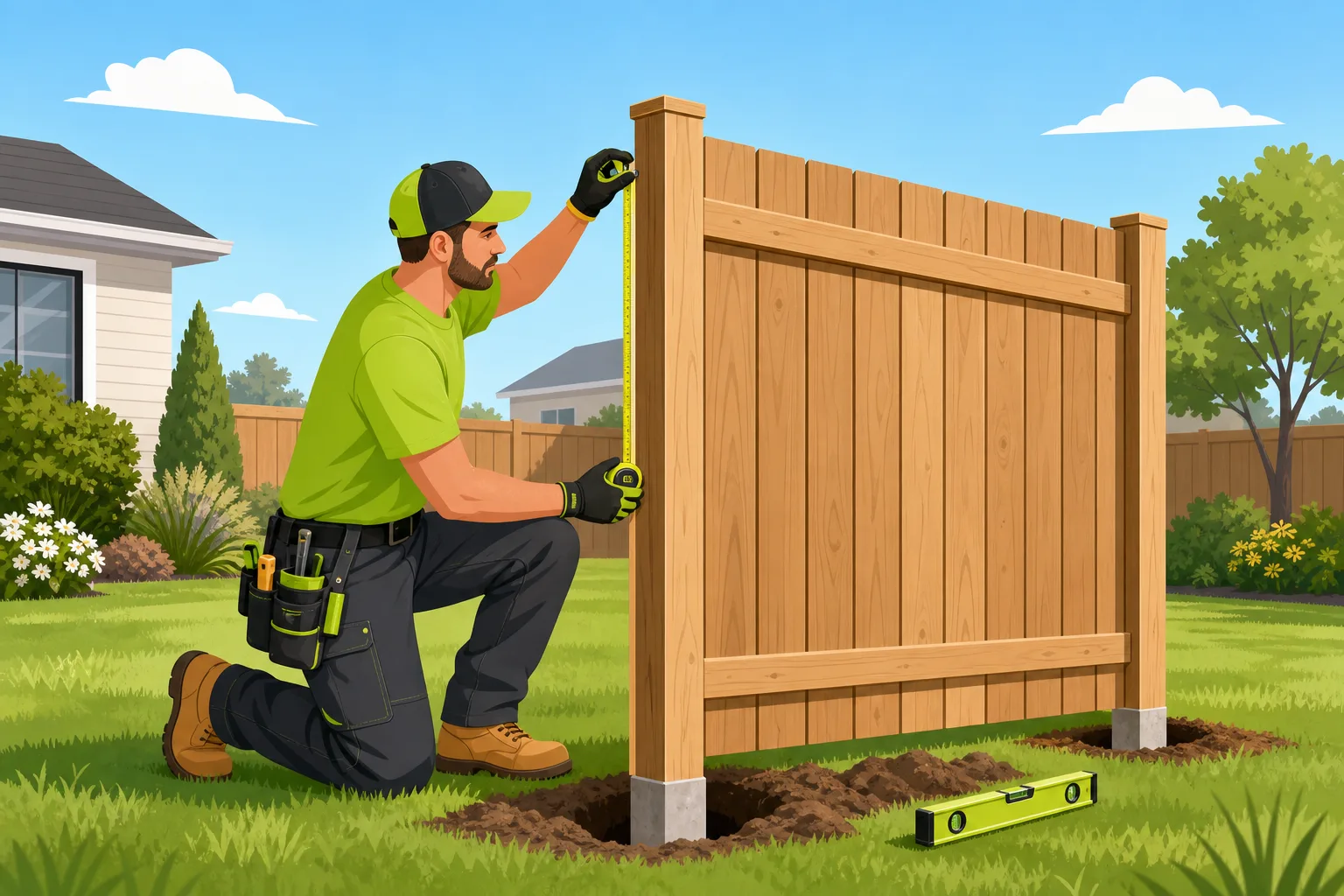
The person searching "fence installation cost" already knows they want a fence — they're trying to calibrate the budget before they call anyone. By the time they reach your site, they've already been disappointed: every site they visited said some version of "it depends, call us for a free estimate."
Your fence company website can either be another source of that disappointment — or it can be the one site that helps them understand what to expect. That second path converts.
We analyzed fencing companies websites from all over the country. Here's what we found about how the top performers handle pricing curiosity, materials education, and project galleries — and how those choices translate directly into whether a visitor calls you or keeps scrolling.
The Pricing Problem Every Fence Company Has — and How to Use It
None of the top-ranking fence companies we analyzed publish prices. This is correct — a fence job can be $3,000 or $15,000 depending on linear footage, material, terrain, and gate count. Publishing a number generates calls from people anchored to the wrong figure.
But the person searching "fence installation cost" isn't going away until they feel like they understand the landscape. They'll click through most of the sites they find looking for something that helps them calibrate. The sites that help them get the call. The sites that just say "free estimate" get the back button.
Across our proprietary local-business website research, pricing was hidden on more than 90% of service businesses' sites — but the gap between sites that address cost anxiety and those that ignore it is stark.
The winning move isn't to publish a price sheet. It's to educate:
- Wood privacy fence: typically runs $18–$35/linear foot installed, with the range explained by cedar vs. pressure-treated pine, height, and terrain
- Vinyl/PVC: more upfront, but the "won't rot, won't splinter, no painting ever" story justifies the premium
- Chain-link: the budget option, with variance based on height and gauge
- Aluminum/ornamental iron: higher ticket, better for pool code compliance and curb appeal
- Composite (Trex/SimTek): the premium tier, marketed on 30-year performance
You're not committing to numbers — you're giving them a map of the territory. A visitor who understands that vinyl costs more upfront but less over 20 years is a better-prepared lead who has mentally accepted the budget range before you answer the phone.
What We Found Analyzing Real Fencing Company Websites
The estimate form is the entire funnel — but the best sites build to it
Every top-performing fencing site we analyzed treats the free estimate as the single conversion event. "Get a Free Estimate" is the primary CTA on the hero, repeated in the header, and restated in the footer. This is table stakes — if your primary button says "Contact Us," you're leaving conversions behind.
But the best sites don't just put up a form and hope. One Denver-area company we studied puts the estimate form directly in the hero section — name, phone, email, ZIP, fence type — before the visitor even scrolls. Another Nashville company offers an instant online quote tool, where the visitor enters their footage and selects their material type and gets a rough range on screen. They still call to firm it up, but the prospect has context before the call.
The instant estimator is the clearest differentiator we found across the category. Most fence companies are still in the "call us" camp. Anything that bridges the gap between "I need to know roughly what this costs" and "schedule a free estimate" is going to outperform pure gating.
Specificity separates the trusted sites from the generic ones
The single biggest gap between top performers and average sites is specificity. Every site claims to be "trusted" or "five-star." Very few back it up with numbers.
One company we studied markets as "200+ five-star reviews." Another displays "360 Google reviews" plus a BBB A+ badge. These are different claims than "our customers love us." A specific number says: we have a track record you can verify.
The same principle applies to warranties. "We guarantee our work" is meaningless. "10-year workmanship warranty, lifetime material warranty on vinyl" is a claim the customer can hold you to. One specialist we analyzed offers a lifetime, transferable warranty against defects and weathering — transferable to the next owner. That's a selling point that shows up on the Zillow listing.
Heritage matters too. "Since 1995" or "Second-generation, 45+ years" proves something no photography can replicate: you'll still be around when there's a warranty question in year twelve.
Project galleries are doing more work than you think
The fencing category is highly visual. A homeowner deciding between wood and vinyl, or trying to figure out whether aluminum ornamental looks too formal for their house, is making an aesthetic judgment. Words don't help them make it. Photos do.
The highest-performing sites we analyzed don't just have a generic gallery — they organize it. One Nashville company displays named, geographically-specific projects: a wood privacy fence in one suburb, a driveway gate in another neighborhood, a commercial chain-link installation across town. One Tampa competitor runs a real before/after gallery, showing the original rotted panels and the finished cedar installation. That before/after format is particularly effective because it maps directly to how your customers think about their problem — the before IS their backyard right now.
The sites that fail here share a common mistake: stock photography or illustrations instead of real installs. Your potential customer is trying to picture your crew in their backyard. Stock photos don't help them do that. Real project photos do.
If you have a gallery with photos organized by material type, you're ahead of most competitors. If you have before/afters, you're in the top tier.
What Your Fencing Website Actually Needs
Table stakes — you're invisible without these
"Get a Free Estimate" as your loudest element. Primary button in the hero, phone number in the sticky header, form repeated mid-page. If someone can't find how to reach you within three seconds, they won't try.
A real installed-fence photo in your hero. Not a rendering or stock image — a fence your crew actually built. Regional landscaping, recognizable residential setting. Authenticity signals immediately that you're a real company with a real track record.
A founding year or equivalent anchor. "Since 1995," "Family-owned for 25 years," "Second generation." If your company is newer, substitute with certification counts, project volume, and specific review counts.
Specific warranty language. Not "guaranteed satisfaction" — "10-year workmanship warranty, lifetime material warranty on vinyl." Write the number, write the scope.
Material navigation organized by type. Wood, Vinyl, Chain-Link, Aluminum/Ornamental, Composite — each with its own page. Don't make customers decode your menu.
An actual review count. "200+ five-star reviews" is a claim. "Five-star service" is noise.
Differentiators — what separates the top 20%
Materials education that addresses the cost question. A page or section explaining trade-offs — upfront cost vs. lifetime maintenance, HOA restrictions, pool code compliance, regional performance differences. The visitor who reads it arrives on the call pre-educated and pre-qualified.
An instant online estimator or rough estimate range. One company we studied built this into their hero form: you enter footage and material type, get a range, then submit contact info to confirm. Even a rough number is a differentiator in a field where everyone else says "call us."
Financing surfaced at headline level. On a $3,000–$15,000 ticket, "24 months no interest" is a conversion driver, not a footnote. When a homeowner is comparing fence companies, financing availability often tips the decision.
Named, geographically-specific project galleries. Tagged by neighborhood or suburb, organized by material. Regional detail makes a gallery feel local and real rather than generic.
Commercial/builder as a second audience. Most fence companies fight over the same residential homeowners. Serving general contractors and builders means competing in a less crowded lane — and those clients repeat.
Common Mistakes That Cost You Leads
Vague trust language. Every fence company says "professional, reliable, trusted." None of those words do anything. A specific number — reviews, years in business, projects completed — converts. "500 completed projects since 2006" beats "trusted local contractor" every time.
No acknowledgment of price. Ignoring cost entirely leaves the visitor feeling like you're hiding something. They searched "fence installation cost" for a reason. Give them enough context to feel oriented, and they'll reward you with a call.
Unsorted galleries. A page of 15 random photos is hard to use. Organizing by material — "Wood | Vinyl | Aluminum | Chain-Link | Gates" — lets visitors navigate directly to what they're considering.
Phone number hard to find on mobile. Across our proprietary local-business website research, click-to-call accessibility was one of the most consistent differentiators. Your customer is on their phone in the backyard looking at rotted fence panels. One tap to call, or they move on.
No financing mention. At this price range, cost is a real objection. "Financing available" addresses it before it stops the conversion. You don't have to publish terms — just surface that the option exists.
Frequently Asked Questions
Should I publish prices?
No fence company we analyzed does — fence jobs vary too much to quote without a site visit. What you should publish is educational context: material comparisons, the factors that affect cost (linear footage, terrain, gate count, material), and your warranty terms. This addresses cost anxiety without committing to numbers that won't match the estimate.
What photos do I actually need?
At minimum: a hero photo of a completed installation your crew built (not stock), and a gallery organized by material. Before/after pairs, crew photos, and geographically-named project examples are what separate the top-performing sites. If you can only do one thing, photograph your five most recent jobs on your phone and use those. Real beats polished every time.
Do I need separate pages for each fence material?
Yes. A homeowner who has decided they want a vinyl fence isn't browsing "types of fences" — they're searching for a vinyl fence company. A dedicated page with its own copy, gallery, and CTA captures that intent.
How do I compete without a long track record?
Lead with what you have: specific review counts, BBB or American Fence Association credentials, and detailed warranty terms. Third-party verifiable credentials substitute well for longevity.
If your current website isn't doing the work described above, GrowLocal builds fencing company websites grounded in this competitor research — project galleries, materials pages, estimate forms, and manual testimonials included. Preview free, then $20–$30/month with no contracts. See the full small business website catalog or go straight to fencing. We also build for adjacent trades — general contractors and landscaping companies — if you're referring a colleague or comparing options.