


Updated June 2026
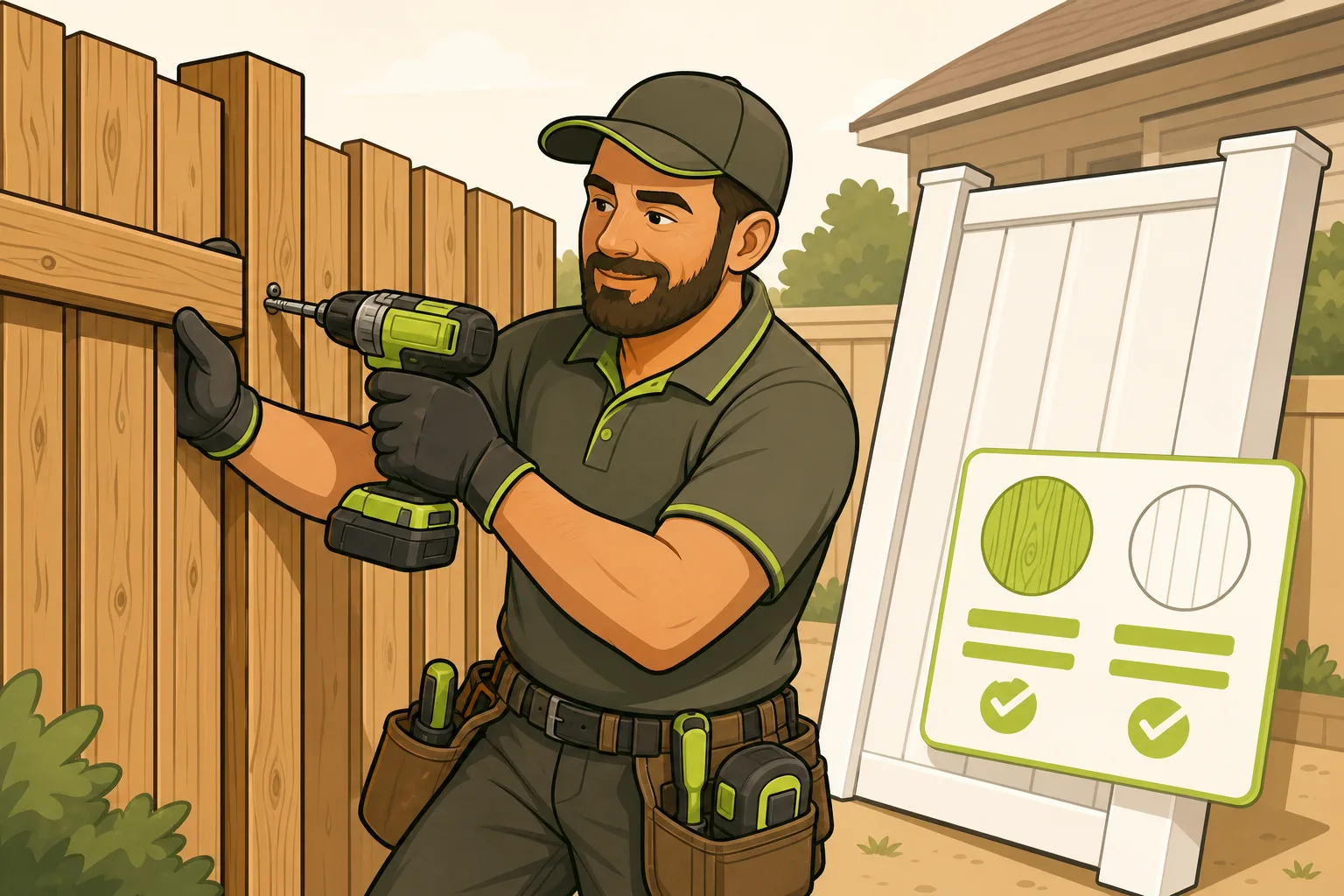
Wood fences cost less upfront — typically $15–$25 per linear foot installed — and vinyl runs $25–$40 per linear foot. But by year 10, the gap closes. A wood privacy fence needs staining every 2–3 years and boards replaced; a vinyl fence needs soap and water. Choose wood for natural warmth and paint flexibility. Choose vinyl for low maintenance and longer lifespan — if your HOA allows the color and profile you want.
This is based on GrowLocal's proprietary research into top-ranking local fencing company websites, plus what fence crews consistently report across years of installations.
What does it actually cost to own each fence for 10 years?
The sticker price is only half the story. Install a 150-foot, 6-foot-tall privacy fence and the numbers look like this:
| Material | Install cost | 10-year maintenance | 10-year total |
|---|---|---|---|
| Pressure-treated pine | $2,250–$3,750 | $1,200–$1,800 (staining + repairs) | $3,450–$5,550 |
| Cedar | $3,750–$5,250 | $900–$1,500 (staining + repairs) | $4,650–$6,750 |
| Vinyl | $3,750–$6,000 | $50–$150 (occasional rinse) | $3,800–$6,150 |
Cedar and vinyl reach near-parity by year 10. Pressure-treated pine starts cheaper but closes the gap faster because it needs more frequent staining.
Extend to 20 years and vinyl pulls ahead. Most wood fences need significant post and rail replacement around year 12–15, adding $1,000–$2,500. A vinyl fence built on properly set posts is typically still solid at that mark with no major investment.
Residential fencing projects typically run $3,000–$15,000. Across GrowLocal's proprietary research into top-ranking fencing companies, every top site leads with a free estimate — because soil conditions, slope, gate count, and regional labor rates change the final number more than material choice does. Get a quote from a local fencing contractor before treating any range as final.
If the numbers in that table look different from what you've seen online, read what every fence cost calculator systematically leaves out — the six variables most tools skip.
What does our crew see when we come back 5 and 10 years later?
This is the question no comparison table answers.
Wood fences at year 5: The most common call-backs are bottom board rot and post-base softening. Posts set in concrete to grade level — a common shortcut — pool water at the base and accelerate decay. Boards in the low sections of a sloped yard fail first. Cedar holds up noticeably better than pressure-treated pine, particularly in yards with irrigation that keeps the soil damp.
Wood fences at year 10: On a pressure-treated pine fence, expect to replace 15–30% of the boards and re-stain the full run. Cedar in the same window looks older but stays structurally solid when stain was applied properly and refreshed once. Gate posts are the first failure point — they carry repeated stress field posts don't.
Vinyl fences at year 5: Virtually no call-backs for material issues. Common returns are post movement from frost heave in cold climates and cosmetic damage from impacts (a backed-into gate, a fallen limb).
Vinyl fences at year 10: Still solid. Panels haven't yellowed in typical climates. Newer UV-stabilized PVC formulations handle sun and heat far better than early vinyl products did.
The honest comparison: Wood looks better at year 1. Vinyl looks better at year 10 — because it still looks like year 1.
Does climate change the answer?
Yes — significantly. This is the dimension every consumer guide glosses over.
Humid Southeast (Florida, Georgia, the Carolinas, Gulf Coast): Wood fences in high-humidity climates decay faster. Mold, mildew, and fungal rot are active problems — not just theoretical ones. Cedar performs better than pine here, but even cedar needs vigilant staining. Vinyl's climate advantage is largest in this region. A well-installed vinyl privacy fence in Tampa or Charlotte typically outlasts a wood fence in the same yard by 8–12 years.
Dry Southwest (Arizona, Nevada, parts of Texas): Wood fences hold up better in dry climates — the absence of moisture is wood's enemy's enemy. UV exposure bleaches stain faster, but the structural integrity of the fence is less threatened. The comparative durability gap between wood and vinyl narrows considerably in Phoenix or Las Vegas.
Cold climates (Midwest, Mountain West, Northeast): Vinyl can become brittle under heavy impact in extreme cold. Modern formulations handle this better than early PVC, but the risk is real at sub-zero temperatures. Wood handles cold-weather impacts better. Frost heave affects both materials equally — it's a post-depth issue, not a material issue.
For a deeper look at how regional factors affect the full range of fencing websites and contractor approaches, the variation across markets is substantial.
What do HOAs actually restrict?
This is where the wood-vs-vinyl math changes for many homeowners — and where ranking pages universally punt with "check with your HOA."
Here's what HOAs typically restrict in practice:
- Vinyl color: Most HOAs that allow vinyl limit it to white, tan, or clay. If you want a wood-grain-look vinyl panel in a warm brown, check before you buy — many HOAs prohibit it even though the product exists.
- Vinyl profile/style: Some HOAs specify that only certain profiles (shadowbox, stockade, picket) are approved. A board-on-board vinyl panel may require separate approval.
- Wood stain color: HOAs that allow wood often require a specific stain color or brand to match adjacent properties. "Natural wood" doesn't always mean unstained.
- Height by location: Front yards frequently have a 4-foot maximum; rear yards allow 6 feet. Decorative post caps may or may not count toward height — the CC&Rs specify.
- Approval timeline: HOA architectural review committees typically take 2–4 weeks to approve a fence application. This must happen before a contractor pulls a permit, which adds time.
The practical implication: some homeowners want vinyl for low maintenance and discover their HOA only approves white picket profiles — not the 6-foot privacy panel they had in mind. Others discover the HOA requires a wood-grain appearance and permits only cedar or redwood. Confirming this before choosing material avoids a costly restart.
Key takeaway: Across GrowLocal's proprietary research into top-ranking local fencing company sites, pricing transparency — across all home-services categories — is hidden on 92% of local business websites. The free estimate is the funnel. That's not evasion — it's because HOA requirements, permit requirements, soil conditions, and site-specific factors genuinely change the number. A contractor who walks the site gives you a real quote; a calculator gives you a range.
Which fence is easier to repair?
Wood wins for partial repairs. Individual boards are interchangeable. A damaged board comes out and a new one goes in. If you're handy, a single-board repair costs $15–$40 in materials. Matching the weathered stain color is the main challenge — new boards are lighter and need staining before installation to blend.
Vinyl requires panel replacement. You cannot replace a single picket in a vinyl panel — the panels are manufactured as units. If a section is cracked or broken, you replace the panel (typically 6–8 feet wide). If the profile is discontinued, sourcing a matching panel years later can be difficult. This is vinyl's most significant maintenance disadvantage — it's infrequent, but when repairs are needed, they're less flexible.
Post replacement is roughly equivalent for both materials in labor cost, though vinyl posts require matching the existing size and color.
Which fence adds more home value?
Both materials add value when they're in good condition, the right style for the neighborhood, and installed professionally. A well-maintained wood or vinyl privacy fence typically adds 3–5% to property value in markets where privacy fencing is common. The materials are comparable — with one catch: a deteriorated wood fence with peeling stain and missing boards actively detracts from value. A buyer sees a project, not an asset.
The material that adds more value is the one that still looks good at the time of sale. Vinyl's durability advantage compounds at resale.
Browse local fencing company websites to see what the professionals in your market are installing and how they present the options.
Frequently Asked Questions About Wood vs. Vinyl Fencing
Is vinyl fence worth the extra cost?
For most homeowners, yes — especially in humid climates and for buyers planning to stay in the home 10+ years. The upfront premium of $10–$15 per linear foot is typically recovered in avoided maintenance costs (staining, board replacement) within 8–12 years. In dry climates, the value proposition is narrower.
What lasts longer, wood or vinyl fence?
Vinyl lasts longer in most climates and with minimal maintenance — typically 20–30 years versus 10–15 years for pressure-treated pine or 15–20 years for cedar. The exception is dry, low-humidity climates where wood's durability gap with vinyl narrows.
Does vinyl fence look cheap?
Older vinyl profiles from the 1990s have a plastic appearance that earned the reputation. Modern formulations include wood-grain textures, multi-tone colors, and heavier wall thicknesses that look substantially better. The white privacy panel reads as clean and low-maintenance rather than natural — whether that's "cheap" is a matter of preference.
Can I get an online quote for a wood or vinyl fence?
Some contractors offer instant online estimators. Most give a quote after a site visit — soil conditions, grade, gate count, HOA requirements, and permit fees all change the number in ways an online form can't capture. Across GrowLocal's proprietary research into top-ranking fencing companies, every site uses a free estimate rather than a published price list. Request a quote from a contractor in your area for an accurate number.
Do I need a permit for either material?
Permit requirements depend on your municipality, not the material. Most jurisdictions require a permit for any fence over a certain height (commonly 6 feet) or within a certain distance of a property line. If your property is in an HOA, you also need HOA architectural review approval — typically before the permit application. A fence contractor who handles permitting manages this for you.
Which fence is better for dogs?
Vinyl has an advantage for dog containment — no individual boards to chew, pry apart, or dig under at board gaps, and a shadowbox vinyl panel has fewer footholds than board-on-board wood. The limiting factor for containment is usually height and post strength, not material. A properly installed wood fence of adequate height works for most breeds.
Does a fence contractor need a website?
Yes — and it needs to work the same way the fence does: show the work, make quoting easy, and hold up over time. A fencing contractor website that leads with a gallery, a specific warranty claim, and a prominent quote form converts the same homeowners reading this comparison.