

Updated June 2026
Google Business Profile is not enough for a funeral director. A GBP listing gets your name into local search results and maps — but it cannot carry your service descriptions, your family-ownership story, your pricing transparency, or a contact form for pre-planning families. The funeral homes that consistently convert both immediate-need callers and advance planners run GBP and a fast owned site together.
This is based on GrowLocal's proprietary research into top-ranking local business websites.
Below: what GBP does well for funeral homes, what it cannot do, a side-by-side comparison table, and why the winning play is always GBP plus your own site.
What Does Google Business Profile Actually Do for a Funeral Director?
GBP puts your funeral home on the map. When a family searches "funeral home near me" at 2 a.m., your listing shows your name, phone number, hours, and star rating. A click-to-call button from a GBP card can save a family precious minutes during one of the worst moments of their lives.
GBP also lets you collect and display Google reviews, post photos of your facility and staff, list basic services, share updates, and show accurate hours. For a funeral home competing against corporate chains like Dignity Memorial, a strong GBP presence is table stakes — not the ceiling.
What Can't a Google Business Profile Do for a Funeral Home?
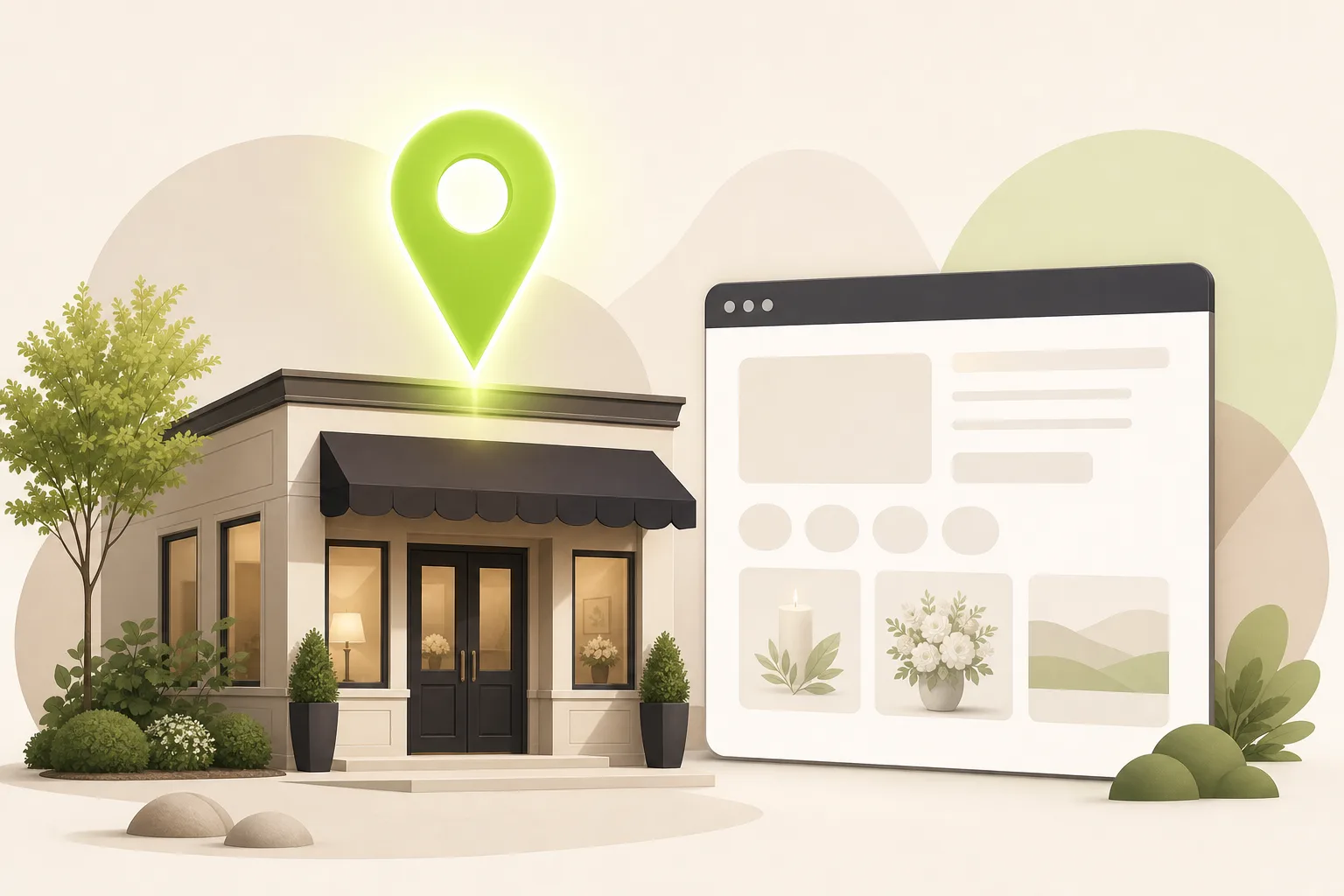
GBP is a directory card. It tells people you exist. Your own website is where you close.
GBP cannot:
- Tell your multi-generational family-ownership story in depth
- Carry a full service breakdown across cremation, burial, pre-planning, veterans services, and green options
- Host pre-planning contact forms (families planning ahead fill forms, not map listings)
- Publish a pricing page or pricing pledge — the single most powerful conversion differentiator in this category
- Run a live obituaries feed (obituary pages drive enormous direct traffic as families share links)
- Build topical authority for grief-related searches: "what to do when someone dies," "children and grief," "pre-planning checklist"
- Control your brand narrative against what a review or a competitor post says
Across our research into top-ranking local business websites, every funeral home that led its market had a full site — not because GBP failed, but because GBP alone cannot carry the depth that death-care services require.
GBP vs. Your Own Funeral Home Website — Side by Side
| Capability | Google Business Profile | Your Own Website |
|---|---|---|
| Google Maps + "near me" search | Yes | Only if linked from GBP |
| Click-to-call (immediate need) | Yes | Yes (sticky header) |
| Google reviews display | Yes | No (manual testimonials only) |
| Full service pages | No — text only | Yes |
| Live obituaries feed | No | Yes — drives repeat traffic |
| Pre-planning contact form | No | Yes |
| Family ownership / founder story | 1–2 lines max | Full About page with history |
| Transparent pricing or pricing pledge | No | Yes |
| Long-tail SEO (grief guides, FAQs) | No | Yes |
| Own your customer data | No | Yes |
The pattern across our research is consistent: GBP wins the first look; your site wins the decision.
Why Obituaries Make Your Website a Different Category of Asset
One thing separates funeral home websites from nearly every other local category: the obituaries feed.
When a family publishes an obituary on your site, they share that URL with everyone — in texts, emails, social posts. Every share drives a visitor to your domain. Those visitors see your brand, your phone number, your services. An active obituaries section turns your site into a destination that earns direct traffic every week, independent of Google. No GBP listing does this.
The strongest funeral home sites we analyzed lead with a live obituaries feed on the homepage, typically showing three to six recent tributes. It signals the home is active, trusted by real families, and embedded in the community.
The Pricing Transparency Play — Only Possible on Your Own Site
In our research into top-ranking local business websites, 5 of 6 funeral home sites do not publish pricing publicly — requiring a phone call or visit to learn what services cost. The FTC Funeral Rule mandates price disclosure when asked, but most funeral homes still keep rates off their website.
That makes any funeral director willing to publish pricing — or even a transparent-pricing pledge with a dedicated pricing page — an instant standout. Grieving families and pre-planners are both anxious about cost. A starting price for cremation or a full funeral removes that anxiety before the first call.
This is only possible on your own website. GBP has no pricing page.
Key takeaway: Five out of six top-ranking funeral homes hide all pricing online — meaning a funeral director with a published pricing page or a transparent-pricing pledge on their own site holds a rare conversion advantage in this category, across GrowLocal's proprietary research into funeral home competitors.
Does Having a Good GBP Listing Mean You Don't Need a Site?
No — and the reason is compounding authority. GBP and your website do not compete. They reinforce each other.
Your GBP listing links to your website. Your website builds topical authority — grief guides, pre-planning checklists, FAQ pages — that ranks in Google separately from your map listing. Families searching "pre-planning checklist" or "what is aquamation" are not looking at a map card. They are reading content. Your site ranks for those searches. Your GBP card cannot.
Eighty-one percent of consumers used Google to read reviews for local businesses in 2024 (BrightLocal Local Consumer Review Survey, 2024) — making GBP essential for reputation. But 89% of consumers say it is important for small businesses to have a website (GoDaddy survey, December 2023). Both numbers point the same direction: you need both.
See our full breakdown of what converts at GrowLocal's funeral home website guide.
What Should a Funeral Home Website Include Beyond GBP?
Based on the top-ranking funeral home sites we analyzed, these sections consistently convert:
- Sticky phone number and click-to-call — immediate-need families call; make it impossible to miss
- Dual CTA hero — "Call Us Now" for today's need, "Start Pre-Planning" for future planning
- Three service pillar cards — Cremation, Burial, Pre-Planning — the universal structure visitors expect
- Live obituaries feed — three to six recent tributes; drives direct traffic and shows the home is active
- Family ownership story — real names, generations, founding year, community ties
- Pricing page or pricing pledge — even an anchor starting price converts anxious families
- Grief resources and FAQ — "what to do when death occurs," "children and grief" — high-search-volume pages that build authority
- Simple contact form — name, phone, email, message — four fields maximum
For a broader view of what makes local service websites convert, see GrowLocal's website hub for local businesses.
A GrowLocal funeral home website includes contact and pre-planning forms, manually entered testimonials, a gallery, service pages, and fast static hosting that loads on a mobile phone in seconds — which matters when a family is searching from a hospital parking lot. GrowLocal sites do not include online booking or live Google reviews integration; the conversion commitment is a fast quote/contact form backed by a 24-hour-response promise.
We see the same dual-mode conversion challenge in other personal-services categories — for example, our analysis of whether GBP alone is enough for a therapist shows the same conclusion: GBP is necessary but not sufficient when clients research for weeks before making contact.
Frequently Asked Questions About Google Business Profile for Funeral Homes
Does a funeral home really need a website if Google Maps shows up first?
Yes. Google Maps shows you exist and where you are. Your website explains who you are, what you offer, and why a family should trust you. A GBP listing cannot carry your service depth, pre-planning forms, obituaries, or pricing transparency — all of which convert families doing research, not just families calling in crisis.
Can I publish my pricing on Google Business Profile?
You can mention a starting price in your GBP description, but GBP has no dedicated pricing page or structure. In our research into top-ranking funeral home websites, 5 of 6 competitors display no pricing publicly — making a funeral director with a real pricing page on their own site a rare standout in the category.
What converts pre-planning families — a GBP listing or a website?
A website, consistently. Pre-planners research over weeks or months. They read grief guides, compare service packages, look at staff bios, and check for pricing before ever making contact. None of that research happens on a map card. Pre-planning forms, downloadable checklists, and dedicated service pages live on your website — not on GBP.
Does a funeral home website help with search rankings beyond "near me"?
Yes. Your website can rank for long-tail queries — "pre-planning checklist," "difference between cremation and burial," "how much does a funeral cost in [city]" — that GBP cannot touch. These searches happen at every stage of the funnel, including years before any family has an immediate need.
What does a good funeral home website need?
A calm, fast-loading site with: sticky phone number, dual CTA hero, three service pillar cards, obituaries feed, family ownership story, real staff photos, a grief resources section, and a simple contact form. A pricing page is optional but powerful. See the full checklist at What Families Need to See on a Funeral Home Website.
Is GBP alone enough if I'm a smaller or newer funeral home?
No — and a newer home needs an owned site more, not less. You haven't yet built the Google review volume or the multi-generational brand recognition that larger competitors rely on. Your site is where you tell your story, publish your pricing, and earn trust before families ever meet you. Starting with GBP only means giving up that credibility-building channel at exactly the moment you need it most.