


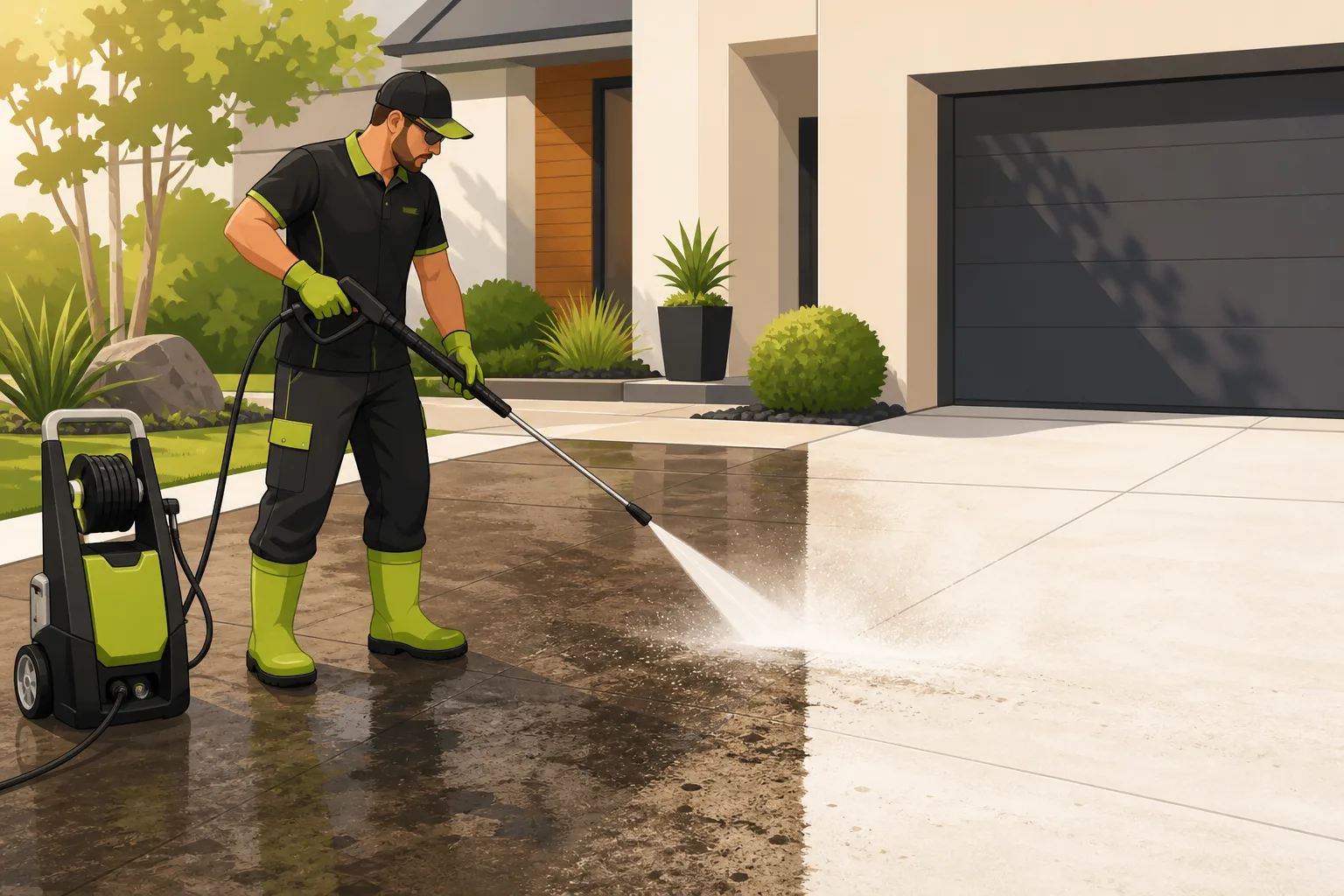
You lose the driveway job in the first 10 seconds. Not to the cheaper guy — to the competitor whose website shows a jaw-dropping before/after photo and a quote form right there on the page. The customer with green algae creeping up their siding doesn't want to hunt for your phone number. They want proof that you can fix it and an easy way to ask you how much.
That's the whole game for pressure washing. Visual transformation proof plus frictionless quote requests. Every other element on your website supports those two things or it doesn't belong.
Here's what we found looking at pressure washing websites from all over the country — the patterns that separate the operators winning jobs online from the ones waiting for the phone to ring.
What the Winning Pressure Washing Sites Are Doing
When we analyzed pressure washer websites from markets across the country, a few things stood out immediately. The sites generating the most leads share a tight set of characteristics that most local operators aren't executing well — or at all.
Before/after photos are non-negotiable. Every strong site in the dataset uses real photography of real local jobs. Not stock images of a pressure washer spraying generic concrete. Actual driveways, actual siding, actual rooftops — with the before shot showing the problem (green algae, black mold, oil stains) and the after showing the clean result. One operator puts a "See Before & After Photos" button directly in their hero section alongside the quote request button. That's smart: it sends the uncertain visitor straight to the highest-converting proof on the site before they've read a word of copy.
Across our proprietary local-business website research, before/after photography was flagged as a high-performing section across many transformation categories — and pressure washing is one of them. The category has a structural advantage here: the transformation is visible, dramatic, and fast. Use it.
Quote forms belong above the fold. The universal conversion model for pressure washing is the free quote/estimate request. No operator in the competitive set shows pricing — the job depends on property size, surface type, service mix, and condition. But they all make the quote request as easy as possible. Name, phone, address, service needed. That's it. A form with 12 fields loses the mobile visitor who found you on Google while standing in their driveway staring at a mildew problem.
Phone numbers appear everywhere. On the sites generating real call volume, the phone number shows up in the header, the hero, mid-page, and the footer. Every instance is a tel: link so mobile visitors can tap to call. One operator pairs their quote button with a "Click To Call" link so you always see both options together. The phone is not a secondary CTA — it's co-primary.
Table Stakes: What Every Serious Site Has
Before you can stand out, you have to clear the floor. These elements are universal on top-ranked pressure washing sites:
| Element | What it looks like |
|---|---|
| Licensed & insured | Stated in the hero or trust strip — never buried in the footer |
| Satisfaction guarantee | "100% Satisfaction Guarantee" appears on nearly every site; the named variant ("our personal guarantee") works harder |
| Review count + star rating | "5.0 based on 400+ reviews" above the fold — linked to the Google source |
| Stat-card trust cluster | 4-card row under the hero: reviews / years in business / properties cleaned / licensed & insured |
| Residential + commercial split | Near-universal nav pattern; keeps residential and commercial visitors in their lane |
| Areas served | A page listing your service territory — not a legal requirement but a conversion and SEO element |
| Named customer testimonials | Not "great service!!!" from anonymous — first name, city, specific job type |
If your site is missing two or more of these, you're getting screened out before visitors read past the hero. Fix the table stakes first.
The Differentiators: What Separates the Top Operators
Once you've cleared the floor, this is where the actual competitive gap lives.
Outcome-first headline copy. Most pressure washing sites lead with the same formula: "[City]'s Best Pressure Washing Service." It's forgettable because it describes you, not the customer's problem. The headline that outperforms is the one focused on the result: "Completely Restore the Look of Your Home" beats "Nashville's Premier Power Washing" every time. Put the city in the subheadline for local SEO — it belongs there — but lead with what the customer gets, not a superlative you and every competitor both claim.
Review count above the fold. Most operators mention reviews somewhere on the page. The strongest ones lead with the number — "5.0 Based on 400+ Reviews" positioned before the headline, not after. When your review count is a specific number and your competitors all say "trusted" and "top-rated" without evidence, you stand out without saying a word about yourself.
Owner-as-brand positioning. For newer businesses without 10+ years of tenure to lean on, this is the most powerful differentiator available. One Phoenix operator built their entire homepage around the owner's face, name, and anti-franchise copy: "you're not getting a call center — you get me." A named personal guarantee ("this is my promise to you") works harder than a generic "100% Satisfaction Guarantee" because it attaches the promise to a person. If you're an independent operator competing against franchise brands, this is your moat.
A 3-step process section. The unstated objection for a lot of first-time customers is "is this a hassle?" A simple "Quote → Schedule → Relax" section with 3 short paragraphs directly addresses that before they hit the contact form. It reduces friction. The sites that include it see it as one of their better-converting sections.
Soft wash vs. pressure wash, explained. If you offer soft washing, brand the methodology. Several operators have built their entire positioning around the idea that soft washing is safer for certain surfaces — siding, roofs, painted wood — than raw pressure. This isn't just a differentiator; it answers a real question your customers are Googling. An FAQ section that covers "What's the difference between soft washing and pressure washing?" earns search traffic and pre-qualifies visitors before they contact you.
Branded micro-copy. "Freaky Fast Quote" sticks. "Get a Free Estimate" is on every other site in your market and nobody remembers it. Small copy investments — a memorable name for your quote process, a tagline that describes the transformation ("from green to clean") — cost nothing and compound across every touchpoint. Your competitors are all interchangeable. Personality is cheap differentiation.
Common Mistakes We See on Pressure Washing Websites
Stock photos. Every strong competitor in the dataset uses real photography of real local jobs. Zero stock images. In a transformation-driven category, a stock photo of a pressure washer spraying generic concrete signals immediately that you don't have actual results to show. Your real before/after photos — even shot on an iPhone — are worth more than polished stock imagery.
Hiding the quote form. Some operators bury the contact form on a separate page and make it easy to miss from the homepage. You should have the form embedded mid-page on the homepage, not just linked from a nav item. One strong operator repeats the quote form in the hero, mid-page, and footer. Don't make someone hunt for the form when they've already decided they want a quote.
Pricing language that contradicts the free-quote model. Every strong competitor in the dataset hides pricing — the quote-based model exists because job pricing genuinely varies by surface area, condition, and service mix. But some sites undercut themselves with copy like "affordable rates" or "competitive pricing" without any support. The compensating move is making the quote feel instant and easy: "We'll get you a quote within the hour" does more work than "affordable."
Generic service descriptions. "We wash driveways and houses" is a missed opportunity. The operators with the most SEO visibility dedicate individual pages to each service — house washing, roof soft wash, driveway pressure washing, concrete and paver sealing, gutter cleaning. Each page answers the specific question a customer types into Google ("pressure washing driveway near me," "soft wash roof cleaning [city]"). A separate page per service takes a day to build and pays in search rankings for years.
No service area depth. Nearly every competitor analyzed has an "Areas Served" page listing the towns and suburbs they cover. None of them have taken the next step: individual landing pages for each service area. One city page per suburb you serve — each with localized copy about that area — is an open SEO opportunity that no one in most markets has claimed yet. If you want organic leads without paying for ads, this is the highest-leverage technical move available to you. We cover this in more depth on the pressure washing websites page.
The Mobile Reality
A meaningful share of pressure washing searches happen on phones — people in the driveway, noticing the grime, acting on a deadline. Your quote form has to work perfectly on a 6-inch screen. Your phone number has to be a tap-to-call link everywhere it appears, not just in the header. Your before/after photos need to load fast — galleries are heavy, and a 3-second load on a 4G connection loses the impatient customer to the next result.
Test your site on your own phone. Fill out your own quote form. If anything gives you friction, your customers are experiencing it too.
What a Strong Pressure Washing Website Gets You
The operators who build this correctly get a specific outcome: they stop being one of three names in a customer's "got a few quotes" list and start being the obvious first call. The before/after proof converts cold traffic before they talk to you. The review count establishes credibility without you making any claims. The fast quote form starts the job conversation immediately.
GrowLocal builds websites for pressure washing companies with all of this built in — before/after galleries, a quote intake form that captures the right information upfront, manual testimonial display, and a design built for the phone-forward, trust-first conversion model this category requires. Plans start at $20–30/month. You preview your site before you pay for anything.
If you're building out your home services presence, the same principles apply to related categories like house cleaning and junk removal — home services with trust barriers and visual proof as the primary conversion drivers. And if you want to see what a solid local business site looks like across dozens of industries, browse all website types.
Quick Takeaways
What every pressure washing site needs:
- Real before/after photos of actual local jobs (never stock)
- Quote form above the fold — name, phone, address, service, that's it
- Phone number as a tap-to-call link in header, hero, mid-page, footer
- "Licensed & Insured" and a satisfaction guarantee stated plainly
- Review count with a specific number, above the fold
What separates the top operators:
- Outcome-first headline ("restore the look of your home") instead of "[City]'s Best"
- Owner's face and name for independent anti-franchise positioning
- Dedicated page per service (house wash, roof, driveway, sealing, gutters)
- Soft wash methodology explained — it answers a real search query
- A 3-step process section that kills the "is this a hassle" objection
The one move most operators haven't made:
Individual landing pages for each suburb you serve. Every competitor has an Areas Served page. Almost none have gone further. This is the open SEO lane in most markets.
FAQ
Should I show my prices on the website?
Every strong competitor hides pricing — the job depends on too many variables to quote without seeing the property. What you should do instead is make the quote request as fast and easy as possible. "We'll get back to you within the hour" and a short form does more work than a price range that anchors you against competitors you can't see.
How many before/after photos do I need?
More is better, but 6–10 strong examples covering your core services (driveway, house wash, roof, concrete) is enough to convert. Use real jobs from your market. A photo of a Tampa pool cage or a Charlotte siding job reads as authentic in a way that generic imagery doesn't.
Do I need separate pages for each service?
Yes, if you want organic search traffic without paying for ads. Each service page is an answer to a specific search query. "Pressure washing driveway [city]" and "soft wash roof cleaning [city]" are different searches from different customers with different problems. One page can't rank for both.
What's the single highest-ROI change on most pressure washing websites?
Adding a before/after gallery if you don't have one, or moving your quote form above the fold if it's buried. Either change can be done in a day and starts converting traffic you're already getting.