


Updated June 2026
The best smoke shop websites share a clear design logic: dark theme, identity-led copy, and a location block built for the customer who searched "smoke shop near me" and needs to decide in the next 10 seconds. In our proprietary research into top-ranking smoke shop sites across Denver, Phoenix, and Tampa, every high-performing site got these three things right. Most did not.
This is based on GrowLocal's proprietary research into top-ranking local business websites. Here's what separates the winners from the also-rans.
Do smoke shops need an e-commerce website or a brochure site?
Most independent smoke shops need a brochure site, not a full e-commerce store.
In our analysis of smoke shop websites, the highest-converting sites made "Get Directions" or a prominent phone number the primary call-to-action — not "Add to Cart." Shipping vape and tobacco products across state lines is a legal compliance minefield (PACT Act, high-risk payment processing, age verification at delivery) that keeps most independent shops firmly in brochure territory.
The conversion action for a local smoke shop is foot traffic: a customer sees your hours and location, decides you're close enough, and walks in. E-commerce doesn't accelerate that — it complicates it.
E-commerce makes sense for multi-location chains with compliance staff, shops with an existing online audience, and specialty glass dealers with national reach. For everyone else, a fast brochure site is the right move.
See how GrowLocal's smoke shop website approach fits the brochure-first model.
What does a good smoke shop website actually look like?
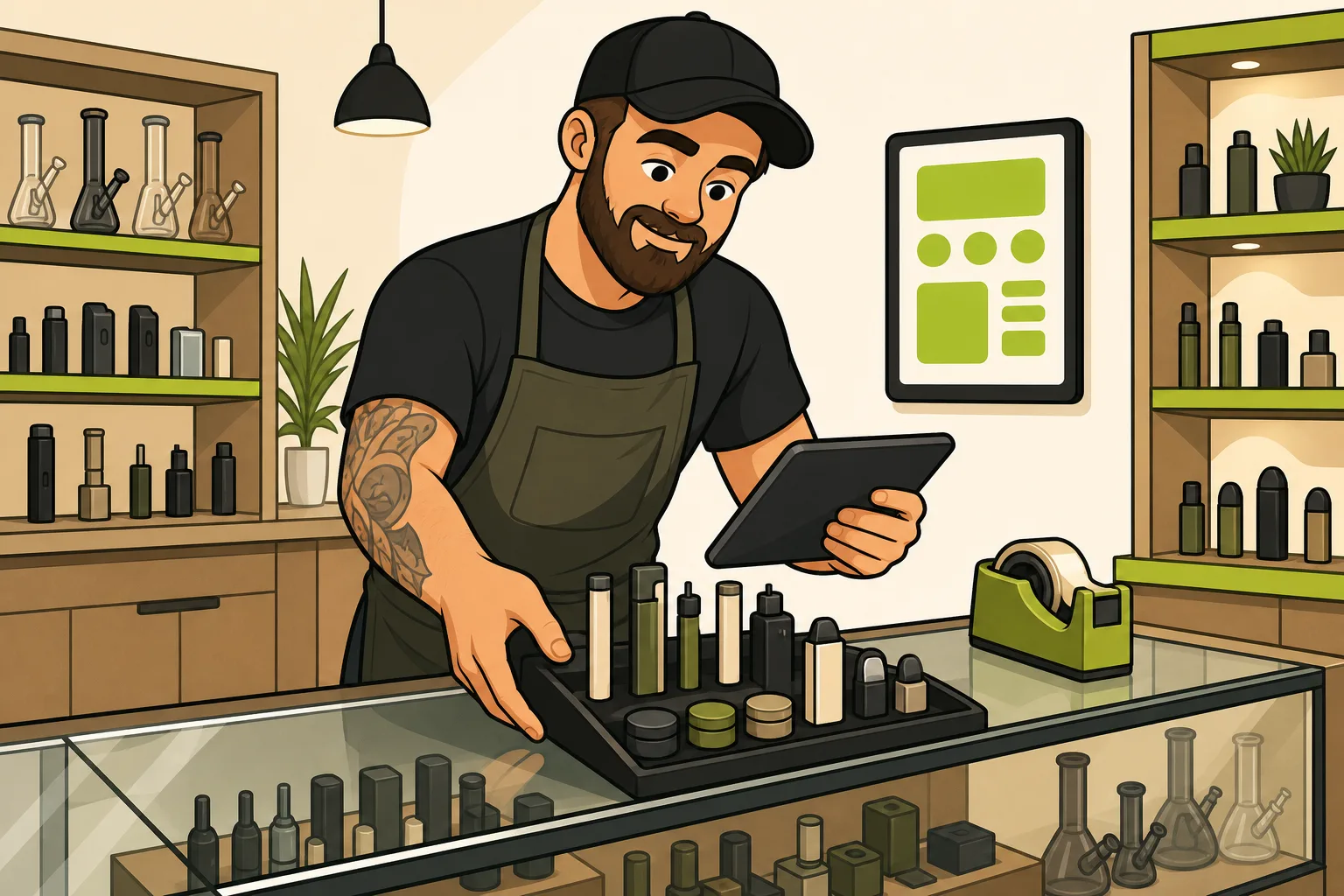
In our research, the strongest smoke shop sites shared a clear visual pattern: dark header and navigation, white or light-gray content body, with product photography carrying all the color.
Five of the six sites we analyzed used this exact scheme. The accents varied — warm amber, neon green, deep purple — but the underlying logic was the same: dark frames for the brand, light canvas for the content. It's the right choice. Smoke shop products are visually rich. Glass pieces, vape devices, and hookah setups photograph beautifully against dark backgrounds. A dark-framed site lets the inventory be the hero.
Two things separated the design leaders from the laggards:
Typography: Weak sites used heavy all-caps default headings ("YOUR ONE STOP SHOP FOR ALL YOUR SMOKE & VAPE SHOP SUPPLIES IN [CITY]!") with no personality. Strong sites used clean, confident display type paired with readable body text.
Photography: Design leaders treated glass like jewelry — real product shots on dark backgrounds, showing texture and color. Weak sites used neon vape renders and smoke-cloud stock images. Stock photos read as cheap to an audience that knows what quality glass looks like.
If you're looking at what smoke shop sites should include, start with these two decisions: commit to a real dark-theme design and invest in actual product photography.
What copy works on a smoke shop website?
Two copy camps exist in this category, and one clearly wins.
Identity-led copy leads with who you are: "Locally-Owned. Family-Driven." or "Tampa's Premier Smoke & Vape Lifestyle Shop." It treats the reader as someone who wants to know your story first.
Keyword-stuffed copy leads with search terms: "YOUR ONE STOP SHOP FOR ALL YOUR SMOKE & VAPE SHOP SUPPLIES IN [CITY]!" It optimizes for robots and reads awkwardly to humans.
The identity-led approach wins — not just in readability, but in differentiation. If every local shop says "best smoke shop in [city]," none is memorable. Put your city name in the title tag and a subhead for SEO. Use your hero headline to say something true about your shop.
We see the same pattern across local business websites in every category — genuine identity beats keyword copy consistently.
What trust signals actually work for smoke shops?
Smoke shop trust signals are different from most retail categories. In our research, the #1 trust signal in this category is local alternative-press awards — "Best Head Shop" badges from alt-weeklies and city publications, cited by name and year.
Why? Smoke shops can't advertise on Google, Meta, TikTok, or Bing. The advertising ban means third-party recognition is more valuable here than in almost any other retail category. A "Best Head Shop" badge from your city's alt-weekly is credible in exactly the way a self-written claim isn't.
The second most effective trust signal: years in business — "Family owned and operated since 2014" or "Celebrating 25 Years." Pair it with named customer testimonials (actual names and quotes, not just star ratings) to build the picture of a real, established shop.
What's absent from this category: BBB badges, industry certifications, money-back guarantees. This category runs on local reputation.
Key takeaway: Across our research into top-ranking smoke shop websites, local press awards and founding-year claims are the trust signals that separate category leaders from the rest — both far more effective than generic "5-star" badges or certificate logos.
What pages does every smoke shop website need?
| Page | What it must do |
|---|---|
| Home | Dark-themed hero with identity-led headline, product category showcase, trust signals (awards + years), location card with hours + phone + map |
| Location(s) | Address, full hours, phone number, map embed, parking notes — one page per store for multi-location shops |
| Products | Category showcase (Glass / Vapes / Hookah / Accessories / CBD-Kratom) with photos — not a price list, not a checkout |
| About | Family/local ownership story, founding year, staff personality, community involvement |
| Contact | Phone, address, hours, simple contact form |
Optional but effective: a "Current Specials" page (updated manually), a rewards program signup, and a blog with buying guides.
Compliance furniture every site needs: A 21+ age statement (prominently placed, minimum in the footer) and FDA-style disclaimer language. In our research, every serious site included this regardless of whether they sold online — it doubles as a trust signal, showing the shop takes compliance seriously.
If you're comparing builders, our smoke shop website builder guide explains which platforms restrict this category and why a static brochure site sidesteps most compliance headaches.
What should the location block include?
The location block is the most important section on a smoke shop website — not the hero.
In our research, every site we analyzed treated location information as the highest-priority content: address, current hours, phone number, and a map link, per store. The reason is straightforward: the dominant search is "smoke shop near me" and buyers pick the nearest open store with the right inventory. If a visitor can't immediately confirm you're open and reachable, they bounce.
What the location block needs:
- Street address linked to Google Maps
- Full hours for every day of the week — list each day explicitly, including Sundays
- Tap-to-call phone number (only 66% of local-business homepages exposed a tap-to-call link in our audit — a costly oversight on mobile)
- Map embed or "Get Directions" link
For multi-location shops, each location gets its own card or dedicated page with its own hours and local photos.
How does a smoke shop handle age verification on a website?
For a brochure site, you don't need an age-gate modal. A prominent "We sell products for adults 21+ only" statement in the footer — plus an FDA-style disclaimer — is standard and sufficient. The JS modal ("Are you 21 or older? Yes / No") belongs on e-commerce checkout pages; on a brochure site, it creates friction without a legal payoff.
Some owners add a simple banner above the fold: "All products for adult use only — 21+ required by law." It's visible compliance without blocking visitors from finding your hours.
If you're still deciding whether a website is worth the investment, our post on whether a smoke shop website pays off covers the ROI case directly.
Frequently Asked Questions About Smoke Shop Website Design
What color scheme works best for a smoke shop website?
Dark header and navigation with a light content body is the dominant pattern in this category — found on the majority of top-ranking smoke shop sites we analyzed. The dark frame suits the product category (glass and vape hardware photograph beautifully against dark backgrounds) and signals quality without looking clinical. Choose one confident accent color — amber, neon green, or deep purple — and apply it consistently to CTAs and highlight elements.
Should I show prices on my smoke shop website?
Most smoke shop brochure sites hide pricing — matching the broader pattern from our research where 92% of local business websites show no prices at all (N=237 sites, 28 categories). Commodity prices change weekly; heady glass prices depend on the specific piece. Standard approach: show product categories with photos and "Come in and see our selection." The exception is a "Current Specials" page — specific deals are effective and low-maintenance.
What's the most important section on a smoke shop website?
The location block — address, hours, phone number, and map link. The dominant search is "smoke shop near me" followed immediately by confirming the shop is open. In our analysis of top-ranking smoke shop sites, every site treated location information as high-priority content, not a footer afterthought. A visitor who can't find your hours in the first 5 seconds will click back and try a competitor.
Do I need a web designer or can I use a template?
You don't need a custom build from scratch. You need a professionally designed brochure site with the right structure: dark theme, real product photos, location block, and a simple contact path. Templates can work, but watch for platform restrictions — many popular builders ban tobacco and vape content. Our smoke shop website builder guide covers which platforms restrict this category.
How do I make my smoke shop website rank on Google?
Get the basics right: city name in the title tag and H1, accurate and consistent name/address/phone across your site and Google Business Profile, a fast-loading mobile site, and real product photos. For local search, Google Maps ranking matters more than organic results — your website's consistent NAP information is a key signal for Maps. Our smoke shop local search guide explains the foot-traffic mechanism.
What testimonials should I put on my smoke shop website?
Use named testimonials — first name and last initial — pulled from real Google reviews with the customer's permission. The strongest sites we analyzed quoted 4–5 specific reviews with names, often citing specific products ("best glass selection in the city") or staff ("always helpful, never judgmental"). Avoid generic claims like "great prices." Specificity signals authenticity.
Ready to see what a properly designed smoke shop site looks like in practice? GrowLocal builds smoke shop websites designed for foot traffic — dark-themed, fast, mobile-ready, with all the trust signals this category requires.