


Social Media Marketing for Interior Designers: What Actually Works
Updated June 2026
Social media marketing for interior designers works when you stop posting tips and start posting entertainment: the before-and-after reveal, the satisfying shelf-styling time-lapse, the "POV: you hired an interior designer" skit, the genuine client-reaction storytime, and the contrarian trend take. These five organic formats drive the reach. The "book a discovery call" post is the easy 20% on top. Instagram Reels plus Pinterest is the realistic two-platform engine, and you only need to post 3–5 times a week if it's the right 3–5.
This is based on GrowLocal's social research into how this category actually earns attention, plus our proprietary research into top-ranking interior design websites.
Why don't "design tips" posts go anywhere?
Dry brochure tips die because they have no hook. The interior design feed that travels is built on five entertainment-first content veins, not on "use the 60-30-10 rule" captions with no reason to stop scrolling. Education has to be entertaining — a myth-bust, an opinion, a satisfying demo — or it never leaves your existing followers.
The promotional post is the smallest slice of a healthy plan. Roughly 75% of what you post should entertain or teach; only about 18–20% should sell. If every post says "book a discovery call," the reach engine stalls and the algorithm stops showing you to non-followers.
Here are the five veins that actually work for this trade.
What is the single best format for an interior designer?
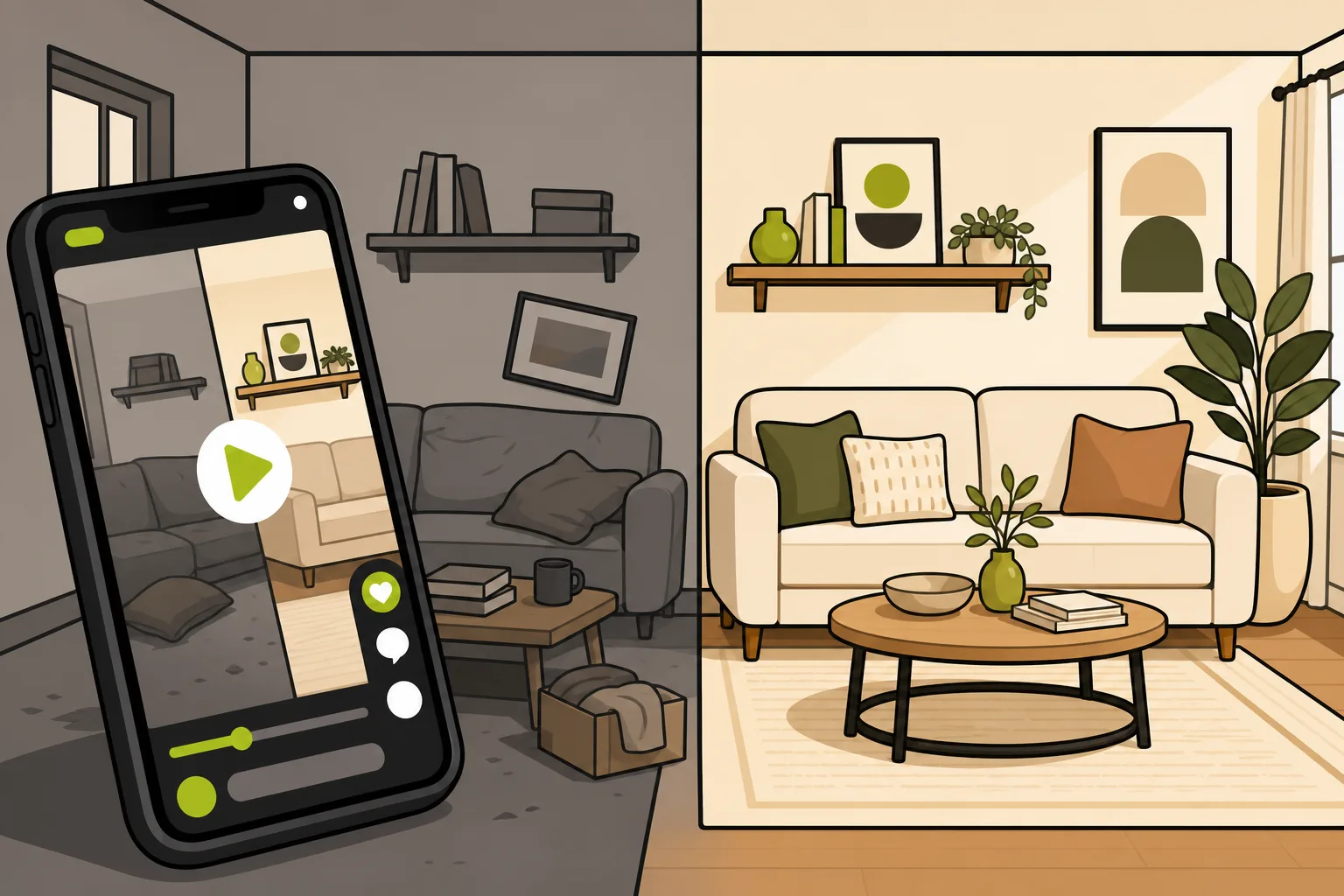
The before-and-after reveal is the category's hero format. "This room went from THIS... to this" is the most reliable organic post an interior designer can make. You cold-open on the cluttered, dated before with no narration, hard-cut to the styled after on the beat of a calm or trending audio, then hold on the finished wide shot and pan across two or three detail moments — the millwork, a textile, the light fixture.
A budget or small-space hook multiplies the reach. "I styled this rental bathroom for under $200" or a #DormTok glow-up broadens your audience far past people ready to hire a designer — and that bigger follow base is what feeds future bookings. Real before/after footage of the same camera angle is the whole trick; matched framing is what makes the transition land.
Key takeaway: The before-and-after reveal is interior design's top organic format. Make it pure reveal with no sell — and add a budget or small-space hook when you can to reach beyond buyers.
What are "satisfying" and ASMR design posts?
Satisfying and ASMR content is the calm-content vein, and it needs no finished client home. The "shelfie" time-lapse is the most repeatable version: open on an empty shelf, console, or mantel, then add items one at a time on the beat — books stacked, a candle, a vase, a plant, a piece of art — do the satisfying micro-nudge, step back, and pull to the magazine-ready arrangement. The caption teaches one principle ("layer heights, mix textures, leave breathing room") and asks people to save it.
The second version is material-pull ASMR: hands flipping through a swatch box, laying out velvet, linen, wood, stone, and paint chips with crisp tactile sounds, then pairing them into the winning moodboard. It showcases your taste and process without a single room photo. Save-worthy is algorithm gold, and these styling formats are the most evergreen thing you can make.
Does humor really work for a luxury design brand?
Yes — relatable humor is one of the strongest follow-drivers in this trade, and it doesn't require dancing. The "POV: you're working with an interior designer" skit, the designer-versus-client dramatization, and the contractor-spouse-versus-designer couple bit all play on a trending audio. So do "designer brain at 2am" and "things interior designers wish you'd stop doing." You play both sides with quick cuts and land an exaggerated punchline.
This is your recurring-character engine. The studio itself, a signature founder voice, or a team/couple dynamic becomes the personality people follow for. An elevated, brand-consistent voice is completely accepted at this tier — you do not have to point at floating text to ride a trend.
How do you use storytime and emotion?
The storytime vein leads with feeling and lets the reveal be the payoff. Open with brief context — who the client is and why the space mattered — glimpse the journey, then show the genuine reaction the moment they walk in, and close on one line about what it means to them. "Her reaction when she saw her kitchen for the first time" is the format. Emotion beats promotion here; the authentic "WOW" does the selling.
One hard rule: residential interiors are private, so get explicit photo and video consent before you publish any client's home or reaction. Real client homes outperform staged or AI-perfect imagery in this category, but consent is non-negotiable.
What about trends and opinions?
Trend reactions and "unpopular design opinions" borrow reach from trend cycles and trending audio. "Rating 2026's biggest design trends," "the trend everyone loves that I'd skip," and "unpopular design opinion:" deliver authority as entertainment. You name the trend, give a quick yes/no/it-depends with a reason, show a real example from your own work, and end on your verdict plus a question to drive comments.
A carousel version works too: the contrarian statement on slide one, real project photos proving your point on the next slides, and the better move stated as a principle at the end. Opinion and myth-busting travel where dry tips die — and they double as proof you actually know the craft.
Which platforms should an interior designer actually use?
Master Instagram and Pinterest before anything else. Instagram Reels is the primary organic engine for transformation, satisfying, humor, and storytime content. Pinterest is the high-intent lead engine — it's a visual search engine where people actively plan kitchens and renovations, and a single keyword-rich pin can drive traffic 12–24 months out, versus roughly 48 hours of life for an Instagram post. TikTok is the reach amplifier for budget transformations, DormTok, and humor when you have capacity. For a solo or boutique firm, depth on two platforms beats spreading thin across five.
| Platform | Role | Best content veins |
|---|---|---|
| Instagram (Reels) | Primary organic engine | Reveals, satisfying/ASMR, humor, storytime |
| Long-shelf-life lead engine (compounds 12–24 mo) | Tall before/after pins, styled "room ideas" pins | |
| TikTok | Reach amplifier | Budget/small-space glow-ups, DormTok, trend reactions |
| Secondary | Repurposed Reels (organic page reach is low) |
A realistic cadence is 3–5 Instagram posts a week mixing Reels and carousels, with consistency prioritized over frequency, plus steady Pinterest pinning since pins compound for months. Batch and schedule — that's how firms keep it sustainable. Whatever you post, keep it 100% real project photography. Stock and AI-perfect renders erode the exact trust this category sells on, and lighting is everything. (Strong, real photos also carry your website — across our proprietary local-business website research, every top-performing design, food, and transformation business used exclusively real photography, with zero stock detected across the analyzed sites.)
What does a healthy month of posts look like?
A healthy monthly mix lands around 75% organic and 25% promotional. Roughly: before/after reveals 25%, satisfying styling and sourcing 15%, myth-bust/opinion 12%, relatable humor 10%, behind-the-scenes 8%, client-reaction storytime 7%, and a spotlight or two — then about 18% promotional, where the discovery-call nudge, a named testimonial, and a seasonal trend-drop live. Hard CTAs concentrate in that promotional slice; everything else ends on a hook, a save prompt, or a question.
Time the promo to seasonal pegs: the New-Year "refresh your space" moment in January, spring refresh in March–May, "grand reveal season" and trend-forecast drops in Q4, and hosting-ready spaces in November–December. And keep it on-brand — no pricing, no discounts, no urgency gimmicks. This category competes on taste and portfolio, not on coupons.
This is a lot of work every week. Is there a shortcut?
Honestly, yes — doing this right is a real weekly job. Five organic veins, two-to-three platforms, batched filming, matched before/after angles, trend audio, consent tracking, Pinterest keywords, seasonal timing. Most designers are busy designing, and the feed is the first thing that slips.
That's the part GrowLocal does for you. We build and host your interior design website, and we auto-write your social posts grounded in your trade and your brand — the reveal captions, the shelfie-styling teaching posts, the myth-bust hooks, the discovery-call nudges — in the right mix, on the right cadence, in the elevated voice this category expects. You stay in control of what goes out; you skip the part where a blank caption box eats your Tuesday night. See how it fits a design studio specifically in our interior design website breakdown, or browse how we build sites for every local trade. If you've read our guide to what an interior design website should include, think of social as the engine that fills it.
Common Questions About Social Media for Interior Designers
How often should an interior designer post on Instagram?
About 3–5 posts a week is the practical target for a solo or boutique studio, mixing Reels and carousels, with consistency valued over raw frequency. Instagram reach decays within roughly 48 hours, so favor save-worthy evergreen formats — styling series, tip carousels — that keep working. Batch and schedule so a busy project week doesn't break your streak.
Instagram or Pinterest — which matters more for interior designers?
Both, for different jobs. Instagram Reels is your reach and brand-voice engine; Pinterest is your high-intent, long-shelf-life lead engine, where a single keyword-rich pin can drive planning traffic 12–24 months out. If you can only commit to two platforms, make them Instagram and Pinterest.
Do I have to dance or be on camera to grow?
No. An elevated, brand-consistent voice is explicitly accepted and preferred at this tier. Face-optional time-lapses — the before/after reveal and the shelfie styling — carry the transformation and satisfying veins without you ever appearing on camera. Humor skits use personality, but plenty of designers grow on reveals and ASMR alone.
Should I post pricing or run discounts on social?
No. Pricing and discount tactics are off-brand for luxury-positioned design firms, and showing rates signals mid-market positioning. It mirrors what we see on the web: across our research into top-ranking local business websites, pricing is hidden on the vast majority of design and professional-service sites, with the consultation funnel doing the converting instead. Keep the CTA to "book a discovery call."
Can I post photos of my clients' homes?
Only with explicit written consent. Residential interiors are private, so always get photo and video permission before publishing a client's space or their reveal reaction. Real client homes are this category's strongest proof and outperform staged or AI imagery — but consent comes first, every time.
What's the fastest way to get reach as a new design account?
Lean into budget and small-space transformations. "I styled this rental for under $200" and DormTok-style glow-ups broaden your audience far past people ready to hire a designer, building the follow base that converts later. Pair that reach content with save-worthy shelf-styling and a recurring humor character.
I don't have time to do all this — can it be automated?
Yes. GrowLocal builds your interior design site and auto-writes your social posts in the right mix and cadence for the trade, so the reveals, styling teaches, and discovery-call nudges go out without you starting from a blank caption box. See our interior design website breakdown for how the site and social work together.