


Social Media Marketing for Plumbers: What Actually Works
Updated June 2026
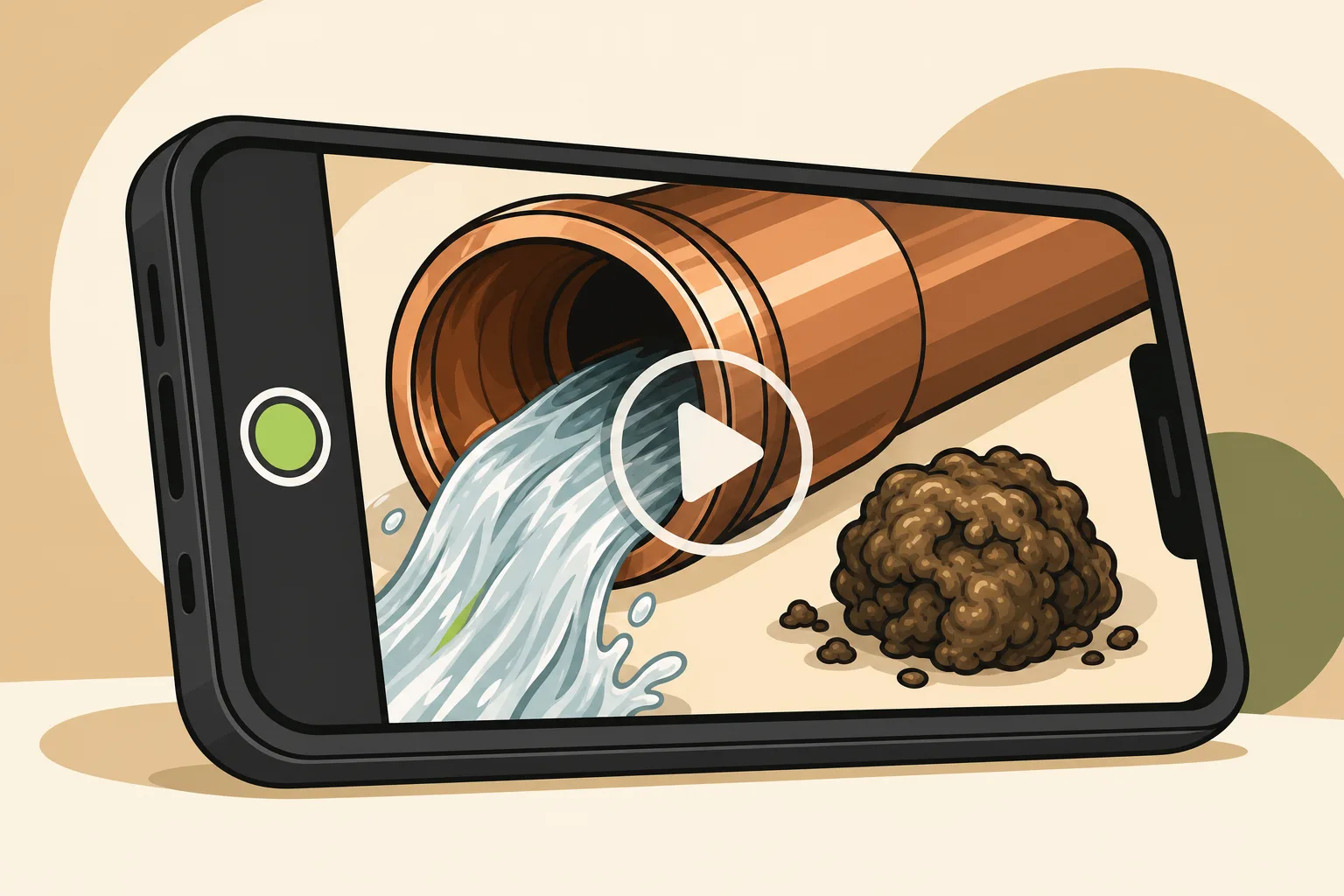
Social media marketing for plumbers works best when you lean into the one thing your trade has that most don't: a viral-native visual genre. The satisfying drain-clog reveal — a hair mass pulled out whole, a grease-berg cleared, water finally rushing free — is the format that travels on TikTok and Instagram Reels. Pair that with gross-but-true storytime clips, relatable "what they said vs. what we found" humor, and seasonal freeze-warning tips, and you build the relationship that makes you the first call when a pipe bursts. Hard sales posts are the small minority. This is based on GrowLocal's category research into how plumbing businesses win attention and customers online.
Below: the exact content veins that earn views for plumbers, a realistic weekly cadence for an owner who's actually on the truck, the platform mix that matters, and how to keep it going without it eating your week.
What kind of plumbing content actually goes viral?
The satisfying clog reveal is the hero format — plumbing is the rare home-service trade with a genuine native visual genre. On TikTok, #draincleaning carries roughly 44,900 posts and #plumbersoftiktok is an established community (per TikTok's own public hashtag pages, viewed 2026). The reveal is the whole content: the worse the before, the stronger the hook.
You don't need five ideas. You need five veins you can mine over and over. Here are the ones that carry the category.
1. The oddly-satisfying clog reveal (your hero format)
Cold-open on the backed-up fixture, send the snake or jetter in, and let the camera hold on the extraction — the hair clog pulled out whole, the grease pulled like a blanket, the water finally rushing free. End on a quiet caption card with the city and no sales ask.
- Hook in the first 1–2 seconds: "Watch what comes out of this drain…"
- Shoot it vertical, captioned (most people watch muted).
- The payoff — clean drain, free-flowing water — should loop.
One rule the trade learned the hard way: a chunk of viral "drain" content is AI-generated fake, and both audiences and algorithms punish it. Real field footage is your moat. Don't fake the gross.
2. The gross-but-true storytime
Talk straight to camera and tease the weird find: "The weirdest thing I've ever pulled out of a pipe." Then walk through the call, the discovery, and the reveal — a foam dinosaur that swelled, a stash of quarters, dentures, a kid's toy army. These clips earn saves and shares because people want to send them to a friend.
Close on a question, not a CTA: "What's the weirdest thing you've lost down a drain?" The comments do the algorithm work for you. Keep it family-friendly — gross is fine, crude is not.
3. Relatable "what they said vs. what we found" humor
Relatability earns follows. The proven plumber comedy formats are simple: the POV skit ("When they say they 'only flush toilet paper'…"), the DIY-gone-wrong reenactment, and the honest pun ("we give a flange about your pipes"). Your crew can be the talent.
4. Myth-busting as entertainment, not a brochure
Education works when it's delivered with energy and a visible demo. Drop a "flushable" wipe in a jar of water and show that it never breaks down. Hold up the grease-berg. The structure: bold claim, show the proof, explain why in plain language, then the "do this instead" tip. End on "save this so you remember" — a save prompt, not a sell.
These myth-busts double as some of your most reusable content: "stop pouring grease down the drain," "where your water shutoff actually is," "the sounds a failing water heater makes."
5. The seasonal weather trigger
Plumbing is one of the most calendar-driven trades, which makes seasonal content your strongest non-evergreen lever. A freeze warning is a same-day post prompt: "First freeze hits {your city} this week — do this tonight," then the 60-second demo (disconnect the hose, drip a faucet, insulate the spigot). The biggest spikes:
- First freeze / cold snap — burst-pipe prevention (the single biggest one).
- Spring thaw — sump-pump checks, post-winter pipe inspections.
- Holiday cooking — grease and garbage-disposal abuse around Thanksgiving and Christmas.
- World Plumbing Day — March 11.
A bonus vein once you've posted a while: recurring characters. The shop dog, the apprentice, the owner's catchphrase — people follow people.
Key takeaway: Plumbing is a trust purchase, not an impulse buy. The satisfying reveal and the honest myth-bust build the relationship; the booking ask is a small slice. Lead with the reveal, not the coupon.
Which platforms should a plumber actually post on?
TikTok and Instagram Reels are the engine; one video should fan out to both plus Facebook. Short vertical video is where satisfying reveals and storytime travel, and the exact same clip cross-posts cleanly. Film once, publish three places.
| Platform | Role for plumbers |
|---|---|
| TikTok | Reach + discovery; where drain reveals and storytime go viral |
| Instagram Reels | Same vertical video; local discovery via tags |
| The local trust + word-of-mouth platform for the 30–65 homeowner; reviews live here | |
| YouTube Shorts | Secondary home for how-to and explainer clips |
| Google Business Profile | Local-intent emergency search; helpful tip posts |
Facebook deserves a specific note: it's where your actual buyer (homeowners 30–65) lives and where neighbor word-of-mouth and reviews happen. The freeze-warning tip and the review-thank-you belong there.
On hashtags, skip the 30-tag dump. Use 3–6 relevant tags — pair the niche community tags (#draincleaning, #plumbersoftiktok, #oddlysatisfying) with one local tag (#YourCityPlumber). The local tag does the geo-discovery; the niche tags ride the established plumber community.
How often does a plumber need to post?
Three to four posts a week, sustained, beats daily bursts you can't keep up. A workable weekly rhythm for an owner-operator:
- 2 short reels — one satisfying clog/repair reveal, one tip or myth-bust.
- 1 before/after — corroded pipe to clean copper, as a carousel or photo.
- 1 social-proof or seasonal post — a thank-you to a real reviewer, or a weather-trigger tip.
Daily posting is not required and isn't realistic when you're on the truck. The trick is to film raw clips in the field on your phone all week, then batch-edit later. You don't need a studio; you need to remember to hit record before the snake goes in.
How do you sell without sounding salesy?
Keep the hard sell to about a quarter of your calendar and let the rest build trust. Plumbing buyers don't book on impulse — they remember who helped them understand their own house, then call that person when water's on the floor. A sustainable monthly mix:
- ~75% organic — satisfying reveals, myth-busts, storytime, humor, before/afters, seasonal tips, behind-the-scenes.
- ~25% promotional — a review milestone, a pre-freeze booking nudge, a
$-off coupon with an expiry, an emergency-availability announcement.
The category gives you natural promo levers without ever publishing prices. Across GrowLocal's proprietary local-business website research, 92% of local business websites hide pricing entirely — funneling visitors to a quote or a call instead — and plumbing follows that rule completely (see our full pricing-transparency data). So your promo posts lean on "free estimate," "waived trip fee," $-off coupons with a date, or a real review count — never a price list. And use one true review number everywhere; don't post 500+ in one place and 700+ in another.
That review count matters more than you'd think. In the home-services category research behind our platform, a specific star rating with a real count is a frequent differentiator — most local competitors stay vague ("trusted," "5-star") without a number. Posting "another 5-star fix this week" with your real total reinforces the one proof currency homeowners actually weigh.
Where does your website fit into this?
Social earns the attention; your site closes it. A reel sends a homeowner who likes you to your profile, and the link in your bio has one job: turn that interest into a call or a quote request. If it points at a slow, pricing-free, trust-thin page, you lose the lead you just earned.
That's the gap a purpose-built plumbing site fills — phone number sticky in the header, a fast quote form, real job photos, your guarantee, your license number, your service area. See our plumbing website breakdown for what converts the traffic social sends. The same patterns hold across trades — the broader local business website research shows the identical phone-first, proof-led structure win in electrical and roofing.
This is a lot of work every week — is there a shortcut?
Yes — done-for-you social is the realistic answer for an owner who's on the truck all day. Everything above is effective and a grind: filming, captioning, editing, scheduling, and keeping a 75/25 mix going across three platforms, every week, forever. Most plumbers start strong and quietly stop by week six.
GrowLocal builds and hosts your plumbing site and writes your social posts for you — already knowing your trade, your brand, and the veins that work for plumbing. We draft the satisfying-reveal caption, the myth-bust, the freeze-warning tip, and the seasonal nudge in your voice, so the only thing left for you is to hit record on the gross part. The content engine that makes plumbers stand out is the part nobody has time for — so we run it.
Start with the site that converts the traffic: see the GrowLocal plumbing breakdown, and let the done-for-you social keep the feed alive while you keep the water flowing.
Frequently Asked Questions About Social Media for Plumbers
What should a plumber post on social media?
Lead with the satisfying drain-clog reveal — it's the one viral-native format your trade owns — plus myth-busting tips ("flushable wipes are a lie"), gross-but-true storytime, relatable humor, and seasonal freeze-warning posts. Keep roughly 75% of it educational and entertaining and only about 25% promotional, because plumbing is a trust purchase, not an impulse buy.
How often should plumbers post on social media?
Three to four times a week, sustained, beats posting daily for two weeks and then stopping. A realistic rhythm is two short reels, one before/after, and one social-proof or seasonal post. Film raw clips in the field on your phone all week and batch-edit them later.
Which social media platform is best for plumbers?
TikTok and Instagram Reels drive the most reach for satisfying reveals and storytime, and Facebook is the strongest local-trust platform for the 30–65 homeowner who actually hires you. The efficient move is to film one vertical video and fan it out across all three, plus Google Business Profile for local emergency search.
Do plumbers really go viral on social media?
Yes — plumbing is one of the few home-service trades with a native viral genre, the oddly-satisfying clog reveal. On TikTok, #draincleaning carries roughly 44,900 posts and #plumbersoftiktok is an established community. The catch: it has to be real field footage, because AI-faked drain clips get penalized by both audiences and algorithms.
Should I show pricing in my plumbing posts?
No — plumbing almost never publishes prices, and across GrowLocal's proprietary local-business website research, 92% of local business websites hide pricing entirely. Use "free estimate," a waived trip fee, a $-off coupon with an expiry date, or a real review count as your promo levers instead, and keep those promotional posts to about a quarter of your calendar.
Can I just pay someone to do my plumbing social media for me?
Yes, and for an owner who's on the truck all day it's usually the realistic choice. GrowLocal writes your plumbing social posts for you — already knowing your trade and the formats that work — and builds the website that turns that attention into booked jobs, so the only thing left for you is to hit record on the satisfying part. For the full breakdown of turning that attention into paying jobs, see how to get more plumbing leads.