


Updated June 2026
Dog behavior modification is a professional program that changes how a dog feels about a trigger — not just what it does on command. If your dog knows "sit" but still lunges, growls, or shuts down with fear, more obedience training won't fix it. You need behavior modification, and in most cases where the problem is aggression, reactivity, or severe anxiety, you need a professional to run it.
This guide covers the key distinction, the signs that DIY has stopped working, and what actually happens when you hire a professional.
What is the difference between dog training and behavior modification?
Obedience training teaches a dog what to do when you give a cue. "Sit," "heel," "stay." The dog learns to respond to your signal. That's a skill.
Behavior modification works on why the dog is doing what it's doing. It targets the emotional state underneath the behavior — the fear that triggers the lunge, the anxiety that drives the destructive pacing, the hair-trigger arousal that makes a dog snap at strangers.
A dog that knows all its commands can still be a behavior modification case. Commands require the dog to comply under pressure. Behavior modification removes the pressure by changing what the dog feels.
The practical difference:
| Obedience Training | Behavior Modification | |
|---|---|---|
| Goal | Dog responds to commands | Dog's emotional response changes |
| Target | Skills and behaviors | Fear, anxiety, aggression, reactivity |
| Best for | Puppies, manners, consistency | Problem behaviors rooted in emotion |
| Owner needed | Usually present, giving cues | Dog can respond independently over time |
| Effect without reinforcement | Can fade | Tends to be more durable |
When does a dog need behavior modification instead of more training?
This is the question most owners get to after months of trying. They've done group classes. They've watched every YouTube video. The dog knows "leave it" — and still loses its mind at other dogs on the leash.
Here are the signs your dog has crossed into behavior modification territory:
- Aggression that hasn't improved with obedience work — growling, lunging, biting, resource guarding, or snapping at family members
- Separation anxiety causing self-injury or destruction — not just whining, but genuine panic: howling, destroying doors, injuring paws escaping
- Fear responses that escalate instead of habituate — the dog isn't "getting used to" the trigger; it's getting worse
- Reactivity that makes regular life dangerous — walks, dog parks, vet visits are no longer manageable
- Sudden behavioral changes in a previously calm dog — especially if recent (this can also signal a medical issue worth ruling out first)
- You've tried the steps and they aren't sticking
The last one matters most. Behavior modification techniques exist in books and videos — desensitization, counterconditioning, threshold management. For mild cases, owners can run them. But for a dog with significant fear or aggression history, DIY behavior modification without a professional reading the dog's signals in real time is genuinely risky. You can inadvertently push a dog past threshold and set the program back weeks.
A good rule of thumb: if the behavior has caused injury, been going on for more than a few months without improvement, or involves anything a child or visitor could encounter, get a professional involved now rather than later.
Key takeaway: In our research into top-ranking dog trainer sites across six markets, behavior-problem owners — dogs with aggression, anxiety, and reactivity — are the segment most willing to invest in professional help, and the one most likely to be underserved by generic obedience training programs. See our full local business website research.
GrowLocalSee a finished Dog Trainers site — built free, no cardWe build it first. You only pay if you launch it — Starts at $5/mo.See Dog Trainers sites we've built
Who should you hire: a dog trainer, a behavior consultant, or a veterinary behaviorist?
The dog training industry is unregulated. Anyone can call themselves a behaviorist. Here's how the credentialed landscape actually breaks down:
Certified dog trainers (CPDT-KA) focus on obedience and skill-building. Many are excellent at foundational behavior work, especially with mild reactivity and manners issues. Good starting point for manageable problems. There are roughly 25,000 CPDT-KA certified trainers worldwide (dogtrainermatch.com, 2026).
Certified behavior consultants (CBCC-KA, IAABC-certified) specialize in the emotional and behavioral problems underneath problem behaviors — aggression, anxiety, phobias, compulsive behaviors. This is the tier most owners with genuine behavior modification needs should target. Ask specifically about their methodology (force-free or balanced training matters for anxious dogs — punishment with a fearful dog tends to suppress warning signals without addressing the root cause).
Veterinary behaviorists (DACVB) hold a veterinary degree plus a specialty board certification in behavioral medicine. They can prescribe medication when anxiety or compulsive behavior has a neurological or physiological component. There are fewer than 90 DACVBs in the entire United States (dogtrainermatch.com, 2026), so waitlists exist. For severe cases — self-injury, bite histories, dogs that have not responded to behavioral intervention — a DACVB is the appropriate referral, often coordinated alongside a trainer or behavior consultant.
Which tier does your dog need?
- Manners, jumping, leash pulling, basic impulse control → certified trainer
- Reactivity, fear, mild-to-moderate aggression, separation anxiety → behavior consultant
- Severe aggression, self-injury, prior failed behavioral intervention, suspected neurological component → veterinary behaviorist, potentially alongside a consultant
For the vast majority of dogs with genuine behavior problems, a qualified behavior consultant with a structured program and methodology transparency is the right starting point. Explore our dog training website guide to see what to look for when evaluating professionals in your area.
What happens at a dog behavior consultation?
Most behavior modification programs begin with an intake consultation — often 60 to 90 minutes. Here's what to expect:
Before the appointment: Complete a detailed behavior history form — when the behavior occurs, how often, and exactly what triggers it. Note any prior training and its methods. Capture video if you can; trainers often cannot replicate anxious or aggressive behavior in a new setting. Bring vaccination records and any medical history — pain is a commonly missed driver of aggression and anxiety.
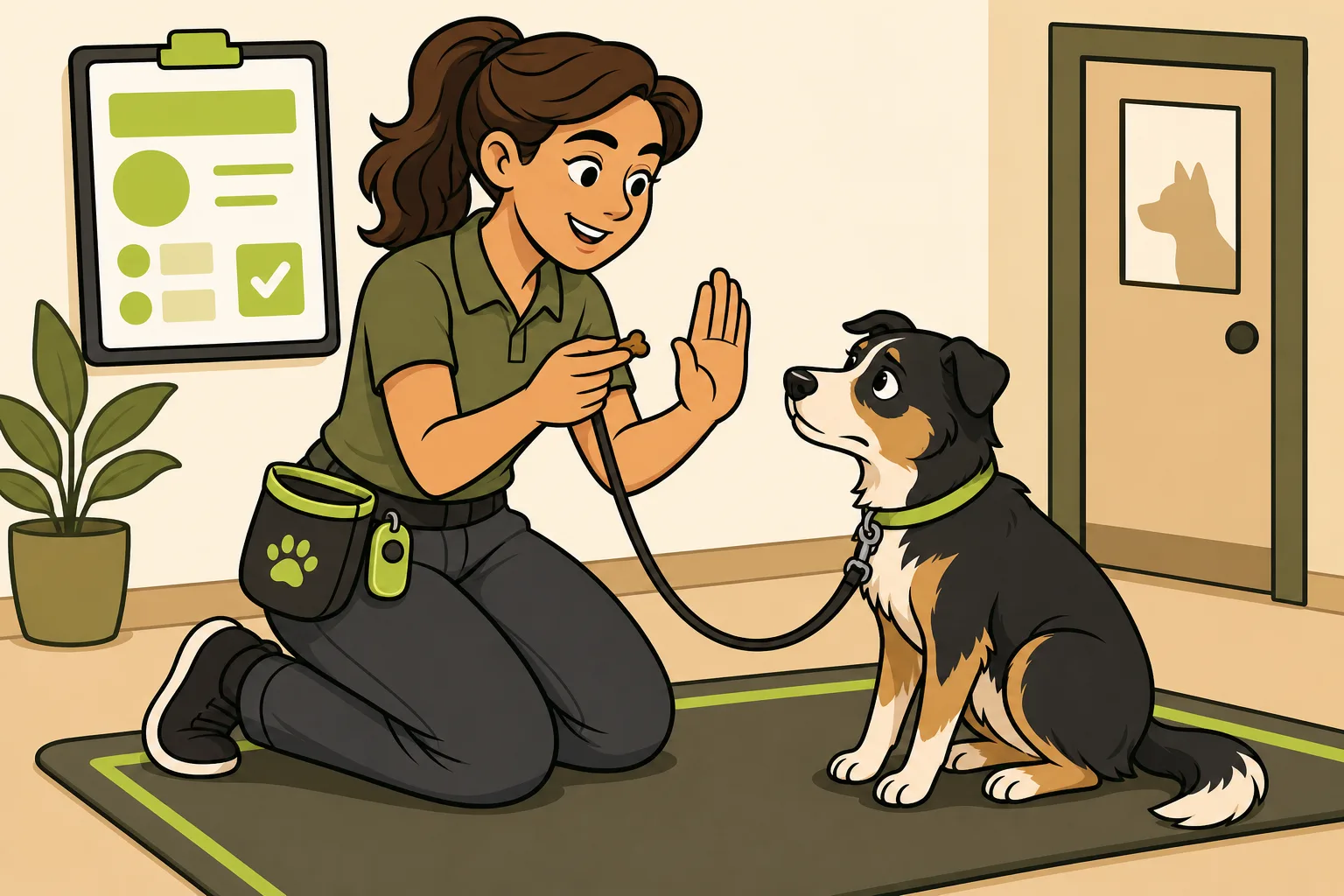
During the first session: The consultant observes your dog's responses, takes a full behavioral history, and assesses emotional state, thresholds, and severity. You'll leave with an initial assessment, a safety and management plan for the interim, and an outline of a modification protocol.
What follows: A structured program — typically two to three coaching sessions per week during active work. You'll learn to read your dog's body language, recognize threshold signals, and run the exercises correctly between sessions.
For dogs with anxiety-rooted behavior, the first program often runs eight to twelve weeks. Aggression cases vary more widely based on history and severity.
Does behavior modification actually work?
Behavior modification works — with the right professional, the right methodology, and consistent owner follow-through.
- Improvement, not always elimination. Many dogs with severe reactivity or aggression histories become manageable. Completely erasing behavioral history is rare and not the right goal.
- Owner commitment is required. This is not "send the dog away and get it back fixed." You will run exercises and maintain the program between sessions.
- Method matters. Force-free approaches — counterconditioning, desensitization — address the emotional root. Suppression methods can make anxious dogs more dangerous by removing warning signals without touching the underlying fear.
One question worth asking any behavior consultant: "What does your methodology look like for a dog that is fearful rather than defiant?" Their answer reveals whether they understand the emotional component or are running obedience under a different name.
See the full range of dog training services on our dog training website guide.
For a closer look at how methodology shapes which trainer is right for your reactive or anxious dog, read our guide to reactive dog training: private lessons vs. group classes.
Across the broader dog trainer and pet services landscape, trainers whose programs produce lasting results consistently explain their methodology in plain English before the first session.
Frequently Asked Questions
Is dog behavior modification the same as obedience training?
No. Obedience training teaches a dog to respond to commands. Behavior modification works on the emotional state driving a problem behavior — the fear behind the lunge, the anxiety behind the destruction. A dog can be fully trained in obedience and still be a behavior modification case.
How long does dog behavior modification take?
It depends on the severity and history of the behavior. Mild reactivity programs often show meaningful improvement in four to eight weeks. Significant aggression or severe anxiety histories can require three to six months of structured work, with owner maintenance ongoing. A responsible behavior consultant will give you a timeline after the initial assessment.
Can I do dog behavior modification at home?
For mild cases — early reactivity, moderate fear of a specific stimulus — owner-led desensitization can work. For behaviors that have caused injury, been present for months, or involve aggression toward people, attempting it without a professional risks pushing the dog past threshold and setting the program back significantly.
What certifications should I look for in a dog behavior consultant?
Look for CBCC-KA (Certified Behavior Consultant Canine — Knowledge Assessed, from CCPDT) or IAABC certification (International Association of Animal Behavior Consultants). For cases that may need medication, a DACVB (veterinary behaviorist) is the appropriate referral. Ask any candidate to explain their methodology in plain terms before committing.
Does a dog trainer's website matter when choosing a behavior modification specialist?
It does — and in our proprietary research into dog trainer sites across six U.S. markets, the strongest trainers lead with a plain-English methodology pledge, list specific services for behavior problems (not just puppies and manners), and make it easy to start a conversation with a quote or contact form. A vague site with generic "obedience training" language and no mention of behavior modification is a signal to dig deeper before booking.
How do I take the first step toward a behavior modification program?
The lowest-friction starting point is a free consultation or short discovery call — the standard intake model used by behavior consultants across the industry. Describe your dog's specific behaviors (triggers, frequency, severity), how long it's been happening, and what you've already tried. That information lets the consultant give you an honest picture of what a program would look like before you commit to anything.
GrowLocal builds fast, professional websites for dog trainers and pet services businesses. Our sites include quote forms, trainer bio pages, service pages for behavior modification and specialty programs, client testimonial sections, and photo galleries — everything a behavior specialist needs to convert distressed dog owners into consultation requests. See what a dog trainer website looks like.