


Updated June 2026
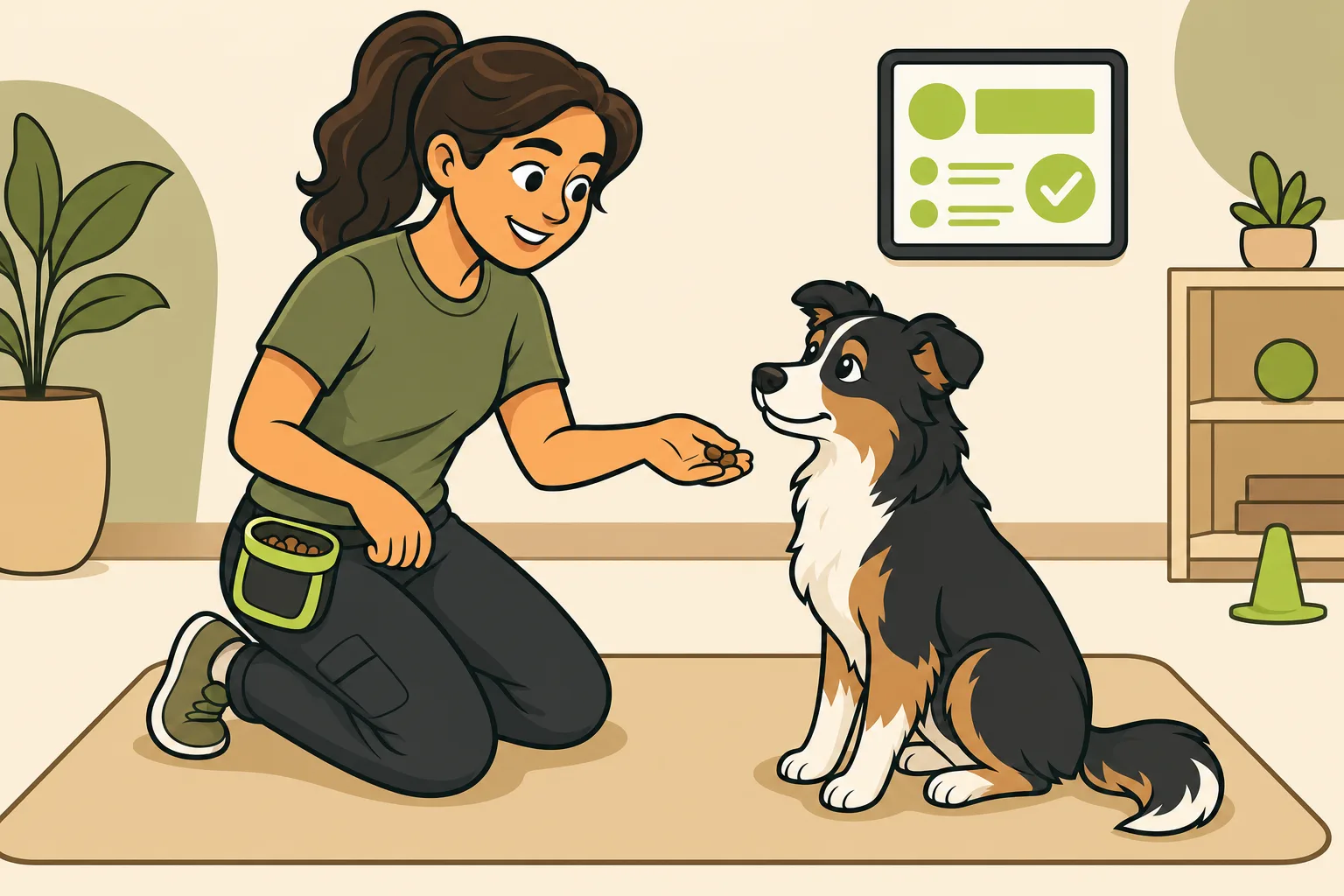
Force-free dog training is a method that teaches dogs using only rewards and the removal of rewards — never pain, fear, or physical corrections. It draws on positive reinforcement (rewarding what we want) and negative punishment (withholding a reward when the dog makes a wrong choice), and excludes any tool or technique designed to cause discomfort. It works for puppies, adult dogs, and dogs with anxiety or reactivity — and it's the approach your trainer uses because the science, and the dogs themselves, back it up.
This is based on GrowLocal's proprietary research into top-ranking dog training sites across six U.S. markets, plus the behavioral science behind what actually happens in sessions with anxious and reactive dogs.
What does force-free dog training actually mean?
Force-free means no pain and no fear as teaching tools. The practical definition is specific: no prong collars, no choke chains, no e-collars, no physical corrections, no intimidation.
What it uses instead: treats, toys, play, praise, and a marker (a click or a word like "yes") to tell the dog the exact moment they got something right. The dog learns through clear feedback — "that behavior earns something good" — not through the threat of something bad.
Behavior driven by reward is stable and generalizes well. Behavior suppressed by punishment can disappear in training but reappear — or escalate — when the pressure isn't there.
Is force-free training just permissive training with no rules?
No. This is the most common misconception, and it's worth clearing up directly.
Force-free training is not "let the dog do whatever they want." Dogs in force-free programs have rules and structure — sit before meals, stay at the door, settle on a mat when guests arrive. The structure is the same as any good training. What's different is how those rules are taught: through clear feedback and reward, not through physical control or the threat of pain.
A dog that chooses the right behavior because it's rewarding is more reliable than a dog that complies to avoid punishment.
Why is it especially effective for anxious and reactive dogs?
This is where force-free training has its clearest advantage, and it's the reason most trainers who specialize in anxiety, reactivity, and behavior modification work this way.
Anxious and reactive dogs already have an elevated threat response. A dog that barks and lunges at other dogs isn't misbehaving — they're in a state of fear or frustrated arousal. Applying punishment to that state adds another aversive to an already-stressed system. The behavior may be suppressed, but the underlying emotional state — fear, frustration — stays the same or gets worse.
Force-free behavior modification works differently. The primary techniques are:
- Counter-conditioning: pairing the thing the dog fears (another dog, a stranger, a loud noise) with something the dog loves (a high-value treat), changing the emotional association at the root
- Desensitization: exposing the dog to their trigger at a low enough intensity that it doesn't provoke a reaction, then gradually increasing intensity as the dog's tolerance builds
Done consistently, these techniques don't just suppress the surface behavior — they change how the dog feels about the trigger. A dog who used to go rigid and lunge at passing dogs can learn to check in with their handler instead. That shift happens from the inside out, not because a correction made the outward behavior stop.
What does a force-free training session actually look like?
Sessions are short — typically 5 to 15 minutes — because that's how dogs retain information best. A longer session produces diminishing returns, not better results.
Here's a typical sequence for a dog with leash reactivity:
- The trainer assesses where the dog's threshold is — the distance at which they notice the trigger but haven't yet reacted. That's the working zone.
- At that distance, every time the dog sees the trigger, they get a high-value reward. The dog starts to learn: trigger → food appears.
- Over sessions, the distance shrinks as the dog's emotional response shifts. The goal is for the dog to look at the trigger and look back at their handler, anticipating something good.
The trainer reads body language constantly — ear position, tail carriage, muscle tension. If the dog is stiffening or scanning, the session is too intense. Progress is made in small increments that keep the dog in the success zone.
For a puppy learning basic manners, sessions are simpler: sit, down, loose leash, name recognition — shaped with a marker and treats in short reps throughout the day.
How does force-free compare to balanced training?
The honest answer is that this is a genuine debate in the training world. Here's what the differences actually mean in practice:
| Force-Free | Balanced | |
|---|---|---|
| Positive reinforcement (rewards) | Yes | Yes |
| Positive punishment (corrections) | No | Yes |
| Tools | Treats, toys, clicker | May include prong, e-collar |
| Approach to unwanted behavior | Redirect, withhold reward, adjust difficulty | Reward + correct |
| Risk of fallout | Low | Higher — punishment can increase fear |
Balanced trainers argue corrections speed results with certain dogs. Force-free trainers counter that corrections risk fallout — the dog suppresses behavior to avoid punishment, but the underlying emotional state stays the same and can resurface as something more serious.
For dogs with anxiety or reactivity, most certified applied animal behaviorists recommend against punishment-based methods because punishment worsens the emotional state driving the behavior. The Pet Professional Guild and the American Veterinary Society of Animal Behavior both formally support force-free, reward-based methods.
Key takeaway: In the proprietary research behind our platform, the strongest dog training sites we analyzed consistently lead with a clear methodology statement — and force-free or positive reinforcement framing is the most common anchor. Owners of anxious and reactive dogs are filtering by methodology before they ever pick up the phone. If you're actively looking for a trainer who works this way, that transparency at the top of the page is the signal you're looking for.
See how dog training sites handle trust and methodology in our local business website research →
What about serious behavior problems — does force-free work there too?
Yes — and for many behavior problems, force-free is the required approach, not just the preferred one. A dog with a bite history, severe separation anxiety, or deep-seated fear aggression needs an approach that doesn't add more aversion to an already-overwhelmed system.
Serious behavior problems often need a professional program, not a single session. For cases involving biting, aggression, or anxiety that hasn't responded to training, a conversation with your vet alongside your trainer is the right path — a veterinary behaviorist (DACVB) can prescribe medication when anxiety is so severe that training alone can't gain traction.
If you're wondering whether your dog's behavior falls into that category, that's exactly what a first consultation is for.
How do I find a force-free trainer?
Look for certifications that signal a force-free foundation: Fear Free Certified Professional, CPDT-KA, CBCC-KA, or membership in the Pet Professional Guild. The trainer's methodology page should state their approach explicitly — if it's vague, ask directly.
Most credentialed force-free trainers offer a free consultation call. That call lets them assess your dog's needs and explain what a program looks like before you spend anything. See what a professional dog trainer website should include →
Frequently Asked Questions
What is the difference between force-free and positive-only training?
They're often used interchangeably, but there's a small technical distinction. Force-free uses both positive reinforcement (rewarding desired behavior) and negative punishment (removing a reward when undesired behavior happens). "Positive only" is sometimes used to describe methods that rely exclusively on adding good things, never withholding. In practice, most force-free trainers use negative punishment — ignoring jumping, ending play when teeth touch skin — so the terms overlap significantly.
Do force-free trainers ever say "no" to the dog?
Yes — they just don't use it as a punishment. Force-free trainers use "no" or an interrupter cue to redirect the dog, then immediately offer the right behavior and reward it. The word itself isn't the issue; what matters is whether "no" is paired with something aversive (physical correction, startle) or simply with the removal of attention and an invitation to try again.
Is force-free training slower than other methods?
It can take more repetition early on, especially for dogs used to pressure-based signals. But the results are more durable — the dog has learned the behavior and the emotional state behind it, not just suppressed a behavior to avoid a consequence. For anxious and reactive dogs, there's no fast route. Across our research into top-ranking local business sites in Austin, Denver, Phoenix, Charlotte, Nashville, and Tampa, every dog training site we analyzed funnels owners to a free consultation rather than quoting a timeline — because every dog genuinely is different.
Will force-free training work for my reactive dog?
For the overwhelming majority of reactive dogs, yes. Counter-conditioning and desensitization — the core tools in force-free behavior modification — have the strongest evidence base for reactivity specifically. Results depend on consistency, the severity of the reactivity, and how long the behavior has been reinforced. A first consultation with a force-free trainer who specializes in reactivity is the only way to get an honest assessment for your specific dog. Read about what reactive dog training actually involves →
How is a force-free trainer different from a dog behaviorist?
A trainer focuses on learned behavior — skills, habits, reactivity protocols. A veterinary behaviorist (DACVB) is a board-certified vet who can also prescribe medication for severe anxiety, compulsive disorders, or aggression. For most dogs, a qualified force-free trainer is the right starting point. For dogs with genuine fear disorders, bite history, or anxiety that hasn't responded to training, your trainer may recommend bringing in a vet behaviorist as well. See when behavior problems need professional help →
How do I start with a force-free trainer?
Most start with a free consultation — a 15–30 minute call where the trainer assesses your dog's history and what you're hoping to change. Come prepared to describe the specific behaviors: when they happen, what triggers them, what you've tried. That conversation tells the trainer what they need to recommend a program. A dog trainer website built for consultations like this makes it easy to reach out and describe what's going on.
Research in this post is based on GrowLocal's proprietary analysis of top-ranking local business websites. See the full data → | Local business website hub →