


Updated June 2026
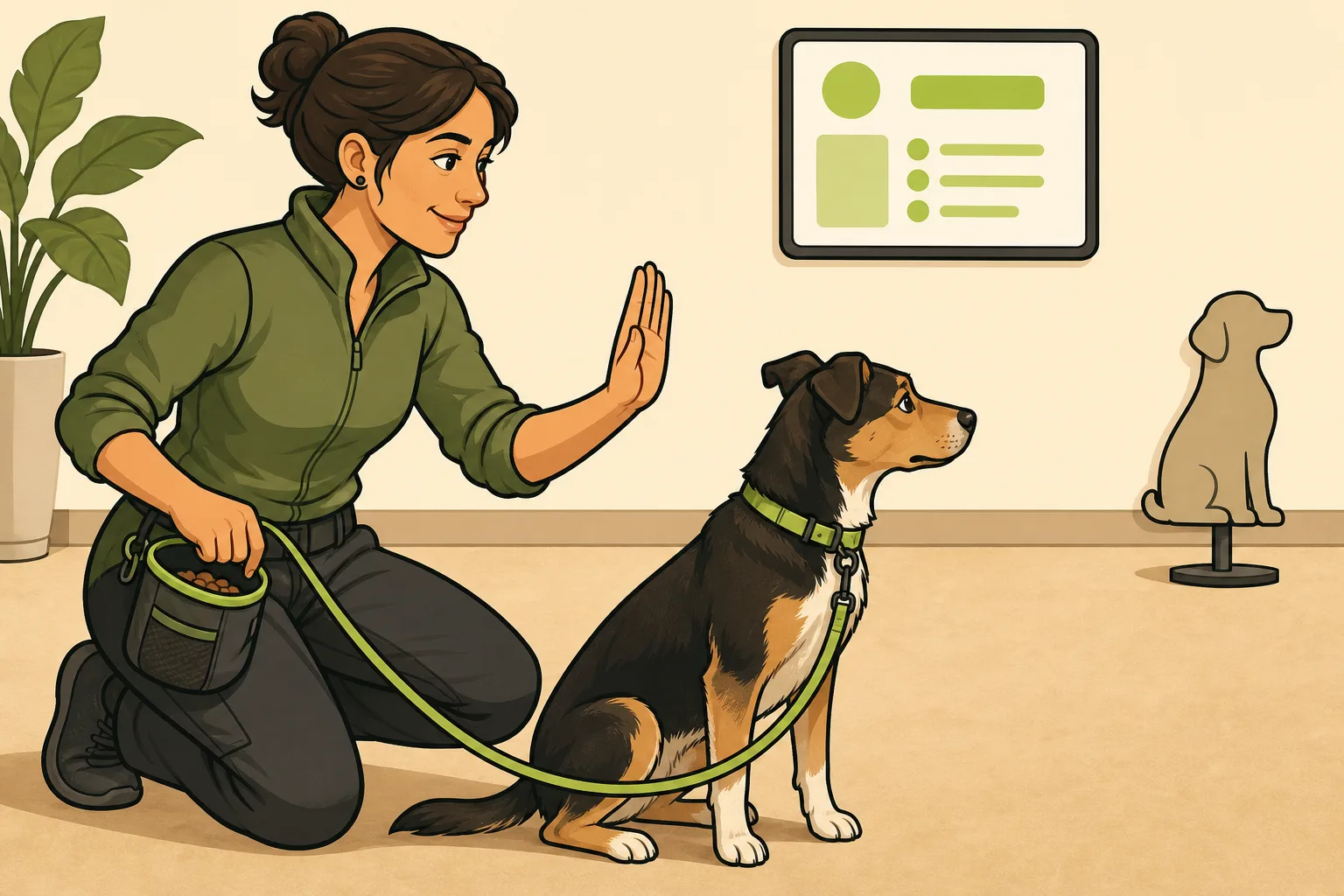
For most reactive dogs — the ones who lunge at other dogs, bark at strangers, or freeze and explode on a leash — private lessons should come first. Group reactive dog classes can work, but only after a trainer has assessed your dog's specific triggers and threshold distances. The decision isn't about price. It's about whether your dog can actually learn in a group setting without going over threshold the moment another dog appears.
This is based on GrowLocal's proprietary research into top-ranking dog trainer websites, combined with the behavioral framework the strongest trainers in the category consistently apply.
What does "reactive" actually mean?
Reactivity is not aggression. This distinction matters before you book anything.
A reactive dog overreacts to specific triggers — other dogs, strangers, bikes, skateboards — with barking, lunging, or hard staring. The underlying driver is almost always fear or frustration, not intent to harm. An aggressive dog intends to eliminate a perceived threat. Most reactive dogs are trying to create distance; they want the scary thing gone.
This matters for training format because:
- Dogs driven by fear need controlled, predictable environments where they can stay under threshold. A group class with unpredictable dogs is the opposite.
- Dogs driven by frustration (leash frustration — wants to greet but can't) may tolerate group classes sooner, because the trigger isn't frightening, just overwhelming.
A trainer's first job at your consultation is to figure out which one applies to your dog. Nothing should be booked until that question has an answer.
What is a "threshold" and why does it decide the format?
Every reactive dog has a distance from their trigger at which they can still think and respond to cues. That's being "under threshold." Cross it, and learning stops entirely — the barking and lunging kicks in.
- In a private lesson, the trainer controls the environment completely. Triggers are introduced at the exact distance your dog can handle.
- In a reactive dog group class, there are 4–6 other reactive dogs in the room. Visual barriers and distance management help, but you don't control every stimulus. That's fine if your dog's threshold is 30 feet. It's a problem if it's 80 feet.
Your dog's threshold distance — for each trigger type, not just "other dogs" — is the number that determines which format they're ready for.
Private lessons vs. reactive dog group classes: what actually differs?
| Factor | Private Lessons | Reactive Dog Group Classes |
|---|---|---|
| Trainer attention | 100% on your dog | Split across 4–8 dogs |
| Environment control | Fully controlled | Partially controlled (barriers, distance) |
| Threshold management | Tailored to your dog's exact distances | Set for the class average |
| Trigger exposure | Staged on your dog's timeline | Other reactive dogs present throughout |
| Cost | Higher per session | Lower; 6-week program ≈ 1 private session |
| Progress speed | Faster for most reactive dogs | Slower; builds generalizable skills |
| Best for | High severity, multiple triggers, fear-based reactivity | Mild–moderate reactivity once foundations exist |
The right sequence for most reactive dogs: start private, then consider a reactive group class once your dog has the impulse control to benefit from controlled group exposure.
Which triggers matter most for the private vs. group decision?
Not all triggers call for the same approach.
Dog-to-dog reactivity only: The most common presentation. A reactive dog class may be appropriate after 3–6 weeks of private work to build foundational skills.
Reactivity to strangers, children, or specific people: Private lessons first. Human triggers are impossible to fully control in a group class, and exposing a fear-reactive dog to an unpredictable audience causes setbacks.
Multiple trigger types: Private lessons until each trigger's threshold distance is mapped and reliable coping skills are built. A class designed around dog-to-dog reactivity won't address human-directed triggers.
Any bite history: Private lessons only. A trainer must determine whether this is reactivity or true aggression before any group exposure.
What does a first consultation actually look like?
Most owners want to know this before they reach out — and most results on this topic don't explain it.
A first reactive dog consultation is typically 60–90 minutes, private, and covers four things:
- History intake: When did it start? What are the exact triggers? What does the behavior look like? What has the owner already tried?
- Behavior observation: The trainer watches your dog in a controlled setting to identify whether the driver is fear, frustration, or true aggression — and establishes baseline threshold distances.
- Methodology explanation: A qualified trainer explains their approach. Most use counter-conditioning and desensitization — teaching the dog to associate the trigger with good things, not to suppress the reaction with punishment.
- Program recommendation: Private only, private-to-group transition, or (in severe cases) referral to a veterinary behaviorist.
Across GrowLocal's proprietary research into top-ranking dog trainer sites, every trainer uses a free consultation as the entry point — never direct class enrollment. The "Book a Free 15-Minute Call" is the lowest-friction version: it lets the trainer hear about your dog's triggers before recommending anything.
Key takeaway: Most reactive dogs should start with private lessons — not because group classes don't work, but because a trainer needs to assess triggers and threshold distances before placing your dog near other dogs. Across GrowLocal's proprietary research into top-ranking dog trainer sites, the free consultation is the universal entry point: it lets the trainer match your dog to the right program before you spend anything on the wrong one.
When should you escalate to behavior modification?
Reactive dog training works on behavior through management and skill-building. Behavior modification works on the emotional state underneath.
Signs it's time to escalate:
- Reactivity is getting worse despite consistent training.
- Fear levels appear high — cowering, refusing food near triggers, shaking.
- There has been a bite or near-bite.
- A trainer has mentioned anti-anxiety medication as something worth discussing with your vet.
A veterinary behaviorist (DACVB) is a vet who specializes in behavioral medicine and can combine medication with a behavior modification protocol. For dogs with clinical anxiety levels, that combination works significantly better than training alone. It's different from a regular vet prescribing Trazodone — a vet behaviorist designs the behavioral side of the treatment plan, not just the medication.
If your dog can't get under threshold at any manageable distance, ask your trainer whether a vet behaviorist referral makes sense. See our broader guide to dog behavior modification and when to hire a professional.
How long does reactive dog training take?
Most owners notice early improvement within 4–8 weeks of consistent private sessions. Significant behavioral change typically takes 6–12 months. Severe cases can run longer.
The variable that matters most: practice between sessions. A trainer teaches you the protocol; you implement it on 20–30 walks before the next appointment. Owners who practice 3–4 times a week progress significantly faster than those who wait for the next session to pick up the work.
Reactive dog training is a commitment. It is worth it.
How do you find a qualified reactive dog trainer?
When evaluating a trainer, look for: force-free methodology stated explicitly; reactivity listed as a specialty; a contact form or phone number where you describe your dog's triggers before paying anything; and named testimonials with specific outcomes — reviews that name the dog and the behavior problem tell you far more than a star rating.
GrowLocal's dog trainer websites are built around exactly these elements — consultation form, phone number, methodology pledge, and named testimonials — so a trainer's site does the qualification work before the phone rings. See our full breakdown of websites for local service businesses.
Frequently Asked Questions About Reactive Dog Training
Is reactive dog training worth it?
Yes. Reactivity is a behavioral and emotional pattern that responds to consistent, professional training — it's not a permanent character flaw. Most dogs show meaningful improvement within 4–8 weeks of private work. The alternative is managing an increasingly entrenched reactive pattern indefinitely, which gets harder as the dog ages.
What is the difference between a reactive dog and an aggressive dog?
Intent. A reactive dog overreacts to triggers with barking and lunging but has no intention to harm — they want distance or access, depending on the driver. An aggressive dog intends to control or eliminate a threat. Most reactive dogs are fear-driven or frustration-driven. A qualified trainer assesses this at the first consultation — always disclose any bite history before the session.
Can my reactive dog go straight into a group class?
Occasionally, if reactivity is mild, the only trigger is other dogs, and your dog's threshold distance is manageable. More often, no. Group reactive classes work best after a few private sessions that build foundational impulse control and focus skills. Placing an unprepared dog into a room with 4–6 other reactive dogs typically causes setbacks rather than progress.
What should I tell a trainer when I first contact them?
Tell them: (1) what your dog reacts to, (2) what the reaction looks like, (3) how long it has been happening, (4) what you've already tried, and (5) whether there has been any bite history. This lets the trainer tell you right away whether private lessons, a reactive group class, or a behavior modification referral is the right fit — before you pay for anything. See also our guide to dog separation anxiety training and when to hire a professional for the same intake framework applied to anxiety-driven behavior.
Do I need a trainer or a veterinary behaviorist?
For most reactive dogs, a qualified force-free trainer is the right first step. A veterinary behaviorist is appropriate when fear levels are so high the dog can't get under threshold at any manageable distance, or when a trainer recommends exploring medication. A vet behaviorist designs a combined medication + behavior modification protocol — which produces better outcomes for severe cases than either approach alone.
How do I know if my dog's reactivity is fear-based or frustration-based?
Fear-based dogs show conflicting body language — forward ears with a tucked tail, raised hackles with a lowered body. They want to flee but feel trapped on leash. Frustration-based dogs pull toward the trigger; they want access, not distance. A trainer identifies this in the first session by watching your dog's body language at different distances from the trigger. The distinction shapes the entire training protocol.