


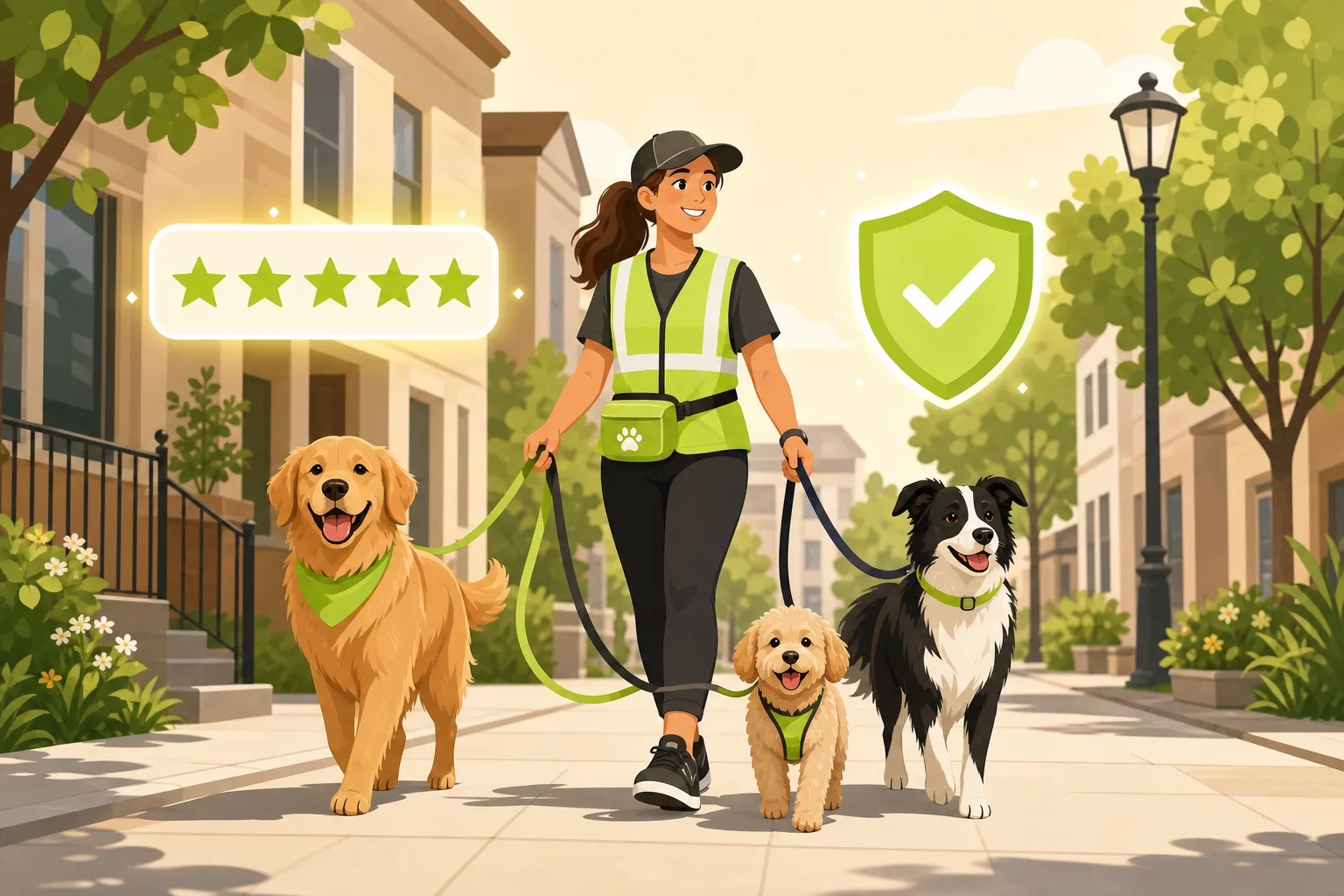
Pet parents hand over their house keys. That's the whole transaction. Before they do, they need to feel certain that the person walking their dog is trustworthy, professional, and won't ghost them on a Tuesday morning when their dog is home alone. Your website is where that certainty gets built — or doesn't.
We analyzed dog walkers and pet sitters websites from all over the country and found a predictable gap: most independent operators have a site, but most sites aren't actually doing the trust work. They have a contact form. They mention they love dogs. But they're missing the specific signals that nervous pet parents need before they hand over a key to a near-stranger.
Here's what we found — and what actually moves the needle.
The Buying Decision Is Emotionally High-Stakes
Dog walking looks like a commodity service from the outside. On the inside, the decision feels more like hiring a babysitter. The customer isn't just shopping for a price — they're trying to answer a quieter question: can I trust this person in my home with my dog?
This changes what your website needs to do. Most service websites just need to convey competence. Yours needs to convey trustworthiness. That's a different job, and it requires different content.
Understand the buying trigger too: most pet parents aren't in a rush. They're planning around a new job schedule, an upcoming trip, or a new puppy. They'll compare two or three providers over a few days. You need a site that holds up under that kind of scrutiny, not one that just catches clicks.
What the Best Dog Walker Sites Actually Show
Looking at the top-ranking independent dog walking and pet sitting websites across multiple markets, a clear pattern emerges. The sites that win the comparison share a specific set of trust signals — and nearly all of them appear above the fold.
"Insured & Bonded" must be visible immediately. Every high-performing site in this category displays this on the homepage, usually at or near the hero. It's the minimum viable proof that you're operating a real business. Its absence is disqualifying — a pet parent who doesn't see it will assume it's not there.
GPS-tracked walks with photo reports have become table stakes. The best sites don't just mention this — they demo it. Screenshots of walk routes. Sample visit reports. The before/after photo of a happy, tired dog. This proof-of-service loop — GPS tracking → photo report after every visit → notification to the owner — is what separates established operators from Rover gig workers, and savvy pet parents know to look for it.
Concrete review counts beat vague testimonials. There's a big difference between "our clients love us" with a carousel of unnamed quotes and "150+ 5-star Google reviews" displayed with an actual rating badge. The concrete number signals volume and verifiability in a way that hand-picked quotes don't. Across our proprietary local-business website research, the majority of competitors across service categories mentioned reviews only in vague terms — making a specific count an instant differentiator in nearly every local market.
Real photos of real people and real dogs. No stock. Every top-performing site in this category uses actual photography — their staff, their clients' dogs, their walkers in action. The trust decision centers on "who is entering my home" — a site with faceless or generic imagery doesn't answer that question.
Team bios with faces. The sites that convert best show the actual humans who will be walking the dog. Name, photo, background, maybe a note about their own pet. Walker bios make the stranger feel less like a stranger.
The Differentiators That Actually Set Sites Apart
Beyond the table stakes, a few things separate the best sites from the merely adequate.
"Employees, not contractors" is the most powerful positioning statement in this category. Pet parents who've been burned by Rover — wrong walker shows up, walker cancels last-minute, app assigns a different person — respond strongly to copy that directly addresses that experience. The sites that explicitly state their walkers are hired, background-checked employees with training, backup coverage, and accountability aren't just describing a model; they're solving a named fear.
Fear Free certification and Pet First Aid/CPR credentials are underused differentiators. Most sites mention insurance. Few go beyond it. Being Fear Free certified (or even just Pet Tech certified) and making it visible on your homepage puts you in a small minority in most markets. If you have it, flaunt it.
Free Meet & Greet is the low-friction CTA this category needs. "Book Now" creates commitment anxiety. "Schedule Your Free Meet & Greet" lowers the barrier — it's just a conversation, not a purchase. The sites that lead with this offer consistently have a better conversion funnel for first-time customers.
A dedicated service area page with neighborhood-level detail signals local authority. The most search-visible site we analyzed had neighborhood-specific landing pages — "[Neighborhood] Pet Sitting & Dog Walking" — across 14 neighborhoods in its market, plus 146 blog posts. That's a local SEO engine built over years. You don't need to start there, but structuring your site to add neighborhood pages gives you a growth path.
We see the same local SEO pattern in adjacent categories — dog grooming and dog training businesses in the same markets invest in neighborhood pages and service area content for the same reason. The search intent ("dog walker near me," "pet sitter [neighborhood name]") maps perfectly to that structure.
The Mistakes Most Pet Service Sites Make
Hiding pricing with no path to a rate — and no signal it exists. Pricing on the homepage isn't expected in this category; pet parents understand that a free consultation or meet-and-greet comes first. But if a potential client can't find a "Services & Rates" page in your nav, the opacity feels like avoidance. The fix is simple: a dedicated rates page linked in your navigation. You don't have to quote on the homepage; you just need to signal that pricing is findable.
Faceless hero sections. A generic dog graphic or stock photo of a golden retriever doesn't build trust. A real photo of your team walking a real client's dog — ideally taken in your actual service area — does. If you're a solo operator, a confident photo of you with a dog is the single highest-return update you can make to your site.
No concrete proof of volume or longevity. "Trusted in [City]" without any quantifier is everywhere in this market — it's almost meaningless at this point. "Trusted since 2010" or "150+ five-star reviews" or "serving [neighborhood] and [neighborhood] for 12 years" is something a customer can hold onto. If you have years in business or a review count worth citing, make it explicit.
Testimonials without names or pet names. A quote attributed to "— K.M." and her dog "fluffy" tells a very different story than "— Karen M. and her Labrador, Biscuit." Real names, real pet names, and real photos where you have them. The emotional specificity is the point.
Anti-Rover positioning done poorly. The contrast with gig apps is genuinely compelling copy — but only when it's specific. "Better than Rover" isn't persuasive. "Our walkers are background-checked employees, not gig contractors. The same person walks your dog every time, and if they're sick, we have backup coverage" is persuasive.
Quick Checklist: What Your Site Needs Before Launch
- "Insured & Bonded" visible at or above the fold
- Real photography of your team with actual dogs — no stock
- Walker bios with names and faces
- GPS-tracked walks and photo reports prominently described
- A concrete review count or badge (not just quotes)
- "Services & Rates" page linked in navigation
- A "Free Meet & Greet" call-to-action (primary or secondary)
- Certifications displayed: Pet First Aid/CPR, Fear Free if applicable
- Association badges: PSI, NAPPS, BBB, local pet sitter associations
- Service area clearly defined — neighborhoods and zip codes where relevant
- Your founding year or years in business stated explicitly
What GrowLocal Builds for Dog Walkers
If you're starting from scratch or rebuilding, GrowLocal builds websites for dog walkers and pet sitters that handle all of the above without you touching code. We've analyzed what works in this specific category — the trust signals, the service page layout, the mobile-first design — and built it into a ready-to-launch template we configure for your business.
You preview it free before committing. If it works for you, it's $20–30/month. We build everything: the site, the content structure, the SEO foundation. You provide your photos, your bio, your service area, and your review count. We take it from there.
GrowLocal has website templates for dozens of local service categories — if you also offer dog grooming or pet boarding as part of your services, we build for those too, with the same category-specific research behind each one.
Ready to see what your site could look like? Preview your dog walking website free — no credit card, no commitment.