


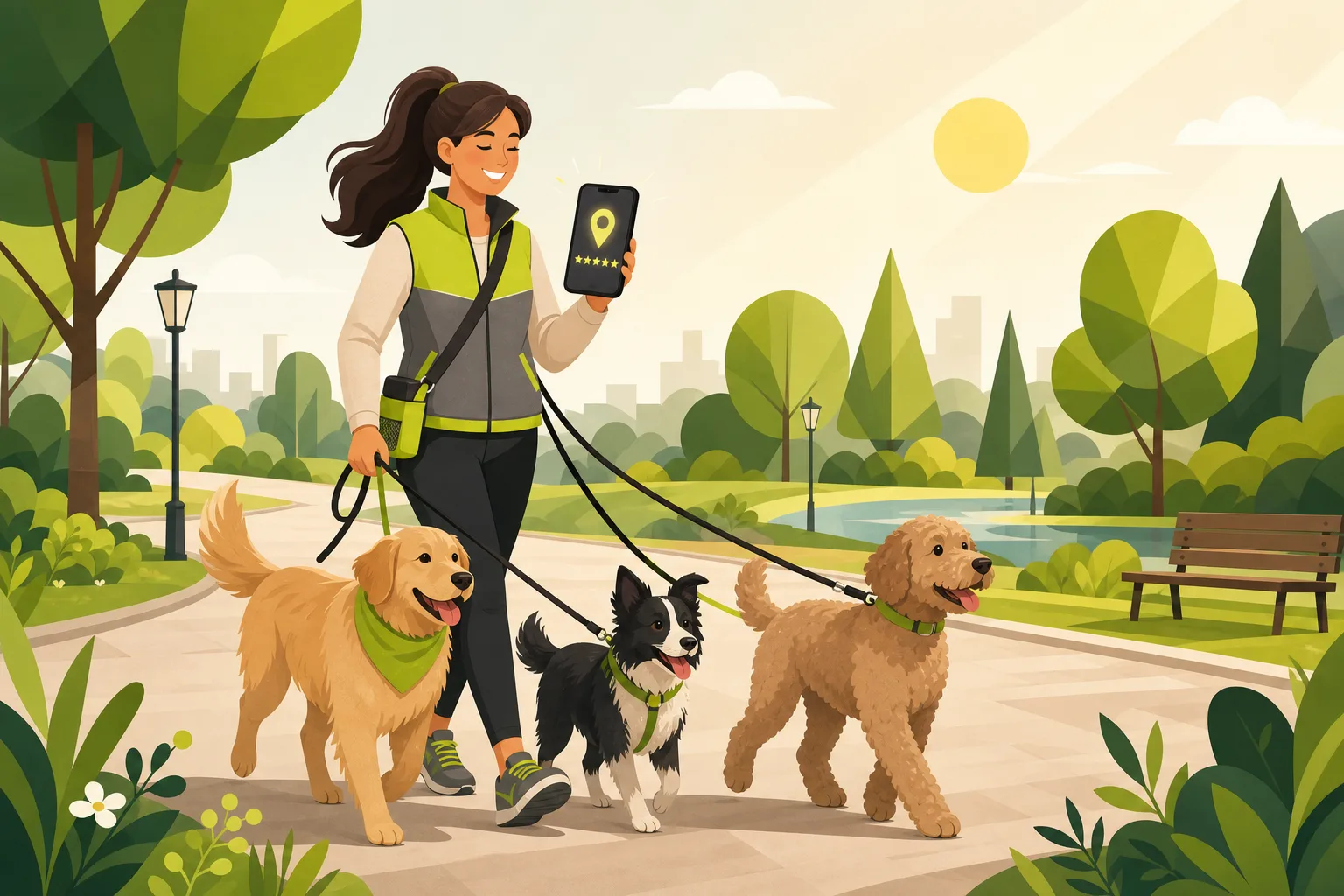
Google Business Profile looks like a complete local marketing plan. You fill out your name, address, phone number, add a few photos, collect some reviews, and you show up on the map when someone searches "dog walker near me." That's the whole game, right?
Not quite. And for dog walkers and pet sitters especially, it's not even most of the game.
The problem isn't that Google Business Profile doesn't work. It does — GBP is a real driver of local visibility and every dog walking business should have one, fully filled out. The problem is what it can't do: it cannot prove you are who you say you are. And in this particular service category, proof of identity is the entire sales job.
What Pet Parents Are Actually Buying
Before a pet parent books their first walk, they're handing you a house key. That's the transaction. Not just "walk my dog" — "enter my home when I'm not there, handle an animal I consider family, and don't disappear when I need you most."
That's an emotionally high-stakes decision. Pet parents compare two or three providers over several days before booking. They're asking a specific, quiet question: can I trust this specific person with this specific access to my life?
Google Business Profile can tell them you exist and that other customers left you stars. It cannot answer the actual question.
What GBP Shows — and What It Can't Prove
Here's what your Google Business Profile shows a prospective client: your name, service area, any photos you uploaded, a star rating and written reviews, your phone number, your website link, and your hours.
Here's what GBP cannot show:
It can't prove you're insured and bonded. Every serious dog walker and pet sitter in every market we analyzed displays "Insured & Bonded" prominently — usually above the fold on their homepage. Your GBP has no field for this. A pet parent searching for coverage details will look at your website, not your profile.
It can't show who's actually walking the dog. The most trust-effective pages on dog walking websites are team bios — a name, a face, a photo, maybe a note about their own pets. These turn strangers into recognizable people. A GBP profile photo of your logo doesn't do that.
It can't demonstrate your process. The modern differentiator in this category is the proof-of-service loop: GPS-tracked walks, time-stamped visit reports, photos sent after every walk. The best independent dog walking operations demo this on their website with screenshots and sample reports. GBP posts can gesture at this, but they can't build the full picture.
It can't explain your background check or hiring standards. Whether you're a solo operator with your own certification history or a business with trained employees rather than gig contractors, none of that verifiable detail lives in your GBP. The "employees, not contractors" positioning — a direct counter to Rover and Wag — requires a page, not a profile field.
It can't display your certification badges. Fear Free certification, Pet First Aid and CPR credentials, Pet Sitters International membership, NAPPS association badges — these are real differentiators in the category. They live on your website, in a trust strip people can actually read and click.
Reviews tell you what, not why. A five-star rating is strong social proof. But a review that says "My dog loves her walks with them!" doesn't tell the nervous new client why they should trust you over the other person with five stars. Detailed, credibility-building testimonials — with specifics, pet names, the scenario — belong on a page you control, where you can frame them with context.
The Trust Hierarchy Prospective Clients Actually Use
When someone finds your GBP listing and considers booking, here's what typically happens: they read your reviews (GBP handles this), click through to your website, look for insurance information, look for photos of actual walkers — not dogs, people — read your About page or team bios, check your rates page, then decide whether to reach out for a meet-and-greet.
Everything after that first click happens off GBP. If your website doesn't exist, or exists but skips these elements, you're asking a nervous pet parent to make a high-stakes trust decision based on a star rating alone. Most won't.
What We Found Analyzing Dog Walker Websites Nationwide
We analyzed dog walkers and pet sitters websites from all over the country, looking at the top-ranking independent operators across multiple markets. A few findings from that research are worth naming directly.
"Insured & Bonded" appeared on every high-performing site, always above the fold. Not on a FAQ page. Not in the footer. Immediately visible. Its absence from a site is treated by pet parents as absence of the coverage itself.
Real photographer-style photos of real walkers beat everything else for conversion. Not logo shots. Not stock images. Not photos of cute dogs (though those help). Actual team members, named and pictured, in the act of walking a client's dog. The purchase decision is "who enters my home" — faceless sites don't answer that.
Concrete review counts outperform vague testimonials. Across our proprietary local-business website research, the majority of competitors mentioned reviews in vague terms — making a specific count like "150+ 5-star Google reviews" an instant differentiator in nearly every local market. GBP generates those reviews. Your website should display the count in a way that signals scale and verifiability, not just embed a generic widget.
The GPS-and-photo-report loop is the strongest modern differentiator. Demonstrating it on your website — with actual screenshots, sample visit reports, and the workflow spelled out — tells the tech-savvy pet parent you're operating a real professional service, not a side gig.
Anti-gig positioning copy is used by the strongest independent operators. Copy that explicitly distinguishes your service from Rover and Wag — trained staff, backup coverage for sick or unavailable walkers, consistent assignments rather than whoever is available — appears on the sites that lead their markets. This copy requires paragraphs, not a GBP post.
The Actual Mistake Most Dog Walkers Make
The most common error isn't skipping GBP. Most dog walkers have some kind of profile. The mistake is treating GBP as the website — collecting reviews, occasionally posting, and leaving a sparse one-page site (or no site at all) as the destination.
This works fine for businesses where trust is established at the transaction. It fails for services where trust is the pre-condition for it.
A pet parent who can't verify your insurance, put a face to your name, or understand your process won't become a recurring client. Recurring clients are the whole revenue model — weekly walks, repeat holiday pet sitting, multi-year relationships. Losing the first booking because your site didn't do the trust work means losing all of those downstream bookings too.
What Your Site Actually Needs (Table Stakes vs. Differentiators)
Non-negotiable before anything else:
- "Insured & Bonded" visible at or near the top of your homepage
- Real photos of real walkers — names and faces attached to the service
- A rates or services page (even if you don't display dollar amounts on the homepage)
- A free meet-and-greet offer — the category's standard friction-reducer
- Team bios with photos
Differentiators that separate you from the crowded middle:
- GPS tracking + photo visit report demo, with actual screenshots
- Concrete review count from Google, displayed with a number ("150+ 5-star reviews") rather than just a widget
- "Employees, not contractors" positioning if applicable — and if you use W-2 employees, this is one of your strongest cards
- Certifications visually displayed: Fear Free, Pet First Aid/CPR, PSI membership badges
- Named certifications and backup-coverage policy — answers the gig-app no-show fear directly
- Neighborhood service-area pages for local SEO (the sites that dominate local search have dedicated neighborhood pages, not just a service-area map)
For a complete breakdown of what the top-performing dog walker and pet sitter sites include — and what most skip — read our guide on what pet parents need to see on your dog walker website.
Common Mistakes Worth Naming
Linking GBP to a site that hasn't been updated in three years. Your GBP might be pristine. If clicking through lands someone on a site with a 2019 copyright notice, broken photo links, and no mention of your current services, the trust you built on GBP evaporates.
Relying entirely on GBP reviews without a testimonial page. Reviews on GBP are third-party verified — that's their strength. But they're also brief and unformatted. A dedicated testimonials page lets you curate the best ones, add context, and display them in a way that works visually, alongside the service that earned each review.
No team photos because you're a solo operator. Even if you're the only walker, a professional photo of you with a dog you've walked — ideally a real client's dog — does more trust work than any text. Solo operators who skip this are invisible in the most important way.
Using stock images. Across our proprietary local-business website research, 100% of top-performing dog walking and pet sitting sites used exclusively real photography. Stock kills credibility in a category where trust is the purchase. If you don't have professional photos yet, smartphone photos of you on an actual walk are better than stock.
No mention of your hiring and background-check process. Even if you're a solo operator, describing your background and certifications is table stakes. For businesses with employees, explaining your hiring standards and training process — especially relative to app-based gig platforms — is one of your most effective conversion tools.
Takeaways
Google Business Profile is your local visibility engine — it gets you found. Your website is where trust gets built, and trust is what actually closes the booking.
If you're relying primarily on GBP and getting clicks but not conversions, the gap is almost always on the site: missing insurance language, no walker photos, vague process description, no concrete review count.
The good news: the bar in this category is low. Most independent operators are on templates that don't do the trust work. A site that answers the key questions — who you are, what you're insured for, who shows up, what happens during the walk — will outperform the field in most markets.
Browse dog walking and pet sitting websites on GrowLocal, or see how we build websites for local service businesses across dozens of trades. Sites start at $20-30/month, include a quote request form and testimonial display, and are built for the trust-conversion job this category requires. Preview yours free before paying anything.