


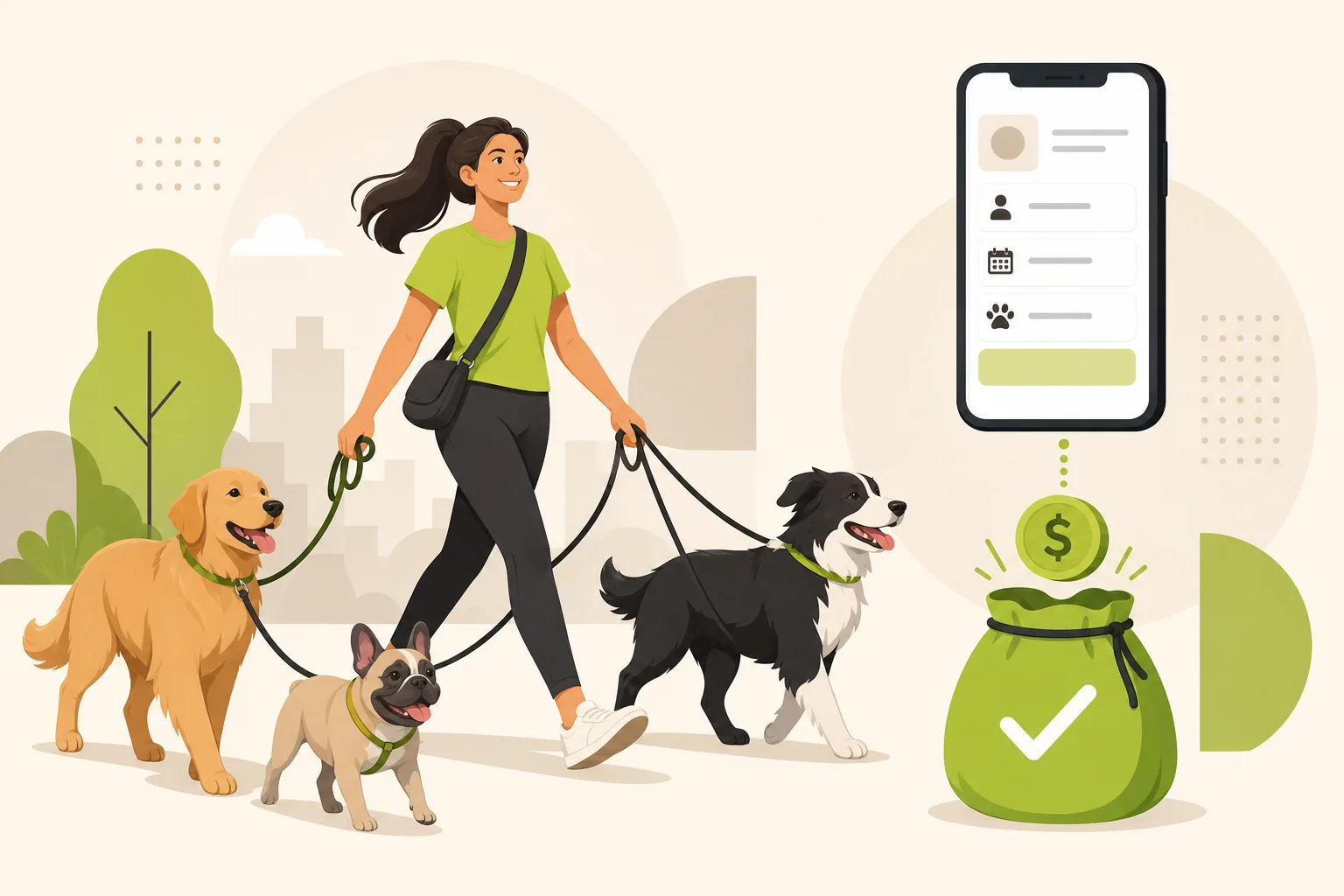
Rover and Wag Are Convenient — Until They're Not
You picked up your first few clients through Rover or Wag. The app handled scheduling, payment, and messaging. You didn't need a website, a booking system, or even a business name. You just showed up and walked dogs.
That's a perfectly reasonable way to start. But if you're doing this full-time — or you want to — you're probably noticing something: the platform takes a cut of every walk, every boarding night, every drop-in visit. Rover's service fee runs around 20%. Wag's is similar. On a $25 walk, you're netting $20 before taxes. On a $30 overnight, the math gets worse.
More importantly, the clients you're building relationships with? They belong to the app, not to you. When Rover changes its algorithm or raises its rates, your business changes too. You have no email list, no phone number database, no way to reach your regulars outside the platform's messaging system.
This post is about when marketplace platforms make sense, when they become a tax on your own client base, and what your own website needs to do to replace what the apps give you.
What the Platforms Actually Give You
It's worth being honest about this. Rover and Wag aren't free money, but they're not just a bad deal either. They solve real problems:
Discovery. When someone new to a city searches for a dog walker, Rover ranks in Google. You don't have to do anything to appear on the first page of results — the platform has already done the SEO work. For brand-new walkers, this is genuinely valuable.
Trust scaffolding. The platform provides reviews, background checks, and payment protection. A nervous pet parent who doesn't know you has a reason to trust the system even if they don't trust you personally yet.
Scheduling and payment infrastructure. You don't need to invoice anyone, chase payments, or manage a calendar manually. The app handles it.
Insurance (sort of). Rover has a coverage program that kicks in for incidents. It's not a substitute for your own policy, but it's a floor.
The honest summary: marketplaces lower the barrier to entry and make it easy to get your first 5 to 10 clients without building anything yourself.
Where the 20% Becomes a Problem
The math shifts when you have recurring clients who book with you every week. If Sarah's golden retriever, Max, gets a 30-minute walk every weekday at $25 per walk, that's $500 a month. On Rover, you're giving up roughly $100 of that — every month — to a platform that didn't do anything to earn it after the first booking.
When we analyzed dog walkers and pet sitters websites from all over the country, the most successful independent operators shared a pattern: they started on the marketplaces, used them to build a base of regulars, and then gradually moved those relationships off-platform. The clients who've walked with you 50 times don't need Rover's trust scaffolding anymore. They already trust you.
The platform fee is most defensible when it's paying for new client discovery. It's hardest to justify when it's a recurring tax on the same clients you've had for two years.
There's also a subtler issue: platform dependency. Rover has changed its fee structure, app policies, and ranking algorithms multiple times. Walkers who'd built their entire business on the platform had no control over how those changes affected their income. If you have your own website, your own booking system, and your own client contact list, a platform policy change doesn't touch you.
The Trigger: When It's Time to Build Your Own Site
You don't need a website on day one. But here are the signals that you do:
- You have 5+ clients who book with you repeatedly and you know their names and their dogs' names
- You're turning down new clients because you're at capacity, which means referrals are happening
- You want to raise your rates above what the platform's price anchoring allows
- You've started thinking about hiring another walker or growing a small team
- You want to serve a specific neighborhood or specialty (reactive dogs, puppies, large breeds) and the platform's generic search doesn't communicate that
Any one of these means you're running a real business, not a side hustle. Real businesses need a home on the internet that they control.
What Your Own Website Needs to Do
When you're coming off a marketplace platform, your website has to replace the trust signals and convenience that the app was providing. Here's what actually matters, based on what we saw across dog walker and pet sitter websites we analyzed from all over the country.
The non-negotiables (table stakes)
Insured and bonded, above the fold. This is the single most universal element across every independent dog walker website we've looked at. Every single one. If it's not visible without scrolling, you're losing pet parents before they read anything else. Most independent walkers carry coverage through Pet Sitters Associates or a similar carrier — name it specifically, not just "fully insured."
Real photos of you with real dogs. Not stock photography. The trust decision in this category is "who is entering my home and handling my dog." A faceless stock photo of a golden retriever on a beach answers none of that. A photo of you, in a neighborhood that looks like theirs, with a dog you've obviously just walked — that does.
Your service area, named specifically. Not just "the greater [city] area." List the neighborhoods. "I serve Midtown, East Nashville, Germantown, and Inglewood" is more credible and more useful than any radius map, and it's how local search works.
A free meet-and-greet offer as your primary call to action. In this category, "Book Now" creates friction because it skips a step the client actually wants. The meet-and-greet is the category's version of a free estimate — it reduces risk for the pet parent and gives you a chance to close in person. Make it the main button.
A contact form that asks the right questions. Dog's name, breed, age, any behavioral notes, service you're looking for. The more qualified the lead, the less back-and-forth before the first booking.
What separates the best sites from average ones
A concrete GPS and photo report walkthrough. The proof-of-service loop — GPS-tracked walk, time-stamped visit, photo report sent after every walk — is what top independent walkers offer that the gig-app model doesn't always guarantee. If you do this, show it on your homepage. A screenshot of an actual report card or a simple "here's what your daily update looks like" section builds a level of accountability that Rover's star ratings can't match.
Specific review count over a generic "5-star" claim. "Trusted by pet parents" is wallpaper. "187 five-star reviews from clients in East Nashville and Germantown" is a fact. If you've accumulated reviews on Google, cite the count directly — one number beats a slider of testimonials every time.
Walker bios with faces. If you're growing a team, this matters even more. Pet parents want to know who has the key to their house. Named bios with real photos and a note about their certifications (CPR/First Aid certified, Fear Free certified) address the anxiety directly.
Transparent rates page. Across our proprietary local-business website research, pricing is hidden on the homepage across most service categories — and dog walking is no exception. But the best independent walker sites put "Services & Rates" right in the navigation. You don't have to list prices on the homepage. You do need a rates page that's easy to find. Total pricing opacity frustrates people who are comparison shopping.
Common Mistakes When Moving Off the Platforms
Building the website but not moving clients over. A website that no one knows about doesn't do anything. When you're ready to move a recurring client off Rover, tell them directly — "I have my own booking system now, and it's easier for both of us." Most clients will follow. Some won't, and that's fine.
Skipping the booking infrastructure. Your website can't just be a brochure. You need a way for clients to actually book, pay, and receive visit updates without you managing it manually. Software like Time to Pet, Precise Petcare, or Swifto is what established independent walkers use. Link your website's CTA to that system rather than just a contact form.
Not addressing the anti-gig positioning explicitly. When we looked at dog walker sites across different markets, the copy that worked hardest was the copy that drew a direct contrast with the app model: trained and background-checked, the same walker every visit, backup coverage so nothing gets dropped. Pet parents who've been burned by a Rover no-show or a last-minute cancellation are actively looking for that language. Use it.
Hoping the homepage will rank by itself. It won't, not at first. What does rank well for independent dog walkers is neighborhood-specific pages. A page titled "Dog Walking in [Neighborhood], [City]" targets exactly the search a pet parent makes when they're looking for someone local. One Charlotte walker we looked at had 14 of these pages — and it's the clear reason her site dominates local search in that market.
What GrowLocal Builds for Dog Walkers
If you want to see what a dedicated dog walker website looks like — with the full trust signal stack, GPS proof-of-service section, neighborhood targeting, and quote request form — GrowLocal builds and hosts sites for dog walkers and pet sitters. The preview is free, and hosting runs $20-30/month once you're live.
We build sites specifically for service businesses like this one — if you want to see the full range of industries we cover, browse what we've built for local businesses.
If you want the full picture on trust signals, photography, and what pet parents specifically look for before they book — we covered that in more depth in our post on what pet parents need to see on your dog walker website.
Quick Takeaways
- Marketplaces are worth it for discovery and your first clients. They're a bad deal for recurring clients who already trust you.
- The 20% platform fee is hardest to justify when it's applied to the same clients you've had for two years.
- Your own site needs four things above everything else: visible insurance/bonding, real photos of you with dogs, a named service area, and a free meet-and-greet CTA.
- The GPS proof-of-service loop — tracked walk, time-stamped visit, photo report — is the differentiator that marketplace profiles can't replicate.
- Neighborhood-specific pages are the real local SEO engine. Start with two and build from there.
- You don't have to leave the platforms. The goal is to stop paying their commission on clients who already know and trust you.