


Updated June 2026
A poorly tuned sprinkler system is one of the most common sources of wasted money in a homeowner's budget. A single broken head can waste up to 25,000 gallons per year — roughly $280 per season. A licensed local irrigator can identify and fix the five most common waste sources in a single service visit, often cutting outdoor water use by 30–40%.
This is based on EPA WaterSense research and GrowLocal's proprietary analysis of top-performing local irrigation company websites.
Below: what your sprinkler system is actually wasting, what a licensed tech checks on an efficiency call, whether a smart controller is worth the cost, and when to call a pro vs. handle it yourself.
How does an inefficient sprinkler system waste water (and money)?
Most homeowners focus on watering frequency. The real waste is in the hardware and settings — not the schedule.
Here are the five culprits a sprinkler technician sees most often:
| Waste Source | What Happens | Estimated Annual Loss |
|---|---|---|
| Broken or missing head | Sprays unchecked or pools in one spot | Up to 25,000 gal / ~$280 |
| Misaligned heads | Waters pavement, not lawn | 1,600–5,760 gal per zone per month |
| Clock-timer controller | Ignores rain, waters on schedule regardless | ~50% more water than needed outdoors |
| High-pressure misting | Fine mist evaporates before reaching soil | 20–30% of each zone's water budget |
| Leaky zone valve | Bleeds water between cycles | 300–900 gal per day, often unnoticed |
The number that gets homeowners' attention: homes with outdated clock-timer controllers use approximately 50% more water outdoors than those that water manually — not from watering more often, but because the timer can't respond to rain or temperature. That shows up directly on the water bill.
Key takeaway: A single broken sprinkler head can waste up to 25,000 gallons of water per year, according to EPA WaterSense research — costing homeowners $280 or more in a single irrigation season. Most of these breaks are invisible from the surface. A licensed irrigator finds them in the first walkthrough.
What does a sprinkler tech actually do on an efficiency check?
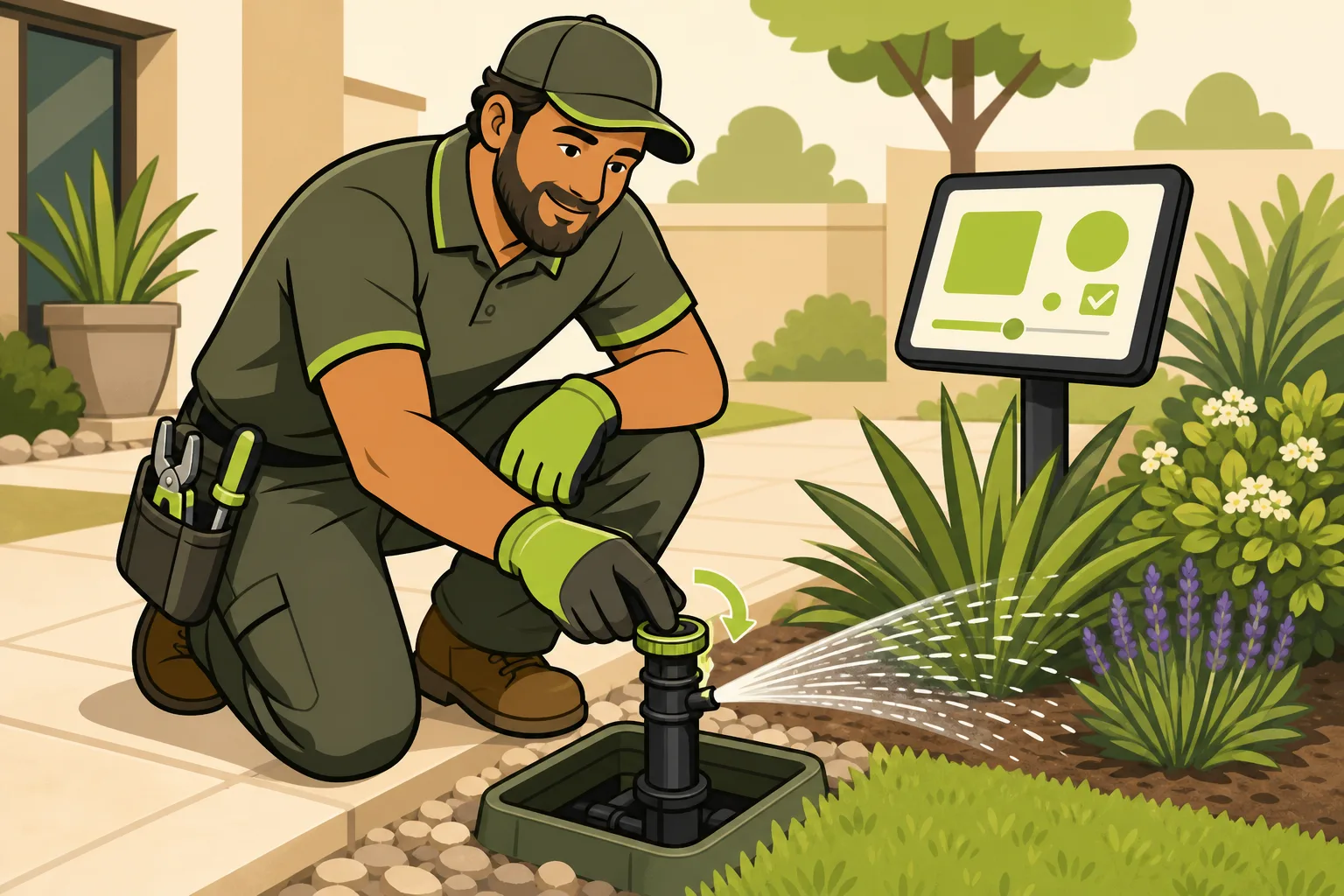
This is the question the generic tips articles never answer. Watering in the morning and installing a rain sensor are good ideas — but a licensed tech does something fundamentally different: a zone-by-zone diagnostic.
Here's what a professional irrigation efficiency check typically covers:
- Zone activation test — run each zone individually, watch every head activate and confirm full coverage, no pooling, no misting
- Head alignment — adjust rotors and fixed heads so spray lands on lawn, not sidewalk or driveway
- Pressure measurement — check operating pressure against manufacturer specs for each head type; high pressure causes misting and wasted water
- Leak and valve check — listen and look for zone valves that don't close cleanly between cycles
- Controller audit — review current run times and start times; adjust for season, sun exposure, and zone type (grass vs. beds)
- Drip zone inspection — check emitter placement and output; drip systems lose efficiency when emitters clog or are buried
- Smart controller evaluation — assess whether the current controller is a candidate for a weather-based upgrade
This diagnostic takes 60–90 minutes for a typical residential system. Most homeowners cannot replicate it, because it requires activating individual zones, reading pressure at the head, and knowing the output specs for different nozzle types.
Is a smart irrigation controller worth the upgrade?
For most homeowners, yes — especially if the current controller is a basic timer model.
A weather-based smart controller adjusts watering automatically based on real-time temperature, rainfall, and soil conditions. It skips scheduled cycles when it rained last night. It runs shorter cycles in cool weather. It doesn't water pavement because a head rotated out of position after a mowing clip.
The numbers:
- Residential homeowners typically see 20–50% reductions in outdoor water use after switching to a properly installed smart controller (UC ANR, EPA WaterSense research)
- The EPA estimates a smart controller upgrade can save the average home up to 15,000 gallons per year
- Many water utilities offer rebates for WaterSense-certified smart controllers, which can offset $50–$150 of the installation cost
One caveat: savings depend heavily on correct programming. A smart controller with wrong zone settings or soil codes won't outperform a timer. Programming is where a licensed irrigator earns the installation cost — the hardware is secondary.
If water bills climb through summer without explanation, a smart controller evaluation is usually the right first call. Many irrigation companies near you include a system check with the installation quote.
What's the most water-efficient way to water a lawn vs. a garden bed?
Spray heads and rotors work well for turf. They're designed for it. For garden beds, ground cover, and shrubs, they're consistently inefficient — and most systems mix both on the same zone by default.
The two-zone principle:
Turf zones (grass): rotary heads or high-efficiency rotors, run early morning (5–9 a.m.). Short cycles run more frequently ("cycle and soak") reduce runoff on slopes.
Bed zones (ornamentals, shrubs, ground cover): drip irrigation, not spray. Drip delivers water directly to root zones and eliminates evaporation. A drip conversion on an existing spray zone typically saves 30–50% of that zone's water budget.
The problem: most residential systems were installed with spray heads covering everything — beds and lawn on the same zone, same run time, same output rate. A licensed irrigator can separate zones, convert beds to drip, and reprogram accordingly. This is not a DIY retrofit — it requires rerouting laterals, adding pressure regulators, and resetting the controller.
For a full picture of what local irrigation companies offer — from backflow testing to seasonal maintenance plans — see our irrigation and sprinkler website examples.
When should I call a licensed irrigator vs. fixing it myself?
DIY is reasonable for a few specific tasks:
- Replacing a single broken head of the same model and nozzle type (matching output rate matters)
- Adjusting spray arc on a rotor head that has drifted
- Resetting controller start times after a power outage
Call a licensed irrigator for:
- Pressure problems — high-pressure misting or low-pressure incomplete coverage requires gauge testing and zone-specific fixes
- Valve malfunctions — stuck-open or stuck-closed valves need to be isolated and replaced; a wrong move can flood a zone or shut off the entire system
- Smart controller installation and programming — the controller itself is easy to mount; the soil, plant, and sun-exposure settings that make it work are not
- Drip conversion — requires line sizing, pressure regulation, emitter selection, and controller reprogramming
- Spring startup — pressurizing too fast after winter can burst fittings; a licensed tech does it in stages with all zones open to bleed air slowly
Across our research into top-ranking local business websites — see the full home services data — irrigation is one of the few home services where top local companies display their licensing number prominently. A Licensed Irrigator number in Texas (or state equivalents in Colorado, Florida, and others) signals the tech has passed training in system design, backflow prevention, and efficiency standards. It matters for any work beyond head replacement.
What should I look for in a local sprinkler company for an efficiency audit?
A few signals that separate professional irrigation contractors from general landscapers who also do sprinklers:
- State irrigator license displayed — not just "licensed and insured," but the actual license number. In Texas it's an LI number from TCEQ; in Colorado, it's a state irrigator certification. Licensed companies have passed irrigation-specific training.
- Efficiency audit offered as a standalone service — not just repair-and-replace. A company that offers system evaluations knows how to diagnose, not just fix what's obviously broken.
- Smart controller experience — ask which brands they install and program. Experience with Rachio, RainBird, or Hunter Hydrawise is a good signal.
- Written scope — any company doing zone work or drip conversion should provide written scope before starting. Don't accept a verbal quote for anything beyond a single head replacement.
The irrigation sprinkler website checklist gives a sense of what a credible local operator's web presence covers — useful when evaluating a company online before you call. For what a professional irrigation company website costs to build, our sprinkler contractor website cost breakdown covers that.
For a broader look at how local home-service businesses present expertise online, see all home service websites we cover.
Frequently Asked Questions
How much water does a sprinkler system waste if it has a broken head?
A single broken or missing sprinkler head can waste up to 25,000 gallons of water per year, equivalent to roughly $280 in water costs over a six-month irrigation season (EPA WaterSense). The loss is often invisible — the head may spray sideways into soil or simply fail to rotate, while the zone timer continues running its full cycle.
How often should a sprinkler system be inspected for efficiency?
Every spring before the irrigation season starts is the standard recommendation. A spring startup inspection from a licensed irrigator includes zone-by-zone activation, head alignment, pressure checks, and controller review. Catching a broken head or misaligned rotor in March costs far less than running a damaged zone through an entire Texas or Colorado summer.
Do smart sprinkler controllers actually save money?
Yes, for most homeowners. Replacing a standard clock-timer with a WaterSense-certified smart controller typically reduces outdoor water use by 20–50%, and the EPA estimates average savings of up to 15,000 gallons per year. Many utilities offer rebates of $50–$150 for WaterSense-certified models. The key is professional programming — a smart controller set with incorrect zone parameters will not outperform a manual timer.
Is drip irrigation better than spray heads for flower beds?
Yes. Drip irrigation delivers water directly to root zones, eliminating evaporation and wet-foliage problems that spray heads cause on ornamental beds. Converting existing spray zones in plant beds to drip typically reduces that zone's water use by 30–50%. It requires zone separation, pressure regulators, and reprogramming — a one-time investment a licensed irrigator handles in a single visit.
How do I find a reputable irrigation company for a water audit?
Look for a company that displays a state irrigator license number (not just "licensed and insured"), offers efficiency audits as a standalone service, and provides written scope before starting any zone work. Online reviews mentioning specific technicians — not just the company name — are a stronger signal than aggregate star ratings. Irrigation and sprinkler contractors in your area vary widely in credentials; the licensing check is the fastest way to separate the field.