


Updated June 2026
A fall sprinkler blowout — using compressed air to force all water out of your irrigation lines before winter — costs $85–$150 for most residential systems. Skip it, and a single hard freeze can crack lateral pipes, split fittings, and blow your backflow preventer, turning a $100 service call into a $500–$3,000 spring repair bill your homeowner's insurance likely won't cover. This post explains exactly what breaks, what it costs to fix, and when to book.
This is based on GrowLocal's proprietary research into top-ranking local irrigation and sprinkler business websites, combined with current contractor pricing data.
What exactly is a fall sprinkler blowout?
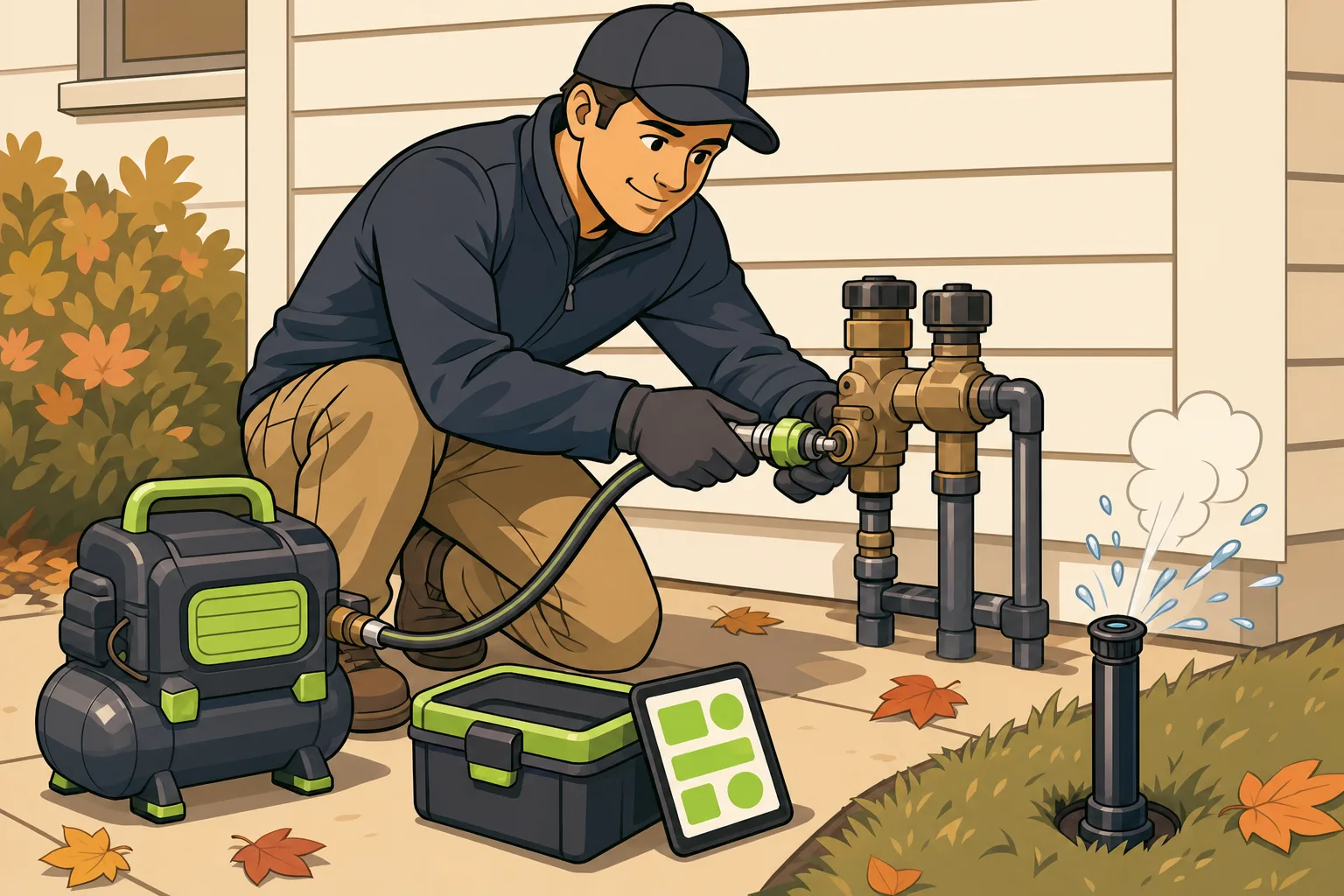
A blowout is the process of connecting a commercial-grade air compressor to your irrigation system's main inlet and forcing pressurized air through each zone — one at a time — until no water remains in the lines, heads, valves, or backflow preventer.
A licensed irrigator opens each zone valve sequentially, runs air at 50–60 PSI until the heads run clear, and then inspects every component before closing out the system for winter. A typical residential system with 6–10 zones takes 30–45 minutes.
This is not the same as shutting off the water. Turning off your main irrigation valve leaves standing water in every pipe, fitting, and valve body. That water freezes.
What happens to your sprinkler system if you skip the blowout?
Water expands by about 9% when it freezes. Inside a closed irrigation system, that expansion has nowhere to go.
Here's what breaks, in order of likelihood:
- Lateral lines (PVC or poly pipe) — The buried pipes running water to each zone head. Poly pipe cracks; PVC fractures. You won't see the break until spring, when you turn the system on and find a geyser in the lawn.
- Sprinkler heads — The plastic housing cracks under expansion pressure. Every broken head needs to be dug up and replaced.
- Valve manifold — The control assembly that opens and closes each zone. A cracked manifold means no zone control until it's replaced — a labor-intensive repair.
- Backflow preventer — The device protecting your home's drinking water from contamination. Backflow preventers are especially vulnerable to freeze damage because they sit above ground and contain multiple internal rubber seals that rupture when water freezes inside them. Replacement typically runs $200–$500.
- Controller wiring connections — Less common, but expansion can pop wire connectors at the valve, requiring rewiring.
A moderate freeze event hitting an un-winterized 8-zone system can break 3–5 heads, crack 1–2 lateral line sections, and damage the backflow preventer — all at once.
How much does freeze damage actually cost to repair?
| Component | Blowout Prevention Cost | Freeze Damage Repair Cost |
|---|---|---|
| Full system blowout | $85–$150 | — |
| Single sprinkler head replacement | Already prevented | $55–$95 per head |
| Lateral line pipe repair (per section) | Already prevented | $150–$350 per break |
| Backflow preventer replacement | Already prevented | $200–$500 |
| Valve manifold replacement | Already prevented | $250–$600 |
| Full system replacement (severe damage) | Already prevented | $2,400–$4,200 |
A realistic moderate-damage scenario — two broken head zones, one cracked lateral, and a damaged backflow preventer — runs $600–$1,200 in spring repairs. A bad season with multiple line fractures and a ruined manifold can push $2,000+.
The math: a $100 blowout in October prevents a potential $1,000+ repair call in April.
Key takeaway: Across GrowLocal's proprietary research into top-performing irrigation and sprinkler websites, fall winterization/blowout emerged as the recurring-revenue backbone of irrigation businesses — and the strongest companies in every market build dedicated seasonal pages for it because it's the one service every installed customer needs, every year, without exception. See our full home-services data.
Will homeowner's insurance cover freeze damage to my sprinkler system?
Usually not. Standard homeowner's policies typically cover "sudden and accidental" water damage — but freeze damage to a sprinkler system is classified as a maintenance failure, not a sudden event. Insurers consider a fall blowout a basic maintenance step, and skipping it means the damage was preventable.
Before assuming coverage, check your policy's exclusions for "maintenance-related damage" and "gradual deterioration." Most homeowners are surprised to learn their standard HO-3 policy explicitly excludes this scenario.
Can I blow out my own sprinkler system?
You can rent an air compressor and attempt a DIY blowout. The problem is that most homeowners use too much or too little PSI — and both are damaging.
- Too high PSI (over 80 PSI) shatters plastic head casings and can crack PVC fittings. The blowout itself becomes the damage event.
- Too low CFM (cubic feet per minute) doesn't clear water from the far ends of long zones — leaving ice-vulnerable pockets the homeowner doesn't know about.
Licensed irrigators use compressors rated 20–50 CFM at 50–60 PSI and know exactly when each zone has run dry. They also know which zones have problematic low spots that need extra attention. A $100 professional blowout with the right equipment is meaningfully safer than a DIY attempt with a rental unit.
For your own safety: never stand over a sprinkler head during a blowout. Compressed air can send a head cap airborne.
When should I book my fall sprinkler blowout?
Timing depends on your region, but the general rule is: schedule before the first hard freeze (sustained below 32°F overnight), not after.
| Region | Book By | Hard Freeze Window |
|---|---|---|
| Northern states (CO, MN, WI, ND) | September | October–November |
| Mid-Atlantic / Midwest (OH, PA, MO) | October | November |
| Southern transition zone (TN, VA, NC) | Late October | November–December |
| Deep South (TX, GA, SC) | November | December–January |
The October problem: fall blowout bookings peak in October across all northern markets. Licensed irrigators' schedules fill 2–4 weeks out during peak weeks. Homeowners who call in late October often can't get a booking before the first hard freeze. Call in September.
If you're not sure whether your area needs a blowout: if overnight temps regularly hit 32°F or below, your system needs one. Poly pipe starts to crack around 25°F; PVC around 28°F. The risk isn't worth testing.
What does a professional fall blowout include?
A typical licensed irrigator service visit covers:
- Shut off the main irrigation water supply
- Connect commercial air compressor to the system inlet
- Open and clear each zone sequentially (1–2 minutes per zone until heads run dry)
- Inspect heads and adjust coverage angle on any that have shifted
- Check valve manifold and backflow preventer for pre-existing cracks
- Shut down and winterize the controller (either power off or set to "rain" mode)
- Note any repairs needed before spring startup
Many irrigation companies offer a bundled annual plan — spring startup + fall blowout — at a flat annual rate. A maintenance plan typically saves $40–$80 versus booking each service separately, and gets you priority scheduling in the busy October window.
See our irrigation and sprinkler website overview for what to look for when choosing a licensed local irrigator.
How does a fall blowout connect to spring startup?
They're two halves of the same recurring service model. A fall blowout closes the system safely; a spring startup reopens it, pressurizes each zone, tests heads, and resets the controller for the new season.
Skipping the blowout makes spring startup dramatically more expensive — because instead of a 45-minute check-and-test, your tech is diagnosing and repairing everything that froze over winter before the system can run at all.
The most efficient path: same licensed irrigator, both visits, every year. If you're selecting an irrigation company, check our full local irrigation and sprinkler company resource or browse all local home-service trades.
If you're also thinking about system efficiency, our post on how your sprinkler system may be wasting water — and what your local tech can fix covers what a tech typically spots during a service visit.
Frequently Asked Questions About Fall Sprinkler Blowouts
What is a sprinkler blowout and why do I need one?
A sprinkler blowout uses compressed air to remove all water from your irrigation system's pipes, heads, valves, and backflow preventer before winter. Without it, residual water freezes inside the system and expands, cracking pipes, shattering head casings, and damaging valves — damage that typically costs $500–$3,000 to repair in the spring.
How much does a fall sprinkler blowout cost?
Most residential systems cost $85–$150 for a professional blowout. The exact price depends on the number of irrigation zones and your region. Across GrowLocal's proprietary research into top-performing irrigation sites, the companies that display flat per-zone pricing for seasonal services — rather than hiding all pricing — are consistently rated as more trustworthy by customers. Expect many local irrigators to price around $10–$15 per zone with a base service fee.
Can I do a sprinkler blowout myself instead of hiring a pro?
Technically yes — but the risk is real. Too much PSI (over 80 PSI) shatters plastic head casings and cracks fittings; too little CFM leaves water in low spots you won't know about. Most homeowners underestimate CFM requirements. Licensed irrigators use 20–50 CFM commercial compressors calibrated to the system. For a $100 service, the professional blowout is nearly always the right call.
What time of year should I schedule a fall blowout?
Book in September for northern states (Colorado, Minnesota, Wisconsin); by early October for the mid-Atlantic and Midwest; by late October for the southern transition zone. Fall blowout schedules fill 2–4 weeks out in October — don't wait for the first frost warning to call.
Does homeowner's insurance cover freeze damage to sprinkler systems?
Rarely. Standard homeowner's policies exclude "maintenance-related" damage, and insurers classify a skipped blowout as a maintenance failure. The freeze damage repair bill lands entirely on you. This makes the $85–$150 blowout a straightforward piece of cheap insurance.
Is a fall sprinkler blowout the same as winterization?
Yes — the terms are interchangeable. "Winterization" is the broader category; "blowout" describes the compressed-air method used to force water out. Some companies also offer drain-and-shut-off winterization for systems with manual drain valves, but the blowout method is more thorough and is the professional standard.
How do I book a fall sprinkler blowout?
Most local irrigators book by phone or a quote/contact form on their website. A few have added online scheduling. Either way, don't wait for the first frost warning — call or submit a quote request in September for northern markets, early October elsewhere. Schedules fill fast once temperatures start dropping.