


Updated June 2026
ISR (Infant Swimming Resource) teaches children ages 6 months to 6 years one survival skill: how to get themselves out of a dangerous water situation through one-on-one, 10-minute daily sessions over 6–8 weeks. For swim school owners, ISR certification is a business decision that changes your pricing model, your schedule, your instructor requirements, and — critically — what your website must explain before a parent ever picks up the phone.
This is based on GrowLocal's proprietary research into top-ranking local business websites, including our analysis of independent swim school sites across Austin, Denver, and Nashville.
What is ISR, exactly?
ISR stands for Infant Swimming Resource. The program was founded in 1966 by Dr. Harvey Barnett in Central Florida and now certifies instructors worldwide. The core promise: teach very young children one reliable survival response so that an accidental fall into water doesn't become a drowning.
The skills vary by age:
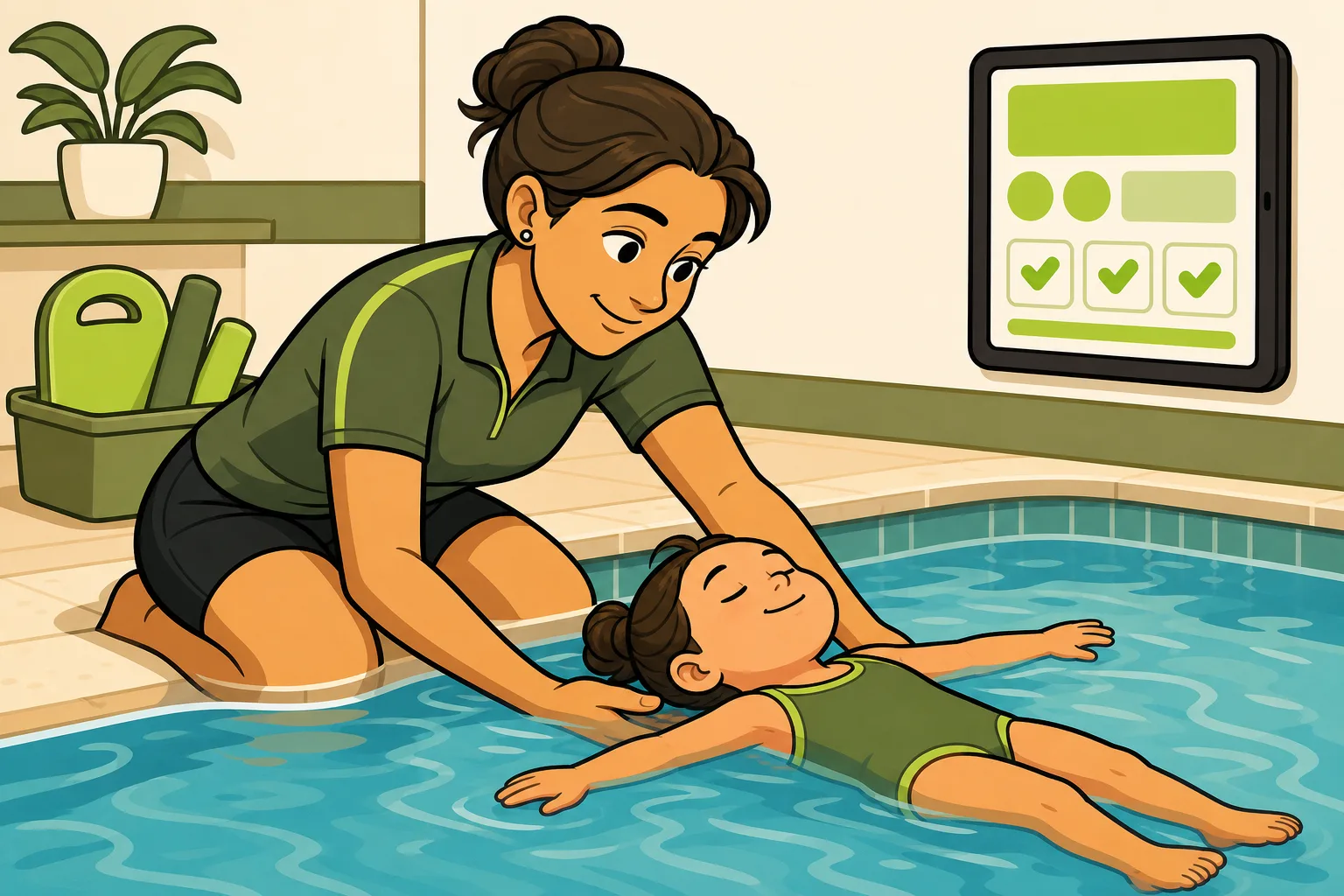
- 6–12 months: Roll-to-float. The infant learns to roll onto their back, float, rest, and breathe until help arrives.
- 1–6 years: Swim-float-swim sequence. The child swims face-down, rolls to float and breathe, rolls back, and keeps going until they reach the pool wall, steps, or shoreline.
- Final week: Fully clothed practice — shoes, diaper bag clothes, everything — to simulate the most realistic accidental-entry scenario.
The program is always one-on-one. Always 10 minutes per session. Always 4–5 days per week. Most children complete the full skill sequence in 5–8 weeks (roughly 30 lessons). After that, refresher sessions are needed as the child grows — because a body that's moved up a clothing size has changed its relationship with water enough to need recalibration.
How does ISR compare to traditional swim lessons?
This is the table every parent asks for — and every swim school owner should have ready on their website.
| Feature | ISR | Traditional Group Lessons |
|---|---|---|
| Age range | 6 months–6 years | 6 months–adult |
| Primary goal | Survival self-rescue | Stroke technique + water comfort |
| Format | 1:1 always | Group (4–8 students typical) |
| Session length | 10 minutes | 30–45 minutes |
| Frequency | 4–5 days/week | 1–2 days/week |
| Program length | 6–8 weeks intensive | Ongoing; semester or monthly |
| Cost (full program) | $600–$1,050+ | $80–$250/month typical |
| Crying during lessons | Common and expected | Less typical |
| Refresher lessons | Needed as child grows | Not required |
ISR is not a replacement for traditional swim lessons — it's a safety foundation. Most ISR families transition into traditional stroke development once the child completes the program.
What does ISR instructor certification actually require?
This is where ISR stands apart from other swim credentials — and why parents who understand it are willing to pay a premium.
To become a certified ISR instructor, you complete an 8-week intensive on-site training with a Certified ISR Master Instructor. The minimum is 80 hours of in-water time. The coursework covers behavioral psychology, child anatomy and physiology, and ISR's proprietary technique. All instructors must hold current CPR and First Aid certification.
After initial certification, ISR instructors attend an annual recertification symposium that includes quality control and continuing education. There is no grandfathering — the recertification is required every year to maintain active status.
For your website, this matters: parents researching ISR are often comparing certified ISR instructors against general "survival swim" providers who use similar language but don't carry the ISR credential. The certification is your proof point. Display it prominently.
Why the daily intensive format confuses parents — and what to do about it
The most common reason parents don't book ISR after visiting a swim school website: they don't understand the format, and nobody explains it clearly.
A parent who's used to Saturday morning group lessons sees "10 minutes per session, 5 days a week" and thinks: that's not enough time. They see "your child will cry during lessons" and think: that sounds harmful. They see "$810 for the program" and compare it to $120/month group lessons.
These objections are answerable — but not if your website buries ISR in two paragraphs on your programs page.
The five questions your ISR FAQ must answer before a parent calls:
-
Why are sessions only 10 minutes? Infant attention spans are short. ISR research shows that 10 focused minutes of one-on-one instruction is more effective for survival skills than 45 distracted minutes in a group. Quality of repetition matters more than session length.
-
Why does my child cry? Learning a physical skill that's unfamiliar creates discomfort. Crying during ISR is normal and doesn't indicate harm. Instructors are trained to distinguish discomfort from distress. Parents can typically observe from the pool deck.
-
What if we miss a day? ISR schedules are intensive by design — muscle memory builds through daily repetition. Missing sessions extends the program. Most instructors build a make-up policy into their enrollment agreement; explain yours explicitly.
-
Does my 6-month-old really need this? ISR teaches infants the roll-to-float reflex, which gives a brief survival window in accidental water entry. Drowning is among the leading causes of accidental death for children under 5 (CDC). The program is insurance, not a swim team pipeline.
-
Do we need refresher lessons every year? Yes, and here's why: as a child's body grows, their center of buoyancy shifts. The motor patterns they learned at 18 months won't transfer cleanly at 2.5 years without review. ISR recommends refresher sessions whenever the child has grown noticeably since their last water time.
Key takeaway: Across GrowLocal's proprietary research into top-ranking swim school websites, the highest-converting sites display at least one nationally recognized credential badge — USSSA, American Red Cross authorization, USA Swimming affiliation, or ISR certification — above or immediately adjacent to the primary enrollment CTA. For ISR-certified schools, that badge is your fastest trust signal. A parent who recognizes the ISR logo has already done the research; they just need to see the badge and a clear way to reach you. (See our full website data)
How much do ISR lessons cost — and how should you frame pricing on your website?
Range: $100–$265 per week, or $600–$1,050+ for a full 6–8 week program, depending on instructor and location. A separate national ISR registration fee ($105 for new students, $40 for returning) is paid directly to ISR at enrollment.
Regional examples from 2026:
- Austin, TX: $810 total
- South Jersey: $1,050 total
- Florida Gulf Coast: ~$260/week
For your website pricing section, the question isn't whether to show the range — it's whether to frame ISR as worth it relative to traditional lessons. The answer is context. ISR parents aren't comparing it to $120/month group lessons; they're comparing it to no safety foundation at all. The per-session equivalent for a $810 program over 30 sessions is $27/session — framing that against a 1:1, certified, 10-minute intensive shifts the conversation.
What your website should not do: hide pricing entirely without any signal of the cost range. ISR parents are highly researched; a school that doesn't mention price at all triggers more friction than one that shows a range and explains what's included.
For a premium program like ISR, showing a cost range with a brief explanation (national registration fee, 1:1 format, certification requirements) reduces sticker shock before the call happens. See what else belongs on a swim school website to convert this audience.
What should your swim school website say about ISR?
If you offer ISR, it needs its own page — not a paragraph buried under "Programs." Here's what that page must include:
Certification badge, above the fold. The ISR logo is a recognized trust signal for parents who've researched the program. Place it next to your enrollment CTA, not in a footer trust strip.
A plain-English explanation of the format. Assume the parent has never heard of ISR. Explain the 10-minute daily format, the 6–8 week timeline, the skill sequence by age group, and why refresher lessons are needed. Parents who understand the format before calling are far easier to close.
Your instructor's credentials. How long have they been ISR certified? How many sessions have they completed? ISR instructors who have been through recertification multiple years in a row have a track record worth stating.
Testimonials from parents, not marketing language. ISR is a trust-intensive purchase — parents are putting their infant in the water daily with a stranger. A local parent testimonial describing their child's first survival float carries more weight than any headline you can write. Pair your credential badge with parent testimonials in close proximity to the enrollment CTA.
An honest FAQ. The five questions above belong on your ISR page, not hidden in a site-wide FAQ. Parents who can't find the answer to "why does my baby cry?" will not book — they'll leave.
A fast contact form paired with a visible phone number. This audience converts by phone at a high rate — a parent ready to enroll their infant won't wait 24 hours for email. GrowLocal sites use a contact/quote form as the primary conversion mechanism. For live scheduling, most ISR instructors use an external tool (Calendly, Mindbody, or Google Calendar bookings) — link to it from your contact page.
For a complete checklist of what every independent swim school site needs, see our swim school website guide and the swim school website checklist. For whether the investment pays off, see is a swim school website worth it.
See how other trust-intensive local trades handle credentials and testimonials at GrowLocal's website builder hub.
Frequently Asked Questions About ISR Swim Lessons
What does ISR stand for in swim lessons?
ISR stands for Infant Swimming Resource. The program was founded in 1966 by Dr. Harvey Barnett and teaches children ages 6 months to 6 years self-rescue skills through one-on-one, 10-minute daily sessions over 6–8 weeks. ISR Self-Rescue® is the trademarked skill sequence the program certifies instructors to teach.
How is an ISR instructor certified?
ISR instructor certification requires an 8-week intensive training program with a Certified ISR Master Instructor, including a minimum of 80 in-water hours and coursework in behavioral psychology, child anatomy, and ISR techniques. All instructors must hold current CPR and First Aid certification and attend an annual recertification symposium to maintain active status. The annual recertification is mandatory — there is no grandfathered status.
Is ISR better than regular swim lessons?
ISR and traditional swim lessons serve different purposes. ISR is an intensive 6–8 week survival foundation; traditional lessons build stroke technique over ongoing enrollment. Most ISR families transition into traditional lessons after completing the program. For parents of children under 4 with regular pool or lake access, ISR provides a safety layer that group lessons don't replicate.
How much do ISR lessons cost in 2026?
A full ISR program typically costs $600–$1,050+ for the 6–8 week intensive, plus a $105 national registration fee for new students paid directly to ISR. Rates vary by region: $810 is a common total in Austin, TX; $1,050 in South Jersey; roughly $260/week on the Florida Gulf Coast. Annual refresher sessions are priced separately by the instructor.
Why do ISR lessons only last 10 minutes?
Ten minutes is the research-supported duration for maintaining an infant or toddler's focused attention. Short, intensive 1:1 sessions build more durable muscle memory than longer group formats. The daily repetition — 4–5 days per week — is what builds the skill, not session length.
Can a GrowLocal swim school website display my ISR certification?
Yes. GrowLocal sites support a certification/trust badge section that can be placed adjacent to the primary enrollment CTA. Your ISR badge, USSSA logo, or other credentials can be displayed alongside parent testimonials and your contact form. The site does not integrate with live booking software — parents who want to schedule directly can be linked to an external tool (Calendly, Mindbody, or a Google Calendar booking page) from your contact page.