


Updated June 2026
Landscaping SEO comes down to one thing: whether your website gives Google what it needs to send local homeowners your way. The right landscaping website structure — dedicated service pages, a project gallery with descriptive alt text, neighborhood-name testimonials, a quote form, and schema markup — is the SEO strategy. You do not need to hire an agency first.
This is based on GrowLocal's proprietary research into top-ranking local business websites.
Below is exactly what an SEO-ready landscaping website looks like, page by page and section by section.
What does "landscaping SEO" actually mean for a local company?
Most landscaping SEO articles assume you are about to hire someone. They cover keyword research tools and backlink outreach — work that happens outside your website.
The bigger opportunity is already inside your website. Google ranks pages based on relevance and trust. Relevance means your service pages say exactly what you do, where you do it, and for whom. Trust means your site loads fast, has real photos, shows your credentials, and gives visitors a clear next step.
A landscaping company that has dedicated service pages, a named-project gallery, and a quote form is already doing 80% of local SEO — because those structural elements are what Google is looking for.
A GrowLocal landscaping website is built with all of these baked in from day one. See what that includes on the GrowLocal landscaping website overview.
What pages does a landscaping website need to rank locally?
One "Services" page cannot rank for "hardscape contractor near me," "irrigation repair," and "lawn care programs" at the same time. Google ranks individual pages — so each service you offer needs its own page.
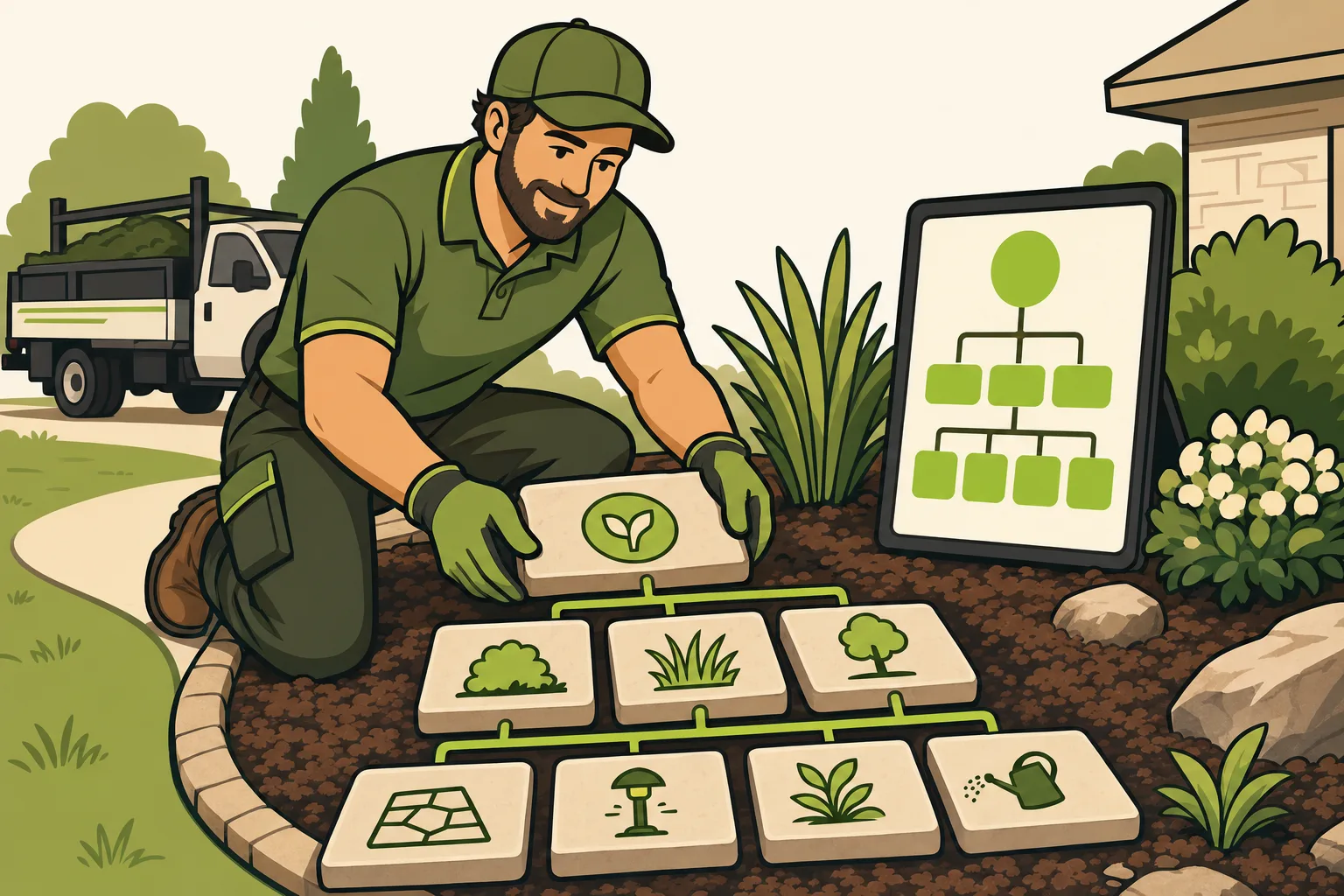
The core page set for a landscaping website:
- Home — broad city + service identity ("Charlotte Landscaping & Hardscape Design")
- Individual service pages — one per distinct service: landscape design, lawn care, hardscaping, irrigation, drainage, outdoor lighting, water features, retaining walls. Each page targets that service's keyword.
- Gallery / portfolio — named projects with descriptive alt text and before/after pairs
- Service area pages — one hub page listing every city you serve; dedicated per-city pages if you serve a large territory
- About — credentials, founding year, license numbers, association memberships
- Contact / Request a Quote — a form with clear fields and a "Free Estimate" offer
The strongest landscaping sites we analyzed lead with "Free Estimates" or "Free On-Site Consultations" as the primary call-to-action across their entire site. The quote form is not just a conversion tool — it signals to Google that this is an active local service business.
For more on what makes a high-converting landscaping site, see what a landscaping website actually needs.
How does your gallery help you rank?
Your gallery is one of the most underused SEO assets in landscaping.
Every image file needs a descriptive name and alt text. Not IMG_4892.jpg with alt text photo. Instead: charlotte-nc-flagstone-patio-installation.jpg with alt text Flagstone patio installation in Myers Park, Charlotte NC. That is a complete local keyword that Google reads as content.
Named project titles work the same way. "The Lakewood Courtyard Project" tells Google that you did a specific kind of work in a specific part of your city — without keyword stuffing.
What to put in every gallery image alt text:
- Service type (hardscape, irrigation, landscape design, lawn care)
- Location signal (neighborhood, city, or city + state)
- Material or plant type when relevant (flagstone, xeriscaping, native plants)
A gallery with 20 well-labeled project photos is doing 20 pieces of local content work for you, completely passively.
See the broader local business website research at GrowLocal to understand how this pattern plays out across other trades.
Why do testimonials with neighborhood names matter for SEO?
Testimonials are trust signals for visitors. They are also geo-relevance signals for Google.
A testimonial that reads "— Sarah M., Charlotte, NC" is fine. A testimonial that reads "— Sarah M., Myers Park" is better. Google reads the content of your testimonials the same way it reads your service pages — neighborhood and city names in testimonials tell Google where you actually work.
The strongest landscaping sites we analyzed display testimonials from named customers, often with the project location or neighborhood alongside the review text. This is not accidental. It is local SEO built into the content layer of the site.
Key takeaway: Across GrowLocal's proprietary research into top-ranking local business websites, pricing is hidden on 85–100% of home-services sites in every category — with "Free Estimate" as the universal conversion bridge. This means your quote form and testimonials are doing the conversion work that pricing would otherwise do. Make both specific and local. See the full home-services data.
What is the one technical thing most landscaping websites miss?
Schema markup — specifically LocalBusiness schema on your homepage and Service schema on each service page.
Schema is structured data that tells Google (and AI search tools like ChatGPT and Perplexity) exactly what your business does, where it operates, and what services it offers. Pages with schema are eligible for rich results in Google Search and are more likely to be cited by AI answer engines.
In our audit of over 130 top-ranking local business websites, 12% of the highest-ranking local business homepages had no structured-data markup at all — leaving rich-result and AI-citation eligibility on the table (N=131, GrowLocal scrape audit).
Site speed is the second most common miss. Google uses mobile-first indexing and penalizes slow pages. A landscaping site with 25 unoptimized images can load in 8–12 seconds on mobile — which increases bounce rates sharply and suppresses rankings. GrowLocal's static site architecture loads pages in under 1.5 seconds, which is a structural advantage over WordPress or Squarespace builds.
Do landscaping service pages need blog posts to rank?
Not necessarily — but specific blog content does compound over time.
Generic landscaping tips ("Top 10 Lawn Care Ideas") have near-zero local search demand and compete against massive national sites. You cannot win those.
Blog content that actually works for local landscaping SEO:
- Seasonal service posts: "When to overseed in [City/Region]", "Best time to install a flagstone patio in Charlotte"
- Local plant guides: "Native plants for Phoenix backyards", "Drought-tolerant ground cover for Austin limestone soil"
- Project walkthroughs: "How we designed a drainage solution for a Ballantyne backyard"
- Cost guides: "How much does a paver patio cost in Charlotte?"
Each of these answers a real question with a local search angle. These posts link back to your service pages, building internal authority, and they earn backlinks from neighborhood sites and local media.
If you are not publishing blog content yet, prioritize getting your service pages and gallery right first. A thin blog on a structurally weak website hurts more than it helps.
For more on displaying your credentials as a trust signal alongside your SEO work, see landscaping license and website trust signals.
Does my Google Business Profile replace my website?
No. They do different jobs — and you need both.
Your Google Business Profile (GBP) controls whether you appear in the map pack when someone searches "landscaping near me." It shows your hours, phone, photos, and Google Reviews. Google Reviews live entirely inside your GBP — they do not automatically appear on your website, and no static site tool can pull live Google Reviews in.
Your website controls what happens after someone clicks through. That is where your gallery, service pages, testimonials, credentials, and quote form live. A strong GBP that points to a weak website leaks leads — visitors click, see a thin one-page site with no gallery and no quote form, and leave.
GBP and website are a pair, not substitutes. Optimize both.
Frequently Asked Questions About Landscaping SEO
How long does landscaping SEO take to show results?
Most landscaping businesses see measurable movement in local search rankings within 3 to 6 months of structural improvements — dedicated service pages, gallery optimization, and schema markup. GBP improvements (more recent photos, review responses) can improve map pack rankings within weeks. SEO compounds over time: a well-structured site generates leads for years.
Does a small landscaping company need SEO, or is word of mouth enough?
Word of mouth is what brings someone to Google — they saw your truck or finished patio in a neighbor's yard and searched your company name. Without a website that ranks and converts, you are losing those referrals to competitors who show up first. Across GrowLocal's research into top-ranking local business websites, every competitive landscaping site we analyzed had a gallery, dedicated service pages, and a quote form — these are now table stakes.
How much does landscaping SEO cost?
Hiring an SEO agency to run landscaping SEO typically costs $1,000–$3,000 per month, ongoing. The alternative is starting with the right website structure so the foundational SEO is already baked in — service pages, gallery, schema, fast load times — without a monthly retainer. A GrowLocal landscaping website includes all of these features as standard.
Do I need to be on every landscaping directory?
The most important directory is Google (your GBP). Beyond that, consistent NAP (name, address, phone) listings on Yelp, Angi, Houzz, and the BBB reinforce local authority. Being on dozens of minor directories matters less than having consistent, accurate information on the five or six directories that homeowners actually use.
What pages should every landscaping website have for SEO?
At minimum: a home page with your city and primary service in the H1, individual pages for each service (landscape design, lawn care, hardscaping, irrigation, etc.), a gallery, an about page with credentials and founding year, service area pages for every city you serve, and a contact/quote-request page. These pages give Google distinct targets to rank for distinct search queries.
Can I do landscaping SEO myself or do I need to hire someone?
Most of the structural work — building out service pages, writing descriptive gallery alt text, setting up schema markup — is done once at the website level. If your website platform handles schema, image optimization, and mobile performance automatically, the ongoing work shrinks to keeping your GBP current and collecting reviews. Hiring an SEO agency makes sense once you have the structural foundation in place and want to accelerate with link building and content at scale.