


Updated June 2026
The best landscaping social media strategy for a crew-first business is simple: photograph every transformation, let AI write the captions, and auto-publish across Instagram, Facebook, and Pinterest while you're still loading the trailer. Run the two as one workflow and a spring cleanup reveal becomes both a portfolio entry and a scheduled post instead of two separate chores. GrowLocal builds and hosts the website — hosting from $5/month, $0 to build and preview; the AI publishing layer is a separate back-office product that isn't open to the public yet, so pair the site with a scheduler you already use.
Based on GrowLocal's proprietary research into top-ranking local business websites.
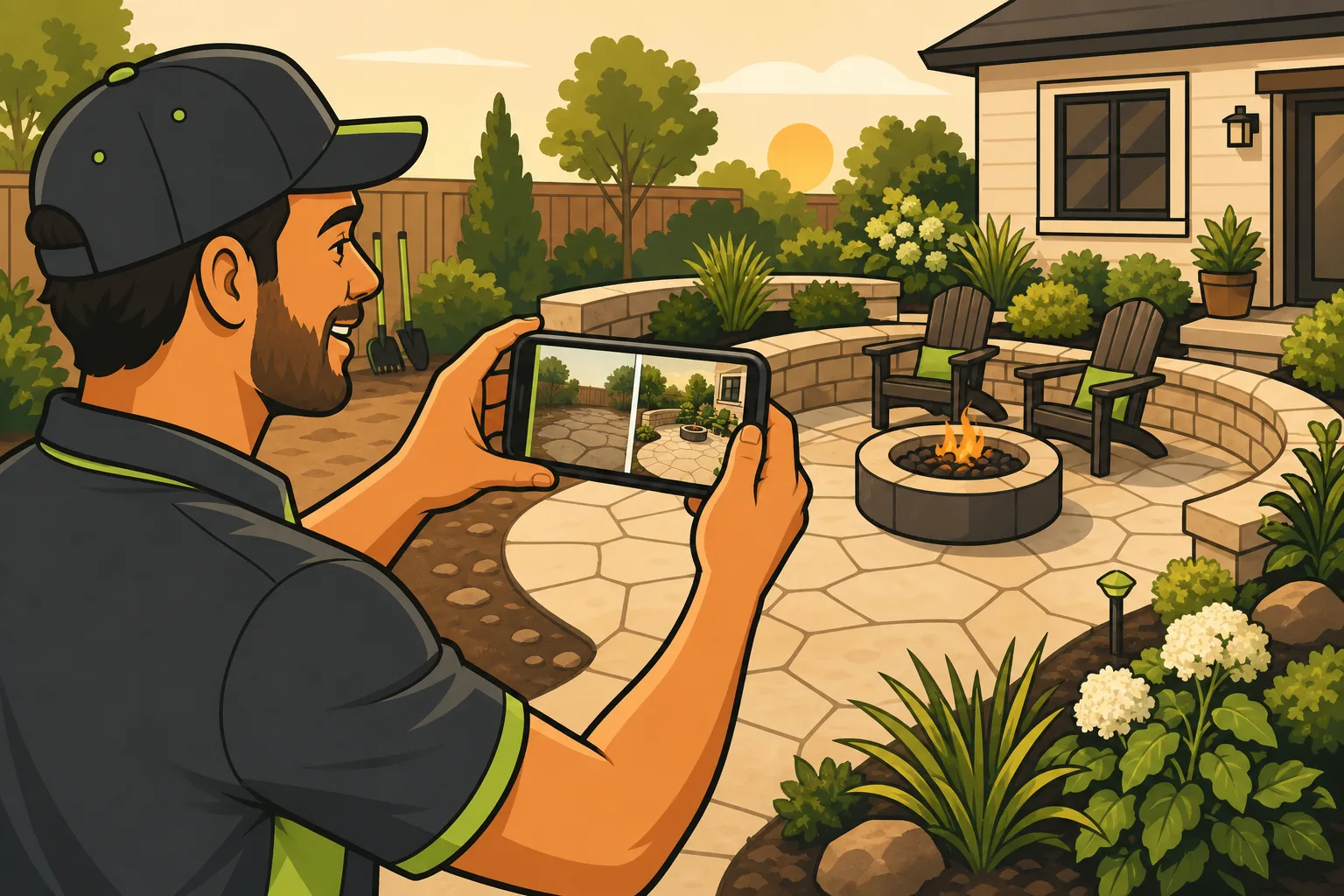
Landscaping is the most photogenic trade in home services. A before-and-after of a spring cleanup, a hardscape install time-lapse, or a fresh mulch reveal can stop a homeowner's scroll the same way a restaurant dish stops a foodie. The problem isn't the content — it's that the crew is always on the tools when the light is best and no one has time to open five apps to post it.
This guide covers how to make landscaping social media work without pulling a crew member off a job.
Why is landscaping such a strong fit for social media?
Landscaping sells transformations, and transformations sell themselves visually. Before-and-after photography is the category's highest-performing content format — across GrowLocal's proprietary local-business website research, before/after photography was identified as a high-performing section across transformation categories, yet absent on most competitors even where it would be effective (see our full before-and-after data). That gap is an opportunity: the landscapers posting consistent transformation content are the ones filling their schedule.
The other reason social media works for landscaping is geography. A patio reveal tagged to a neighborhood shows up in feeds of people who live two streets away — free local reach that no flyer can match.
What should a landscaping company post on social media?
The strongest landscaping feeds rotate through four post types:
- Before/after transformation photos — spring cleanups, sod installs, hardscape reveals, fall leaf cleanouts. Shoot the "before" the moment your crew arrives.
- Seasonal service reminders — mulching windows, aeration timing, irrigation startup/shutdown. These drive bookings by meeting homeowners at decision moments.
- Process clips — edging lines going in, a retaining wall rising course by course, a freshly graded bed. These show craft and build confidence before a prospect calls.
- Project spotlights — a named project ("the Birchwood backyard overhaul") with a short caption about the homeowner's goal, the challenge, and what you planted. Story-led posts earn saves.
Pinterest deserves a slot here. Boards organized by service type (patios, native plants, water features) accumulate inbound reach for months after a pin — far longer than a feed post's lifespan.
| Platform | Best content type | Posting frequency |
|---|---|---|
| Carousels (before/after angles), Reels (time-lapse) | 3–4× per week | |
| Project spotlights, seasonal promotions, quote CTAs | 3× per week | |
| Finished project photos organized by service board | 5–7× per week | |
| Commercial work, process credibility, hiring posts | 1–2× per week |
How does AI help write landscaping social media captions?
Writing captions is the task most landscapers skip because it feels like homework after a ten-hour day in the sun. AI caption writing solves that.
Category research is what makes an AI caption land — a spring cleanup photo gets copy tied to the season, the service, and a CTA, not a generic "great day on the job!" caption. The mechanics are the same whatever tool you use: posts drafted from your brand and service list, then scheduled to Instagram, Facebook, Pinterest, YouTube, X, LinkedIn, TikTok, Threads, and Bluesky. GrowLocal's own AI publishing layer works this way but is a separate back-office product that isn't on sale to the public yet — treat it as on the way and ask us where it stands.
For landscaping crews, the AI approach also solves the seasonal rhythm problem. Customers book spring cleanups in late winter, and the companies whose feeds are already full of "spring is coming" content win those early-bird bookings. An automated schedule handles that timing even when your office is buried in February estimates.
Why run landscaping website and social together?
Running your website and social separately means doubling your effort for the same photo. A project you photograph for Instagram should simultaneously become a portfolio entry on your website — not a task for someone to remember later.
Running website and social as one workflow means a transformation photo goes into your site gallery and gets queued for social publishing in the same step. Your landscaping website becomes the hub — before/after galleries, quote form, testimonials, service pages — so every social post has somewhere to land. A homeowner who clicks from an Instagram reel should reach a fast, mobile-ready page with a clear "Get a Free Estimate" button.
Across GrowLocal's proprietary local-business website research, real project photography was confirmed on 100% of top-ranked landscaping competitors analyzed — zero stock detected across the competitive set. The website is where those photos live permanently. Social is where they get distributed.
Key takeaway: The landscaping companies winning on social aren't doing more work — they're documenting the work they're already doing and publishing it consistently. 100% of top-ranked landscaping websites we analyzed used real project photography, and the businesses pairing that same content with scheduled social posts compound the reach of every job they complete.
Which social channels matter most for landscaping?
Instagram and Facebook are the non-negotiables for residential landscaping. Homeowners in the 30–55 age bracket — the core landscaping buyer — scroll both. Pinterest is the sleeper: landscaping ideas are among the most-saved home improvement content on the platform, and pins have a long shelf life compared to feed posts.
LinkedIn matters for commercial landscaping clients and hiring. TikTok and Reels reach younger homeowners entering their first owned-home buying window, which is an emerging landscaping market segment.
Across our research into top-ranking local business websites, Instagram feed embeds and social integration appeared most commonly on businesses in visual categories — landscaping, home services, and creative trades — because the work speaks for itself when shown consistently.
For most landscaping crews: Instagram + Facebook as primaries, Pinterest as a compounding channel, everything else as secondary. GrowLocal's back-office publishing layer is built to cover all nine channels from one queue, but it is a separate product that isn't on sale to the public yet — today, plan on scheduling through a tool you already have and ask us where ours stands.
How much time does landscaping social media actually take?
For a small crew, the honest answer is: too much, if done manually. Writing captions, sizing photos per platform, scheduling posts, keeping up seasonal timing — it adds up to hours a week that most landscapers don't have during the growing season.
The done-for-you model flips the math:
- The website — GrowLocal hosting starts at $5/month, $0 to build and preview, with your exact rate set mostly by the working features in the finished site (published band $5–$14/month)
- The posting queue — one place to schedule all nine channels, whether you write the captions or a drafting tool does
- The automated layer — GrowLocal's own AI publishing is a separate back-office product that isn't publicly available yet, so ask us where it stands instead of budgeting for it
Website hosting runs $60–$168 a year at the published $5–$14/month band on monthly billing — an illustration of the band, not a quote. Whether a single spring cleanup or hardscape consult covers that depends on your own ticket prices and what the work nets after costs. For local business website and social options across all trades, the website subscription is consistently the lowest-cost marketing channel a small crew can run.
More context in our guides: social media management pricing for 2026 and AI post generator vs. done-for-you.
What makes a landscaping social media post convert to a call?
Three elements separate posts that generate quote requests from posts that just get double-taps:
- A clear location signal. Tagging the neighborhood (not just the city) puts your work in front of people who live near the job. A caption mentioning "north Charlotte" or "Scottsdale's McCormick Ranch area" does more local targeting than any hashtag.
- A seasonal CTA with friction removed. "Book your spring cleanup now — slots fill in March" tells the viewer what to do and why to do it today. Combine it with a link to your website quote form.
- Real project context. "Three-day hardscape install: flagstone patio + built-in planters + drainage solution for a yard that flooded every spring" is more compelling than "Another beautiful project!" because it names the problem solved — which is the same problem a prospect might have.
For landscapers with a website that includes a portfolio and quote form, every social post has somewhere to point. Without that landing destination, even great content leaks leads.
Frequently Asked Questions
Does landscaping social media actually bring in new customers?
Yes — visual transformation content performs consistently well for landscaping because homeowners are making aspirational purchase decisions. A before-and-after post of a neighbor's backyard is one of the most credible forms of local social proof available. The condition is consistency: posting sporadically and going quiet in winter trains the algorithm to suppress your content.
Which platform is best for a landscaping business in 2026?
Instagram is the strongest primary platform for residential landscaping — Reels and carousels reach homeowners in your service area and show project quality at a glance. Facebook supports the older homeowner demographic and local community groups. Pinterest builds compounding organic reach for project-inspiration content. For most small crews, Instagram + Facebook as primaries is the practical starting point.
How many posts per week should a landscaping company publish?
Three to four posts per week on Instagram and Facebook is the practical floor for consistent algorithmic presence. Below that, engagement stalls between posts. A done-for-you or AI-assisted scheduling tool handles this volume without adding hours to a crew-owner's week.
Does before/after content really outperform other landscaping posts?
Across GrowLocal's proprietary local-business website research, before/after photography was identified as a high-performing section in transformation categories — including landscaping — yet absent on most competitor sites even where it would clearly be effective. Shoot the "before" the moment the crew arrives — that photo is the one most owners forget.
Can I run landscaping social media without hiring a social media manager?
Yes. AI writing tools now generate captions grounded in your specific services and seasonal calendar, then push them into a scheduling queue so you're not managing copy or timing manually. GrowLocal's own AI publishing layer is a separate back-office product that isn't publicly available yet — the website subscription (hosting from $5/month) is what we sell today, so pair it with a standalone scheduler for now.
What should I post during the winter slow season?
Post content that builds spring booking pipelines: "Spring cleanup slots are filling — get on the calendar now," fall hardscape completions, climate-specific plant care tips, and behind-the-scenes prep. Landscaping social media should never go fully dark in winter — that's when homeowners are planning spring work and comparing crews.
Does GrowLocal include a website with social media?
GrowLocal builds and hosts the website: portfolio gallery, quote form, testimonials, and service pages, with hosting starting at $5/month and $0 to build and preview. Social publishing is a separate back-office product — never part of the website price — and it isn't on sale to the public yet, so run posting through a tool you already have and ask us where ours stands. See the full breakdown at our landscaping website page.