


Updated June 2026
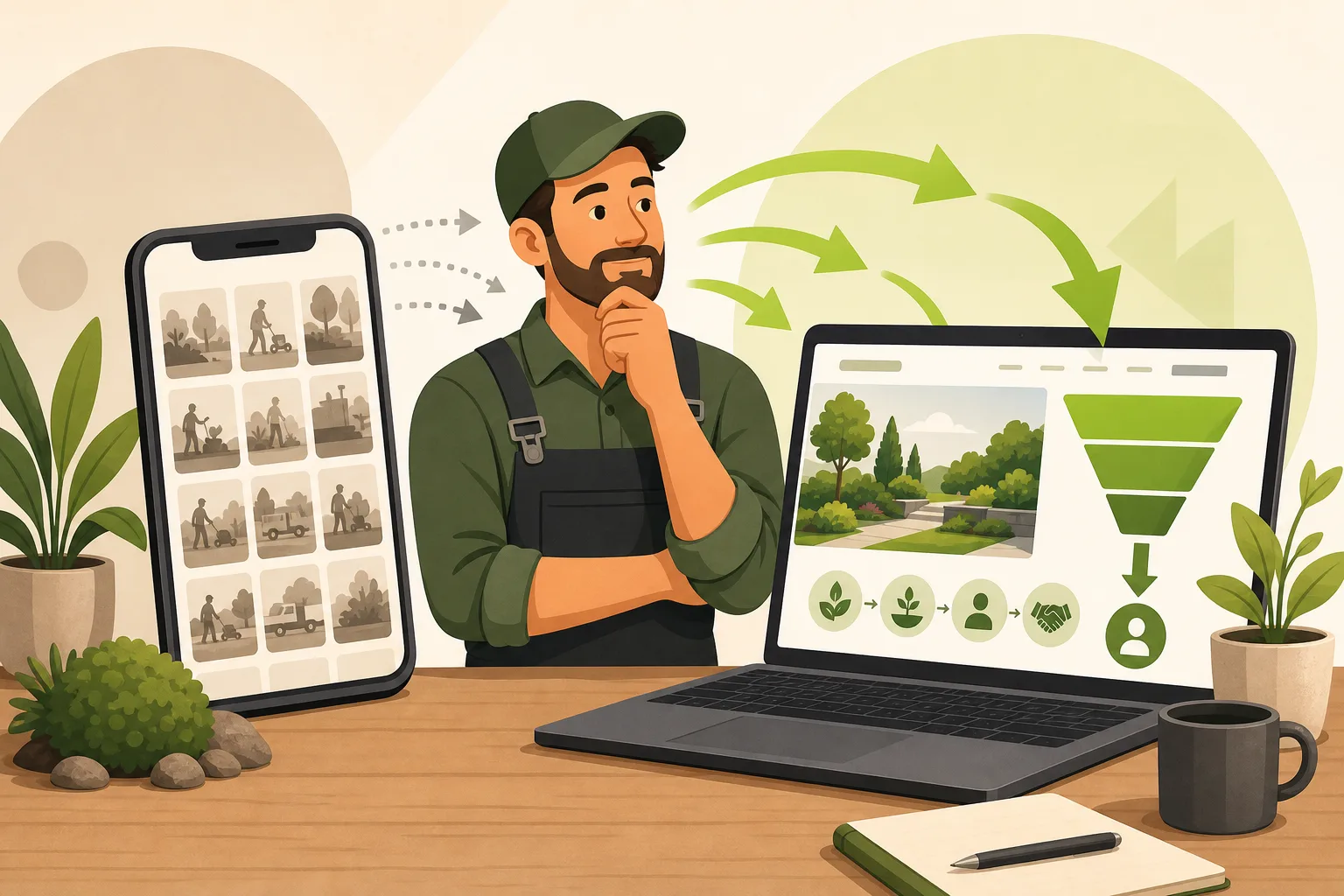
Thumbtack for landscaping works — until you do the math. At a $5,000–$100,000+ project ticket, paying $25–$75 per shared lead means you're handing back a meaningful slice of every job before you've ever started. A landscaper running 80 jobs a year can spend $12,000–$24,000 on platform leads — and build nothing that generates the next one. An owned website eliminates that cost entirely. The math is not close.
This analysis is based on GrowLocal's proprietary research into top-ranking local business websites, plus documented Thumbtack fee models and landscaping-specific conversion data.
How does Thumbtack landscaping pricing actually work?
Thumbtack charges landscapers per lead — meaning you pay each time a homeowner's contact information is passed to you. In 2026, lead costs for landscaping commonly range from $25 to $75 per lead, with higher-ticket services (hardscape installs, outdoor kitchens, full landscape design) at the upper end.
The structural problem is not the dollar amount. It is three compounding factors:
- Shared leads. The same inquiry is sold to multiple landscapers simultaneously. You pay before you know whether you're competing against two other pros or six.
- No guarantee of response. BBB complaints through early 2026 document landscapers being charged $30–$170 for leads where the homeowner confirmed they never submitted a request. You pay regardless.
- No brand equity. The homeowner searched "landscaping near me" and found Thumbtack — not you. If they book you, you are "the Thumbtack landscaper." The next time they need service, they go back to Thumbtack.
Angi (formerly HomeAdvisor) operates the same model, with landscaping lead fees commonly reported at $15–$80 per contact.
Key takeaway: Across GrowLocal's proprietary local-business website research (N=237 sites, 28 categories), a free estimate offer is the universal conversion bridge in landscaping — the strongest sites lead with "Free Estimates" or "Free On-Site Consultations" as the primary call to action. That same offer on your own site generates the same lead at zero cost per contact.
What does Thumbtack landscaping actually cost per year?
The table below models a mid-size residential landscaper doing 80 booked jobs at an average ticket of $5,000 — the lower end of design and installation work.
| Scenario | Annual revenue | Lead spend | Close rate assumed | Cost per booked job |
|---|---|---|---|---|
| 100% Thumbtack, $50/lead avg, 20% close rate | $400,000 | ~$20,000 | 20% | ~$250/job |
| 100% Thumbtack, $75/lead avg, 15% close rate | $400,000 | ~$40,000 | 15% | ~$500/job |
| 50% Thumbtack / 50% direct | $400,000 | ~$10,000–$20,000 | Mixed | ~$125–250/job |
| 100% direct (owned site, 2–3 yr transition) | $400,000 | ~$0–$3,000/yr | Referral/organic | ~$0–38/job |
Those close rates are generous. Industry data puts shared-lead conversion at 10–30%, and landscapers frequently report closing cold platform contacts at the lower end since the customer is price-shopping across multiple pros simultaneously. At a $25,000 outdoor room job, paying $250–$500 per acquisition via Thumbtack is survivable — but it is permanent. The website cost is fixed.
What does Thumbtack give landscapers that a website doesn't?
It's worth being direct here. Thumbtack solves a real problem for landscapers who are:
- Just starting. You have no referral network, no Google presence, no reviews. Thumbtack puts you in front of homeowners who are searching right now.
- Testing a new service area. Organic local SEO takes 12–18 months to develop. Thumbtack can fill a schedule gap while the long-term asset compounds.
- Filling calendar holes. The platform functions like a faucet — on when you need work, off when you're booked.
The problem most landscapers hit is staying on the platform past the point where it makes financial sense. Once you have 30–50 clients, a gallery of named projects, and a Google Business Profile generating reviews, every dollar going to Thumbtack should be going to profit instead.
A website is a well. Slower to dig, but you own it.
Does a landscaping website actually generate leads — or is it just a brochure?
Only if it is built like a conversion tool, not a brochure. The landscaping sites we've analyzed at GrowLocal that generate consistent inbound share three non-negotiables:
The free estimate form is above the fold. Not one click away — visible the moment someone lands on the page. Button copy that works in landscaping: "Get Your Free Estimate," "Request a Free Consultation," "Get Started." The form above the fold is the single biggest differentiator between a site that generates leads and one that doesn't.
The phone number is in the sticky header. Across our research into top-ranking local business websites, five of six competitive landscaping sites display the phone number in a persistent header. The one that buries it converts the least. Landscaping customers — especially for $10,000+ projects — want a direct call option.
The gallery shows finished living spaces, not grass. Homeowners deciding between a $15,000 patio install and a $2,000 lawn program are making emotional decisions. Outdoor kitchen photography, finished pergolas, before-and-after patio transformations — these close design-build jobs. Close-up lawn shots do not.
Across our research into top-ranking local business websites, longevity is the most universally deployed trust signal in landscaping — every competitive site displays a founding year in the hero or stats bar, with tenures ranging from 16 to 45+ years. That founding year does something Thumbtack never can: it tells the homeowner they are not your first job.
What should a landscaping website include that Thumbtack doesn't cover?
Thumbtack profiles are constrained by the platform: photos, reviews, a service category, and a blurb. That is the same structure every other landscaper on the platform has.
An owned landscaping website can carry:
- Named project galleries. The strongest landscaping sites name individual projects ("The Lazy River Project," "Woodland Retreat") and pair before-and-after images with customer testimonials from that job. Named projects convert at a price point where homeowners are imagining their own yard.
- Service-area pages. Dedicated pages per neighborhood or ZIP code are how Google decides you are a local result — and they compound over time. Thumbtack manages this internally; your website builds it permanently.
- Credentials on-page. Across our research into top-ranking local business websites, the strongest landscaping sites display license numbers directly on the page — ROC numbers, state department of agriculture IDs, certified arborist designations. Thumbtack lists "background checked"; your site can show the specific credential.
- Dedicated service pages. Individual pages for landscape design, lawn care programs, hardscaping, irrigation, and drainage — each one is an organic search entry point Thumbtack cannot index.
How long does it take a landscaping website to generate leads?
Honest timeline: a new landscaping website does not generate organic Google traffic on day one. Service pages targeting city-specific queries ("patio installation [city]," "lawn care programs [city]") typically take 6–18 months to develop meaningful organic rankings in competitive markets.
What happens before that:
- Week one: Link the site from your Google Business Profile. Referrals sent to your phone or social page can now be directed to the estimate form — converting existing demand at zero cost.
- Month one–three: Referral and word-of-mouth traffic converts higher than marketplace leads because those contacts arrive with context, not a price-shopping mindset.
- Month 12–18: Organic service-page traffic develops. At that point, the site generates leads at a fixed monthly cost, not a per-contact fee.
The parallel-run model — using Thumbtack for quick fills while the website ramps organic authority — is how most landscapers make the transition. Handyman businesses and house cleaning companies follow the same arc at the 12–24 month mark. Landscaping's higher ticket size makes the switch more financially urgent. Browse the full comparison at GrowLocal's home-service website hub.
Frequently Asked Questions About Thumbtack for Landscapers
How much does Thumbtack charge landscapers per lead?
In 2026, Thumbtack lead fees for landscaping range from $25 to $75 per contact, with hardscape and design-build jobs at the upper end. The fees are charged per contact — you pay whether the homeowner books you, ghosts you, or goes with a competitor who responded faster. Shared leads mean multiple landscapers pay the same fee for the same inquiry.
Is Thumbtack worth it for landscapers?
For landscapers who are just starting or filling schedule gaps, Thumbtack is a reasonable short-term tool. The problem emerges at scale: at realistic close rates of 15–25% and lead costs of $50–$75, you can spend $300–$500 per booked customer. For design-build tickets starting at $5,000, that math can work — but Thumbtack builds nothing. Every job booked through the platform requires paying again for the next one.
What is the typical Thumbtack landscaping close rate?
Platform-wide data puts contractor close rates at 10–30% for shared marketplace leads. Landscapers report lower rates on cold platform contacts than on referrals, because the customer is price-shopping across multiple pros and has no prior relationship with you.
Can a landscaping website compete with Thumbtack in local search?
Yes — and in most markets, a well-structured landscaping website ranks above Thumbtack's category pages for local queries like "landscaping company [city]" or "patio installation [city]." Thumbtack owns its branded search; local landscaping queries are won by websites with service-area pages, Google Business Profiles, real project photography, and a consistent review history. It takes 12–18 months to build, but the position is durable.
Does a landscaping website need online booking?
No. The standard conversion flow in landscaping is quote-first — a homeowner submits a request, you call to qualify, then you schedule a site visit. No one commits to a $15,000 patio project through an online calendar. A contact form with a stated response time (24 hours is the competitive benchmark from our research) is the right tool. That is what GrowLocal landscaping sites include.
What trust signals does a landscaping website have that Thumbtack can't replicate?
License numbers displayed on-page, named project galleries with before-and-after pairs, a founding year in the hero, and neighborhood-specific testimonials. These signals signal established local expertise. Thumbtack shows "background checked"; your website shows 22 years in business and a state department of agriculture license number.
How do I transition from Thumbtack to owning my own landscaping leads?
Run both in parallel for 12–18 months while the website builds organic authority. Redirect referrals and word-of-mouth contacts through the site's estimate form. As organic traffic grows, reduce Thumbtack spend starting with the highest lead-cost job categories. See what a GrowLocal landscaping site includes to understand the baseline conversion infrastructure.
Are Thumbtack landscaping reviews portable to your own website?
Thumbtack reviews stay on Thumbtack's platform. When a homeowner searches your business name on Google, they will not see your Thumbtack reviews unless they navigate to the platform. An owned website can display testimonials from any source — including named customers with specific project details — which is more conversion-effective at the landscaping price point.