

Updated June 2026
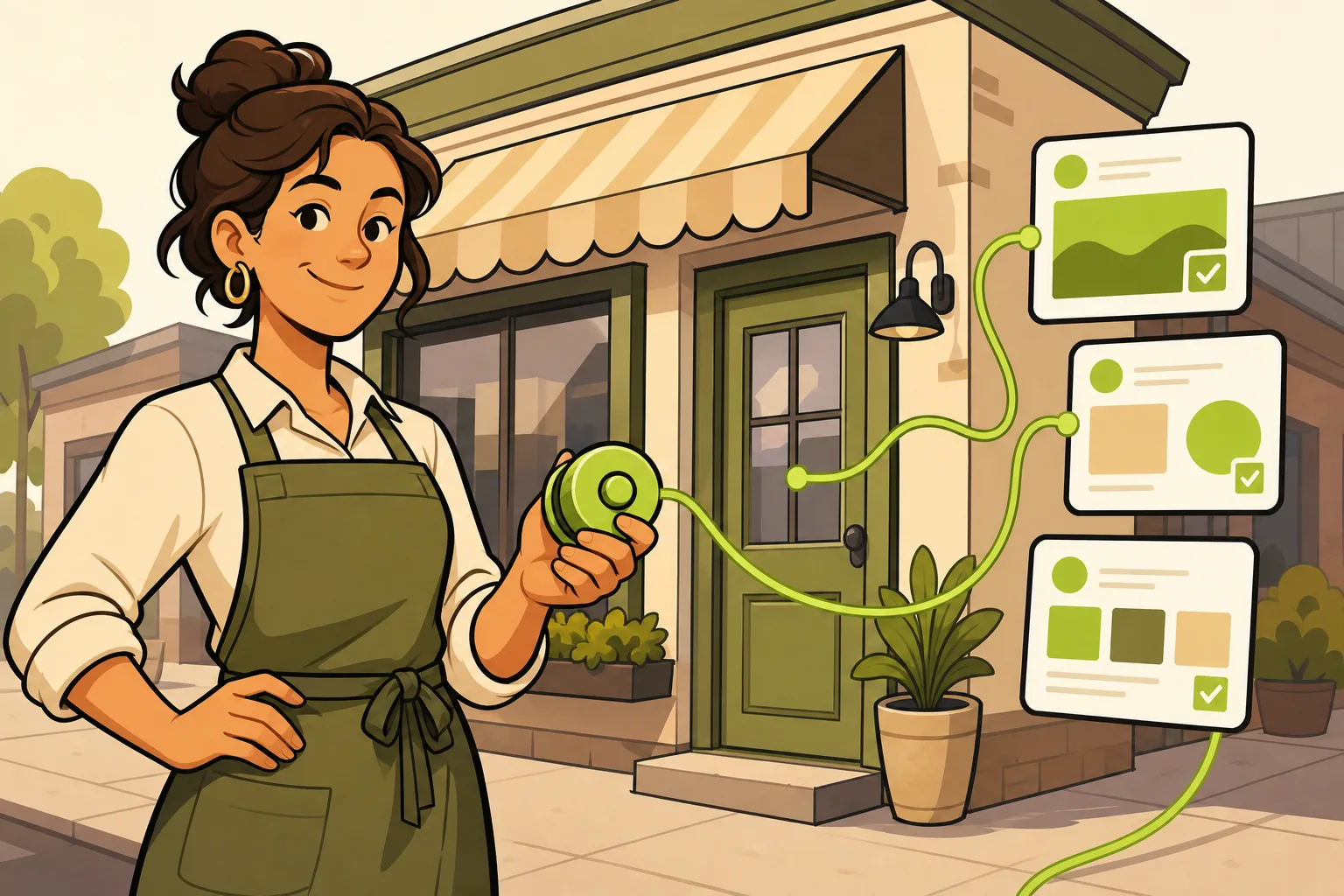
You can run local social media marketing without an agency and without a separate tool. Post to Instagram, Facebook, TikTok, and eight other channels, let AI write your captions from your brand and category, and manage it alongside your website — from one login. No retainer. No third app. No middleman.
This is based on GrowLocal's proprietary research into top-ranking local business websites.
Below: what agencies actually do (and what you can do yourself), which platforms matter most for local, what to post and when, and how a single platform handles both your website and your social — starting at $10 per month.
What does a social media agency do for a local business?
A local social media agency typically handles content creation, scheduling, and sometimes ad management. They charge $500–$3,000 per month for most small businesses. That fee covers maybe 3–5 posts per week, stock-heavy creative, and monthly reports.
What it rarely covers: deep knowledge of your specific trade, your customers, or your neighborhood. An agency writer who handles a plumber in the morning and a yoga studio in the afternoon produces generic copy that reads exactly like that.
You know your business. The gap isn't knowledge — it's time and tooling.
| Task | Agency | DIY + GrowLocal |
|---|---|---|
| Write posts | Staff writer (generic) | AI trained on your brand + category |
| Schedule to 9 channels | Yes | Yes (IG, FB, X, LinkedIn, TikTok, Pinterest, YouTube, Threads, Bluesky) |
| Website + social in one place | No | Yes |
| Monthly cost | $500–$3,000 | $10–$50 |
| Long-term contracts | Often 6–12 months | Monthly |
Which social media platforms matter for local businesses?
For most local service businesses, three platforms drive the most foot traffic and inbound calls.
Facebook reaches the widest age range of local buyers. Homeowners, parents, and customers over 35 — the people who spend the most with local businesses — still live on Facebook. Events, promotions, and before/after posts perform well here.
Instagram rewards visual trades: landscaping, hair salons, painting, food, fitness. If your work looks good, Instagram is your strongest channel. In our analysis of top-ranking local business websites, Instagram feed integration appears most commonly on sites in beauty, food, and creative services — the categories where the work IS the marketing.
TikTok rewards personality and process content. Short walk-through videos, transformations, and "day in the life" clips perform well regardless of follower count. A local roofer explaining how to spot hail damage gets more reach on TikTok than a perfectly designed graphic on Facebook.
For a restaurant or food business, Instagram and TikTok together are the primary acquisition channels. For a contractor or home-service provider, Facebook is still where the jobs come from.
How much does local social media marketing cost without an agency?
Agency pricing starts at $500/month and climbs fast. Mid-market agencies charge $1,500–$3,000/month for posting alone. Ad management is billed separately.
DIY tools like Buffer, Hootsuite, and Later start free but charge per channel at scale — and none of them write your content or manage your website.
GrowLocal bundles website + social in one plan:
| Plan | Price | What's included |
|---|---|---|
| Starter | $10/mo | Website + manual social posting (you write the captions) |
| Growth | $30/mo | Website + AI writes posts (grounded on your brand and category research) |
| Pro | $50/mo | Growth features + highest channel limits |
The AI-writes tier ($30/month) generates posts grounded in your brand voice and category-level industry research — not live inventory or current hours, but trade-specific, local-relevant content your competitors pay an agency hundreds of dollars a month to produce.
Key takeaway: Across GrowLocal's proprietary local-business website research, 92% of local business websites hide pricing entirely (N=237 sites, 28 categories) — which means most of your competitors are also paying for marketing tools without telling anyone what they cost. Transparent pricing is itself a differentiator. At $30/month, the cost of AI-assisted social is one-tenth of a typical agency retainer.
What should a local business post on social media?
Most local businesses overthink content. The posts that drive real calls and visits are simple.
What works:
- Before/after shots (renovation, cleaning, detailing, hair, landscaping — anything with a visible transformation)
- Behind-the-scenes process clips (loading the truck, prepping the job site, mixing the color)
- Quick answers to the questions you get every week ("Do I need a permit for a fence?" / "How often should I seal my driveway?")
- Specific local references — your neighborhood, a local event, a street you just worked on
- Customer outcomes described in plain language ("Three-bedroom in Eastside — floors done in one day")
What to skip:
- Motivational quotes with no connection to your trade
- Stock photos of hands shaking or light bulbs
- Post templates that look like every other small business on the platform
- Content that could apply to any business in any city
In our analysis of top-ranking local business websites, the dominant hero copy formula across plumbing, electrical, pest control, flooring, and dozens of other categories is "Trusted + City + Trade Name" — the same identity-first pattern dominates social too. Specificity is what makes local content convert.
How often should a local business post on social media?
Consistency matters more than volume. Three posts per week, every week, outperforms ten posts one week and silence the next.
A sustainable weekly rhythm:
- Monday: a process or behind-the-scenes post (build trust)
- Wednesday: a finished-job photo or short before/after clip (show work)
- Friday: a local reference, a seasonal tip, or an answer to a common question (build community)
That's 12 posts per month — enough to stay visible without burning out. If you have the AI-writes tier, set it and it posts on schedule. If you're on the $10 plan, you write the caption once and it distributes to all nine channels in one click.
Why does running social from your website platform make sense?
Most local businesses run their website on one platform and their social on another. That means two logins, two monthly bills, two places where something breaks. More importantly, it means your social content and your website content are disconnected — different voices, different offers, different calls to action.
When social and website run from the same place, the message is consistent. A post goes out about your spring cleaning service, and your website is already showing a quote form for exactly that. A customer taps your Instagram bio link and lands on a site that matches what they just saw.
Explore the full range of local business websites GrowLocal builds to see how the website + social integration works across categories.
Also worth reading: our breakdown of social media management pricing in 2026 and the agency vs. tool comparison for small businesses — both go deeper on the cost math.
Frequently Asked Questions
Can I really do local social media marketing without an agency?
Yes — and most local businesses already do. The gap isn't strategy; it's the tooling to write, schedule, and distribute content without spending hours on it. AI-assisted tools now do the writing; scheduling tools handle the distribution. The main reason to hire an agency is time, not expertise you lack.
Which social platform is best for local business marketing?
Facebook reaches the broadest local buyer base. Instagram is strongest for visual trades. TikTok rewards short process or transformation videos regardless of following. Start with one platform you'll post on consistently, then expand. Most local businesses see the best return from Facebook + Instagram together.
How much should a local business spend on social media marketing?
Without an agency, $10–$50/month covers tooling. In our proprietary research into top-ranking local business websites, 92% of competitors hide pricing entirely — which means the bar for being transparent and specific about your own value is low. Spending $30/month on AI-written posts is a fraction of a $1,500/month agency retainer and gives you full control.
Do I need to post every day to see results from social media?
No. Three posts per week — consistent, specific, and local — outperform daily posting with generic content. Frequency matters less than consistency and relevance to your actual customers and neighborhood.
What is the difference between social media marketing and social media management?
Marketing is strategy and content — what you post and why. Management is operations — scheduling, distributing, and keeping the calendar full. Most agencies bundle both. With the right tool, management becomes nearly automatic; you only need to focus on the marketing part.
Does GrowLocal post to all social channels automatically?
On the AI-writes tier ($30+/month), posts are generated and scheduled to up to nine channels — Instagram, Facebook, X, LinkedIn, TikTok, Pinterest, YouTube, Threads, and Bluesky. The AI grounds posts in your brand voice and category-level research. It does not pull live inventory, current hours, or real-time promotions; those details you can add manually or via your website's service pages.
Is social media marketing worth it for a neighborhood service business?
For most local service businesses, social media is the cheapest way to stay visible between jobs. One before/after photo per week of real work in your market builds more trust than most paid ads. Pair it with a fast website that matches the content, and the two reinforce each other every time someone looks you up after seeing a post.
Do I need a separate website if I'm already active on Instagram or Facebook?
Yes. Social platforms own your audience — a policy change, a suspended account, or an algorithm shift can cut your reach overnight. A website you own is the permanent record: your services, your quote form, your gallery, your credibility. Social drives discovery; your website closes the sale.