

Updated June 2026
Meal prep Instagram marketing works because hungry eyes buy. Post your this-week's menu with craveable photos and a clear order link, and you turn a scrolling stranger into a paying customer before dinner. Repeat that drop every week — same day, same format, same brand voice — and your feed becomes a revenue channel. Based on GrowLocal's proprietary research into top-ranking local business websites.
The challenge isn't the content. It's the clock. Most meal prep owners cook Sunday and Thursday, then forget to post until Tuesday when the craving window has closed. This post shows how to build a system where the weekly menu drops on time, captions write themselves, and every channel gets the post — without touching a scheduling tool at 6 AM.
Why does Instagram work so well for meal prep businesses?
Meal prep is a craving product. The moment someone sees a well-lit container of chicken tikka masala with macros in the caption, they want it. That sensory trigger is why food and beverage accounts outperform almost every other local category on Instagram — the product IS the visual content.
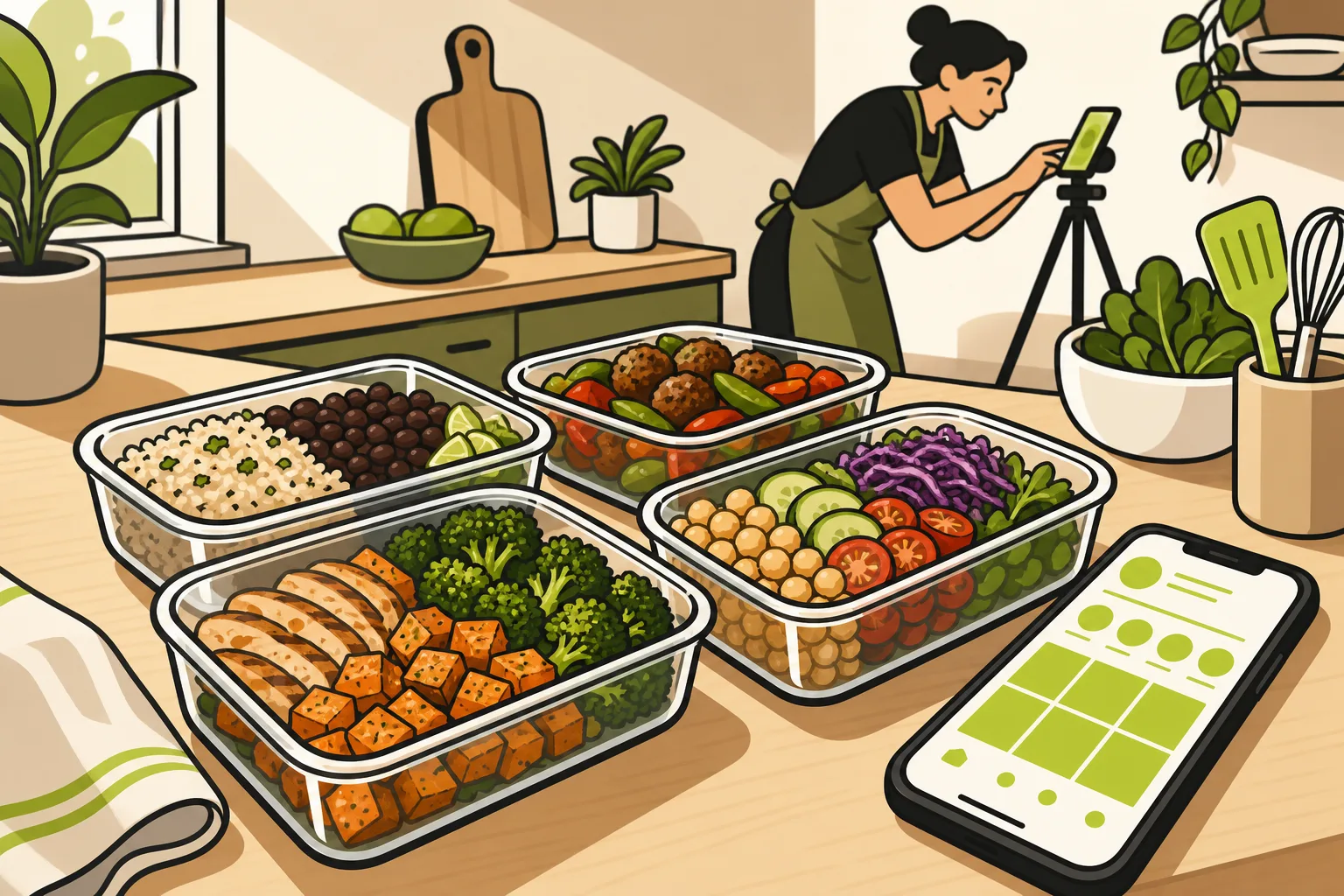
The IG/TikTok feed works like your storefront window. When someone scrolls past your weekly menu Reel on a Monday morning, they're already thinking about what to eat this week. That's the buying window. Miss it and you've lost the order to whoever posted first. Across our proprietary research into top-ranking local business websites, food businesses with real photography — actual plated meals, not stock — consistently dominated their categories, with zero top-performing food competitors using stock images.
The menu drop isn't just a post. It's an order trigger. Done right, it moves people from passive followers to paying customers in under 24 hours.
What should a weekly meal prep Instagram post include?
A meal prep website on GrowLocal pairs with your social posts to close the sale — but first the post has to trigger the craving. Every weekly menu drop needs five elements:
- A craving-first visual — close-up of your most photogenic meal, ideally shot in your packaging so they picture it arriving at their door
- The full week's menu — list it in the caption or use a carousel; followers use this to decide if this week is "their week"
- Macros or dietary tags — keto, paleo, gluten-free, high-protein; fitness customers won't order without these details
- A hard order deadline — "Order by Wednesday for Sunday delivery" creates urgency and protects your production schedule
- One direct link — your ordering page, not your homepage; reduce the path between craving and checkout
Caption voice matters as much as the visual. The strongest meal prep operators in our research use warm, encouraging tone — "nourish" over "nutrition protocol," "fresh" over "macro-optimized." Your caption should read like a friend describing your food, not a label.
How often should a meal prep business post on Instagram?
Consistency beats frequency for local meal prep accounts. One high-quality, well-timed menu drop per week — posted Monday morning when craving intent peaks — outperforms five mediocre mid-week posts. Build from there:
| Post type | Frequency | Purpose |
|---|---|---|
| Weekly menu drop | Once per week (Monday) | Primary order driver |
| Behind-the-scenes Reel | 1–2x per week | Trust and brand building |
| Customer result / testimonial | 1x per week | Social proof |
| Dietary highlight | 1–2x per week | Segment reach (keto, vegan, etc.) |
| Engagement Story (poll, question) | Daily | Algorithm fuel |
The menu drop is non-negotiable. Everything else is amplification. If you can only do one thing, post the menu Monday between 10 AM and noon — that's when buy intent for the week peaks, and your post lands right as the "what am I eating this week?" decision is being made.
What's the biggest mistake meal prep owners make on Instagram?
Posting late. The weekly menu drop is time-sensitive. If your order cutoff is Wednesday, your menu post needs to land Monday — not Tuesday night, not Wednesday morning. By then the craving window is closing and people have ordered from whoever showed up first.
The second mistake is writing captions on the fly. When you're running a kitchen, prepping meals, and handling deliveries, caption-writing falls off the list. Weeks go by. Followers disengage. The algorithm buries your next post.
Both problems have the same fix: a system that runs without you thinking about it.
Key takeaway: Across GrowLocal's proprietary local-business website research, 100% of top-performing food businesses used exclusively real photography — actual meals, actual packaging, actual kitchen — with zero stock images detected across any top-ranked food competitor site. Your phone camera pointed at your best meal is worth more than any content template.
Should I post my meal prep menu on TikTok and Pinterest too?
Yes — and not just as reposts. Each platform has a different craving trigger:
- Instagram — the primary weekly drop; Reels get new-follower reach, carousel menu posts get saves and repeat views
- TikTok — short prep videos and taste-test Reels; discovery platform for reaching people who've never heard of you
- Facebook — local community groups and repeat buyers; great for the order-deadline reminder on Tuesday/Wednesday
- Pinterest — evergreen meal photos that drive search traffic for specific dietary terms (keto meal prep, high-protein lunch, gluten-free dinner delivery)
The trap is treating each channel as a manual job. A good system creates the menu post once and routes it across all platforms — same photo, slightly adjusted captions. The goal is presence everywhere a hungry local is scrolling, without spending an hour per platform.
A GrowLocal meal prep website is the anchor for that: one current-menu page with macros and an order button that every channel can point at, so the post only has to create the craving. AI-written posting across the nine channels — Instagram, TikTok, Facebook, Pinterest, YouTube, LinkedIn, X, Threads, and Bluesky — is a separate back-office service that isn't publicly available yet; ask us where it stands.
For context on how this compares to doing it manually or hiring someone, see our breakdown of social media management pricing for local businesses.
Do I need a website if my meal prep business is already on Instagram?
Yes — and this is one of the most expensive mistakes in the local meal prep category. Instagram is discovery. Your website is where the order closes.
When a hungry follower clicks your bio link on a Monday morning, they need to land on a page that shows this week's full menu with macros, a clear order button, and your delivery area. If they land on a generic homepage with no current menu, you've lost them. That craving window is about 90 seconds.
Across our research into top-ranking local business websites, 92% of local business websites hide pricing entirely — but the meal prep sites we analyzed that showed starting prices ($12–$17/meal range) converted faster than those that buried it. Showing "starting at $13/meal" in the hero removes the biggest objection before the customer even gets to the menu.
Your website and Instagram work together. IG drives the craving; your site closes the sale. One without the other leaves money on the table. See how other food and service businesses handle this in GrowLocal's category directory.
For the AI vs. DIY tradeoffs, our guide to AI social media post generators vs. done-for-you services covers the real differences. For the optimal weekly rhythm, the social media posting schedule for local businesses has the channel-by-channel breakdown.
What does a full meal prep social media system look like?
A working weekly rhythm for a solo or small-team operator:
- Friday — finalize menu; shoot 3–5 photos of hero meals in delivery packaging
- Saturday/Sunday — write or approve captions for Monday drop + mid-week posts
- Monday 10 AM — menu drop publishes across IG, TikTok, Facebook, Pinterest
- Wednesday — order-deadline reminder Story ("Last chance — closes tonight")
- Thursday — customer result or testimonial post
Steps 2 and 3 are the ones that break first, and they're the ones worth automating or delegating — a scheduler plus a caption template you reuse every week gets you most of the way. On GrowLocal, what you buy today is the website: free to build and preview, then hosting starting at $5/month when you launch. AI-written posting is a separate back-office service that isn't publicly available yet.
The system runs on a schedule, not on your memory. The weekly menu drop is too time-critical to leave to "I'll post it when I get a chance."
Frequently Asked Questions
What's the best time to post meal prep content on Instagram?
Monday between 10 AM and 1 PM is the strongest window for a weekly menu drop. That's when buy intent for the week peaks — people are planning meals after the weekend and are most receptive to "this week's menu" content. Post the order-deadline reminder on Wednesday afternoon to catch last-minute decisions.
Can I use the same content on Instagram, TikTok, and Facebook?
Yes, with minor adjustments. The same video or photo works across platforms; caption tone shifts slightly (TikTok = direct and casual, Facebook = community-focused, Instagram = brand-polished). Posting manually to each platform is time-consuming — a scheduling system that routes one post to multiple channels is the practical path for a small team.
How does GrowLocal's social feature actually write my meal prep captions?
GrowLocal's AI social writing is grounded on your brand profile and category-level research — the patterns and format that work for meal prep businesses specifically. It's not a generic AI caption tool. It's a separate back-office service rather than part of the site price, and it isn't publicly available yet — ask us where it stands. The design point is that you review and approve before anything goes live. See what's included in a GrowLocal meal prep website — you handle your business, we take care of everything online.
Does posting on Instagram replace needing a website for meal prep orders?
No. Instagram drives discovery and craving; your website closes the order. When a follower clicks your bio link after seeing the Monday menu drop, they need a page with the full current menu, macros, pricing, delivery area, and an order button — not a static homepage. Across our proprietary research covering local business websites, real photography combined with a clear ordering path was the single most consistent pattern on top-performing food business sites (N=237 sites, 28 categories).
How much does it cost to run social media for a local meal prep business?
Options range from $0 (do it yourself, free scheduling tools with limited posts) to $300–$500/month (hiring a freelance social media manager). On GrowLocal, the piece you can buy today is the website that closes those orders: free to build and preview, then hosting starting at $5/month when you launch, with domain, hosting, SSL, SEO work, and unlimited edits included. Your exact monthly rate depends mostly on the working features in your finished site. AI-written social posting is a separate back-office service and isn't publicly available yet.