


Updated June 2026
AI can write your roofing social media posts from the job-site photos you already take — storm damage, tear-offs, finished roofs, drone shots — then auto-schedule them to Facebook and Instagram while you're running crews. The result is a steady stream of neighborhood-visible content that captures leads where storm-season demand lives. Based on GrowLocal's proprietary research into top-ranking local business websites.
Roofing is won and lost on trust, timing, and local visibility. Social media delivers all three — but only when it actually gets done consistently. This guide covers what to post, which platforms matter, how AI removes the friction, and how your website closes the leads.
What should a roofing company post on social media?
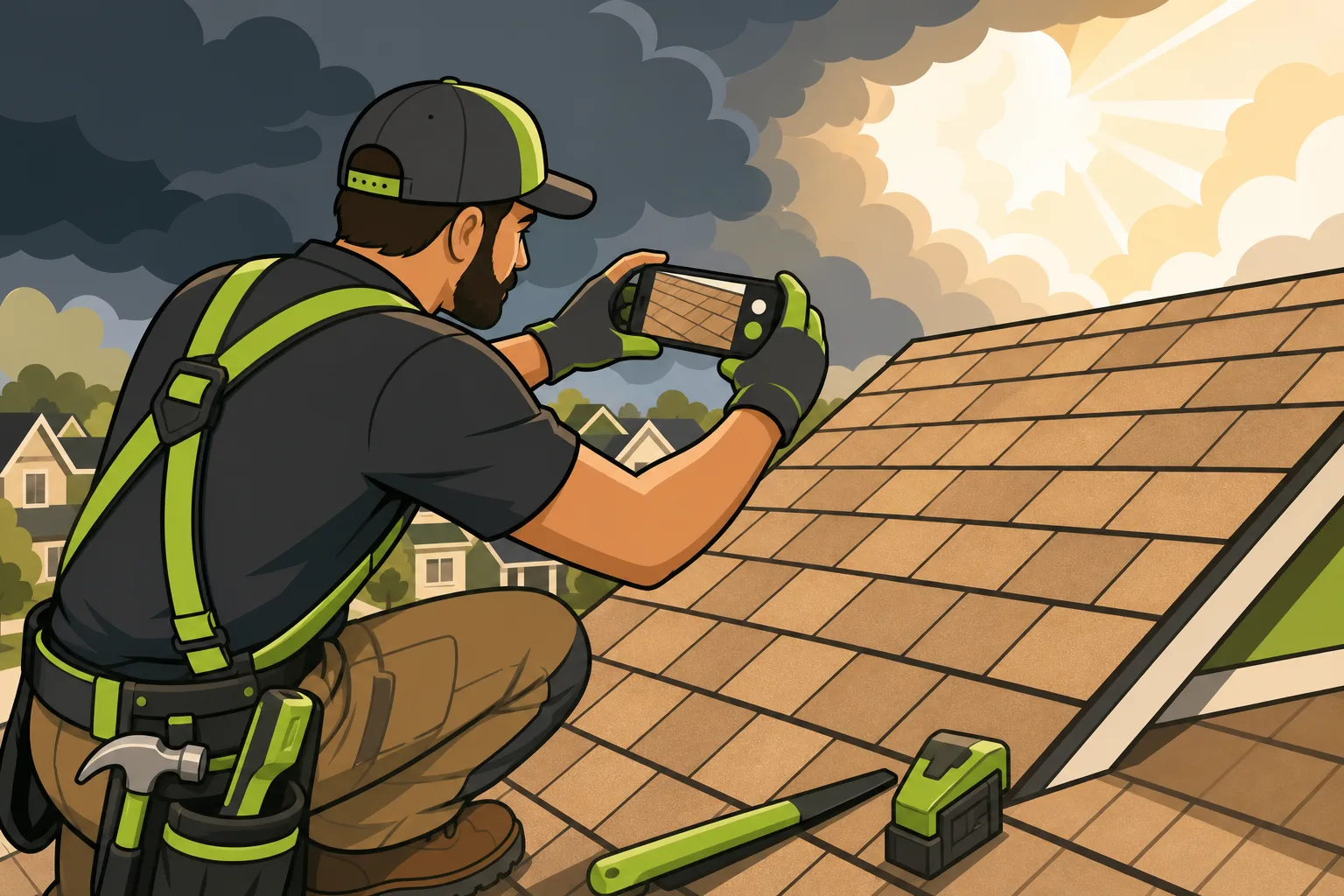
Start with your phone camera. Every finished roof, every tear-off mid-process, every drone shot of a storm-damaged neighborhood is social content. The strongest roofing posts come from real job sites because that's what homeowners need to see before they call anyone.
The five content types that drive roofing leads:
- Before/after project photos — shingle-curled damage Monday, pristine ridge line by Friday. No caption needed beyond your city and material.
- Storm damage walk-throughs — a 30-second phone video of hail dents on flashing, granule loss in gutters, or wind-lifted starter strips. Homeowners watching wonder if their roof looks the same.
- Finished roof reveals — wide shot from the street, detail on drip edge, drone shot if you have one. Portfolio proof, not bragging.
- Insurance claim explainers — short posts on how the claim process works, what "$0 beyond deductible" means. Removes the mystery and positions you as the guide.
- Team-on-the-roof shots — crew in branded gear, safety in view. Humanizes the business without saying a word about professionalism.
What does NOT work: stock photos of generic roofs, vague "We love what we do!" captions, and reposted manufacturer marketing. Homeowners can tell. Across our proprietary local-business website research, the top-ranked roofing competitors in every market used exclusively real photography — zero stock detected across 12 competitors analyzed.
Which platforms actually generate roofing leads?
Facebook and Instagram are where storm-season roofing leads live. Neighborhood groups on Facebook light up after hail events — that's where someone posts "anyone have a roofer they trust?" and whoever shows up in that feed wins the job. Instagram lets finished work do the selling: a clean, high-contrast after-shot of a GAF shingle roof in a well-known subdivision reaches people who live two streets over.
| Platform | Primary use | Storm-season advantage |
|---|---|---|
| Neighborhood groups, local shares, older homeowners | Geo-targeted posts reach affected zip codes fast | |
| Portfolio photos, drone shots, before/after | Reels of damage walk-throughs go local-viral | |
| Nextdoor | Neighborhood-specific word-of-mouth | Single recommendation seen by 200+ nearby homeowners |
| Commercial roofing, property managers | Relationship-building, not emergency leads |
For most roofing companies, two to three posts per week on Facebook and Instagram is enough to stay top of mind. The problem isn't knowing what to post. It's doing it consistently while running a full crew schedule. That's where AI changes the math.
How does AI write roofing social media posts from job photos?
Upload a job-site photo, and the AI reads your brand (service area, tone), pulls from roofing industry content knowledge, and generates a finished caption ready to schedule.
A photo of hail-dented flashing becomes: "Storm rolled through [City] last week. This is what impact damage looks like on 10-year-old flashing — hairline cracks that won't show up until the next rain. Free inspection, no obligation."
A finished-roof drone shot becomes: "Before: missing shingles, exposed decking, visible water damage. After: new [material], 5-year workmanship warranty. [Neighborhood], [City]. If your neighbors got hit, so did your roof."
On GrowLocal's AI social plan, the platform writes posts grounded in your brand and roofing industry patterns, then auto-schedules them to Facebook, Instagram, and seven other channels. Manual posting is available on the entry plan; AI writing kicks in at $30/month. The $50/month tier unlocks the broadest posting limits across all nine channels.
See how the roofing website and social media package handles both sides together.
When should roofers post on social media?
Timing matters more in roofing than almost any other trade. Storm season creates windows where a single well-timed post in the right zip code is worth 20 posts in a quiet month.
Post immediately after a local storm event. Not tomorrow — within hours. When a hail event hits your service area, the homeowners who saw it happen are already reaching for their phones. A photo of job-site storm damage with your service area named in the caption gets seen by exactly the audience you want, at the exact moment they're primed to act.
Keep a baseline cadence between storms. Across our research into top-ranking local business websites, the companies that captured leads year-round were visible between weather events, not just during them. A steady rhythm of finished roofs, team photos, and educational content keeps you in front of neighbors who will eventually need a new roof.
Key takeaway: Across GrowLocal's proprietary local-business website research, 100% of top-ranked roofing competitors had no pricing visible on their homepage — every site used "free estimate" or "free inspection" as the conversion bridge. Social media's job is to earn enough trust that homeowners fill out that form. Consistent, real-photography posts do that faster than any other content type.
A good default: two project posts per week (before/after or finished reveal), one educational post (insurance tips, maintenance, storm warning signs), one team or community post. During active storm season, increase to daily posts in affected neighborhoods.
How does social media connect to your roofing website?
Social media builds awareness. Your website closes the lead. The two have to work together or you're leaving jobs on the table.
A homeowner sees your storm-damage walk-through on Facebook, taps to your profile, clicks the website link, and hits a quote form. That sequence converts only if the site loads fast, the form is front and center, and there's enough trust content (reviews, certifications, real project photos) to confirm what the post promised.
Across our analysis of top-ranking local business sites in Austin, Denver, Phoenix, Charlotte, Nashville, and Tampa, phone numbers appeared three to seven times on top-performing roofing homepages — a consistent pattern across home-service research. Social media delivers the warm lead; your website converts it.
GrowLocal builds both sides. The roofing website is a fast static site with a quote form, testimonials, project gallery, and local SEO — paired with the social system that feeds it warm traffic. See how this works across trades at the local business website hub.
What makes roofing social media posts different from other trades?
Roofing buyers are in one of two states: urgency (storm hit, something is visibly wrong) or dread (the roof is aging, they know a conversation is coming). Neither state is casual. That changes what content works.
The strongest roofing companies we analyzed lead every post with social proof and locality, not personality. Nobody is trying to be funny or clever. The content that converts is: real project in a real neighborhood, with enough detail that the viewer recognizes the situation. A Denver roofer posting a hail-damaged decking reveal from a job in a named subdivision reaches everyone who lives near that subdivision — and they all know that hail hit them too.
The content types that fall flat: generic "tips" without real photos, motivational quotes, and promotional posts without showing actual work. Roofing audiences are skeptical by nature — they've heard about storm chasers. Real photography of real jobs in real neighborhoods earns the call.
AI-generated captions grounded in your actual photos outperform templated content libraries because the photo is the trust signal. The caption is just context. See how AI-written posts compare to done-for-you social management for a breakdown of the tradeoffs.
For context on how pricing works across social management options, see social media management pricing for 2026.
Frequently Asked Questions
How often should a roofing company post on social media?
Two to three times per week is a sustainable baseline for most roofing companies. During storm season or after a local weather event, increase to daily posting in affected zip codes. Consistency matters more than frequency — a predictable posting schedule builds the neighborhood recognition that generates word-of-mouth leads.
What kind of photos perform best for roofing social media posts?
Before/after pairs and storm damage walk-throughs consistently generate the most engagement. Drone shots of completed roofs perform well on Instagram. The key is real photography — across our proprietary local-business website research, zero stock photos appeared on any of the top-ranked roofing competitors analyzed. Authenticity is the non-negotiable standard in a high-trust, high-ticket category.
Does social media actually generate leads for roofing companies?
Yes — especially on Facebook during and after storm events. Neighborhood groups and geo-targeted posts reach homeowners exactly when urgency is highest. The conversion path is social post → website → quote form or call. Both sides have to work together; one without the other loses the lead.
Which social platforms are most important for roofing companies?
Facebook first, Instagram second. Facebook's neighborhood groups make it the highest-priority platform for storm-season lead generation. Instagram's visual format lets finished project photos and drone shots do the selling. Nextdoor is worth maintaining for referral visibility. LinkedIn matters only if you're targeting commercial property managers.
Can AI really write roofing social media posts that don't sound generic?
When the AI writes from your actual job-site photos and is grounded in roofing-specific content knowledge, the output reflects real work in real neighborhoods. Photo-grounded AI posts that name your service area and show real damage or real results perform on par with manually written content and take a fraction of the time.
Do I need to hire a social media manager for my roofing company?
Not necessarily. A managed plan at $30–$50/month with AI-written posts covers consistent publishing without agency overhead. Someone on staff who can take job-site photos and spend five minutes reviewing drafts is enough to run a competitive social presence. A full social media manager makes sense only for paid ad campaigns or multi-location operations.
How does my website connect to my social media for roofing leads?
Social media drives warm traffic; your website converts it. Every post should point back to your site via your link in bio or a direct caption link. When someone arrives from a social post, they need a fast-loading page with a visible phone number, a quote form, and enough trust content (reviews, certifications, gallery) to confirm what the post promised. GrowLocal's roofing website and social package is built to handle both sides of that conversion path.