


Social Media Marketing for Accountants: What Actually Works
Updated June 2026
Social media marketing for accountants works when you stop posting "tax tips" graphics and start posting myth-busting, busy-season humor, and the oddly-satisfying bookkeeping reset. Accounting is a non-visual trust purchase, so reach comes from education-as-entertainment and a real face on camera — not from another stock high-five carousel. LinkedIn is your B2B engine; Instagram, TikTok, and Facebook carry the consumer and humor layer. Keep roughly 75% of your feed no-sell education and personality, and save the "book a free consult" push for the deadline weeks.
This guide breaks down the exact content veins that travel for this trade, the realistic cadence, and the honest reality of keeping it up every week.
What kind of social content actually works for an accounting firm?
The content that travels for accountants is correction, relatability, and completion — not generic advice. Owners scroll past "5 tax tips" graphics. They stop for a confident CPA saying "no, you cannot write that off." These are the five organic veins that consistently earn reach and saves for this trade.
Myth-busting and "react to bad tax advice" — your single strongest format
The flagship format for accounting is the myth-bust. A CPA debunking a viral TikTok "tax hack," or a rapid-fire "write-offs you THINK are deductible but aren't," does three jobs at once: it shows authority, it rides the trend it's correcting, and it gets saved.
Concrete post: state the myth on screen, deadpan — "You can write off your whole car because you put a magnet on it." Beat one: here's what people think. Beat two: here's what the tax code actually says. Beat three: the plain-English takeaway. End on a question ("what did you think was deductible?"), never a sell. On TikTok, the stitch/react version — "this hack isn't fake, it just isn't for everyone; the difference between a smart move and an audit is usually context" — is native and travels via the post it debunks.
This is the authority engine of the whole feed. The hard line: educate generally, then "talk to your CPA." Never give advice that reads as guidance for one person's specific situation.
Busy-season humor — the most human format for a dry trade
Relatable humor is what makes an anxiety-heavy trade feel human, and it drives the shares and follows education can't. The bits write themselves once you live the calendar.
- "POV: it's April 14th and a client just texted a shoebox of receipts."
- "The face I make when someone says they track expenses in their head."
- "Things my clients say vs. what I actually hear."
- "Busy-season starter pack."
Act out the reaction, land the punchline every owner recognizes, and end on "tag a business owner who does this." Keep it warm — the joke is the shared experience, never mocking a client's money stress.
The bookkeeping reset — this trade's "oddly satisfying" clip
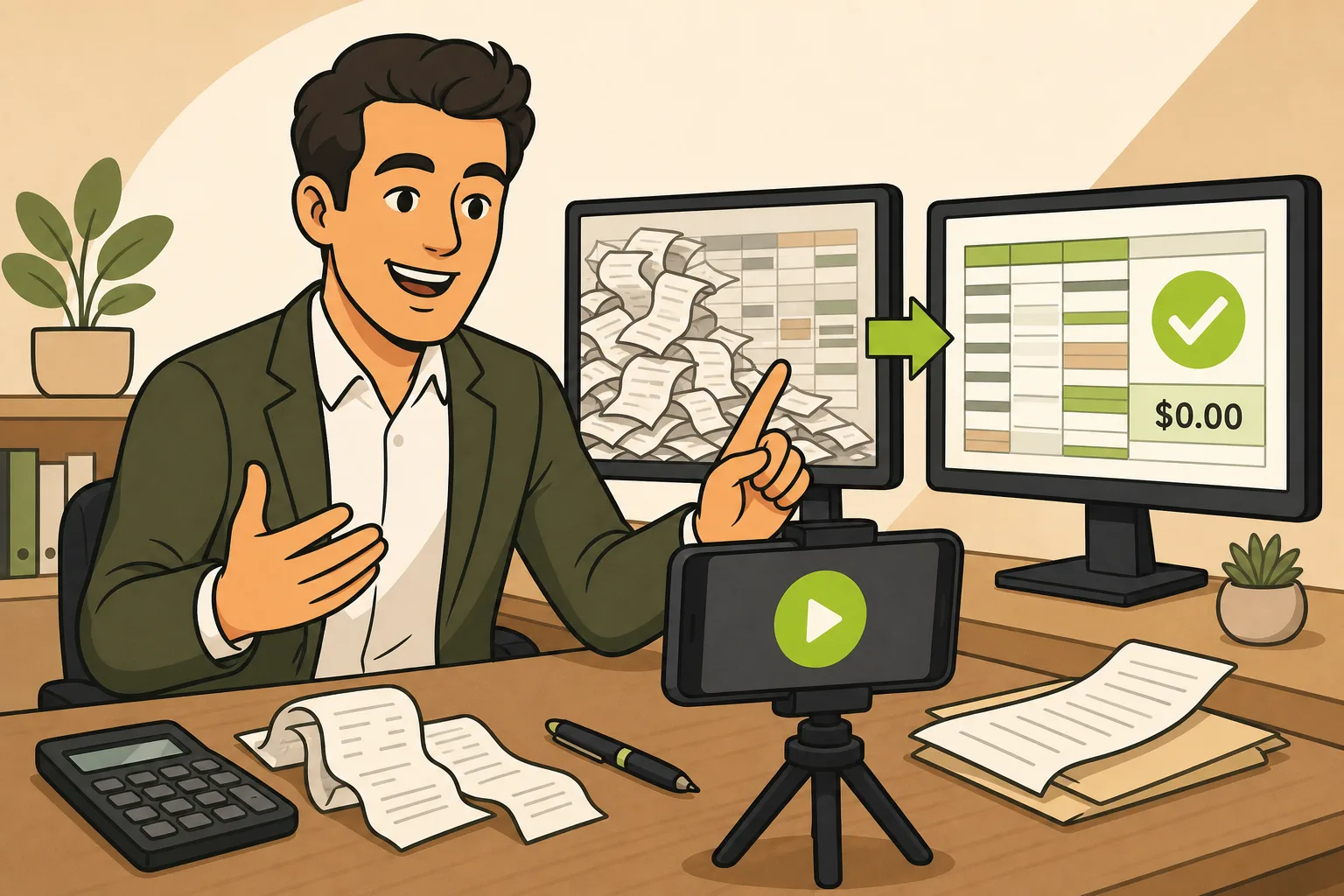
Accounting's one true ASMR analogue is the books reset: a chaotic, color-coded-wrong spreadsheet morphing into a clean categorized ledger, a year of shoebox receipts becoming a tidy binder, a reconciliation finally hitting "difference: $0.00." It scratches the same brain-itch as a power-wash reveal, and it works because of the Zeigarnik "sense of completion" payoff.
Screen-record or shoot overhead: the chaos, a speed-ramped cleanup, the clean color-coded result, the snap-to-zero reconciliation. Calm pacing, captions on, no sell — just the reveal. Use a demo file or fully anonymized data; client confidentiality is non-negotiable.
Anonymized client storytime — emotional beats outperform promotion
The funny or moving real-client moment earns saves and shares that no booking ad will. The classic: "when a client poses a 'hypothetical' to their accountant, don't open with your tax fraud." Or the sincere origin beat — "why I became a CPA, and it wasn't the spreadsheets."
Tease the moment, tell it fully anonymized with no figures, land the human turn — the relief, the laugh, the lesson — and close on a reflective line. People don't call a CPA because they love taxes; they call because they're stressed, and you get to be the person who makes it make sense. Change every name and number. Confidentiality is the hard constraint.
The recurring CPA character — para-social trust
A recurring on-camera personality — "the CPA who's seen it all," a weekly "dumb tax question of the week," a day-in-the-life during busy season — builds the para-social trust that converts a nervous buyer. The face on camera is the single strongest trust signal in a trade where every competitor ships the same navy template and stock handshake. Real founder and team content does the relatability work that user-generated content does in visual trades. That instinct matches what we see across our proprietary local-business website research: years in business is the most universally present trust signal, showing up in hero subtext, trust strips, and navigation badges in nearly every category — a recurring, credentialed face on camera is the social-content version of that same signal. That instinct matches what we see across our proprietary local-business website research: years in business is the most universally present trust signal, showing up in hero subtext, trust strips, and navigation badges in nearly every category — a recurring, credentialed face on camera is the social-content version of that same signal.
Which platforms should an accounting firm actually post on?
LinkedIn is the primary platform for a firm serving business clients — roughly 80% of B2B social leads come from LinkedIn, and it's where referral contacts vet a firm before a first meeting. Native video there earns about 5x the engagement of link posts. Match the platform to the buyer:
| Platform | Role | Best content |
|---|---|---|
| Primary B2B engine | Myth-bust + education in a peer voice, short native video, deadline carousels | |
| Instagram / TikTok | Consumer, personal-tax, humor | Myth-bust Reels, busy-season humor, the bookkeeping reset, storytime |
| Local community + older clients | Local sponsorships, community spotlights, deadline reminders | |
| Google Business Profile | Non-negotiable local-trust surface | Deadline tips, reviews, hours, local posts |
A pure B2B firm can skip TikTok and lean on LinkedIn plus Google Business Profile. A firm doing individual tax prep or building local awareness should run the Instagram/TikTok humor layer hard. Either way, captions stay on — most viewers watch muted. The same LinkedIn-first, myth-bust-and-authority playbook shows up in an adjacent trust-first profession — see social media marketing for financial advisors.
How often should an accountant post on social media?
A small firm should target about 2x/week on LinkedIn, 2–4x/week on Instagram or TikTok if you're running the consumer layer, and 1–3x/week on Facebook — and let the tax calendar set the rhythm. You do not need to post daily.
The accounting calendar IS the content calendar. Cadence spikes January through April, then again around the quarterly-estimate dates (Jun 15, Sep 15, Jan 15) and the Oct 15 extension deadline. Year-end brings the "moves to make before Dec 31" planning push. Off-season runs lighter on education and planning. A "days until April 15" countdown is a category cliché — reframe it as a planning prompt, not a gimmick.
Key takeaway: Keep roughly three-quarters of your feed no-sell education and personality — myth-busting, humor, the books reset — and reserve the ~25% promotional slice for deadline pushes, reviews, and the free-consult nudge. Stapling "book a free consult" onto every post is the failure mode for a trust purchase.
A few honest don'ts for accounting social
Some lines are non-negotiable for this trade, partly for reach and partly for liability:
- Never give person-specific tax advice. Educate generally, then point to a consultation. It's a compliance and liability line, not a style choice.
- Never promise a guaranteed refund, savings, or outcome.
- Never seed the bare #accountant hashtag — it's been hijacked as an adult-content euphemism on TikTok and pulls the wrong audience. Use #accountantsoftiktok, #cpa, #taxtips, and a local #{city}cpa tag instead.
- Never publish client names, figures, or identifying detail without consent.
- Skip the stock high-fives and 2014-era countdown carousels the category is drowning in.
Why this is a lot of work — and what to do about it
Done right, this is a real weekly job: filming myth-bust clips, writing busy-season bits, screen-recording a clean bookkeeping reset, captioning everything, tracking the deadline calendar, and keeping the mix mostly organic. Most firm owners are slammed exactly when the content calendar peaks — April is not the month to also become a video editor.
That's the gap GrowLocal closes. We build and host your firm's site, then write your social posts for your trade automatically — grounded in this exact playbook of accounting veins, your brand, and the deadline calendar, not generic filler. The myth-bust prompts, the deadline carousels, the captions: done for you, in your voice. You stay the expert on camera; we handle everything else online.
It pairs with a site built to convert the same buyer. Across our proprietary local-business website research, 92% of local business websites hide pricing entirely — and in professional services the free consultation is the universal conversion offer, with pricing hidden on effectively every firm we analyzed. A fast site that surfaces your reviews and routes to a "schedule a free consultation" form turns the attention your posts earn into booked calls. See our full pricing-transparency data and professional accounting website design for how that converts.
When you're ready, explore GrowLocal sites for accountants and CPAs — or browse every trade we build for to see the same done-for-you approach across categories.
Frequently Asked Questions About Social Media for Accountants
What should accountants post about on social media?
Post myth-busting "react to bad tax advice" clips, busy-season humor, the satisfying bookkeeping-reset reveal, anonymized client storytime, and a recurring on-camera personality. Keep about 75% of it no-sell education and personality, and use the tax-deadline calendar to set what you post and when.
Is LinkedIn or Instagram better for a CPA firm?
LinkedIn is better for a firm serving business clients — roughly 80% of B2B social leads come from LinkedIn, and it's where prospects vet you before a first meeting. Instagram and TikTok are stronger for individual tax prep, local awareness, and humor. Many firms run LinkedIn as the engine and Instagram for personality.
How often should a small accounting firm post?
Aim for about 2x/week on LinkedIn and 2–4x/week on Instagram or TikTok if you run the consumer layer, with cadence spiking January through April and around quarterly and extension deadlines. Daily posting isn't required; consistency tied to the tax calendar matters more.
Can accountants give tax advice on social media?
Educate generally, but never give advice that reads as guidance for one person's specific situation — that's a compliance and liability line. The safe pattern is to explain a rule in plain English, then say "talk to your CPA about your situation." Never promise a guaranteed refund or outcome.
Why do GrowLocal sites hide pricing for accountants?
Across our proprietary local-business website research, 92% of local business websites hide pricing entirely, and in professional services the free consultation is the standard conversion offer rather than a price list. A fast site that surfaces reviews and routes to a "schedule a free consultation" form converts better than posting rates a buyer can't interpret without context.
Do I need to hire someone to run my firm's social media?
You can do it yourself, but it's a real weekly job that peaks exactly when you're slammed in tax season. GrowLocal writes your social posts automatically — grounded in your trade's content veins, your brand, and the deadline calendar — so you stay the expert on camera while we handle the rest online.