


Social Media Marketing for Architects: What Actually Works
Updated June 2026
Social media marketing for architects works when you treat your existing work as content: post the sketch-to-render reveal, the hand-built study model, the before-and-after of an "unbuildable" site, and a little warm profession humor. On Instagram and TikTok, short vertical Reels of your real process out-perform polished portfolio dumps. Lead with the visual payoff, not your firm name, and post 3–5 times a week. The work you already do is the content — you just have to film it.
This guidance is grounded in GrowLocal's research into how architecture firms actually grow on social, plus our proprietary research into top-ranking local-business websites. Below: the specific content veins that travel for architects, the realistic platform mix and cadence, and the honest catch — keeping this up every week is a job in itself.
What kind of social content actually works for an architect?
The content that works for architects is process and personality, not a feed of finished hero shots. Architecture is a visual, high-consideration profession, so the winning posts let people watch you think — and laugh with you about the work. Five veins do the heavy lifting.
The satisfying process reveal (your single most ownable format)
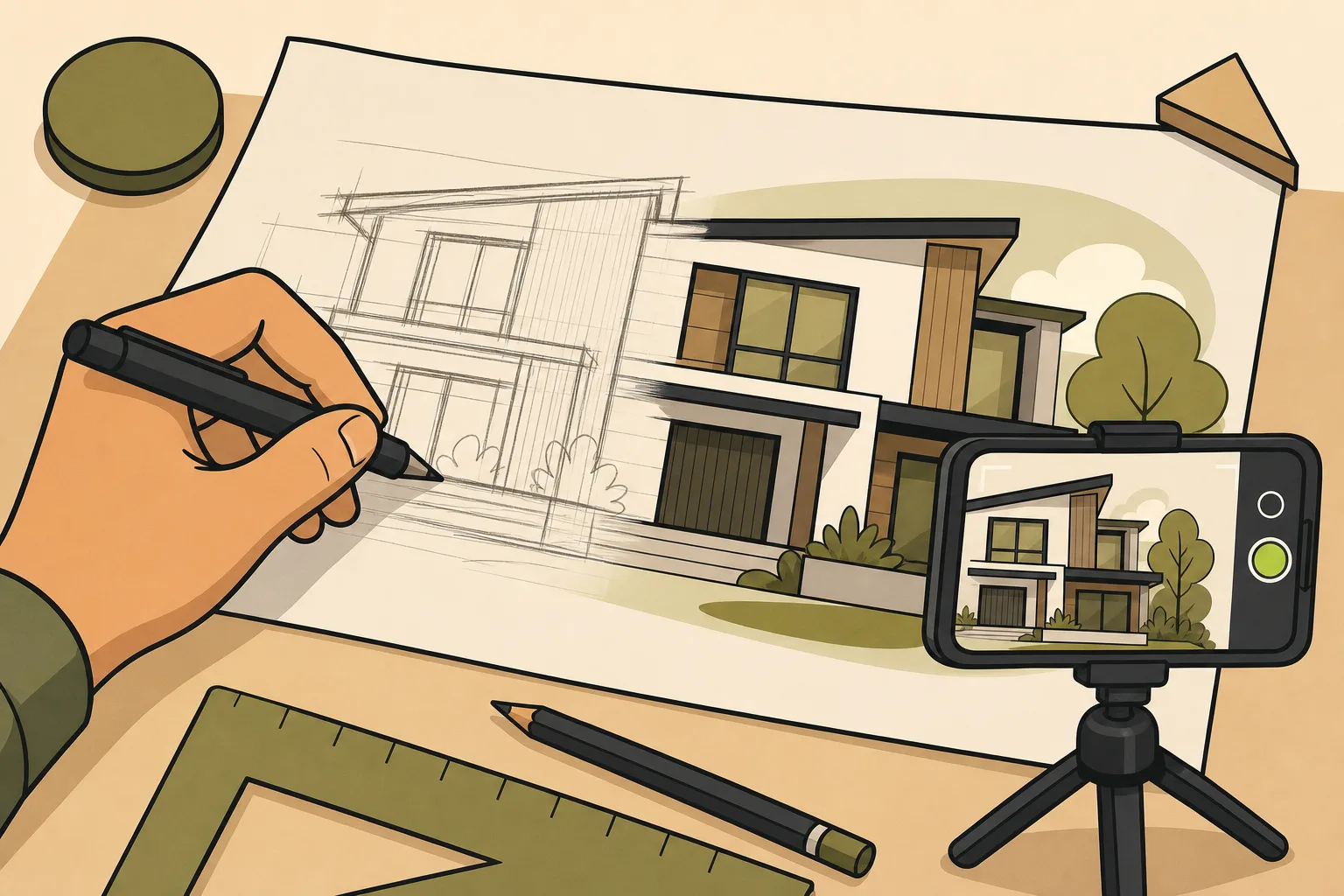
The sketch-to-render reveal is the most ownable format an architect has. Cold-open on blank trace paper, speed-ramp a freehand sketch building up with the pencil sounds turned up, then hard-cut to the clean 3D render of the same elevation. It uses work that already happens at your desk. No props, no script — just the thing you do every day, filmed.
The physical-model version travels just as well. Time-lapse a basswood massing model coming together, knife and glue sounds up front, then a slow rotate of the finished piece under a desk lamp. Process-model accounts built whole followings on exactly this. If your firm still builds study models, that's free ASMR content most competitors aren't making.
The before-and-after (organic-native here, not an ad)
Before/after is native organic content for architects because the transformation is the post. Hold a dated, awkward "before" room for two to three seconds on a trending audio, then transition to the finished space. Add one honest line about why it works — better light, honest proportion, one clear move. Keep it educational, never "book yours." Renovation and adaptive-reuse firms get the most mileage; a site everyone called unbuildable is the strongest cold open you have. Across our proprietary local-business website research, before/after photography is one of the highest-performing sections in transformation-heavy categories — yet it's frequently missing even on sites that would benefit most from it, which is exactly the gap a renovation-focused architect can fill. Across our proprietary local-business website research, before/after photography is one of the highest-performing sections in transformation-heavy categories — yet it's frequently missing even on sites that would benefit most from it, which is exactly the gap a renovation-focused architect can fill.
Profession humor (the warm kind)
Relatable humor is a proven architecture vein, and #architok runs on it. The reliable bits:
- POV reenactments of real client asks — "POV: the client wants a fourth bedroom in the same footprint."
- Architect-vs-engineer standoffs and the eternal load-bearing-wall conversation.
- Expectation vs. reality — the glamorous version of the job cut against the warm glow of the iMac at 2 a.m.
One rule: keep it self-aware, never contemptuous of clients. Humor that punches down at the people who hire you reads as contempt and quietly costs you the relationship sale.
Storytime and the client journey
Emotional client-journey posts save and share better than anything promotional. Build a carousel: the family who thought their lot was too tight, the early sketches, the turning-point idea, framing photos, then reveal day. The arc ends on emotion, not an ask. The catch is consent — never post a private client's home, address, or reveal before they've gone public and said yes. Privacy of a private residence is a hard line, not a guideline.
The named principal as the recurring character
Boutique architecture is a personal trust sale, so the architect's face is the brand. A recurring day-in-the-life or Monday site-visit series — hard hat on, finishes in hand, one curveball solved live — humanizes the firm and answers trust objections without ever selling. The named principal stating one belief they refuse to compromise on builds the para-social follow that turns a stranger into an inquiry.
Should architects teach on social, or just show pretty buildings?
Teach — but as entertainment, never as a brochure. Cost and process are the highest-search homeowner questions, so myth-bust them with personality. A carousel titled "what your architect fee actually pays for" or "the most expensive mistake people make before they hire an architect" does double duty: it earns saves and it pre-answers the objection in a sales conversation. State the myth on slide one, bust it across the next few, reframe on the last (a good architect saves money over the life of a build), and end on a question, not a booking link.
This educate-don't-sell instinct is also what your website should do. Across our proprietary local-business website research, 92% of local business websites hide pricing entirely — and architecture is near-universal on this, funneling visitors to a consultation instead of a number (see our full pricing-transparency data). That's fine for the category, but it means your social and your site have to earn the consult by demystifying the process, since you're not competing on a posted price. The firms that explain "how it works" convert the homeowners who are intimidated by it. See our architect website breakdown for how the process section does that job on-page. We see the same consultation-first, teach-don't-sell pattern in social media marketing for interior designers, an adjacent trade with the identical high-consideration sales cycle. We see the same consultation-first, teach-don't-sell pattern in social media marketing for interior designers, an adjacent trade with the identical high-consideration sales cycle.
Key takeaway: Architecture sells a relationship, not a transaction. With 92% of local business sites hiding pricing, your social content has to do the convincing a price tag can't — show the process, teach the fee, and let the work build trust.
Which platforms should an architect actually post on?
Instagram is the home base, with TikTok as the fast-growing process-and-humor channel. Each platform earns its place differently, so match the format to the room rather than cross-posting blindly.
| Platform | Why it matters for architects | Best content |
|---|---|---|
| Visual discipline; Reels reach non-followers; Explore rewards niche + location tags | Reels (process, before/after), carousels (storytime, myth-bust), year-in-review | |
| TikTok | #architok and #constructiontok reward process and humor | Model-build ASMR, POV humor, sketch-to-render |
| Evergreen idea-boarding for residential and renovation | Before/after pins, house-plan boards | |
| Matters more here than most trades — commercial work, awards, developer relationships | Project spotlights, awards, AEC insight | |
| Google Business | Local-intent capture | Project photos, reviews, location |
Real project photography and credited renderings only — no stock, and no obviously fake AI hero shots. In the same research, top-ranked architecture sites used exclusively real project photography, with zero stock detected. Fake-looking visuals destroy the exact trust you're trying to build. Pre-construction projects can lean on labeled 3D renderings, which often out-perform photos in this category.
How often should an architect post — and on what?
Three to five posts a week sustains reach, and consistency beats volume every time. You don't need a viral hit; you need a feed that proves you're active and that the work is real. The sustainable way to hit that cadence is to mix evergreen with timely.
A healthy weekly architect mix looks roughly like this:
- ~20% satisfying process — sketch-to-render, model builds, drone reveals
- ~15% before/after transformations
- ~12% profession humor / relatable client bits
- ~10% behind-the-scenes day-in-the-life and site visits
- ~10% education-as-entertainment myth-busts
- ~8% storytime client journeys
- The rest is your promotional quarter — consult nudges, awards, project announcements — and that's the only place a hard CTA belongs
Anchor the calendar with a recurring series (a Monday day-in-the-life, a weekly "house of the day") and the seasonal beats: a January "planning your build this year" push when homeowners commit, spring groundbreaking time-lapses, fall award announcements, and a year-in-review carousel in the slow November–December window. The organic 75% should end on a hook or a question — "follow for the build" — not "DM to book."
This is a lot of work every week. Is there a shortcut?
Honestly: yes, this is a real job. Filming the sketch-to-render, editing a before/after to a trending audio, writing the myth-bust carousel, sourcing the right local-plus-niche hashtags, and doing it three to five times a week — while running an actual practice and showing up on site — is more than most boutique firms can sustain past the first enthusiastic month. The content veins above are learnable, but the cadence is what breaks people.
That's the gap GrowLocal closes. We build and host your architecture site, and we write your social posts for you — grounded in your trade and your brand, using exactly the veins on this page. We already know the architect playbook: the process reveal, the warm humor, the consultation-not-quote framing, the awards beat. You keep designing; we keep the feed alive. It's the same done-for-you posture as your website — see professional architect website design, browse every trade we cover, or read why local businesses need their own website before the social work pays off.
Frequently Asked Questions About Social Media for Architects
What should an architect post on Instagram?
Lead with process and personality: the sketch-to-render reveal, a hand-built model time-lapse, a before/after of a renovation, and warm profession humor. Reels reach non-followers, so prioritize short vertical video, and use real project photography or labeled renderings — never stock. Open on the visual payoff, not your firm name.
How often should an architect post on social media?
Three to five times a week sustains reach, and consistency beats occasional volume. Mix evergreen content (past projects, process explainers, model builds) with timely moments like groundbreakings and award announcements so you don't burn out. A recurring weekly series, like a Monday day-in-the-life, makes the cadence easier to hit.
Is TikTok worth it for architecture firms?
Yes — TikTok is the fast-growing process-and-humor channel for architects, with active #architok and #constructiontok communities. Model-build ASMR, sketch-to-render reveals, and POV client-request humor travel well there. It rewards authentic, slightly messy process footage over polished marketing.
Should architects show pricing on social media or their website?
No — architecture is a high-consideration relationship sale, and pricing language cheapens it. Across our proprietary local-business website research, 92% of local business websites hide pricing, and architecture firms near-universally say "schedule a consultation" instead. Use your content to teach what the fee covers rather than posting a number.
Do I need to hire a marketing agency, or can I do social myself?
You can absolutely do it yourself using the content veins above — the work you already do is the raw material. The real challenge isn't ideas, it's keeping a 3–5-post-a-week cadence while running a practice. If that's the wall you hit, a done-for-you service that already knows the architect playbook — like GrowLocal's social posting for architects — keeps the feed alive without adding a second job.