


Social Media Marketing for General Contractors: What Actually Works
Updated June 2026
Social media marketing for general contractors works when the post IS the work — a tight drywall-mud pass, a kitchen before-and-after reveal, a "look what was behind this wall" story. The trade is visual proof, so satisfying process clips, transformation reveals, and honest jobsite storytelling earn reach and trust. Stapling "free estimate, link in bio" onto every post does not. The feed earns the call; the booking ask is the rare minority.
Below is the practical version for a remodeler or builder: the specific content formats that travel, the realistic weekly cadence, the platform mix, and what to do when filming five posts a week stops being realistic.
What kind of content actually gets a contractor reach?
The work itself is the content. General contracting is a visual-proof trade, so the formats that pull are the ones that let a homeowner feel the craft and the outcome. Five organic veins do almost all the work:
- The satisfying / ASMR process clip. A tight, in-focus shot of one repetitive motion — a drywall-mud pass, a tile-spacer pull, a caulk bead, a popcorn-ceiling scrape, a screed float. Natural sound up, no music, no sell. One reported drywall-mud clip (creator @putch8) hit roughly 47.7 million views and 4.5 million likes on a single video. This is pure watch-bait you already film every day.
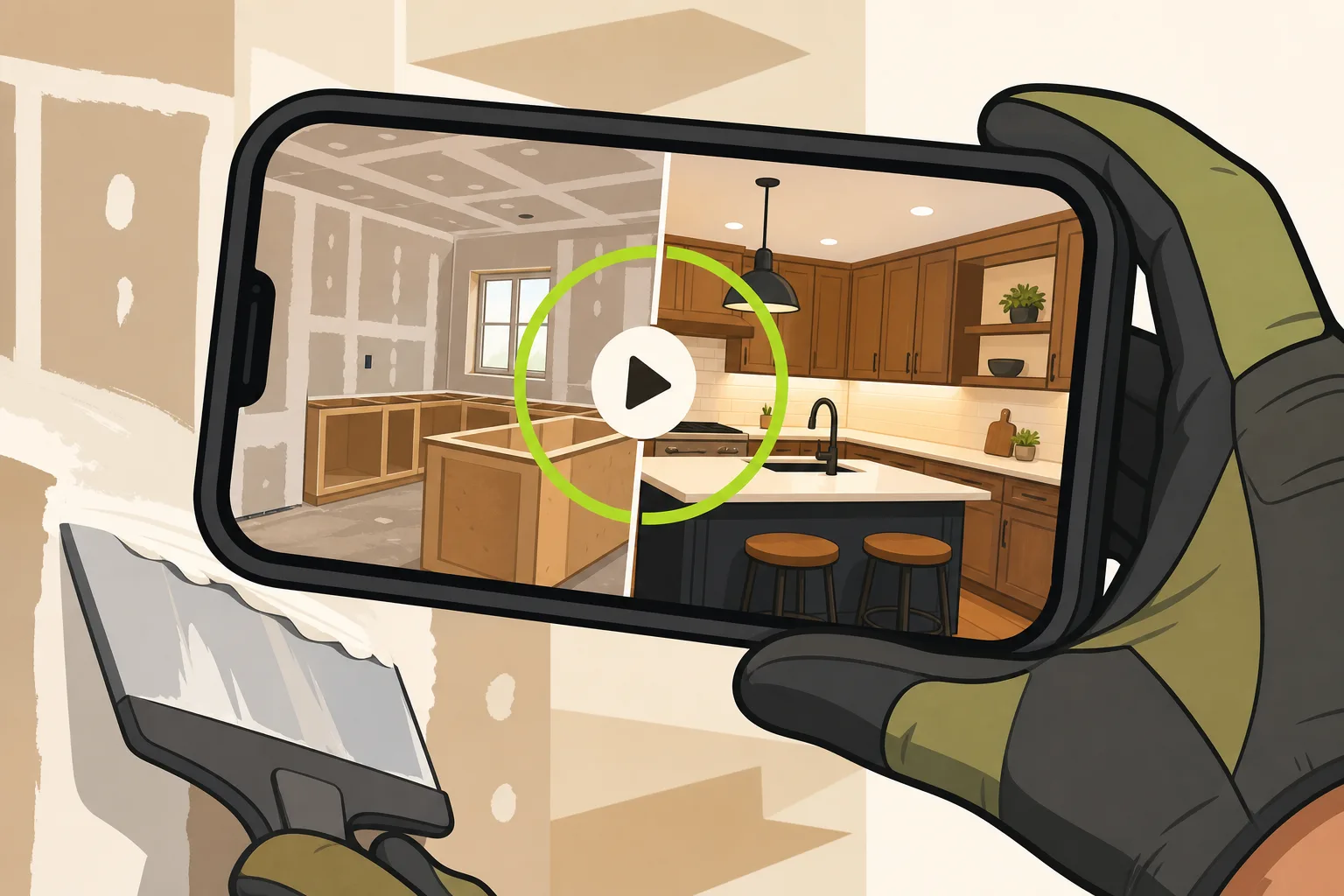
- The before / after transformation reveal. Cold-open on the dated "before," hard-cut to the finished "after" on a trending audio beat. Homeowners binge this like HGTV — #homerenovations carries well over a billion cumulative views, with #kitchenrenovation and #bathroomrenovation each in the tens of millions. It is proof plus desire in fifteen seconds.
- Relatable jobsite humor. The gullible apprentice, the serial-moaner, "POV: you're the new lad on site," the "Certified Caulk Installer" deadpan fail roast. One account built entirely on this vein, Hilarious.Construction, has grown past 517,000 followers on "Laugh as Hard as You Work." Punch up at the situation, never at the customer.
- The storytime / "here's what the video didn't tell you." War stories, the hidden water damage you found in the wall, the honest reason a kitchen cost what it cost, the homeowner who almost DIY'd it. Authenticity — dust, sweat, surprises — reliably out-pulls glossy production.
- The recurring character. The apprentice's learning arc, the foreman's weekly hot take, the shop truck. People come back for the person, which builds a follow loop that survives between jobs.
If a post could be about any trade, it failed. The reach lives in the mud knife, the reveal, and the surprise behind the drywall.
Which of these should I actually post most?
Lead with the reveal and the satisfying clip; let promotion be the periodic minority. A workable monthly mix for a contractor:
| Content type | Share of feed | Why it earns it |
|---|---|---|
| Before / after reveal | ~30% | The hero format — kitchen, bath, whole-home transformations |
| Satisfying / ASMR process | ~20% | Pure watch-bait; mud, tile, caulk, demo |
| Behind-the-scenes / day-on-the-job | ~15% | "What we found behind the wall" answers the trust objection |
| Humor + recurring character | ~20% | Shares and tags convert into follows |
| Tips / myth-busting + storytime | ~10% | Save-bait authority ("what most people get wrong about a remodel") |
| Promotional (booking / seasonal / proof) | ~10% | The periodic conversion post, not the bulk |
These are trust purchases that play out over months, so discount-spam underperforms. Roughly 70–80% of the feed should be organic watch-and-save content; the "we're booking spring kitchens now" post is the small remainder.
What makes a contractor's reel actually stop the scroll?
The hook in the first frame. The clips that travel cold-open on the work or a curiosity gap, not on a logo or an intro:
- The reveal tease: "Wait for the after…" / "Swipe to the after."
- The process cold open: the first frame is the mud knife or tile spacer, no preamble.
- The hidden-truth hook: "Here's what the renovation video didn't tell you" / "Look what was behind this wall."
- The war-story hook: "The worst thing we've found on a jobsite" / "The last guy did THIS."
- The cost-honesty hook: "Why this kitchen actually cost what it cost."
- The relatable POV: "POV: you're the apprentice on day one."
Curiosity-gap and process-cold-open hooks go furthest. "Book your free estimate" as a hook does not — it signals an ad, and the algorithm and the viewer both scroll past.
Keep it raw, not glossy
Real beats polished here. Shoot vertical reels on a real job site with on-screen captions and visible dust. Time-lapse a multi-day phase — demo, framing, drywall, tile — down to fifteen to forty seconds. Use carousels for step-by-step "swipe to the after" transformations. Never use stock or AI-perfect images: in a visual-proof trade, glossy that looks staged reads as unproven, and grime reads as honest.
How often does a contractor really need to post?
Three to five posts a week, every week, beats one polished post a month. Consistency matters more than volume, and a single weekly post no longer earns the reach it used to even with hashtags. TikTok rewards higher frequency — one to three a day where you have the capacity — but a steady 3–5 cadence across platforms is the sustainable baseline.
The engine that makes that survivable is the phone roll. Photos and clips captured during the estimate, the demo, rough-in, and finish on every active job supply the whole calendar. Raw jobsite capture beats waiting for a polished edit that never gets made.
Where should a general contractor actually be?
Instagram and TikTok first, with Google Business Profile as the non-negotiable foundation. Each platform earns its place:
- Instagram / Facebook — where homeowners research and vet a remodeler before calling. Before/after reveals and named 5-star reviews live here.
- TikTok — the broadest reach for satisfying-process and humor content, and a younger audience.
- YouTube Shorts — the home for full "start to finish" walkthroughs with evergreen search value ("full kitchen remodel").
- Pinterest — a secondary, search-driven home for kitchen and bath pins homeowners save during the planning phase.
- Google Business Profile — project spotlights keep the profile fresh and feed the local map pack.
You do not need all of them. Two platforms posted consistently beat six posted occasionally.
Does the website still matter if the social is good?
Yes — social earns attention, but the site is where the high-dollar decision gets made, and it is where most contractors leave money on the table. Across GrowLocal's proprietary local-business website research, 92% of local business websites hide pricing entirely (N=237 sites, 28 categories) — general contracting is one of the categories where every analyzed competitor hid all pricing, funneling visitors to a quote form instead. That is fine, but it means the form and the proof have to carry the conversion.
It also means the gap is wide open. Across our proprietary local-business website research, before/after galleries are a high-performing section that most competitors still omit even where it would obviously work — the exact format that wins on social is missing from most contractor websites. The reel pulls them in; a fast, photo-dense site with a 3–4 field quote form closes them. See our general contractor website breakdown for what the strongest sites actually include, and our cross-trade website research hub for the patterns that repeat across home services.
Key takeaway: With 92% of local business sites hiding pricing, your social proof and your quote form are doing the selling — so the before/after content that wins on TikTok belongs on your website too.
Honestly, this is a lot of work every week. Now what?
It is. Filming three to five posts a week, writing hooks, cutting reels, tracking trending audio, and keeping a steady before/after pipeline is a second job on top of running crews and chasing estimates. Most contractors start strong, post daily for two weeks, and then a busy build season swallows the calendar.
That is the part GrowLocal does for you. We build and host the fast, photo-dense website your reels point to — and because we built it, we already know your trade, your service area, and your brand. From the same place, GrowLocal writes your social posts for you: the before/after captions, the satisfying-clip hooks, the local hashtags, the seasonal "booking spring kitchens" nudge — grounded in how general-contractor content actually performs, not generic filler. You stay on the tools; the feed keeps moving.
The veins in this guide are the formats we write to. If keeping up with them every week is the thing falling off your plate, that is the part worth handing off. See how it works for a general contractor website and social setup, or read our take on why local businesses still need their own website.
Common Questions About Contractor Social Media
What should a general contractor post on social media?
Post the work: tight satisfying process clips (drywall mud, tile, caulk), before/after transformation reveals, day-on-the-job behind-the-scenes, relatable jobsite humor, and honest storytime ("what we found behind this wall"). Reveals and satisfying clips should make up roughly half your feed, with promotional "booking now" posts kept to about 10%.
How often should a contractor post on Instagram or TikTok?
Three to five posts a week, consistently, is the sustainable baseline — TikTok rewards higher frequency where you have capacity. One post a week no longer earns meaningful reach even with hashtags. The realistic way to hit that cadence is to capture photos and clips on every active job rather than waiting for polished edits.
Do contractors need a website if they're active on social media?
Yes — social earns attention, but the site is where a high-dollar remodel decision gets made. Across GrowLocal's proprietary local-business website research, 92% of local business websites hide pricing entirely, which means your project gallery and quote form carry the conversion. The before/after content that performs on social belongs on a fast, photo-dense site too.
What kind of social posts hurt a contractor's reach?
Stapling "free estimate, link in bio" onto every post kills organic reach — let the work earn the follow and keep promotion to a periodic minority. Avoid stock or AI-perfect images (they read as unproven in a visual-proof trade), never show the inside of a client's home or their reaction without written consent, and don't post unsafe practices that undercut your licensed-and-insured trust signal.
Should I hire someone or use a website builder for my contractor marketing?
You can run social yourself with a phone and a consistent capture habit, but the weekly grind of filming, writing hooks, and posting is what most owners drop once build season hits. A done-for-you option that already knows your trade and brand — and already runs the website your posts point to — removes the part that actually falls off the plate. GrowLocal builds and hosts the site and writes the social posts from one place.