


Social Media Marketing for Home Inspectors: What Actually Works
Updated June 2026
Social media marketing for home inspectors works because your job already produces the most watchable content on the internet: real defect reveals. The format that wins is short vertical video — a soft rotted joist that cuts like cake, a deadpan crawlspace roast, the find that saved a buyer five figures — filmed on actual job sites, not stock footage. Build the organic reach with those reveals; keep promotion to about a quarter of your posts. Instagram or TikTok is your primary channel; LinkedIn is a separate track aimed at the agents who actually send you repeat work.
That's the whole strategy in five sentences. Below is how each piece works for this specific trade — the content veins that travel, the realistic weekly cadence, and the honest catch about keeping it up.
Why does home inspection do so well on social media?
Home inspection is one of the rare professional trades with a native viral genre. It has its own hashtags — #inspectortok and #homeinspectionhorrors — built entirely on real defect reveals. You walk into a different house every day and find something nobody was supposed to see. That's not a marketing problem to solve; it's a content engine that already exists.
The reason it pulls is trust. When buyers watch you stab a screwdriver into a "fine-looking" deck and it sinks to the handle, they're sold on the value of an inspection before you ever pitch one. The biggest accounts in the genre prove the ceiling: one inspector is widely reported at roughly 1.7 million followers, and individual "house disaster" reveal clips routinely pull millions of views. You don't need those numbers. You need the format.
What kind of content should a home inspector post?
Lead with the defect, not the service. Four organic veins carry almost all the reach in this trade, and every one of them rides on real footage shot on a job you actually did.
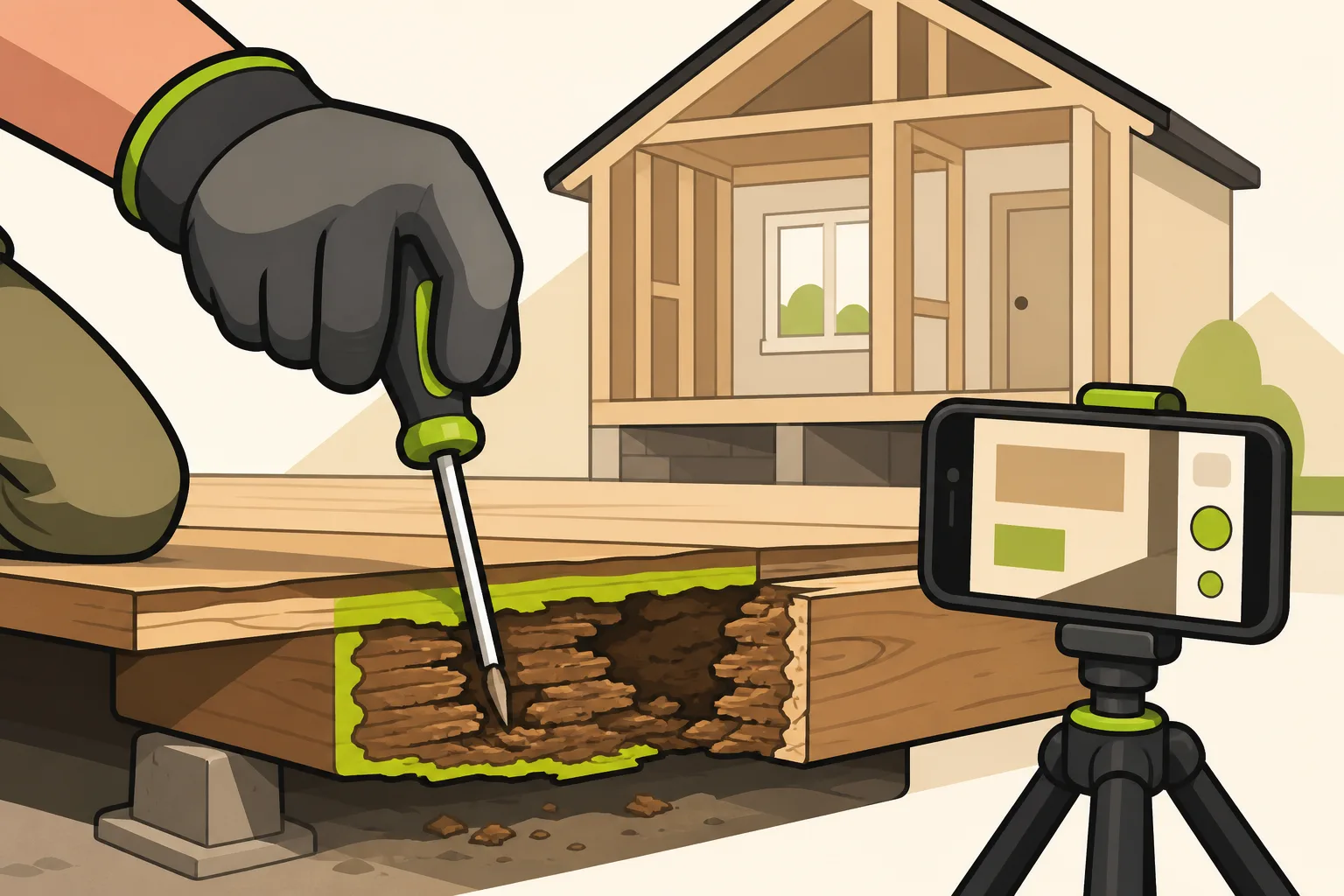
1. The satisfying / ASMR reveal. This is the hero genre. A blade or awl pressed into soft rotted wood, sinking in like cake. A moisture meter climbing. The hollow tap of a wood-tap test. One inspector's rotted-wood slicing clips were widely reported at over a million likes, with commenters openly calling themselves "obsessed with house-stabbing videos." The structure is dead simple: cold-open on the blade already touching the wood, hold on the satisfying push, drop one dry line ("yeah, that's not structural anymore"), end on watch-bait — "and that was the support beam." No call to action, ever. The satisfaction is the point.
2. The humor / horror reveal. The dominant format. Deadpan, sarcastic narration roasting a flip or a new-build disaster as you descend into the dreaded space. Hook over the crawlspace door — "The seller said don't go in the crawlspace. Okay." — then pan to the reveal and let each defect get worse than the last. "They gave up on the plumbing at 4:59 on a Friday." The non-negotiable rule: roast the work, never the homeowner. Punch at the flipper, the builder, the DIY — keep it good-natured. Mean-spirited content reads as untrustworthy in a trade that sells trust.
3. The storytime / emotional arc. "I told this buyer to walk away — here's why." Set the stakes (someone about to make the biggest purchase of their life), show the find on camera (foundation crack, hidden mold, failed electrical), name what it would have cost after closing, then land the human beat: this is the job, I'm on the buyer's side. These get saved and shared because they reframe you from "deal-killer" to "the person in your corner."
4. The recurring character / segment. A named series — "That Ain't Right," "Big Bunch of Nope" — with the same intro card, the same catchphrase close, your face as the brand. This is what turns a one-off viral view into a follower who comes back. Same beats every episode, tease the next one, no sell.
Riding on top of all four: education-as-entertainment. The "this is why you get an inspection" lesson lands after the reveal, never as a dry talking-head brochure. A clean-looking house with a painted-over water stain is a better myth-buster than any explainer you could script.
A realistic weekly content mix
A healthy home-inspection calendar runs roughly 75% organic, 25% promotional. Defect-reveal content (satisfying + humor) is the single biggest reach driver, so it gets the most slots:
| Content type | Share of posts | What it is |
|---|---|---|
| Satisfying / ASMR reveal | ~22% | Rot-cut, moisture-meter, wood-tap climax shots |
| Humor + myth-bust defect | ~22% | Deadpan crawlspace/flip roasts; "clean ≠ problem-free" |
| Tip / education | ~14% | "What this defect means for you" carousels |
| Storytime / emotional | ~8% | "The find that saved a buyer" |
| Behind-the-scenes + character | ~9% | A day on the ladder; the named series |
| Promotion (reviews, booking, seasonal) | ~25% | Social proof, availability, new services |
Which platform should a home inspector focus on?
Master one primary channel and one secondary — not all five. For a local inspector, Instagram Reels is the recommended primary: it's visual, buyer-facing, and agents reshare it. TikTok is where the defect-reveal genre is biggest, so it's the natural primary if your style leans comedic. Facebook mirrors Instagram and is where local buyers actually live; YouTube Shorts repurposes the same vertical clips with no extra filming.
LinkedIn is your secondary, and it's a completely different audience: real-estate agents — the trade's true repeat customer. Agents don't want defect comedy. They want forwardable, professional posts: your turnaround time, your service area, "content you can send a nervous buyer," reassurance that you protect the deal instead of blowing it up. Treat LinkedIn as a referral-relationship channel, not a reach channel.
Format norms are strict here, and they all come back to authenticity:
- Real job-site footage only. Stock photos kill credibility in this trade — the entire genre's trust comes from "this is an actual house I was in today."
- Vertical, 20–60 seconds, the defect on screen within the first 1–2 seconds.
- Captions on for sound-off viewing; your own hands and face in frame.
- Never stage or fabricate a defect. One inspector faced a state-board investigation over falsification claims. Authenticity is the product — faking it can cost your license.
How often should a home inspector post?
About three posts a week is the practical target — industry guides for inspectors explicitly recommend "post 3x/week" as the ramp goal. The good news for this trade: every inspection is a fresh defect to film, so you're never staring at a blank content calendar. Batch one or two strong reveals plus one education or promo post each week.
Higher-volume creators post near-daily off their job pipeline, but a working solo inspector shouldn't chase that. Run your LinkedIn agent content as a separate, lighter 2–3x/week track of forwardable posts. Keep hashtags tight: three to five niche genre tags (#homeinspection #inspectortok #homeinspectionhorrors) plus one hyper-local tag built from your city — #CharlotteHomeInspector, #ColoradoHomeInspection — because the local tag is what surfaces you to nearby buyers and the agents you want referring you.
A few hard don'ts, because this trade has unusual liability:
- Never post a property address or identify the seller, buyer, or agent — you're inside a private transaction. Film the defect, not the owner's belongings.
- Don't staple "book in bio" onto every reveal. Organic content earns the follow; booking comes from your separate, smaller promo track.
- Skip the alarmist "your house is killing you" fear-mongering. Inform, don't terrorize.
Key takeaway: The defect reveal is your reach engine and your sales pitch at once. Film real finds, roast the work and not the person, keep it ~75% organic — and let the booking come from a small, separate promo track.
Isn't this a lot of work every single week?
Yes — and that's the honest catch. Filming a clean reveal, cutting it vertical, writing a deadpan caption, picking the right local hashtag, then doing it three times a week while you're also crawling through attics and writing reports? That's a second job. Most inspectors start strong in week one and go dark by week six.
This is also where a sharp website quietly does heavy lifting. Across our proprietary local-business website research, 92% of local business websites hide pricing entirely (N=237 sites, 28 categories) — so when a buyer finds your viral clip and clicks through, a fast site with a clear quote form and a same-day-report promise is what converts the curiosity into a booking. The social content earns the attention; the site closes it. See our full pricing-transparency data.
That's the gap GrowLocal is built to fill. We build and host the fast, conversion-ready site behind your social presence — and because we research every trade we serve, we already know the home-inspection playbook: the defect-reveal veins, the agent-versus-buyer split, the seasonal "before winter" hooks. We can write your social posts for you, grounded in what actually performs for inspectors, so the content keeps going out in week six and week twenty-six. You stay on the ladder; the posting takes care of itself. See exactly how we approach it in our home inspection website and content breakdown.
Frequently Asked Questions
What's the single best type of post for a home inspector?
The defect reveal filmed on a real job — a soft-rotted-wood cut, a deadpan crawlspace roast, or a "find that saved a buyer." It's both your highest-reach content and your most persuasive sales argument, because watching you find hidden damage sells the value of an inspection without a word of pitch.
Should I use TikTok or Instagram for my inspection business?
Pick one as primary based on style: Instagram Reels for a visual, buyer-and-agent-facing presence, or TikTok if your content leans comedic, since the defect-reveal genre is biggest there. Master one primary plus LinkedIn as a secondary agent-referral channel — don't try to run all five platforms at once.
Is it legal to post videos from inside someone's house?
Film the defect, never the home's identity — no property address, no identifying the seller, buyer, or agent, and no filming the owner's personal belongings, because you're under contract inside a private transaction. Roast the work (the flip, the builder, the DIY), never the homeowner. And never stage or fabricate a defect; one inspector faced a licensing-board investigation over falsification claims.
How often do I actually need to post?
About three times a week is the realistic target most inspector marketing guides recommend, and it's achievable because every inspection hands you a fresh defect to film. Batch one or two reveals plus one education or promo post weekly, and run lighter agent-focused LinkedIn content on a separate track.
Do I need a website if my social media is doing well?
Yes — social earns the attention, but the website closes it. Across our proprietary local-business website research, 92% of local business websites hide pricing entirely, so a fast site with a clear quote form and a same-day-report promise is a real differentiator when a viral clip sends a buyer your way. See how the pieces fit in our home inspection website breakdown and the broader local business website research.
Can someone just do the social posting for me?
Yes — that's the model GrowLocal runs. We build and host your site and can write your social posts for you, grounded in the content veins that actually perform for home inspectors, so the posting keeps going even on weeks you're buried in inspections.