


Social Media Marketing for HVAC: What Actually Works
Updated June 2026
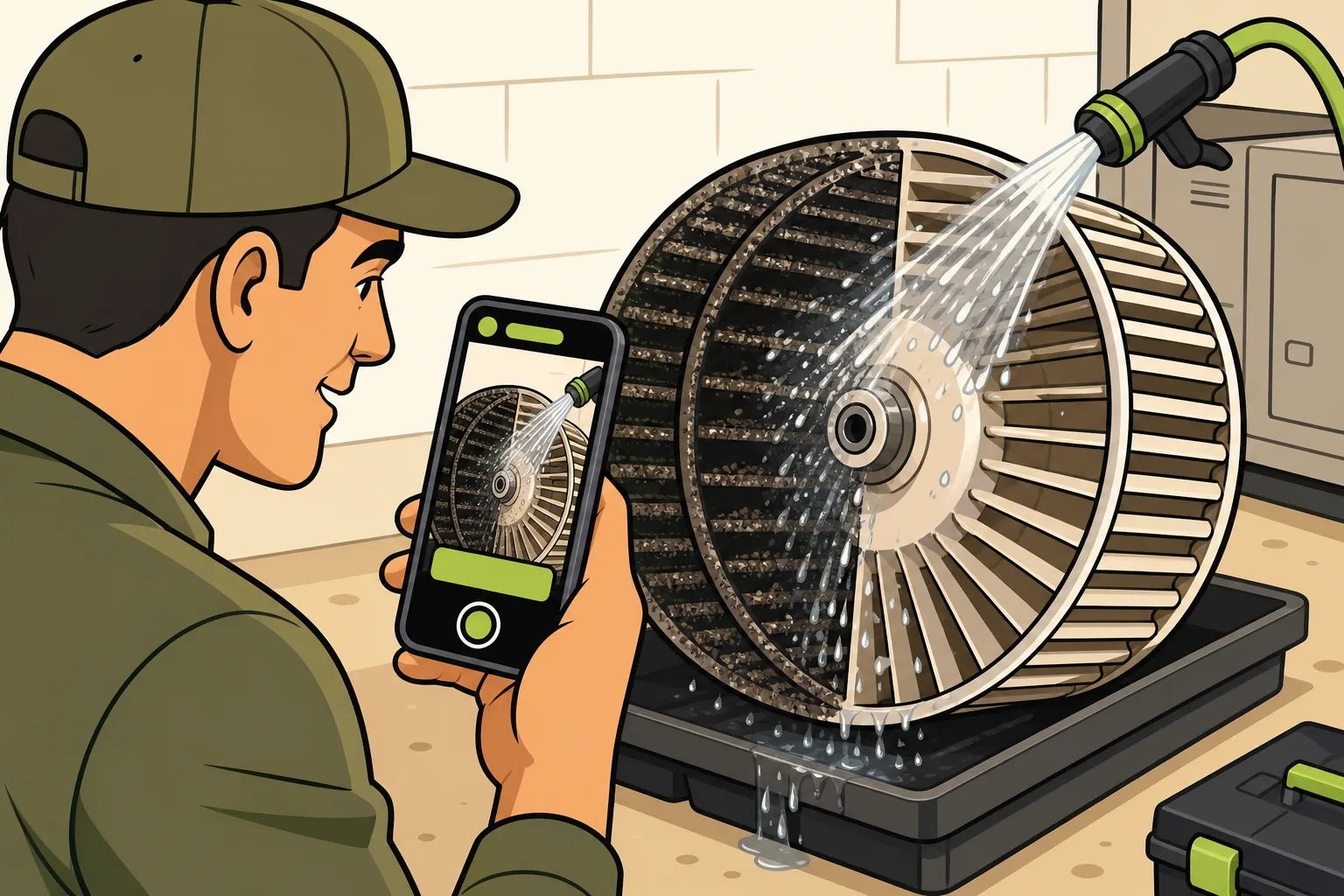
HVAC social media that works is not photos of new units bolted to a house — those are invisible to homeowners and nobody cares. What wins is filth-removal reveals (a five-summers-dirty blower wheel rinsed clean), relatable tech humor ("don't touch the thermostat"), shock-reveal education ("this is what we found in your vents"), and the occasional rescue storytime — posted 3 to 5 times a week, year-round, by a real tech on camera. Promotion is roughly 1 in 5 posts, never the baseline.
That runs against most owners' instinct: post a "Call us today!" graphic, get three likes, conclude social "doesn't work for HVAC." It works — you're running the wrong content. Below is the realistic playbook for the trade.
What kind of HVAC content actually gets views?
Five trade-specific genres carry HVAC's organic reach — and "before/after install shots" is not one of them. A new condenser looks identical to an old one, so the equipment swap is invisible. The content that travels is built on grime, personality, and surprise, not hardware.
- The satisfying / ASMR cleaning reveal. HVAC's real before/after — filth removal, not unit swaps. Open on the dirtiest frame (a caked blower wheel, a furry coil, a duct untouched in years), burn "last cleaned: never" across the top, cut through the brush, the foaming coil cleaner, the rinse, land on spotless spinning metal. On TikTok, lean sound-on and let the vacuum's debris-avalanche carry it. Caption: "This is what 5 summers of dust looks like. Your air goes through this before you breathe it." No CTA. Highest-watch-time vein in the trade.
- Relatable tech humor. The "don't touch the thermostat / look at me… no" POV is a recognized, recurring HVAC format. So is the install-struggle "iykyk" bit: cold-open on a 115-degree attic crawl in July, quick comedic cuts of the grind, self-aware on-screen text, land on the absurdity. Under 15 seconds, single tech, real van behind them. It humanizes the crew and answers the "are these real people?" objection.
- Shock-reveal education. Pull the black, clogged filter that "was supposed to be white," say in one line what it costs in airflow and energy, show the swap interval, end on the clean filter. Or the face-on-camera myth-bust: "Your AC isn't broken — it's doing THIS." The killer framing for HVAC is "here's the real answer, no upsell" — it hits the trade's number-one customer fear directly.
- Storytime / emotional rescue. A free-system giveaway to a veteran who went two summers without AC, a no-heat family helped before a freeze. Open on the moment, brief backstory (with consent), the install, then the reaction — the real payoff. The heart vein: saves and shares, never a discount, and it skews to the older homeowners who live on Facebook.
- The recurring character. Across all of the above, the same on-camera tech — "the AC guy" — is who people come back for. Pick the tech who's natural on camera and make them the face.
If your content could be about any business, it failed. The grime, the deadpan, and the named tech are what make it HVAC.
How often should an HVAC company post on social media?
Three to five posts a week, every week, year-round — consistency beats volume by a wide margin. A company posting three times a week in November outperforms one that posts fifteen times in spring then vanishes. Off-season silence hurts you: a dormant profile reads as "out of business" to a homeowner checking whether you're legit before they call.
A healthy mix follows the 80/20 rule — the most-repeated warning in the trade is stop treating every post as an ad. A working calendar, roughly:
| Content type | Share of posts | Why it's there |
|---|---|---|
| Tip / myth-bust education | ~25% | Authority without the brochure |
| Satisfying / ASMR cleaning reveals | ~20% | The reach engine — highest watch time |
| Relatable humor | ~15% | Humanizes the crew, builds the character |
| Behind-the-scenes / crew | ~10% | Answers "real, local, professional" |
| Storytime / emotional | ~10% | Saves and shares, the heart |
| Social proof (reviews) | ~10% | HVAC's main source of UGC |
| Seasonal triggers | ~5% | Timed to real weather |
| Overt promo / booking nudge | ~5–10% | The periodic engine, never the baseline |
That last row is the whole point. Education plus satisfying plus personality earns the reach; the booking push only converts because the other 80% earned the audience first.
Which platforms matter for a local HVAC business?
Facebook and Instagram come first, YouTube Shorts next, and TikTok is a high-upside option that only pays off with weekly technician-led posting. The reasoning is local and demographic, not trend-chasing.
- Facebook + Instagram (first): Facebook reaches the older homeowner who owns the house and pays for the $8,000 system; Instagram carries visual proof and the DM estimate. Storytime and review posts land hardest here.
- YouTube Shorts (next): The same vertical clips, a second home, with searchable longevity.
- TikTok (high-upside optional): 44% of US adults aged 30–49 now use TikTok, up from 22%, with engagement up roughly 49% year over year (Pew Research Center / industry reporting, 2024–2025) — the homeowner audience is real, the trade is underutilized, so weekly early movers capture outsized attention. Only works if you post weekly.
- Google Business Profile: A seasonal tip post doubles as local SEO and reassurance to anyone reading your reviews. High-leverage, often skipped.
- LinkedIn: Only for commercial or property-manager HVAC.
One format underpins all of it: a 30–60 second technician-led vertical video — quick problem shot, short fix, the result — with on-screen text naming both the issue and the neighborhood, so the algorithm and the viewer both read "local expert." Raw, real-jobsite footage beats polished or AI-generated video; consumer preference for AI-creator content has fallen from 60% in 2023 to 26% in 2025 (industry reporting, 2025), making a real tech in a branded uniform your best trust asset.
How do I use the four seasons for content?
HVAC has a built-in four-season rhythm, and the pro move is to post about three months ahead of demand — seeding the homeowner's memory before the system fails, not chasing the panic call after.
- Spring: AC tune-up reminders, "before the first 90-degree day, here's what we check."
- Summer: Heat-wave urgency in a community tone — "if your AC dies in the heat, turn it off and call," not a discount.
- Fall: Pre-winter furnace inspection, "October is when we're busiest for a reason."
- Winter: "Don't wait for the first freeze to find out your furnace is dead," plus no-heat rescue stories.
Real weather events — a heat wave, a cold snap, a post-storm scramble — are live triggers for a helpful neighbor post, not a promo. Name the weather, give two or three things the homeowner can do right now, add the safety line. That gets shared into local groups in a way no coupon ever will.
Key takeaway: The reach engine for HVAC is filth-removal reveals, relatable tech humor, shock-reveal education, and rescue storytime — posted 3–5x a week, year-round, by a real tech on camera. Promotion is ~1 in 5 posts. The owner who treats social as a "Call us today!" billboard is the one who concludes it doesn't work.
Why does my own HVAC social media never look like this?
Because doing it right is a real, recurring job — and you already have one in attics. It takes a tech who's natural on camera, raw jobsite footage filmed while you work, captions burned in, the dirtiest frame shot before you clean it, a calendar that holds 3–5 times a week through a 110-degree July and a dead-quiet November, seasonal content planned a quarter ahead, and the discipline to keep 80% non-promotional when every instinct screams "sell."
That's why most HVAC profiles are a logo, three stale photos, and a coupon. Not because owners are lazy — because peak season, when the content is best, is exactly when you have no time to post it.
This is the gap GrowLocal closes. We build and host your HVAC website, and we write your social posts for your trade — grounded in exactly the veins on this page, in your brand, on a real calendar. We already know HVAC's engine isn't equipment swaps; it's the grime reveal, the deadpan, the seasonal nudge. You keep doing the work that's yours — fixing systems and showing up — and the every-week posting becomes our problem. Same philosophy behind our whole websites-for-local-business platform: you handle the trade, we handle everything online.
One honest note: across our proprietary local-business website research, 92% of local business websites hide pricing entirely (see our full pricing-transparency data), funneling every visitor to a quote form or call (N=237 sites, 28 categories). Social drives the homeowner to your profile; a fast, honest website with a clear quote form and your real license numbers turns that attention into a booked call. The two only work together.
Common Questions About HVAC Social Media Marketing
Does social media marketing actually work for HVAC companies?
Yes — when you post the right content. The reach comes from satisfying cleaning reveals, relatable tech humor, shock-reveal education, and rescue storytime, not from promotional graphics. Owners who conclude social "doesn't work" are almost always posting "Call us today!" ads, which the algorithm and homeowners both ignore.
What should an HVAC company post about on social media?
Filth-removal reveals (a dirty blower wheel or coil cleaned on camera), relatable bits like the "don't touch the thermostat" POV, shock-reveal education (the black clogged filter, the "what we found in your vents" myth-bust), behind-the-scenes crew footage, and emotional rescue stories. Keep promotional posts to about one in five.
How often should an HVAC business post on social media?
Three to five times a week, every week, year-round. Consistency beats volume — a steady 3-a-week schedule outperforms a spring binge followed by off-season silence, and a dormant profile reads as "out of business" to a homeowner checking your legitimacy before calling.
Which social platform is best for a local HVAC company?
Facebook and Instagram first (Facebook reaches older homeowners, Instagram carries visual proof and DM estimates), YouTube Shorts next, and TikTok as a high-upside option that only pays off with weekly technician-led video. Google Business Profile posts double as local SEO. LinkedIn matters only for commercial HVAC.
Should HVAC social media posts include before-and-after photos?
Not of equipment swaps — a new unit looks identical to an old one, so the install is invisible to homeowners. The before/after that travels in HVAC is filth removal: a caked coil or a black filter cleaned on camera. That grime payoff is the trade's true transformation content.
Do I still need a website if I'm active on social media?
Yes. Social earns attention; your website converts it. Across our proprietary local-business website research, 92% of local business websites hide pricing entirely, so a fast site with a clear quote form, real license numbers, and a 24-hour-response promise turns a viewer into a booked call. See our HVAC website breakdown and the home-services website data.
Can I outsource my HVAC social media instead of doing it myself?
Yes, and for most owners it's the realistic move — posting 3–5 times a week through peak season is a job on top of a job. GrowLocal writes your posts grounded in your trade and brand, on a real calendar.