


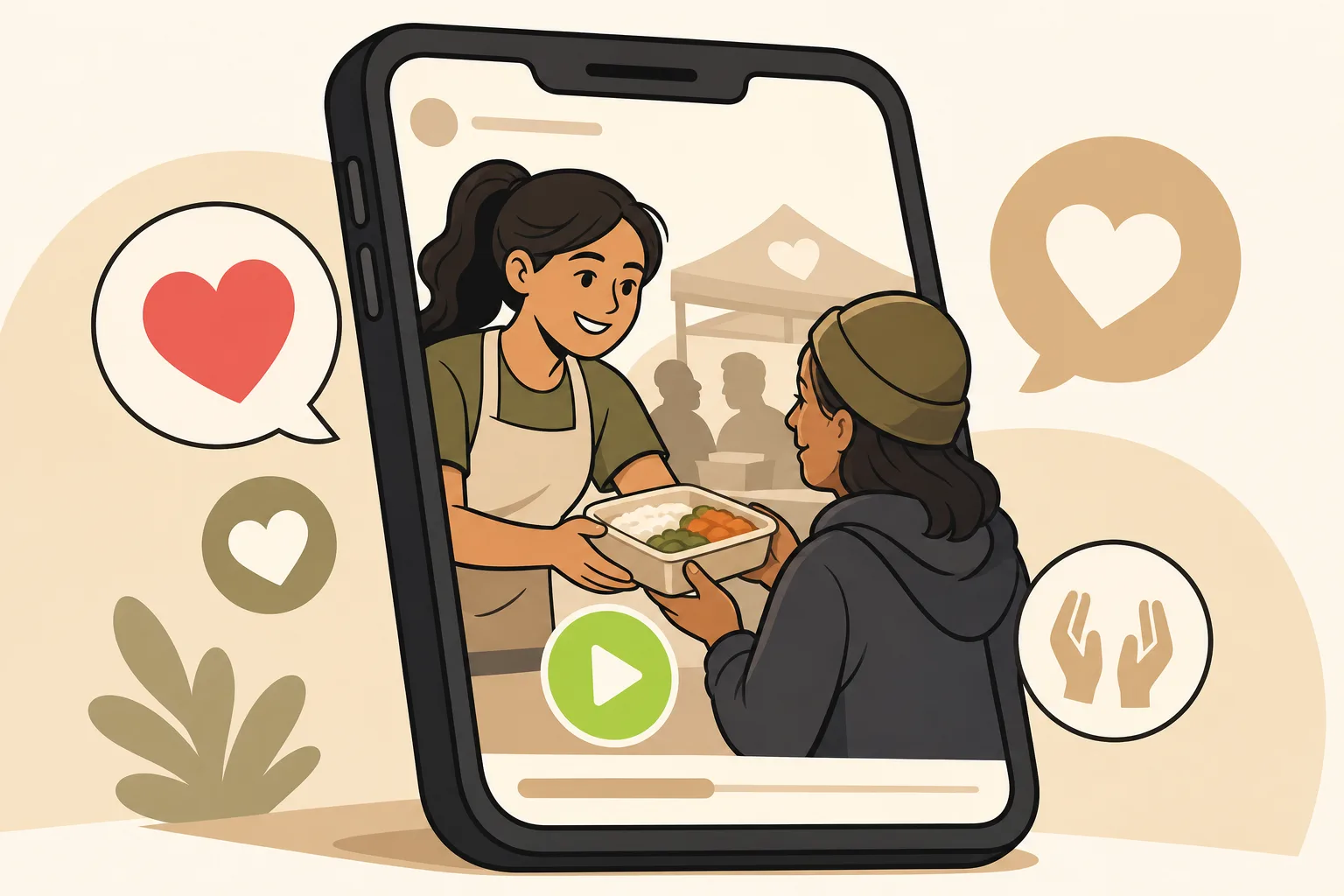
Social Media Marketing for Non Profit: What Actually Works
Updated June 2026
Social media marketing for nonprofits works when you stop asking for money and start closing the loop on it. The content that actually travels is "because of you" impact storytelling, public gratitude to donors and volunteers, and honest behind-the-scenes footage of the work — with the donation ask kept to a small, periodic minority of the feed. Post 3 to 5 times a week, lead with a human face in the first three seconds, and never run the discount-promo or "oddly satisfying" gimmicks that win for other trades. For nonprofits, dignity and real numbers are the format.
That single rule — give before you ask — is why most nonprofit feeds underperform. They staple a "Donate" button to every post, kill their own reach, and never build the connection that makes giving feel like a relief instead of an obligation.
What kind of posts actually get shared by donors?
The posts that get shared are impact stories that close the loop between a gift and a real outcome. The hero genre for nonprofits is the "because of you" storytime: open on a real person, state where they started, show the program that helped, reveal where they are now, and end on gratitude — not an ask.
The structure is reliable. Hook with a face, never a logo: "Because of you, this family slept warm last night." State the before. Show the turning point — the meal, the shelter, the case worker. Reveal the now. Close on "because of supporters like you," and stop there. A donor-appreciation video from one Seattle animal-welfare org was widely reported at a ~12.39% engagement rate — roughly 40 times the nonprofit median — because gratitude is magnetic in a way that asking never is.
The second vein is the spotlight: a volunteer, a donor, or a returning beneficiary, named and on camera. "Meet Maria. For three years she's prepped Tuesday-morning meals." These become your recurring characters — the shop dog, the program animal, the volunteer everyone recognizes — and para-social familiarity is what turns a follower into a monthly giver.
Should a small nonprofit be on TikTok or stick to Facebook?
Stick to Facebook and Instagram first; add TikTok only if your story is genuinely visual. Facebook reaches 93% of nonprofits and Instagram 85%, per nonprofit-sector reporting, and those are where your actual donors are. LinkedIn matters (~81%) if you court corporate partners and grants. TikTok (~15%) and X (~25%) lag for most local causes.
Match the vein to the platform:
| Platform | What it's for | Best vein |
|---|---|---|
| Community + direct fundraising | "City showed up today" community posts; transparency BTS | |
| Reach + emotional storytelling | "Because of you" Reels; myth-bust carousels; donor-thank-you Stories | |
| Partner + grant credibility | Founder origin story; corporate-partner shout-outs | |
| TikTok | New audiences, low-production | Raw emotional storytime ("POV: you find out what your $25 did") |
One animal-rescue org on TikTok built real reach with nothing but simple short videos, a cute-animal subject, and a voiceover — no gimmicks. That's the bar: authentic and emotional, not polished and clever.
What's the behind-the-scenes content that builds trust?
Behind-the-scenes content answers the one question every donor silently asks: "where does my money actually go?" A day-in-the-life Reel — time-stamped from the 6am load-in through the unglamorous logistics to the impact moment that made it worth it — answers that without ever selling.
This is the Sacramento History Museum / Oregon Zoo model: huge followings built on raw, candid footage of the real workday. Show the grind, not just the highlight. On Facebook, run the transparency version: "This month our team prepped 4,200 meals across the city — here's exactly how," then invite questions in the comments instead of donations.
The third trust vein is the myth-bust carousel — education delivered as a save-worthy swipe-through. "5 things most people get wrong about homelessness in our city," one plain-language idea per slide, each grounded in a real number, closing on "save this and share it." Carousels are the highest-save format on Instagram, and they build authority without ever asking for a dollar.
Key takeaway: A healthy nonprofit feed runs roughly 75% organic / 25% promotional — gratitude and "because of you" stories carry the feed, and the donation ask is periodic, never stapled to every post. Asking on every post is what kills your reach.
How often should a nonprofit post, and when do you actually ask for money?
Post 3 to 5 times a week — sustainable for a small team, and quality beats volume in this category. Keep Reels to 60 to 90 seconds with captions burned in and the hook in the first three seconds. Thank donors, volunteers, and your board publicly a few times a year as a recurring gratitude beat.
The ask has a season. The nonprofit calendar is anchored by GivingTuesday — December 1, 2026 — and the year-end giving push from October through December, when tax-deduction urgency peaks. But the weeks leading in stay on story, gratitude, and awareness. The donation ask spikes only on the day itself, and only with real urgency: a live matching gift, a real deadline, a real progress number. Never fake scarcity.
What to avoid is as important as what to post. For this sensitive category, do not:
- Use discount, "sale," or "limited-time" promo voice — it's the wrong register entirely.
- Lead with suffering or poverty-porn imagery — lead with hope, agency, and outcome.
- Post a beneficiary without clear, informed consent and dignity-first framing.
- Run ASMR, oddly-satisfying, or comedy-skit gimmicks that work for other trades.
- Invent impact — say "325,502 meals," never "thousands helped."
Equip your supporters, too. Volunteer and donor user-generated content is high-trust, low-effort reach: repost an event photo with permission and credit, hand advocates a simple social kit with your branded hashtag, and you build a loop where supporters create content to get featured.
Where does your website fit into all this?
Your website is the conversion floor under every post — the place a moved follower lands when they're finally ready to give. Social builds the emotional connection; the site has to catch it with a Donate button that's impossible to miss and an origin story that reinforces the feeling. Across our proprietary local-business website research, the strongest nonprofit sites put the donation button in the top-right nav on every page, styled as a colored button, never a buried text link.
The two channels feed each other. The founder origin story you tell on LinkedIn is the same story that anchors your About page. The "because of you" impact numbers from your Reels are the same specific figures — "$27M awarded since 2002," not "millions" — that build trust in your impact section. If you're rebuilding the site that all this traffic lands on, see our nonprofit website breakdown for the page structure and trust signals donors expect, and the full local-business website research for the cross-category patterns behind it.
This is a lot of work every single week. Who actually does it?
Honestly? Most small nonprofits can't sustain it. Three to five thoughtful posts a week — each needing a real story, consent, footage, captions, the right hashtags, the right platform, and a seasonal calendar that knows when to hold the ask — is a part-time job on top of running programs. That's why so many nonprofit feeds drift into "Donate now" spam: it's the only thing left when the team runs out of time.
This is where GrowLocal's done-for-you social comes in. We already build and host the site, so we already know your mission, palette, programs, and numbers — which means we can write the "because of you" stories, the volunteer spotlights, and the GivingTuesday lead-in in your voice, on the right cadence, without you starting from a blank caption box every week. The posts ground in your actual impact data, and the ask stays where it belongs: periodic and dignified.
If you'd rather spend your week on the mission than on the content calendar, that's the trade we built for. Start with your nonprofit website, and the social engine runs off the same foundation.
Frequently Asked Questions
How many times a week should a nonprofit post on social media?
Three to five posts a week is the sustainable cadence for a small nonprofit team, and quality beats volume in this category. Keep Reels to 60 to 90 seconds with captions on. Ramp toward near-daily storytelling for four to eight weeks around GivingTuesday and year-end, but keep those lead-in weeks on story and gratitude, not the ask.
What should a nonprofit post about instead of asking for donations?
Lead with "because of you" impact stories, public gratitude to donors and volunteers, behind-the-scenes day-in-the-life footage, your founder origin story, and myth-bust awareness carousels. A healthy feed is roughly 75% organic and only 25% promotional. The donation ask is periodic — reserved mostly for campaign days — because stapling it to every post kills your organic reach.
Which social platform is best for a small nonprofit?
Facebook and Instagram first — Facebook reaches 93% of nonprofits and Instagram 85% per nonprofit-sector reporting, and that's where your donors are. Add LinkedIn if you pursue corporate partners or grants, and TikTok only if your story is genuinely visual. Pick where your actual donors are, not just where follower counts are highest.
How do I post about the people we help without exploiting them?
Always get clear, informed consent before posting any beneficiary, and frame the story around hope, agency, and outcome — never suffering or "poverty porn." Show where someone is now, not just where they started, and credit them as a person with a future, not a fundraising prop. When in doubt, ask the person how they want their story told.
Does my nonprofit still need a website if we're active on social media?
Yes — social builds emotional connection, but your website is where a ready donor actually gives. The strongest nonprofit sites we analyzed keep a colored "Donate" button in the top-right nav on every page and anchor the homepage with a specific impact number and the founding story. Treat social as the hook and the site as the conversion floor that catches it.
Can I get help running my nonprofit's social media?
Yes — GrowLocal offers done-for-you social as part of the same platform that builds and hosts your site. Because we already know your mission, brand, and impact numbers, we write the impact stories, spotlights, and seasonal lead-ins in your voice on a steady cadence, so your team can stay focused on programs instead of the content calendar.