


Social Media Marketing for Real Estate Agents: What Actually Works
Updated June 2026
Social media marketing for real estate agents works when the feed is roughly 75% organic content and 25% promotion — built on five native genres: the smooth one-shot home tour with an unexpected reveal (real estate's ASMR), relatable POV agent humor, the closing-day storytime, a recurring day-in-the-life character, and hyperlocal myth-busting. The agents who blow up are not the ones posting "Just Listed" graphics all day. They are the ones who turned an agent's existing listing photos and daily chaos into watchable short video.
This guide breaks down exactly which content veins win for residential agents, the realistic posting cadence, and where the listing graphics actually belong.
What kind of real estate content actually goes viral?
The content that travels is visual transformation plus education-as-entertainment — and agents are uniquely positioned for both, because every listing already comes with professional photos and video. Most local trades have to manufacture footage. An agent walks into pro-shot homes for a living.
Five organic veins do the heavy lifting:
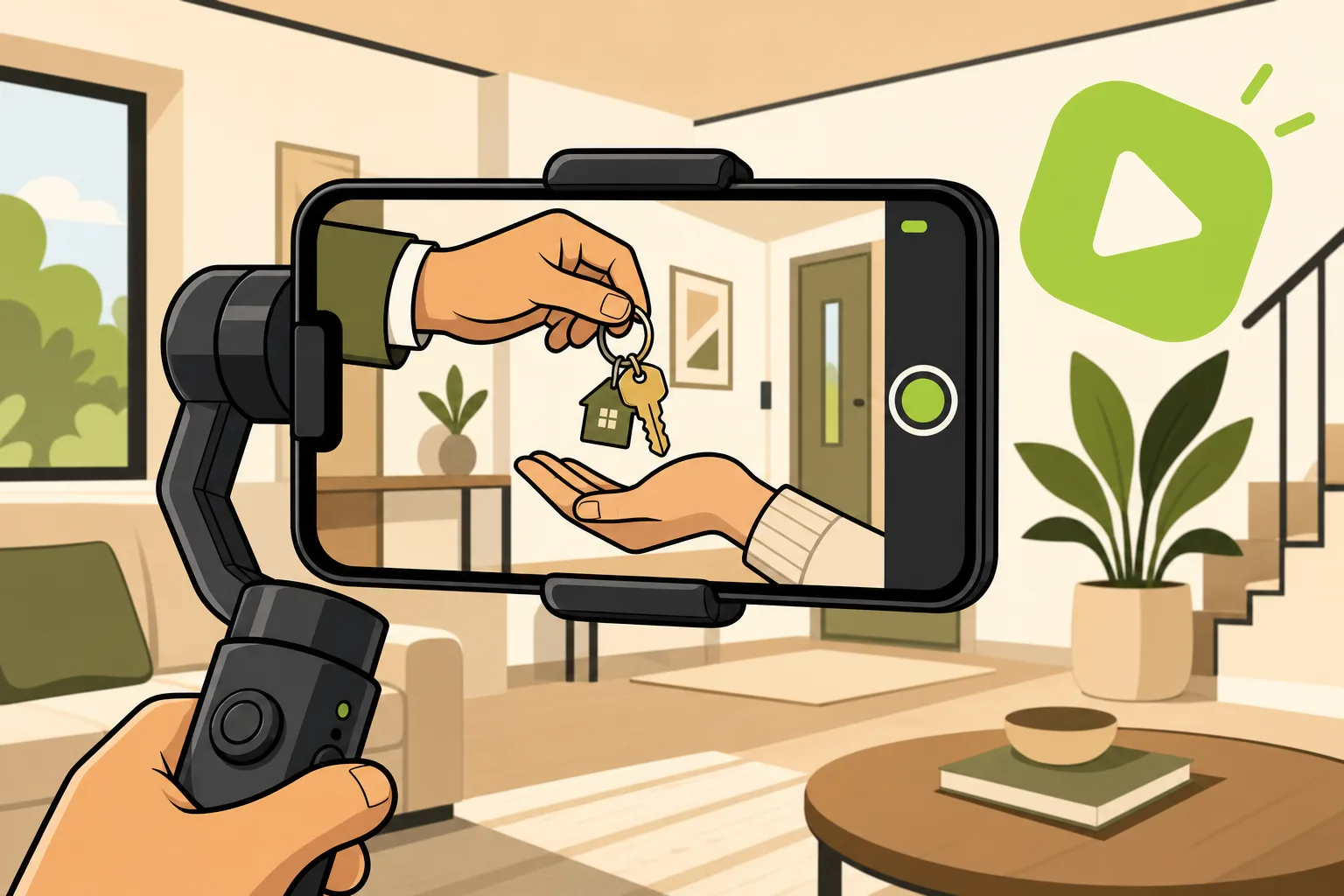
- The satisfying one-shot tour — a single seamless gimbal walk through a home that builds to an unexpected feature.
- Relatable agent humor — POV skits about the universal pain of the job.
- The storytime — a client's journey from first showing to keys in hand.
- The recurring character — a day-in-the-life that makes followers feel like they know you.
- Hyperlocal education — myth-busts and neighborhood guides that beat generic advice every time.
Key takeaway: Across our proprietary local-business website research, real-estate is one of the categories where every competitor hid pricing entirely and leaned on visual proof instead. The same instinct wins on social: lead with the home and the human, not the price tag.
Real estate's ASMR: the one-shot reveal tour
The single most native format is the smooth, gimbal-stabilized one-shot tour that builds to a "wait for it" moment — a hidden room behind a bookshelf, a waterfall island, an infinity pool, a door that opens to something unexpected. The hook lives in frame one as on-screen text: "Wait til you see what's behind this bookshelf." Then you hold the reveal and let it breathe — no caption ask, no sell.
Shaky footage kills this instantly — buyer confidence drops the second the frame wobbles, and a $30 phone gimbal is the entire production budget. The other half of this vein is the closing-day key handover, the literal moment keys change hands, shot clean. That clip is consistently cited as the most powerful emotional asset an agent can post.
The humor vein: POV agent skits
The funniest real estate accounts are not selling houses in their videos at all. They are riffing on the universal pain of the job: "POV: your buyer wants to offer 100k under asking," "POV: there's no furniture at the open house so I got comfortable," "realtors when the client finally answers after 3 days." Creators like Matt Lionetti, The Broke Agent, and The Property Brothers-in-Law built large followings almost entirely on this relatable, self-deprecating agent-life comedy.
The mechanics are simple: set the relatable premise in the first two seconds with a text overlay, act out the reaction over trending audio, land the punchline, end on the in-joke ("agents know"). No call to action. The shares and comments come from other agents and buyers who recognize the moment — exactly the signals the algorithm rewards.
The storytime: closing-day emotion
This is the vein that earns saves and shares without a single word of selling. You open on the emotional payoff — the tears, the hug, the keys — then rewind through the client's struggle: the family that almost gave up, the renter of twelve years, the offer that finally got accepted on the ninth try. Then you land back on the closing-day moment and hold it. "She cried when I handed her these keys" is the whole hook.
It works because buying a home is a once-in-years emotional event, and people follow the agent who clearly cares about the outcome, not the commission. One rule is non-negotiable: get written consent before posting any client's face.
The recurring character: day-in-the-life
People hire a person, not a logo — so the day-in-the-life vein builds a para-social follow loop that converts months later. "Day in the life of a {city} realtor (it's chaos)," "come with me to 3 showings before noon." Quick cuts through the coffee, the car, the showings, the team goofing in the office, one honest moment that humanizes you, end on the day's win.
The stronger version is a niche persona — "the foodie agent who finds you the house near the best taco truck." A specific character is more memorable than a generic "professional agent," and it gives every post a through-line.
Hyperlocal education: myth-busts and neighborhood guides
Education only travels when it is local and a little spicy. The reliable opener is a bold myth-flip: "Stop believing you need 20% down to buy a house." Debunk it fast with the real number (most first-time buyers put down far less; FHA runs 3.5%, VA can be 0%), give one why-it-matters line, and close with "follow for more {city} home tips." That is an engagement nudge, not a sales pitch.
The long-tail version is the neighborhood guide — "what it's REALLY like to live in {neighborhood}," walked on camera with the cafes, parks, schools, and honest tradeoffs. This is the social-video mirror of the category's biggest SEO play: the best real-estate sites run hundreds of per-neighborhood pages. Hyperlocal content compounds local trust the same way those pages compound local search. One Fair Housing guardrail: describe the place, never who "belongs" there.
How often should a real estate agent post on social media?
Three short-form videos a week is the floor for the algorithm to distribute you, and agents who clear that bar grow noticeably faster than agents who post sporadically. A practical growth-mode week is roughly five Reels (two lifestyle/local, two education, one tour), two to three carousels for saves, and daily Stories for warm-lead activation.
But sustainability beats intensity. One well-made Reel a week for six months beats five a week followed by burnout — pick a cadence you can actually hold.
| Format | Role | Realistic weekly volume |
|---|---|---|
| Reels / TikTok | Reach engine (tours, humor, myth-busts) | 3–5 |
| Carousels | Saves + education (checklists, tips) | 2–3 |
| Stories | Lead activation, BTS, polls | Daily, 6–10 frames |
| Listing / valuation promo | Conversion | Capped at ~10–15% of total |
Which platforms matter most for real estate agents?
Instagram and TikTok are the primary organic-growth engines for residential agents, because their algorithms can push an unknown agent's video to thousands of local viewers without an existing following. TikTok skews toward the millennial cohort that makes up the largest share of buyers.
The supporting cast matters too:
- YouTube — long-form neighborhood vlogs and day-in-the-life, high search intent.
- Facebook — still reaches older sellers and local community groups.
- LinkedIn — investor, relocation, and luxury referral networks.
- Pinterest — saves on staging and first-home checklists.
- Google Business Profile — reviews and neighborhood posts that compound local trust.
Vertical short-form wins on reach: real-estate Reels engage at roughly double the rate of static posts in the sector. Captions on, a text hook in the first frame, and resist over-polishing — authentic phone footage outperforms anything that looks like a brokerage ad.
Where do "Just Listed" posts actually belong?
Listing graphics belong to a minority of the feed — cap pure listing and promo at about 10–15%. A feed that is wall-to-wall "Just Listed / Just Sold" reads as a walking billboard and tanks engagement. The promotional 25% is better spent on the home-valuation lead magnet ("curious what your {city} home is worth? DM me your address"), which captures the high-value seller lead, plus occasional social proof and seasonal pushes.
Spring is the single biggest content moment — the busiest season and the strongest "is now the time to sell" hook of the year. Ride local market-shift headlines, rate moves, and new developments with quick hyperlocal market-update Reels that set up the valuation CTA later.
This is a lot of work every week. Can it be done for you?
Honestly: yes, the strategy above is a real weekly job. Filming tours, editing Reels, writing keyword-rich captions, building carousels, and keeping Stories warm is a content operation most agents cannot sustain alongside selling homes. That is the gap — they start strong, then quit by week three.
That is the part GrowLocal handles. We build and host your real estate site, and we write your social posts grounded in your own brand, your listings, and your market — using the exact category-native veins above instead of generic "post consistently" filler. Because we already know how this trade's content works, the posts sound like an agent who lives in your city, not an AI. See our real estate website breakdown for how the site and social work together, and how we apply the same hyperlocal pattern across every local trade we build for.
We are honest about what we do and do not do: GrowLocal gives you a fast, mobile-ready site with quote and contact forms, galleries, and testimonials — plus done-for-you social content. We do not run live booking widgets or sync live reviews; we capture leads with a fast form and a 24-hour-response promise, then run the content engine.
Frequently Asked Questions
How often should real estate agents post on Instagram?
Aim for at least three short-form Reels per week — the floor for the algorithm to distribute your content — plus two to three carousels and daily Stories. A sustainable cadence you can hold for months beats a heavy schedule you abandon after three weeks.
What type of real estate post gets the most engagement?
Short-form vertical video wins: real-estate Reels engage at roughly double the rate of static posts in the sector. The highest performers are the satisfying one-shot home tour with an unexpected reveal, relatable POV agent humor, and closing-day storytime clips.
Should real estate agents be on TikTok or just Instagram?
Both, if you can sustain it — their algorithms can surface an unknown agent's video to local viewers without an existing following. TikTok in particular reaches the millennial cohort that makes up the largest share of homebuyers.
How many hashtags should a real estate agent use?
A small, hyperlocal set beats a stack. Instagram now caps hashtags and behaves more like a search engine, so keyword-rich captions ("homes for sale in {city}") drive more discovery than hashtag dumping. Use one or two geo tags plus a couple of niche tags.
Can I show client photos and sold prices in my posts?
Only with written consent. Closing-day photos and reaction clips are the highest-trust content you can post, but get explicit permission before showing any client's face, address, or sold price, and honor Fair Housing language throughout.
Do I need to hire someone to run my real estate social media?
You can do it yourself, but it is a real weekly job, and consistent filming, editing, and captioning is what most agents abandon. A done-for-you service like GrowLocal writes posts grounded in your brand and market so the content keeps shipping while you focus on clients. See our real estate website breakdown for how it fits together.