


Social Media Marketing for Restaurants: What Actually Works
Updated June 2026
The social content that fills restaurant tables isn't menu ads — it's appetite and personality. The five genres that travel for restaurants are satisfying close-ups (the cheese pull, the sizzle, the sauce pour, filmed sound-on), kitchen behind-the-scenes, relatable server humor, the owner's origin story, and a recurring on-screen character like the bartender or the shop dog. Post these 3–5 times a week on Instagram Reels and TikTok, add daily Stories during service and 2–3 Google Business Profile posts a week, and keep the mix roughly 75% organic to 25% promotional. A wall of "order now" graphics is the failure mode.
This guide breaks down each genre with concrete post ideas, the realistic weekly cadence, and the platform split — then where a done-for-you option fits.
What kind of restaurant content actually gets views?
The reach comes from food you can almost taste and people worth following — not from posting your menu. 74% of people use social media to decide where to eat, and 40% try a restaurant after seeing food photos online (Sauce, 2025). Five category-native genres do the heavy lifting. Learn these instead of generic "post consistently" advice.
Satisfying, sound-on food close-ups
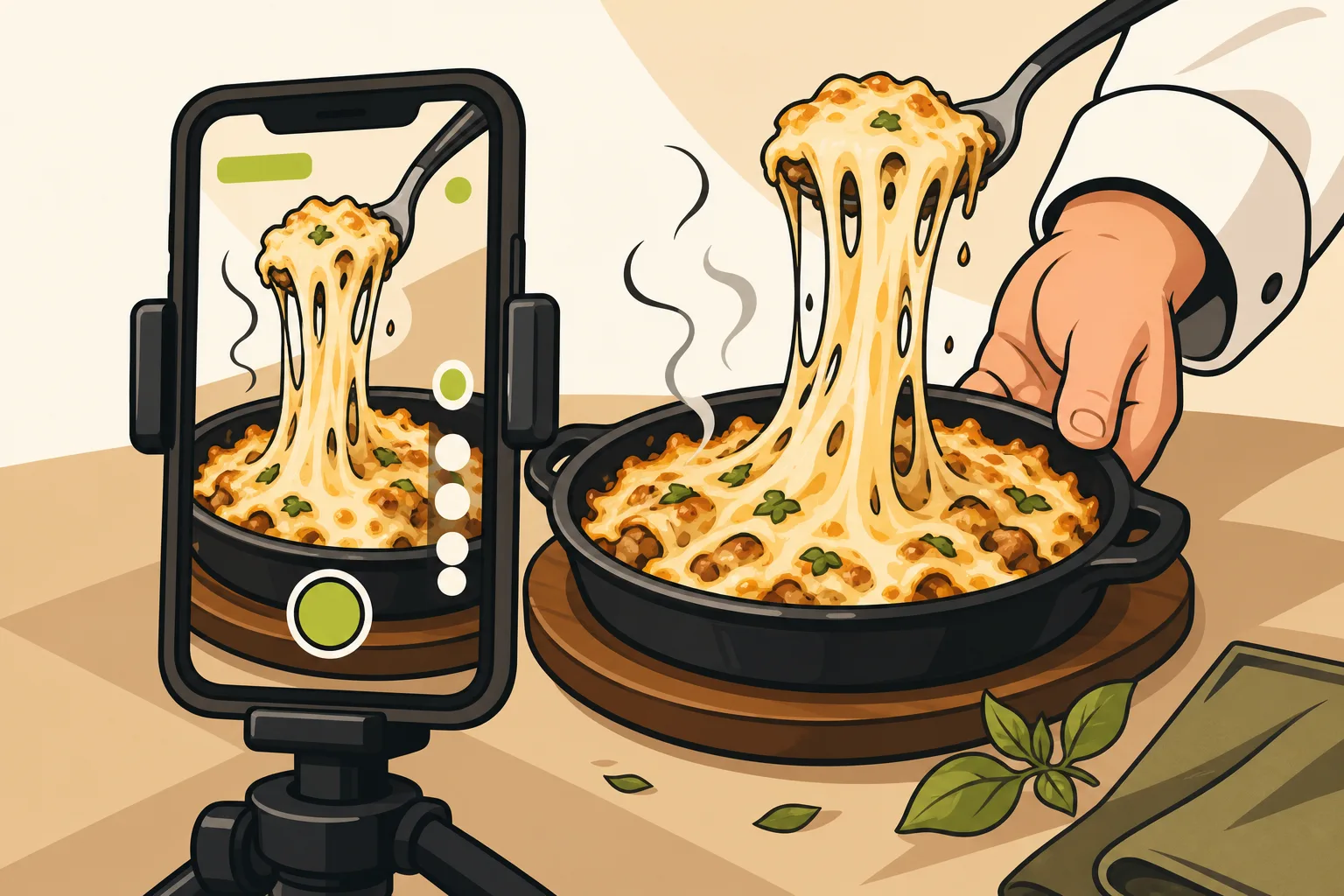
This is the hero genre for restaurants. Put your single most satisfying moment in frame one: the cheese pull, a steak hitting the flat-top, a sauce pour, dough stretching, the crack of a crème brûlée. Film it tight, in macro, with the real audio captured clean — food is the one niche people watch sound-on more than any other.
A working post is eight seconds long: frame one is the action, two or three macro angles follow, the last beat is the finished plate with steam still rising. No caption ask. The food is the whole post. Lead with the trigger — strong-hook food clips earn three to five times the watch time of clips that warm up slowly.
Kitchen and service behind-the-scenes
People save the stuff they can't see from the dining room. A dinner-rush timelapse, a dish built from scratch start to finish, the chaos of the line, a plate coming together on the pass. Behind-the-scenes clips get roughly four times the save rate of polished product shots, and a Paris restaurant reportedly hit millions of views on BTS with under 2,500 followers.
This is the easiest genre to scale: one staffer films two or three real moments a week on a phone. Open on the heat of the line, cut through the real process, show the crew working, end on the finished plate or the room filling up.
Relatable server and kitchen humor
#serverlife and #serverpov are a massive native comedy vein — creators like Drew Talbert and Gabriella Zottola built followings on it. The format: set a relatable premise in one line ("POV: the table that 'just needs five more minutes' at 9:58"), play out the dramatized reaction, land the cathartic "what we wish we could say" twist.
Use your real team and your real dining room. Comedic timing beats production value. Keep it good-natured — the bit is about the job, never punching at an actual guest.
Storytime and the origin
Heritage is the strongest trust signal a restaurant has — every site in our restaurant research carried a "since YEAR" claim. Turn it into a Reel. Open on the owner's face or the dish with a hook line ("why this has been on our menu since 1986"), tell the short backstory, tie it to the food on the plate now, land on the emotional note with no sell. Origin stories and family-recipe posts earn saves and shares because emotion outperforms promotion.
A recurring character
People come back for people. Build a repeatable named segment: the bartender's drink of the week, a line cook with a catchphrase, the host, even the restaurant dog or cat. Same intro and framing each time so it becomes a series viewers return for. It's a para-social loop — the regulars who follow your character are the ones who walk in on a slow Tuesday.
Key takeaway: Restaurants win on social with appetite and personality, not menu ads — and 40% of people try a restaurant after seeing its food online (Sauce, 2025). The satisfying sound-on close-up is the format that travels.
How often should a restaurant post — and where?
Food is one of the few categories that rewards near-daily posting, because freshness is a recurring reason to follow. Instagram and TikTok are the two primary engines; Google Business Profile is the third, intent-driven pillar. Here's the realistic weekly rhythm.
| Platform | Cadence | Job it does |
|---|---|---|
| 3–5 Reels/feed posts a week + daily Stories during service | Appetite + ambiance showcase; your regulars' home base | |
| TikTok | 3–5 videos a week | Where one clip can reach hundreds of thousands organically |
| Google Business Profile | 2–3 posts a week (daily is fine) | Catches "dinner near me" searchers at decision time |
| 1–2 posts a week | Older regulars, events, community goodwill |
Going from one TikTok a week to three to five is the single biggest view lift you can make. Post at hungry hours — 11am–1pm and 5–7pm — and lean Tuesday through Thursday afternoons on TikTok. Businesses posting weekly to Google Business Profile gained an average of 2.3 local-pack positions over six months (Malou / HigherVisibility). One caveat: Google Business Profile is decision-intent, not vibe — keep those posts short and action-first, lead with what's available tonight, and use the CTA button. It rejects phone numbers in the text and uses no hashtags.
A healthy calendar runs about 75% organic to 25% promotional: roughly a fifth satisfying close-ups, a chunk of behind-the-scenes and daily specials, a slice of humor, then storytime, customer reposts, trends, and your character rotating through. The promo — happy hour, the seasonal menu, the holiday reservations — works only because the organic content earned the follow first.
What about hashtags and reposting customers?
Keep hashtags lean and always geotag. Three to six tags is the sweet spot: a branded restaurant tag, one or two neighborhood or city tags, one or two broad food tags like #foodie or #eeeeeats, and the dish or cuisine. Over-tagging reads as spam. The geotag matters most — local diners search by location when they're deciding where to eat tonight, and the tag surfaces your post in those searches.
Customer photos are the highest-credibility content you have. User-generated content carries roughly twice the conversion impact of branded content, and 93% of marketers say it outperforms traditional ads. The workflow: promote a branded hashtag on receipts and table tents, watch that tag and your geotag, DM the guest for permission, then repost with credit into a "Customer Favorites" Story Highlight. Make the room photogenic — good light, a signature plate, a mural or neon wall — and train staff to invite the photo. Two non-negotiables: real food only (never stock, never AI-generated food — it reads fake and breaks trust in this category), and never repost a customer's face without asking.
Honestly, who has time for all of this?
Nobody running a kitchen does — and that's the catch. Doing this right means filming several real moments a week, editing vertical video sound-on, writing captions that don't sound like ads, picking the geotag and the lean hashtag set, scheduling around meal hours across three platforms, and keeping a different rhythm going on Google Business Profile. Every week. Forever. The genres above are simple to understand and genuinely hard to sustain through a dinner rush.
That gap is exactly what GrowLocal closes. We build and host a fast, photo-forward restaurant website that does the appetite and reservation job — then we write your social posts for you, grounded in your trade and your brand. We already know the restaurant playbook: the satisfying close-up leads, the daily special is the recurring hook, the origin story is the heritage moat. You keep cooking; we keep the feed alive.
Browse what we build for local businesses across every trade — the same appetite-first thinking shows up in adjacent food categories too, from bakeries to cafés.
Frequently Asked Questions
What should a restaurant post on social media?
Lead with appetite and personality, not menu ads. The five genres that travel are satisfying sound-on food close-ups (the cheese pull, the sizzle), kitchen behind-the-scenes, relatable server humor, the owner's origin story, and a recurring on-screen character. Keep the overall mix about 75% organic to 25% promotional.
How often should a restaurant post on Instagram and TikTok?
Aim for three to five Reels or feed posts a week on Instagram plus daily Stories during service, and three to five videos a week on TikTok. Food rewards a near-daily heartbeat because freshness is a recurring reason to follow. Post at hungry hours — 11am–1pm and 5–7pm.
Does Google Business Profile matter for restaurants?
Yes — it catches people who just searched "dinner near me," which is the highest-intent moment there is. Businesses posting weekly to Google Business Profile gained an average of 2.3 local-pack positions over six months (Malou / HigherVisibility). Keep those posts short and action-first, use the CTA button, and skip hashtags and phone numbers in the text.
Should restaurants use AI-generated food photos?
No. This category lives or dies on real photography — across our proprietary local-business website research, every top-ranking restaurant site used exclusively real photos, with zero stock detected. AI-generated or stock food reads fake and breaks the trust that drives a diner to walk in.
How do I get customers to post about my restaurant?
Make the space photogenic, promote a branded hashtag on receipts and table tents, and train staff to invite the photo and tag. Then monitor your tag and geotag, DM guests for permission, and repost with credit into a "Customer Favorites" Highlight. User-generated content has roughly twice the conversion impact of branded content.
Can someone run my restaurant's social media for me?
Yes — GrowLocal builds and hosts your restaurant website and writes your social posts for you, already grounded in the restaurant playbook and your brand. It's built for owners who want the feed kept alive without learning video editing between dinner rushes.